This Is Our First Look At The Wolf Armored Fighting Vehicle That Aims To Replace The Bradley这是我们首次看到旨在取代布雷德利步兵战车的“狼”式装甲战车。
Wolf is competing against a variant of the German-designed Lynx to become the Army's XM30 Mechanized Infantry Combat Vehicle.
By Joseph Trevithick
Published Oct 12, 2026 1:46 PM EDT
General Dynamics Land Systems (GDLS) has offered the first official look at its proposal to replace the U.S. Army’s Bradley Fighting Vehicles, called the Wolf. The Wolf is one of two designs competing to become the Army’s future XM30 Mechanized Infantry Combat Vehicle (MICV). Just earlier today, we published a detailed update on the XM30 competition, including new information about both entrants and the Army’s testing plans, which you can find here .
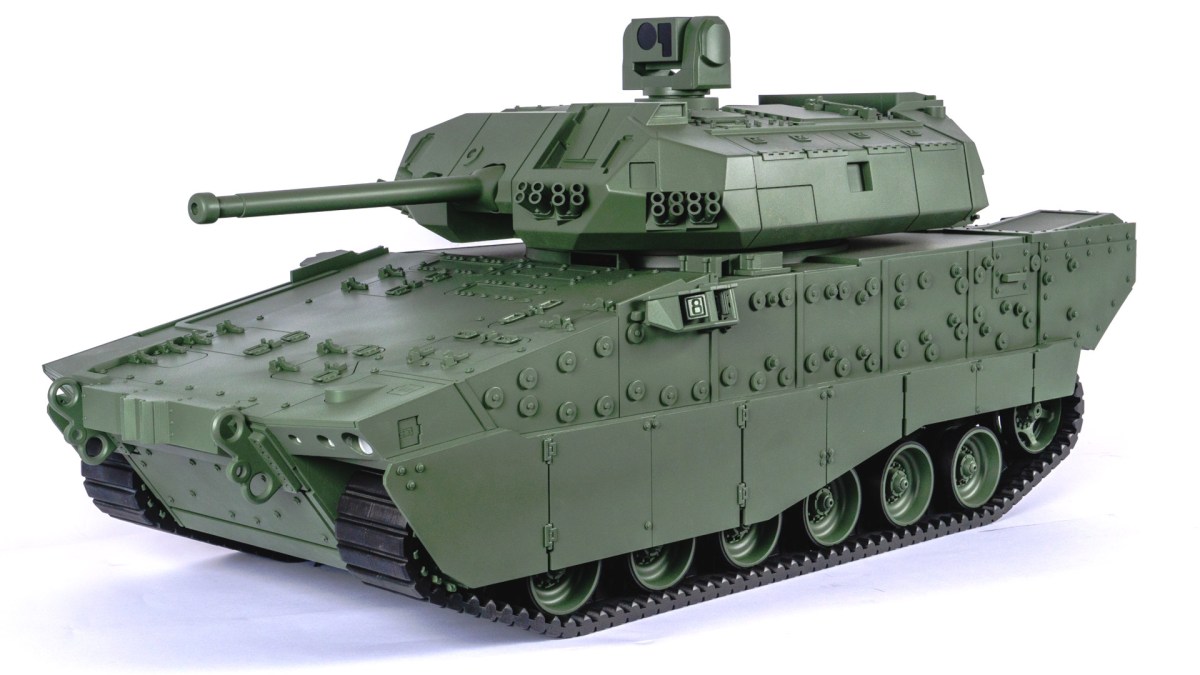
GDLS is showing the one-eighth-scale model of Wolf, seen at the top of this story and made by a company called KiwiMill , at the Association of the U.S. Army’s (AUSA) main annual convention, at which TWZ is in attendance . Wolf is facing off head-to-head against a version of the Lynx from Germany’s Rheinmetall, supplied via the company’s U.S. subsidiary, American Rheinmetall.
It has already been established that Wolf is a further evolution of the GDLS’ Griffin III design, which was first shown publicly at AUSA back in 2018. Griffin III was derived from the ASCOD 2 infantry fighting vehicle, for which Spain was the launch customer, and which is now entering service in Latvia. The U.S. Army’s now-cancelled M10 Booker ‘light tank’ and the British Army’s much-troubled Ajax are also members of this broader family of armored vehicles.
A side-by-side comparison of the model of the Wolf, at left, and the Griffin III demonstrator, at right. GDLS/KiwiMill
The design of the Wolf, at least based on the model, is substantially different from the earlier Griffin III demonstrator.
Wolf’s turret has a broader, flatter, and overall more streamlined shape, which is in line with its remotely-operated design. There is just a single sensor turret on top, along with space for a forward-looking sensor suite to the left of the main 50mm cannon. What may be apertures for additional sensors or other systems are seen elsewhere along the front and sides of the turret. It also has more launchers for smoke grenades around the front edges compared to the Griffin III.
A focused look at the Wolf’s turret as seen on the one-eighth-scale model. GDLS/KiwiMill
Compared to the Griffin III, the Wolf’s hull has also been much revised, including the elimination of a traditional driver’s hatch in front of the turret ring. The vehicle’s commander (who also acts as the gunner) and driver sit side-by-side deeper inside the hull. Up to six passengers can ride in a compartment further at the rear. For comparison, the Bradley has a crew of three, as well as the ability to carry six passengers.
The Wolf’s hull also features side skirts that were not found on the Griffin III demonstrator. A different style of tracks is also depicted on the model. The picture of the model that GDLS shared shows sensors facing outward from a position on the side of the hull toward the front, as well. This makes sense, as the design features a distributed camera system to offer a full 360-degree view of the outside to personnel riding within, the broad benefits of which you can read more about here .
Another look at the hull of the Wolf, as seen on the model. Note the outward-facing sensors positioned toward the front, as well as the lack of any traditional driver’s hatch. GDLS/KiwiMill
“Because we have a reduced crew from the Bradley [which has a commander and gunner in turret] there has to be greater efficiency in how those soldiers execute their tasks,” Geoffrey Norman, GDLS’ director for U.S. Strategy & Growth, previously noted to TWZ . “The software and menu logic are very intuitive.”
Next-generation fire control, sensor, and networking/communications capabilities, as well as improved active and passive defenses, are key requirements for the XM30 program. Both Wolf and American Rheinmetall Lynx-based designs have built-in launchers for loitering munitions, with GDLS having chosen to integrate AeroVironment’s Switchblade 300 more specifically. What we have seen on the Wolf model so far does not appear to explicitly show this particular feature.
Wolf and Lynx both also feature hybrid-electric propulsion, which will bring various benefits, especially in terms of fuel economy and electrical power generation, compared to the diesel-engined Bradley. When it comes to the boost in on-board electrical power, “the emphasis from the Army has really been about having margin on the vehicle for future [system] requirements – directed energy, counter-UAS systems, or fill-in-the-blank,” GDLS’ Norman has also told us in the past.
A rendering of the Lynx-based XM30 design. American Rheinmetall
As it stands now, both GDLS and American Rheinmetall have delivered prototypes of their respective designs to the Army, with initial testing having been conducted at Aberdeen Proving Ground in Maryland. Soldier touchpoints and field evaluations are now set to occur at Fort Hood in Texas between February and March of next year. You can read in more detail about both entrants in the XM30 competition and what is known about their features in our past reporting here .
An actual Wolf prototype, seen under wraps, after being delivered to the US Army’s Aberdeen Proving Ground in Maryland around the end of August 2026. GDLS
In the meantime, we have now gotten clear views of both designs vying to become the Army’s XM30 replacement for the venerable Bradley.
Contact the author: joe@twz.com
Comments couldn’t be loaded. Please refresh the page.
作者:约瑟夫·特雷维西克
发布于美国东部时间2026年10月12日下午1:46
通用动力陆地系统公司(GDLS)首次正式公布了其旨在取代美国陆军布雷德利步兵战车的方案,名为“狼”(Wolf)。“狼”是参与竞标陆军未来XM30机械化步兵战车(MICV)的两款设计方案之一。就在今天早些时候,我们发布了关于XM30竞标的详细更新,其中包括关于两家竞标公司和陆军测试计划的最新信息,您可以在这里查看。
GDLS公司正在美国陆军协会(AUSA)的年度大会上展示其八分之一比例的“狼”(Wolf)模型,该模型由KiwiMill公司制造,本文开头图片即为该模型。TWZ公司也出席了此次大会。“狼”模型将与德国莱茵金属公司通过其美国子公司美国莱茵金属公司提供的“山猫”(Lynx)模型进行正面交锋。
目前已证实,“狼”装甲车是通用动力陆地系统公司(GDLS)“格里芬III”装甲车的进一步发展版本,后者于2018年在美国陆军装备展(AUSA)上首次公开亮相。“格里芬III”源自ASCOD 2步兵战车,西班牙是ASCOD 2的首个客户,该战车目前正在拉脱维亚服役。美国陆军现已取消的M10“布克”轻型坦克和英国陆军饱受争议的“阿贾克斯”轻型坦克也属于这一装甲车家族。
左侧为 Wolf 模型,右侧为 Griffin III 演示样机,两者并排对比。GDLS/KiwiMill
至少从模型来看,Wolf 的设计与早期的 Griffin III 演示机有很大不同。
狼式坦克的炮塔外形更宽、更扁平、整体线条更流畅,这与其遥控操作的设计相符。炮塔顶部只有一个传感器炮塔,主50毫米炮左侧预留了前视传感器套件的空间。炮塔前部和侧面其他位置似乎还预留了用于安装其他传感器或其他系统的开口。与格里芬III型坦克相比,狼式坦克的前缘还增加了烟雾弹发射器的数量。
聚焦观察“狼”式坦克八分之一比例模型上的炮塔。GDLS/KiwiMill
与“狮鹫III”相比,“狼”式坦克的车体也经过了大幅改进,包括取消了炮塔前方的传统驾驶员舱盖。车长(兼任炮手)和驾驶员并排坐在车体更深处。车体后部还有一个可容纳六名乘客的舱室。相比之下,“布雷德利”战车的乘员为三人,但可搭载六名乘客。
“狼”式装甲车的车体还配备了“格里芬III”演示车所没有的侧裙板。模型上还展示了不同样式的履带。通用动力陆地系统公司(GDLS)分享的模型图片显示,车体侧面朝前安装的传感器也朝向外部。这合情合理,因为该设计采用了分布式摄像头系统,可以为车内人员提供360度全方位外部视野,其诸多优势可在此处了解更多。
这是“狼”式战车模型船体的另一张照片。请注意位于船头的外向型传感器,以及缺少传统驾驶员舱盖的设计。GDLS/KiwiMill
“由于我们的乘员比布雷德利战车(炮塔内有一名指挥官和一名炮手)要少,所以士兵们执行任务的效率必须更高,”通用动力激光系统公司(GDLS)美国战略与增长总监杰弗里·诺曼此前向TWZ指出。“该软件和菜单逻辑非常直观。”
新一代火控、传感器和网络/通信能力,以及改进的主动和被动防御系统,是XM30项目的关键要求。沃尔夫导弹和美国莱茵金属公司基于“山猫”导弹的设计都内置了巡飞弹发射器,其中通用动力陆地系统公司(GDLS)更具体地选择了集成AeroVironment公司的Switchblade 300发射器。目前我们看到的沃尔夫导弹似乎并没有明确显示这一功能。
Wolf 和 Lynx 都采用了混合动力推进系统,与柴油动力的 Bradley 战车相比,这将带来诸多优势,尤其是在燃油经济性和电力输出方面。通用动力激光系统公司 (GDLS) 的 Norman 此前也曾告诉我们,提升车载电力容量“真正重要的是为车辆预留未来系统需求的余量——定向能武器、反无人机系统等等”。
基于Lynx的XM30设计效果图。美国莱茵金属公司
目前,通用动力激光系统公司(GDLS)和美国莱茵金属公司均已向美国陆军交付了各自设计的原型机,并在马里兰州阿伯丁试验场进行了初步测试。士兵体验和实地评估计划于明年2月至3月在德克萨斯州胡德堡进行。您可以在我们之前的报道中了解更多关于XM30竞标双方及其已知功能的信息(点击此处)。
一架真正的“狼”式无人机原型机,在2026年8月底左右交付给位于马里兰州阿伯丁试验场的美国陆军后,被遮盖起来。通用动力激光系统公司(GDLS)
与此同时,我们现在已经清楚地看到了两种竞相成为陆军 XM30 替代老旧的布雷德利步兵战车的设计方案。
联系作者:joe@twz.com
评论加载失败,请刷新页面。