Polish defense minister calls for US industry to establish European facilities波兰国防部长呼吁美国企业在欧洲建立工厂
Władysław Kosiniak-Kamysz spoke the same day that another senior Polish commander said Patriot deliveries to Poland are expected to be delayed.
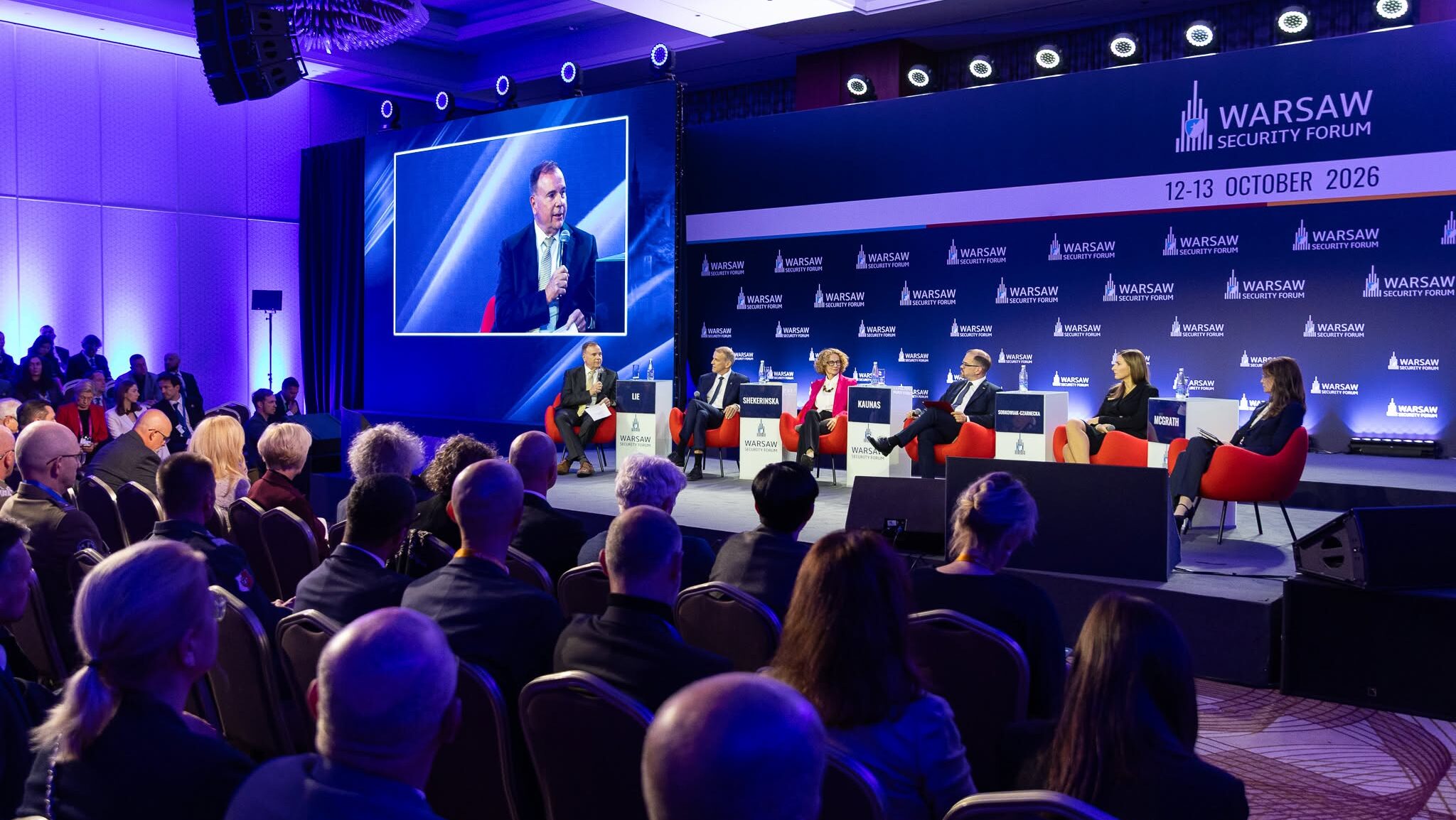
Panellists at the Warsaw Security Forum discussion European military plans (Bartosz Głowacki)
WARSAW — Poland’s national defense minister is calling on Europe to develop an “enduring, predictable” alliance with the US, encompassing information exchange, military capabilities and defense industry collaboration.
“I believe that within the ‘NATO 3.0’ strategy, it is worth emphasizing a strategy for the defense industry,” Władysław Kosiniak-Kamysz told the Warsaw Security Conference on Monday. “Relocating production lines and maintenance facilities to Europe, for instance, for Patriot missiles and systems, is crucial for the independence of both the United States and Europe.”
The comments arrived on the same day that Polish army operational commander Gen. Ireneusz Nowak noted at the event that Patriot deliveries are set to be held up . “At this point it looks like we are going to be affected as well,” he said. “That’s very visible in the area of PAC-3 MSE Patriot missiles, they’re going to be delayed for sure .”
Ukraine has called on European partners to supply it with additional Patriot missiles to fend off Russian attacks. Kosiniak-Kamysz said the current situation in Ukraine shows how dangerous a breakdown in supply chains would be in a crisis scenario, so Europe must do everything to be strong and independent enough to take action toward greater reindustrialization.
Additionally, he warned that the European Union has been grappling with the issue of military mobility for years, and “yet, there are still no decisions in place to allow for the free movement of our troops without requiring the consent of individual regions.”
The matter needs to be resolved as soon as possible, he stressed, through the adoption of sound legislation. “It should be automatic: if someone calls for help, they want those troops to reach them, and everyone else should provide support,” he explained.
From a big picture perspective, Europe cannot wait until 2035 to become strong, said Kosiniak-Kamysz, as he argued that NATO’s 5 percent GDP defense spending pledge should be brought forward to 2030.
Kosiniak-Kamysz said Europe must make its defense industry supply chains independent, and this is a task that needs to be addressed as a matter of urgency, because “we cannot rule out equipment from outside the European Union if it is critically needed.”
In his view, it stands to reason that collaboration with the US on items like low-cost, long-range precision strike capabilities, drones and anti-drone systems, as well as artificial intelligence, could prove worthwhile.
“So let us not rule out the possibility of creating Polish-US or European-US joint ventures, that could also tap into [SAFE] European funds,” he said. Of the €44 billion ($49 billion) from the SAFE program, nearly one-third went to Poland, and two-thirds of that amount has already been allocated to the Polish defense industry.
At a strategic level, he also declared that Poland is stronger with Washington’s backing.
“The more American troops there are in Poland, and if we have a permanent base and a lasting American military presence, the better equipped we are to shoulder responsibility for NATO’s eastern flank,” he said.
Kosiniak-Kamysz said also Warsaw will be ready for full-scale deterrence, thanks to investments in the defense industry, military mobility, transatlantic cooperation, relocating production to Europe, and joint investments in critical defense capabilities.
Speaking alongside Kosiniak-Kamysz, Minister of National Defence of Lithuania Robertas Kaunas said in the case of a Russian attack against Lithuania, it might be two weeks before US, Polish, German, British troops could arrive and reach the Soviet border to Lithuania. He echoed Kosiniak-Kamysz words, saying his country is investing in a national division, and an anti-drone air defense system, combining all different types of sensors, under a single ecosystem, backed by artificial intelligence.
Elsewhere, NATO Deputy Secretary General Radmila Shekerinska said that different things required to implement the alliance’s newly unveiled “ theory of victory ,” includes logistics, procurement and intelligence. “NATO is able to defend us. … But in order for all of us to keep this strategic advantage that we have [to] invest, create the capabilities, apply them, employ them, train the troops,” she said.
Shekerinska said NATO needs to speed up procurement procedures “to prepare [a] completely new approach in what is the capability, and how to make sure that NATO will have them when it will be needed.”
Rounding off panelist contributions, Magdalena Sobkowiak-Czarnecka, Poland’s Secretary of State for Defense, said she hopes the moment has come for the US government and US companies to finally agree on co-production in Europe, as US warehouses are empty. According to her, Warsaw is open to other countries, setting up shop in Poland for maintenance, logistics or production.
“If there’s any foreign company trying to sell something to us, we are not only looking on the quality and price, we give four extra conditions: the maintenance center, co-production, local suppliers or at least investing in education here,” Sobkowiak-Czarnecka stressed. She added that the issue of standing up local maintenance centers is one the Polish government is trying to resolve with from Washington.
“We are open for co-production, we are open … [to] companies from different parts of the world, but the condition is you have to work with our industry,” she concluded.
Breaking Defense Video
Telle talks ‘manufacturing rodeo,’ supply chain ‘weak links’: AUSA Day 1
New leaders, new drone command: What we expect from AUSA 2026
Unpacking Boeing’s F/A-XX win, plus a report from wartime Ukraine
How Hegseth envisions a new Autonomous Warfare Command
What Europe’s military air fleets will look like in 30 years
Riyadh gets closer to F-35s, Damascus presses sovereignty and an expert take on Iran
Drone-hunting on the border, plus turmoil at an Air Force think tank
The future of European airpower might be unmanned
The big news out of AFA, plus a guided tour of the show floor
Why the ‘right to repair’ matters to the Pentagon
华沙安全论坛的小组成员讨论欧洲军事计划(Bartosz Głowacki)
华沙——波兰国防部长呼吁欧洲与美国建立“持久、可预测的”联盟,涵盖信息交流、军事能力和国防工业合作。
“我认为,在‘北约3.0’战略中,应该重点强调国防工业战略,”瓦迪斯瓦夫·科西尼亚克-卡米什周一在华沙安全会议上表示。“例如,将‘爱国者’导弹和系统的生产线和维护设施转移到欧洲,对于美国和欧洲的独立自主都至关重要。”
就在同一天,波兰陆军作战司令伊雷纽什·诺瓦克将军在活动上指出,“爱国者”导弹的交付将会延迟。他说:“目前看来,我们也会受到影响。这一点在PAC-3 MSE型‘爱国者’导弹领域尤为明显,它们的交付肯定会延迟。”
乌克兰呼吁欧洲伙伴向其提供更多“爱国者”导弹,以抵御俄罗斯的攻击。科西尼亚克-卡梅什表示,乌克兰目前的局势表明,在危机情况下,供应链中断将造成多么严重的后果,因此欧洲必须竭尽全力变得足够强大和独立,以便采取行动,推动更大程度的再工业化。
此外,他还警告说,欧盟多年来一直在努力解决军事机动性问题,“然而,目前还没有任何决定允许我们的军队在无需获得各个地区同意的情况下自由流动。”
他强调,这个问题必须尽快通过制定健全的法律来解决。“这应该是自动化的:如果有人需要帮助,他们希望军队能够赶到,其他人也应该提供支持,”他解释说。
科西尼亚克-卡米什表示,从大局来看,欧洲不能等到 2035 年才变得强大,他认为北约将 5% 的 GDP 国防开支承诺提前到 2030 年。
科西尼亚克-卡米什表示,欧洲必须使其国防工业供应链独立,这是一项需要紧急解决的任务,因为“如果急需,我们不能排除从欧盟以外采购设备的可能性”。
他认为,与美国在低成本、远程精确打击能力、无人机和反无人机系统以及人工智能等领域开展合作,很可能是值得的。
“因此,我们不能排除建立波兰-美国或欧洲-美国合资企业的可能性,这些企业也可以利用[SAFE]欧洲基金,”他说道。SAFE计划总额为440亿欧元(490亿美元),其中近三分之一流向了波兰,而这笔资金的三分之二已经分配给了波兰国防工业。
在战略层面上,他还宣称,有了华盛顿的支持,波兰会更加强大。
他说:“驻波兰的美军越多,如果我们拥有永久基地和持久的美军存在,我们就越能更好地承担起北约东翼的责任。”
科西尼亚克-卡梅什还表示,得益于对国防工业的投资、军事机动性、跨大西洋合作、将生产转移到欧洲以及对关键国防能力的联合投资,华沙将做好全面威慑的准备。
立陶宛国防部长罗伯塔斯·考纳斯与科西尼亚克-卡梅什一同发表讲话时表示,如果俄罗斯对立陶宛发动攻击,美国、波兰、德国和英国的军队可能需要两周时间才能抵达并到达立陶宛与苏联接壤的边境。他呼应了科西尼亚克-卡梅什的说法,称立陶宛正在投资建设国家防空系统和反无人机防空系统,该系统将各种类型的传感器整合到一个由人工智能支持的单一生态系统中。
北约副秘书长拉德米拉·舍克林斯卡娅表示,要落实北约新近公布的“胜利理论”,需要开展多项工作,包括后勤、采购和情报。“北约有能力保卫我们……但为了保持这一战略优势,我们必须投资、创造能力、运用能力、部署能力并训练部队,”她说道。
谢克林斯卡表示,北约需要加快采购程序,“以制定一种全新的方法,明确北约的能力是什么,以及如何确保北约在需要时能够拥有这些能力。”
波兰国防部国务秘书玛格达莱娜·索布科维亚克-查尔内茨卡在小组讨论的最后发言中表示,她希望美国政府和美国企业能够最终就欧洲联合生产达成一致,因为美国的仓库目前空置。她表示,华沙欢迎其他国家在波兰设立维修、物流或生产基地。
索布科维亚克-查尔内卡强调:“如果有外国公司试图向我们推销产品,我们不仅关注质量和价格,还会提出四个额外条件:建立维修中心、合作生产、使用本地供应商,或者至少投资本地教育。”她补充说,波兰政府正在努力与华盛顿方面协商解决建立本地维修中心的问题。
她总结道:“我们欢迎联合制作,我们欢迎来自世界各地的公司,但条件是你们必须与我们这个行业合作。”
突破性防御视频
特勒谈“制造业乱象”、供应链“薄弱环节”:AUSA第一天
新领导人,新无人机指挥部:我们对 AUSA 2026 的期待
深入剖析波音F/A-XX的竞标结果,以及来自战时乌克兰的报道
赫格塞斯设想的新型自主作战指挥部
30年后欧洲军用空军机队会是什么样子
利雅得距离F-35战机更近一步,大马士革强调主权,以及专家对伊朗的看法
边境无人机猎杀行动,以及空军智库的动荡
欧洲空军的未来或许在于无人化。
AFA展会最新动态,以及展会现场导览。
为什么“维修权”对五角大楼如此重要