North Korea’s ‘Hunchback’ Missile Submarine Makes First At-Sea Appearance For Missile Tests朝鲜“驼背”导弹潜艇首次出海进行导弹试验
North Korea claims to have launched two cruise missiles from its bizarre modified Romeo class missile boat. North Korea claims to have launched two types of strategic cruise missiles from a submarine off its east coast.
Published Oct 15, 2026 5:01 PM EDT
North Korean state media
North Korea says it has test-fired two types of submarine-launched strategic cruise missiles off its east coast, in what appears to be the first time its bizarre Hero Kim Kun Ok submarine has been seen at sea in at publicized manner. If the vessel truly was the launch platform, the tests would mark its first confirmed weapons trials and a potential step toward operational service. Unveiled with considerable fanfare in 2023 , the Hero Kim Kun Ok has been billed by Pyongyang as a centerpiece of its future nuclear-armed navy, but its operational status and actual capabilities have remained unclear.
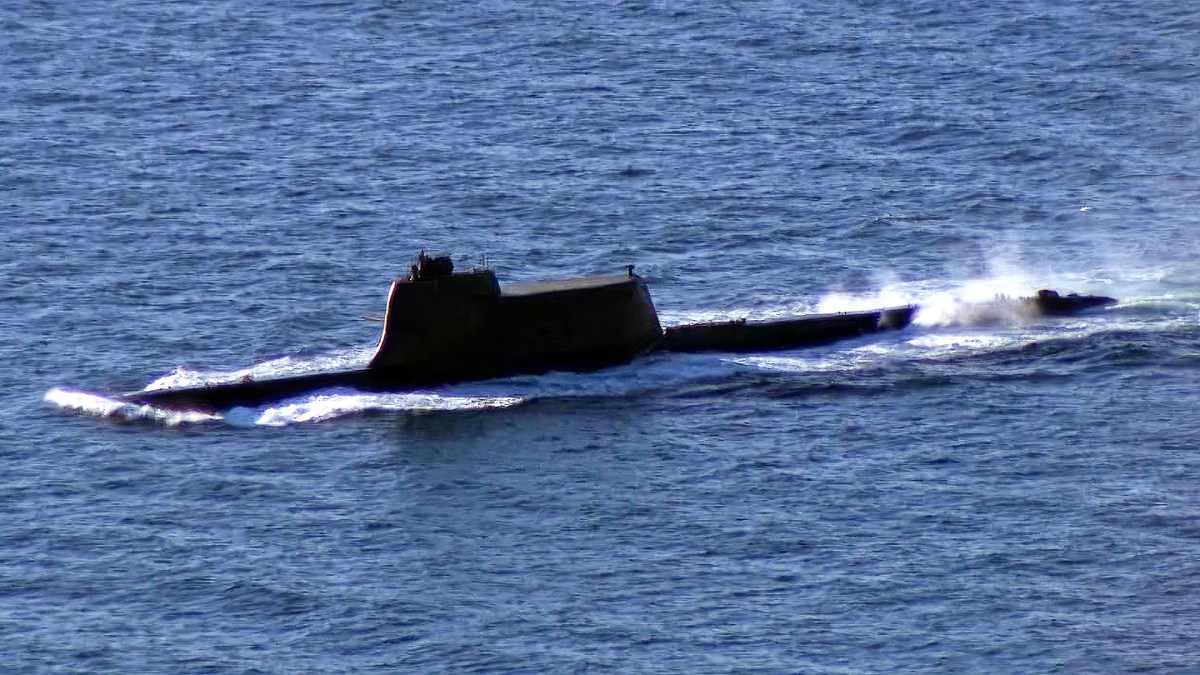
The launches took place Wednesday, October 14, with state media Korean Central News Agency (KCNA) reporting the activity earlier today. North Korea said the tests were intended to assess the readiness of its underwater combat systems, improve the Navy’s ability to execute strategic missions, and demonstrate the reliability of its deterrent. Along with imagery of the cruise missiles, KCNA released one photo of the Hero Kim Kun Ok underway, which you can see at the top of this story.
The launch of a cruise missile, apparently from a vertical launch tube. North Korean state media North Korean state media
Submerged launch of one of the North Korean cruise missiles. North Korean state media
KCNA did not otherwise identify the submarine involved or disclose the missiles’ ranges, flight paths, or performance. South Korea’s Joint Chiefs of Staff (JCS) said it had detected and tracked the launches from before firing through the cruise and terminal phases. A JCS spokesperson said one missile type was launched from a vertical launch system and another from a torpedo tube. This would match the imagery we are seeing, it would also match the Hero Kim Kun Ok’s unique capabilities. The South Korean military assessed that the launches came from a submarine but did not initially identify the vessel publicly.
There remains a possibility that the 3,000-ton-class Hero Kim Kun Ok was not actually involved in launching the missiles. North Korea has long used underwater platforms for test missile launches and has paired these with images of an actual submarine for propaganda purposes. However, the JCS confirming they came from a submarine would lend additional credence to the possibility Hero Kim Kun Ok did indeed launch the missiles. If this is the case, it would indicate that North Korea has begun validating weapons systems aboard the submarine ahead of deployment. At the very least, we can confirm that the Hero Kim Kun Ok is now sailing, although South Korean and U.S. intelligence would be acutely aware of its movements and it could have been in at sea testing for years now, we just don’t know.
North Korea unveiled the submarine in September 2023, describing it as its first “tactical nuclear attack submarine” and one of the Navy’s core offensive platforms. At the launching ceremony, North Korean leader Kim Jong Un was quoted as saying that arming the Navy with nuclear weapons “brooks no further delay.”
The North Korean diesel-electric submarine Hero Kim Kun Ok , which has the hull number 841. North Korean state media
Nevertheless, many questions remain about the submarine’s design and operational prospects. Overall, it remains a heavily modified derivative of a Cold War-era Romeo class diesel-electric submarine — nearly an antique by today’s standards — rather than a purpose-built guided missile submarine. Previous imagery shows 10 missile launch tubes concealed in the prominent ‘turtle back’ aft of the sail, in addition to torpedo tubes, although the precise configuration, usable capacity, and operational status of those systems remain uncertain.
The absence of publicly reported weapons tests from the vessel over the following years raised questions about its development. Analyst Shin Jong-woo of South Korea’s Defense and Security Forum told Reuters that the latest launches suggested combat-system testing for operational deployment was underway. He also suggested that North Korea may have resolved technical problems and could also test a submarine-launched ballistic missile (SLBM) before the vessel enters service. North Korea has previously presented SLBMs of increasing size , but has lacked a suitable submarine to launch them from.
The North Korean diesel-electric submarine Hero Kim Kun Ok during its launch. North Korean state media
Missile launches while the submarine is submerged represent a more demanding and operationally relevant capability than firing from the surface.
At the same time, a missile launch of any kind demonstrates only part of the capability required for a submarine like this to be effective at all. An operational submarine must also be able to deploy reliably, remain sufficiently difficult to detect, maintain its weapons, and execute missions under realistic conditions.
A vertical launch system (VLS) can provide dedicated capacity for certain missile types — potentially much larger ones — and may enable faster launches or larger salvos than a configuration relying exclusively on torpedo tubes. Torpedo tubes offer an alternative launch method, but with different constraints on weapon dimensions, handling, and firing procedures.
The forward four tubes are larger than the rear six on the submarine’s ‘turtle back.’ This would allow the boat to carry multiple types of missiles, possibly including a mix of short-range and longer-range submarine-launched ballistic missiles (SLBMs) and submarine-launched cruise missiles (SLCMs).
A North Korean cruise missile in flight after submerged launch. North Korean state media
Testing both systems would be consistent with an effort to validate multiple elements of the submarine’s weapons architecture.
North Korea has pursued submarine-launched missiles for years. In March 2023, it reported a submarine-launched cruise missile test from the older 8.24 Yongung submarine. In January 2024, Pyongyang said it had fired Pulhwasal-3-31 strategic cruise missiles from that same vessel. The earlier sub is in the 2,000-ton-class and is understood to have only one or two vertical launch tubes.
North Korea’s description of the weapons as “strategic” cruise missiles should also be treated cautiously. North Korea’s long-range cruise missile program is well established and a nuclear payload is a major part of its ambitions, but how mature or reliable a nuclear warhead is for this application at this time isn’t clear. Regardless, ground, surface, and now subsurface-launched cruise missiles are a key part of North Korea’s broader deterrent architecture.
According to reports, Wednesday’s activity was the first publicly reported underwater North Korean missile-testing event since the January 2024 launch.
Compared to the 8.24 Yongung submarine, the Hero Kim Kun Ok has a larger hull and additional vertical launch tubes, but it still uses very dated diesel-electric propulsion, which presents hugely different endurance, acoustic, and operating constraints compared with nuclear propulsion or even modern diesel-electric submarine capabilities.
As to the expectation that Pyongyang may test an SLBM from the submarine before deployment, this would be a likely milestone toward North Korea fielding a credible sea-based nuclear deterrent.
North Korean SLBMs identified as the Pukguksong-5 on parade in January 2021. North Korean state media
North Korea is also pursuing a separate nuclear-powered submarine project , unveiled as under construction in March 2025. Its completion and operational timeline remain uncertain. Nuclear propulsion is a much bigger challenge, but if perfected, such a boat would be of considerably greater value, especially as a second-strike capability.
People seen looking at a TV broadcast at Seoul Railway Station showing North Korean leader Kim Jong Un unveiling the manufacturing site for a future nuclear-powered missile submarine at an undisclosed location. Photo by Kim Jae-Hwan/SOPA Images/LightRocket via Getty Images SOPA Images
The latest submarine tests come amid a broader series of North Korean weapons demonstrations, including reported hypersonic missile tests on September 20 and October 3, as well as tactical ballistic missile launches earlier in October.
The sequence is consistent with Pyongyang’s effort to diversify its delivery systems and complicate military planning for South Korea, the United States, and Japan.
A satellite image of the Pongdae Submarine Factory on the northeast coast of North Korea, the center of its submarine development activities. Google Earth
The activity also carries a diplomatic message. North Korea has repeatedly insisted that it will not abandon its nuclear weapons while the United States maintains what Pyongyang calls a hostile policy. It has also rejected the suggestion that adjustments to U.S.-South Korean military exercises would be sufficient to change the underlying relationship.
The tests also follow North Korea’s rejection of an apparent diplomatic opening from U.S. President Donald Trump after Washington sought to reduce tensions surrounding a U.S.-South Korean military exercise.
Kim touring the Sinpo submarine yards back in 2019, the first time we got a glimpse of the future Hero Kim Kun Ok . North Korean state media
A submarine able to launch missiles from less predictable locations complicates defensive planning for South Korea and the United States. The challenge extends beyond intercepting missiles after launch to detecting and tracking the submarine before it reaches a potential firing position. Even a partially capable vessel places additional demands on potential adversaries.
Were things to ‘go hot’ on the Korean Peninsula, any submarine capable of carrying strategic weapons would be at the top of the targeting list for Pyongyang’s adversaries. A submarine based on the archaic Romeo class design would be fairly easy to track from the time it leaves its berth. This is especially the case bearing in mind the sophisticated nature of South Korea’s anti-submarine capabilities.
Future submarines will become increasingly more challenging, however. That problem could intensify if future North Korean boats make more use of Russian assistance in developing their capabilities. Submarine technology is supposedly part of the payment to Pyongyang for its help in the war in Ukraine. This could become a much larger problem, even if Moscow were to provide North Korea with advanced Kilo class boats, for example.
For now, provided that the Hero Kim Kun Ok launched the missiles, which seems most likely, this would indicate that North Korea is advancing weapons integration aboard a submarine intended to expand its offensive naval capabilities. The fact that the Hero Kim Kun Ok is now at sea also signals progress toward deployment.
Whatever the ultimate operational effectiveness of the Hero Kim Kun Ok and its emerging missile armament, Pyongyang continues to demonstrate incremental improvements to its submarine forces.
Contact the author: thomas@thewarzone.com
Comments couldn’t be loaded. Please refresh the page.
发布于美国东部时间2026年10月15日下午5:01
朝鲜官方媒体
朝鲜声称在其东海岸附近试射了两种潜射战略巡航导弹,这似乎是其造型奇特的“英雄金坤玉”号潜艇首次以公开方式出现在海上。如果该潜艇确实是导弹发射平台,那么此次试射将标志着其首次武器试验得到证实,并可能标志着其向作战服役迈出了重要一步。“英雄金坤玉”号于2023年高调亮相,平壤方面将其标榜为未来核海军的核心,但其作战状态和实际性能一直不明朗。
此次发射于10月14日星期三进行,朝鲜官方媒体朝中社(KCNA)当天早些时候报道了此事。朝鲜方面表示,此次试验旨在评估其水下作战系统的战备状态,提升海军执行战略任务的能力,并展示其威慑力量的可靠性。除了巡航导弹的图片外,朝中社还发布了一张“英雄金坤玉”号航母航行中的照片,您可以在本文顶部看到这张照片。
一枚巡航导弹发射升空,显然是从垂直发射管发射的。朝鲜官方媒体报道。
朝鲜潜射发射一枚巡航导弹。朝鲜官方媒体
朝中社并未透露涉事潜艇的具体身份,也未披露导弹的射程、飞行轨迹或性能。韩国联合参谋本部表示,他们已探测并跟踪了导弹从发射前到巡航和末段的整个发射过程。联合参谋本部发言人称,其中一种导弹是从垂直发射系统发射的,另一种是从鱼雷发射管发射的。这与我们目前看到的图像相符,也与“英雄金坤玉”号潜艇的独特性能相符。韩国军方评估认为导弹来自潜艇,但最初并未公开该潜艇的身份。
仍有可能3000吨级的“英雄金坤玉”号潜艇并未实际参与导弹发射。朝鲜长期以来一直利用水下平台进行导弹试射,并经常将试射画面与实际潜艇的影像结合起来用于宣传。然而,如果联合参谋本部确认导弹确实来自潜艇,则将进一步佐证“英雄金坤玉”号确实发射了导弹的可能性。如果情况属实,则表明朝鲜已开始在潜艇上对武器系统进行部署前的验证。至少我们可以确认,“英雄金坤玉”号目前正在航行,尽管韩国和美国的情报部门对其动向高度关注,而且该潜艇可能已经进行了多年的海上测试,我们对此并无定论。
朝鲜于2023年9月公开展示了这艘潜艇,称其为首艘“战术核攻击潜艇”,也是海军的核心进攻平台之一。在下水仪式上,朝鲜领导人金正恩表示,为海军配备核武器“不容再拖延”。
朝鲜柴电潜艇“英雄金坤玉”号,舷号841。朝鲜官方媒体
然而,关于这艘潜艇的设计和作战前景,仍存在诸多疑问。总体而言,它与其说是一艘专门建造的导弹潜艇,不如说是冷战时期罗密欧级柴电潜艇的深度改装衍生型——以今天的标准来看,它几乎已经是古董了。此前的图像显示,除了鱼雷发射管外,指挥塔后方显眼的“龟背”结构内还隐藏着10个导弹发射管,但这些系统的具体配置、可用容量和运行状态仍不确定。
此后几年,该舰未公开进行任何武器试验,引发了人们对其研发进展的质疑。韩国国防安全论坛分析师申钟宇(Shin Jong-woo)告诉路透社,最近的几次发射表明,该舰的作战系统测试正在进行中,以备投入实战部署。他还表示,朝鲜可能已经解决了技术难题,并有可能在该舰服役前进行潜射弹道导弹(SLBM)的测试。朝鲜此前曾展示过尺寸不断增大的潜射弹道导弹,但一直缺乏合适的潜艇进行发射。
朝鲜柴电潜艇“英雄金坤玉”号下水仪式现场。(朝鲜官方媒体)
潜艇在水下发射导弹比从水面发射导弹更具挑战性,也更具作战意义。
与此同时,任何类型的导弹发射都仅仅展示了此类潜艇有效作战能力的一部分。一艘可作战的潜艇还必须能够可靠部署、保持足够的隐蔽性、维护武器系统,并在实际条件下执行任务。
垂直发射系统(VLS)可为特定类型的导弹(包括尺寸更大的导弹)提供专用发射能力,并且与完全依赖鱼雷发射管的配置相比,VLS 可能实现更快的发射速度或更大规模的齐射。鱼雷发射管提供了一种替代发射方式,但对武器尺寸、操作和发射程序有不同的限制。
潜艇“龟背”上的前部四个发射管比后部的六个发射管要大。这将使该艇能够携带多种类型的导弹,可能包括短程和远程潜射弹道导弹(SLBM)和潜射巡航导弹(SLCM)的混合发射。
一枚朝鲜巡航导弹在水下发射后飞行。(朝鲜官方媒体)
对这两个系统进行测试,符合验证潜艇武器架构多个要素的努力。
朝鲜多年来一直在发展潜射导弹。2023年3月,朝鲜宣布从较老的8.24级永雄潜艇上试射了一枚潜射巡航导弹。2024年1月,平壤方面表示,已从同一艘潜艇上发射了“普尔瓦萨尔-3-31”战略巡航导弹。据悉,8.24级永雄潜艇排水量为2000吨,仅有一到两根垂直发射管。
朝鲜将这些武器描述为“战略”巡航导弹,这种说法也应谨慎对待。朝鲜的远程巡航导弹计划已相当成熟,而携带核弹头是其雄心壮志的重要组成部分,但目前核弹头在此类应用中的成熟度和可靠性尚不明确。无论如何,陆基、水面以及现在的潜射巡航导弹都是朝鲜更广泛的威慑体系的关键组成部分。
据报道,周三的活动是自 2024 年 1 月发射以来,朝鲜首次公开报道的水下导弹试验活动。
与 8.24 永雄级潜艇相比,英雄金根玉级潜艇拥有更大的船体和额外的垂直发射管,但它仍然使用非常过时的柴电推进系统,与核动力推进系统甚至现代柴电潜艇的性能相比,其续航能力、声学性能和操作限制都存在巨大差异。
至于平壤可能在部署前从潜艇上测试潜射弹道导弹的预期,这将是朝鲜向拥有可信的海基核威慑力量迈出的重要一步。
2021年1月,朝鲜检阅部队展示了被确认为北极星-5型的潜射弹道导弹。(图片来源:朝鲜官方媒体)
朝鲜还在推进一项独立的核动力潜艇项目,该项目于2025年3月宣布开工建造。其完工和服役时间表仍不确定。核动力推进技术难度更大,但如果成功研制,这种潜艇的价值将大大提升,尤其是在二次打击能力方面。
在首尔火车站,人们正在观看电视直播,画面显示朝鲜领导人金正恩在某个未公开的地点揭幕了未来核动力导弹潜艇的制造基地。照片由金在焕/SOPA Images/LightRocket via Getty Images提供。
朝鲜此次潜艇试验正值一系列更广泛的武器展示之际,其中包括据报道于 9 月 20 日和 10 月 3 日进行的超音速导弹试验,以及 10 月初进行的战术弹道导弹发射。
这一举动与平壤努力使其投送系统多样化,并使韩国、美国和日本的军事计划更加复杂化的努力是一致的。
朝鲜东北海岸丰台潜艇工厂的卫星图像,该工厂是朝鲜潜艇研发活动的中心。谷歌地球
此次活动也传递出外交信息。朝鲜一再坚持,只要美国继续奉行平壤所称的敌对政策,朝鲜就不会放弃核武器。朝鲜还拒绝了调整美韩联合军演就能改变两国关系的提议。
此次试验也发生在朝鲜拒绝美国总统唐纳德·特朗普在华盛顿试图缓和围绕美韩联合军演的紧张局势后所展现的外交姿态之后。
2019年,金正恩视察新浦潜艇厂,这是我们第一次见到这位未来的英雄金坤玉。朝鲜官方媒体
一艘能够从难以预测的位置发射导弹的潜艇,无疑会给韩国和美国的防御计划带来复杂化。挑战不仅限于导弹发射后的拦截,还包括在潜艇到达潜在发射位置之前对其进行探测和跟踪。即使是部分具备发射能力的潜艇,也会给潜在对手带来额外的挑战。
如果朝鲜半岛局势升级,任何能够携带战略武器的潜艇都将成为平壤对手的首要目标。基于老旧的罗密欧级设计的潜艇,从离开泊位的那一刻起就很容易被追踪。考虑到韩国先进的反潜能力,这一点尤其如此。
然而,未来的潜艇将面临越来越大的挑战。如果朝鲜未来的潜艇在能力发展方面更多地依赖俄罗斯的援助,这个问题可能会更加严重。据称,潜艇技术是俄罗斯向平壤支付的乌克兰战争援助款项的一部分。即便莫斯科向朝鲜提供先进的基洛级潜艇,例如,这仍然可能成为一个更大的问题。
目前来看,如果“英雄金坤玉”号潜艇确实发射了导弹(可能性极大),则表明朝鲜正在推进潜艇武器集成,旨在增强其进攻性海军能力。“英雄金坤玉”号目前已出海,也标志着其部署工作正在取得进展。
无论“英雄金坤玉”号及其新兴导弹武器的最终作战效能如何,平壤都在不断展示其潜艇部队的逐步改进。
联系作者:thomas@thewarzone.com
评论加载失败,请刷新页面。