Reprogramming robots in the mud: How Army Special Ops trains its new robot technicians在泥泞中重新编程机器人:陆军特种部队如何训练其新机器人技术人员
“What we’re building is a soldier that can adapt a piece of robotic kit to the mission, to the enemy, to the terrain,” said Maj. Gen. Jason Slider, commander of the John F. Kennedy Special Warfare Center and School.
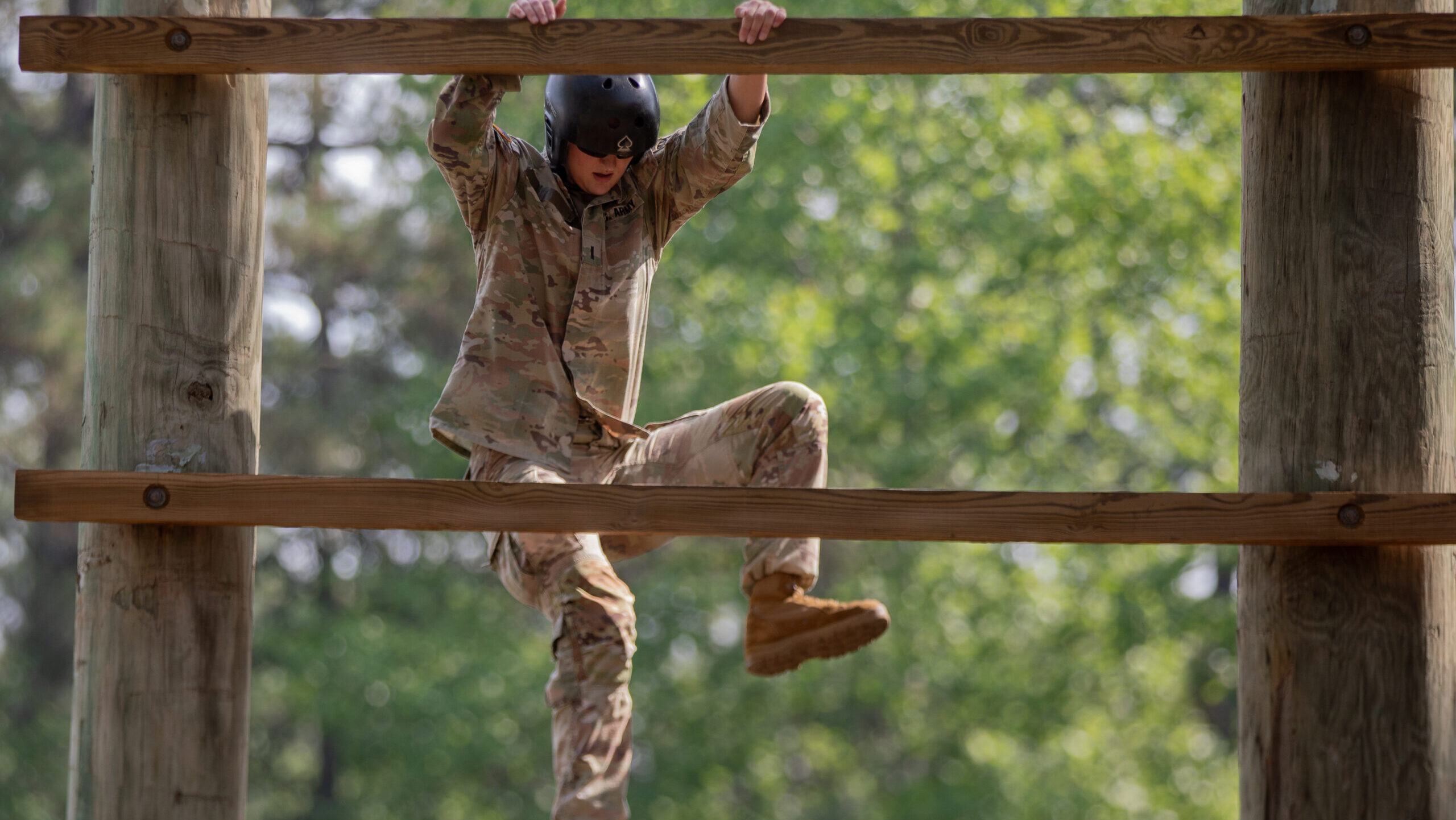
U.S. Army Soldier assigned to the U.S. Army John F. Kennedy Special Warfare Center and School climbs an obstacle during an NFL-Army Special Operations Forces commercial production event at Camp Mackall, Hoffman, North Carolina, June 14, 2026. (U.S. Army photo by Spc. Roddie Arline)
WASHINGTON — As the US military reorganizes to rapidly deploy new drones and other unmanned weapons, the Army’s special operations school is building a cadre of exper t warrant officers to w rangle the robots on the battlefield: Military Occupational Specialty 390A , Robotics Technicians.
“If you really want to understand what a 390-Alpha is, what these warrant officers are capable of, I invite you out to Clarke Range , Alabama, during the first week in November,” said Maj. Gen. Jason Slider. That’s when the second-ever class of MOS 390A candidates will conduct their final field exercise. Inspired by lessons from battlefields in Ukraine , the Caucasus , and the Middle East , the wargame will stress-test the candidates’ capability to improvise under fi re, he explained.
“What we’re building is a soldier that can adapt a piece of robotic kit to the mission, to the enemy, to the terrain,” Slider said.
Slider commands the Army’s John F. Kennedy Special Warfare Center and School (SWCS), which graduated its first class of MOS 390A soldiers just two weeks ago . He and one of his chief aides, Chief Warrant Officer Michael Updike, spoke about the new program Tuesday at a GovExec event on the sidelines of the annual Association of the US Army conference .
As the simulated enemy presents a changing range of threats, the candidates will have to rethink their tactics and reprogram their robots on the fly, in the field, and under stress, Slider and Updike explained. Electronic warfare will scramble their radio control links, block GPS, and cut them off from cloud-based AI coding tools, forcing them to rely on only the technology they can bring with them and get to work in the mud.
“When everything goes black … they still have to be able to reach back into their toolkit and bring out those [programs] to put into the Raspberry Pi to get the robot to do what it needs to do,” Updike said. In the first class’s final exercise earlier this year, for example, the students fit a quadcopter with a $1,000 HD camera and connected it to a decentralized mesh network , enabling the data to route around jammed nodes.
“They have to do all that innovation in the field,” Updike emphasized, “without large models that are connected to the internet.”
Large Language Models, cloud-based services in general, and even GPS navigation are frequently jammed on battlefields in Ukraine. Even when they are available, soldiers must take care, lest their radio transmissions reveal their location to the enemy and bring down a devasting precision strike. The “final crucible” exercise at Clarke Range reflects that grueling modern battlefield.
“We had specifically designed this capstone exercise to drive failure,” Slider said. “[It] gives the students another opportunity to try — and maybe fail again.”
It’s crucial to understand what 390A soldiers are and what they aren’t, Slider emphasized. They’re not drone operators, although they can operate drones. They’re not programmers, although they can code, often using miniaturized AI tools small enough to run on a ruggedized laptop in the field. Instead, these warrant officers are technical experts who stand between the commissioned officers, who command the force, and the enlisted personnel, who specialize in operating specific systems.
The 390As act as “system integrators,” Updike explained, with both deep and broad understanding of different Army drones, ground robots, networks, and how they work together. Above all, the 390As are trained to adapt, modifying that array of interdependent systems to meet new threats.
“We looked at Nagorno-Karabakh and Ukraine, and we’re studying the ongoing conflicts in the Middle East,” Slider said. “We learned … units that that solely focus on pilots quickly lose the advantage to an adversary or an enemy force that can adapt.”
That adaptation can’t be solely technological, either, he said. It must encompass tactics and sheer human resilience as well.
“All the tech that we’re talking about is, I think, important, and it’ll help get the soldier to the objective,” Slider said. “But it’s always been true that the soldier has got to be really comfortable in the mud … closing with the enemy and finishing the fight.”
2026年6月14日,在北卡罗来纳州霍夫曼的麦考尔营,一名隶属于美国陆军约翰·F·肯尼迪特种作战中心和学校的美国陆军士兵在NFL-陆军特种作战部队联合举办的商业宣传活动中攀爬障碍物。(美国陆军下士罗迪·阿林摄)
华盛顿——随着美国军方重组以快速部署新型无人机和其他无人武器,陆军特种作战学校正在培养一批专家准尉,以在战场上操控这些机器人:军事职业专长 390A,机器人技术员。
“如果你想真正了解什么是390-Alpha准尉,了解这些准尉的能力,我邀请你11月的第一周来阿拉巴马州的克拉克靶场,”杰森·斯莱德少将说道。届时,第二批390A准尉候选人将进行最终的实地演习。他解释说,此次演习借鉴了乌克兰、高加索和中东战场的经验教训,旨在检验候选人在枪林弹雨中随机应变的能力。
“我们正在打造的是一名能够根据任务、敌人和地形调整机器人装备的士兵,”斯莱德说。
斯莱德指挥着陆军约翰·F·肯尼迪特种作战中心和学校(SWCS),该中心两周前刚刚迎来了首批390A特种作战兵种(MOS 390A)的毕业生。周二,他和他的主要助手之一,准尉迈克尔·厄普代克,在美国陆军协会年会期间举办的GovExec活动上谈到了这个新项目。
斯莱德和厄普代克解释说,由于模拟敌人会呈现不断变化的威胁,候选人必须随机应变,在战场上、在压力下重新思考战术并重新编程机器人。电子战会干扰他们的无线电控制链路、屏蔽GPS信号,并切断他们与云端人工智能编程工具的连接,迫使他们只能依靠随身携带的技术,在泥泞的战场上开展工作。
“当一切都陷入黑暗时……他们仍然需要能够重新打开工具箱,拿出那些程序输入到树莓派中,让机器人完成它需要做的事情,”厄普代克说道。例如,在今年早些时候第一期课程的最终练习中,学生们为一架四轴飞行器配备了一个价值1000美元的高清摄像头,并将其连接到一个去中心化的网状网络,使数据能够绕过拥堵的节点进行传输。
“他们必须在现场进行所有这些创新,”厄普代克强调说,“而没有连接到互联网的大型模型。”
在乌克兰战场上,大型语言模型、云服务乃至GPS导航经常受到干扰。即使这些服务可用,士兵也必须小心谨慎,以免无线电传输暴露自身位置,招致毁灭性的精确打击。克拉克靶场的“最终考验”演习正是对这种残酷现代战场环境的真实写照。
“我们特意设计了这个毕业设计练习,就是为了让学生们经历失败,”斯莱德说。“它给了学生们另一次尝试的机会——也许还会再次失败。”
斯莱德强调,了解390A士兵的职责至关重要。他们不是无人机操作员,尽管他们能够操作无人机;他们也不是程序员,尽管他们能够编写代码,而且通常使用小型化的人工智能工具,这些工具小到可以在野外坚固耐用的笔记本电脑上运行。相反,这些准尉是技术专家,他们位于指挥部队的军官和专门操作特定系统的士兵之间。
厄普代克解释说,390A 型人员扮演着“系统集成商”的角色,他们对陆军的各种无人机、地面机器人、网络以及它们如何协同工作有着深入而广泛的了解。最重要的是,390A 型人员接受过适应性训练,能够调整这些相互依存的系统,以应对新的威胁。
“我们考察了纳戈尔诺-卡拉巴赫和乌克兰,并且正在研究中东持续不断的冲突,”斯莱德说。“我们了解到……那些只专注于飞行员的部队很快就会失去优势,被能够适应变化的对手或敌军击败。”
他还表示,这种适应不能仅仅依靠技术,还必须包括战术和人类自身的韧性。
“我认为我们讨论的所有技术都很重要,它们能帮助士兵达成目标,”斯莱德说。“但士兵必须真正适应泥泞环境……与敌人近身搏斗并结束战斗,这一点始终不变。”