The most important alliances will lead to critical minerals最重要的联盟将带来关键矿产资源。
In the 21st century, geopolitical and economic advantage will depend on forging new links in strong supply chains.
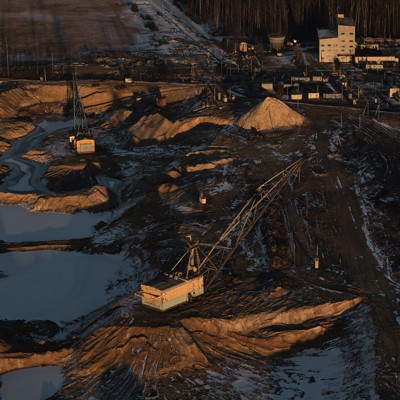
Drag-line excavator mines rare earth materials on Ukrainian soil on February 25, 2025, in the Zhytomyr region of Ukraine. Kostiantyn Liberov/Libkos/Getty Images
In the 21st century, geopolitical and economic advantage will depend on forging new links in strong supply chains.
The raison d’être of the “ Concert of Europe ,” the preeminent compact between the great powers of the 19th century, was to maintain the balance of power and suppress revolutionary movements. The post-World War II alliance systems sought collective security and deterrence. And the most relevant alliances of the 21st century will be the ones that secure the materials needed for key armaments and new technologies.
In the first decades after the Cold War, the global economy seemed to settle on a dispensation that was heavily digital, light on assets, and tilted toward “just-in-time” manufacturing. It also leaned on heavily financialized business models that privileged services, software, and ever smaller and faster microprocessors.
Then came what American mining entrepreneur Robert Friedland dubbed the “ revenge of the miners .” Emerging technologies—starting with electric vehicles and running through data centers and artificial intelligence—required prodigious quantities of material inputs from bulk metals to rare earth elements. And so did modern conflicts, from Russia’s war on Ukraine to the American-Israeli conflict with Iran.
The physical economy is back, and with a vengeance. Years of underinvestment and long lead-up times mean that surging global demand will exceed supplies of most critical minerals for the foreseeable future.
Further exacerbating the challenge for many countries, especially the United States and its traditional allies, is the dominant position that a single country, China , has painstakingly consolidated in the global production and processing of many critical minerals. It produces up to 98 percent of the world’s processed gallium and germanium, 95 percent of its refined magnesium, more than 90 percent of its rare earths and battery-grade graphite, 80 percent of its cobalt and tungsten, and 70 percent of its titanium. China is even the top producer of several metals that are mostly mined elsewhere.
The military effects of this commercial advantage are highlighted by this year’s conflict in the Middle East. One study by researchers at the Payne Institute for Public Policy at the Colorado School of Mines looked at the first 96 hours of combat after the war was launched on Feb. 28. In that period, the scholars estimated, U.S. and Israeli forces deployed 5,197 offensive and defensive munitions, consuming some 2,197 kg of cobalt and 11,444 kg of tungsten—materials of which China controls roughly 80 percent of the supply. (Remember that, unlike metals used in buildings or other manufactured good, metals used in armaments get only one use and cannot be readily recovered or recycled.) The much-discussed challenge of replacing the Pentagon’s depleted arsenal is not only about production facilities but about the materials they need.
The need to reduce this dependence on a geopolitical competitor was the impetus behind President Trump’s Executive Order 14415 . It restricts defense contractors’ use of waivers to source critical minerals and other material inputs from foreign adversaries, expanding oversight over supply chains of subcontractors. It also instructs the Secretary of War to fast-track efforts to identify alternatives and other remedies to supply-chain gaps.
Nor is defense materiel the only driver of demand for critical minerals. The AI revolution has turbocharged competition for some two dozen minerals for everything from power infrastructure (prices for copper , for example, hit near-record highs in early September) to transformer cores where grain-oriented electrical steel has been identified as an especially constrained enabling material, while shortages of gallium, germanium, graphite, lithium, cobalt, and rare earths threaten both chip manufacturing and the buildout of data centers.
The U.S. administration’s concerns about supply-chain vulnerabilities are shared with some of America’s closest allies, with the leaders of the G7 striking an urgent tone in the joint declaration on securing supply chains for critical minerals coming out of their June summit in Évian-les-Bains: “In light of the high degree of market concentration, the need to reduce vulnerabilities regarding those resources and the growing use of arbitrary trade restrictions, we recall the urgency of diversifying our supply chains and building our collective resilience.” Moreover, in a marked departure from the past G7 communiqués on the subject which tended to be long on platitudes and short on substance, the group committed to specific quantifiable targets for reducing its members’ dependence on the unnamed “single supplier outside the G7 and partner countries” whose “use of non-market policies and practices and economic coercion, including arbitrary export restrictions and retaliatory measures on critical minerals and their related dual-use items” threaten the security of G7 to less than 60 percent by 2030 for REEs and permanent magnets and thereafter to half “as soon as possible.”
This undertaking will not be easy and is only possible as a collective effort to develop resources where they can be found among friends (or, at least, non-adversaries), supporting processing value chains, and incentivizing production through the judicious use of guaranteed offtake agreements. Success for any alliance will be predicated on its expanding the political geography. While Australia, Brazil, and South Korea were included in the G7 discussions this year, noticeably absent was anyone from Africa, the continent being home to one-third of the earth’s mineral resources, including a majority of some key minerals like cobalt, manganese, and the platinum group metals. Success will depend as well on embracing new technologies to increase production. Infrastructure, too, is the key to unlocking bottlenecks in global critical minerals supply chains, while cultivating numbers of qualified personnel is essential to optimizing the transformation of raw ores into high-purity materials as is the availability of reliable, cost-effective energy at massive industrial scale for all the steps from crushing and grinding to chemical separation and thermal refining—all requirements which in turn will shape the composition of alliances for strategic materiel.
At the start of the Cold War, American journalist Walter Lippmann famously described alliances as resembling chains. Prevailing in the 21st century’s struggle for geopolitical and economic advantage will require forging new links to build a chain that is strong, seamless, and resilient.
Ambassador J. Peter Pham, former U.S. Special Envoy for the Great Lakes and Sahel Regions of Africa and a distinguished fellow at the Atlantic Council, is Executive Chairman of Ivanhoe Atlantic.
This commentary is published in coordination with the 2026 Global Security Forum , of which Defense One is a media partner
NEXT STORY: The military may be top-heavy. Don't make things worse with hasty cuts.
2025年2月25日,在乌克兰日托米尔州,一台铲式挖掘机正在乌克兰土地上开采稀土材料。图片来源:Kostiantyn Liberov/Libkos/Getty Images
在21世纪,地缘政治和经济优势将取决于在强大的供应链中建立新的联系。
19世纪列强之间最重要的协定——“欧洲协调”的存在理由在于维护权力平衡并镇压革命运动。二战后的联盟体系追求集体安全和威慑。而21世纪最重要的联盟将是那些能够确保关键武器和新技术所需物资供应的联盟。
冷战结束后的最初几十年,全球经济似乎形成了一种高度数字化、轻资产、偏向“即时生产”的格局。它也依赖于高度金融化的商业模式,这种模式优先发展服务、软件以及越来越小、越来越快的微处理器。
随后,美国矿业企业家罗伯特·弗里德兰称之为“矿工的复仇”到来了。新兴技术——从电动汽车到数据中心和人工智能——需要大量的材料投入,从大宗金属到稀土元素。现代冲突,从俄罗斯入侵乌克兰到美以冲突,也同样如此。
实体经济强势回归。多年的投资不足和漫长的准备期意味着,在可预见的未来,全球对大多数关键矿产的需求激增将超过供应。
对许多国家,尤其是美国及其传统盟友而言,更棘手的挑战在于,中国已在全球许多关键矿产的生产和加工领域建立了主导地位。中国生产的加工镓和锗占全球总量的98%,精炼镁占95%,稀土和电池级石墨占90%以上,钴和钨占80%,钛占70%。中国甚至还是某些主要产自其他地区的金属的最大生产国。
今年中东冲突凸显了这种商业优势的军事影响。科罗拉多矿业大学佩恩公共政策研究所的研究人员进行的一项研究考察了2月28日战争爆发后最初96小时的战斗情况。据学者估计,在此期间,美以军队部署了5197枚进攻性和防御性弹药,消耗了约2197公斤钴和11444公斤钨——而中国控制着这些材料约80%的供应。(需要注意的是,与用于建筑或其他制成品的金属不同,军火制造中使用的金属只能使用一次,而且难以回收或再利用。)五角大楼武器库的更新换代这一备受关注的挑战,不仅关乎生产设施,更关乎其所需的原材料。
减少对地缘政治竞争对手的依赖是特朗普总统签署第14415号行政命令的初衷。该命令限制国防承包商利用豁免权从外国敌对国家采购关键矿产和其他原材料,并加强了对分包商供应链的监管。此外,该命令还指示陆军部长加快寻找替代方案和其他补救措施,以弥补供应链缺口。
国防物资并非关键矿物需求的唯一驱动因素。人工智能革命极大地加剧了对约二十几种矿物的竞争,这些矿物的应用范围涵盖电力基础设施(例如,铜价在9月初接近历史最高水平)到变压器铁芯,其中取向电工钢被认为是一种特别紧缺的关键材料。与此同时,镓、锗、石墨、锂、钴和稀土的短缺威胁着芯片制造和数据中心的建设。
美国政府对供应链脆弱性的担忧与美国的一些最亲密盟友不谋而合。七国集团领导人在6月于埃维昂莱班举行的峰会上发表的关于保障关键矿产供应链的联合声明中,语气十分紧迫:“鉴于市场高度集中,需要减少这些资源方面的脆弱性,以及任意贸易限制的日益增多,我们重申供应链多元化和增强集体韧性的紧迫性。”此外,与以往七国集团就此主题发表的往往空洞陈词滥调、缺乏实质内容的公报截然不同,该集团承诺制定具体可量化的目标,以减少其成员对未具名的“七国集团及其伙伴国以外的单一供应商”的依赖。该供应商“使用非市场政策和做法以及经济胁迫,包括任意出口限制和对关键矿产及其相关两用物项采取报复措施”,威胁到七国集团的安全。到2030年,稀土元素和永磁体的依赖度将降至60%以下,此后“尽快”降至一半。
这项任务绝非易事,唯有通过各方共同努力才能实现,具体措施包括:在友好国家(或至少是非敌对国家)境内开发资源,支持加工价值链,并通过合理运用承购协议来激励生产。任何联盟的成功都将取决于其政治版图的拓展。尽管澳大利亚、巴西和韩国参与了今年的七国集团(G7)会谈,但非洲却明显缺席。非洲拥有全球三分之一的矿产资源,其中包括钴、锰和铂族金属等关键矿产的大部分储量。此外,能否成功还取决于能否采用新技术来提高产量。基础设施也是解决全球关键矿产供应链瓶颈的关键,培养大量合格人员对于优化原矿转化为高纯度材料至关重要,而大规模工业规模的可靠、经济高效的能源供应对于从破碎和研磨到化学分离和热精炼的所有步骤也同样重要——所有这些要求反过来又将影响战略物资联盟的组成。
冷战初期,美国记者沃尔特·李普曼曾精辟地将联盟比作锁链。要想在21世纪的地缘政治和经济竞争中胜出,就需要建立新的联系,构建一条牢固、无缝且富有韧性的链条。
J·彼得·范大使曾任美国非洲大湖区和萨赫勒地区特使,也是大西洋理事会的杰出研究员,现任伊万霍大西洋公司执行主席。
本文由Defense One与2026年全球安全论坛联合发布,Defense One是该论坛的媒体合作伙伴。
下一篇报道:军队可能存在人员臃肿的问题。不要仓促裁员,以免雪上加霜。