Army Wants High-Energy Laser Weapons It Can Put On “Any Vehicle In The Motorpool”陆军希望研发出能够安装在“车队中任何车辆”上的高能激光武器。
The Army sees modular laser systems not tied to specific vehicles as key to truly operationalizing and distributing counter-drone laser capabilities.
新闻视频
By Joseph Trevithick
Published Oct 15, 2026 2:15 PM EDT
The U.S. Army is pursuing a family of modular and scalable laser directed energy weapons that can be fitted to any vehicle in its inventory. The service sees this as key to expanding the operational use of lasers, particularly to provide an extra layer of defense against drone threats, and outside of dedicated units. The Army is already fielding high-energy lasers operationally on a limited basis, including along the border wth Mexico , but the technology has faced continued hurdles to more widespread use in recent years.
Army officials and industry representatives discussed what is currently called the Enduring-High Energy Laser (E-HEL) program during a panel discussion this week at the Association of the U.S. Army’s (AUSA) main annual convention , at which TWZ was in attendance. In September, AeroVironment received the first production contract under E-HEL to supply examples of its 30-kilowatt-class LOCUST X3 laser directed energy weapon system. The Army has already acquired earlier LOCUST variants, including vehicle-mounted and palletized types , through more experimental programs, and these are the systems now deployed along the southern border. The U.S. Navy has also at least tested a containerized version of LOCUST for shipboard use as part of its own larger laser ambitions .
“We’re focused on any vehicle in the motorpool. I want to try to integrate future capability of high-energy lasers into it,” Army Brig. Gen. Guy Yelverton, the Capability Program Executive for Defensive Fires with the Portfolio Acquisition Executive Office for Fires, said during the panel on Monday. “And, so, our E-HEL is on a sled. With that, I can look at integrating it onto multiple different vehicles.”
“And then, as I think about vehicle agnosticness, if I open up my aperture to MOS [military occupation speciality] agnostic, and ensure that it’s easy to train, easy to operate, I can not just focus on air and missile defense organizations,” he continued. “I can now look at any formation type to be able to put a high-energy laser capability into it for the counter-UAS [uncrewed aerial systems] fight.”
“That gives me even more opportunities to share this capability across all Army formations, and give our senior leaders [the] maximum amount of thought process and input into where the system goes, who the soldier is that’s operating it, and I’ve given them quite a solution,” he added. “It’s a great dilemma to have of where do I put all this capability.”
In 2022, the Army reactivated the 4th Battalion, 60th Air Defense Artillery Regiment (4-60th ADA) at Fort Sill, Oklahoma, as part of plans to field new laser-armed Directed Energy Maneuver-Short Range Air Defense (DE M-SHORAD) systems based on the 8×8 Stryker light armored vehicle. Reliability and other issues with DE M-SHORAD vehicles led the Army to shift focus , and 4-60th ADA has since assumed a more traditional air defense role. The problems with the DE M-SHORAD system are indicative of struggles that have dogged laser-directed energy weapon developments across the U.S. military , and that have led to several other programs being severely truncated or outright cancelled in recent years.
One of the Stryker-based DE M-SHORAD system prototypes. US Army One of the Army’s initial prototype DE M-SHORAD vehicles. US Army
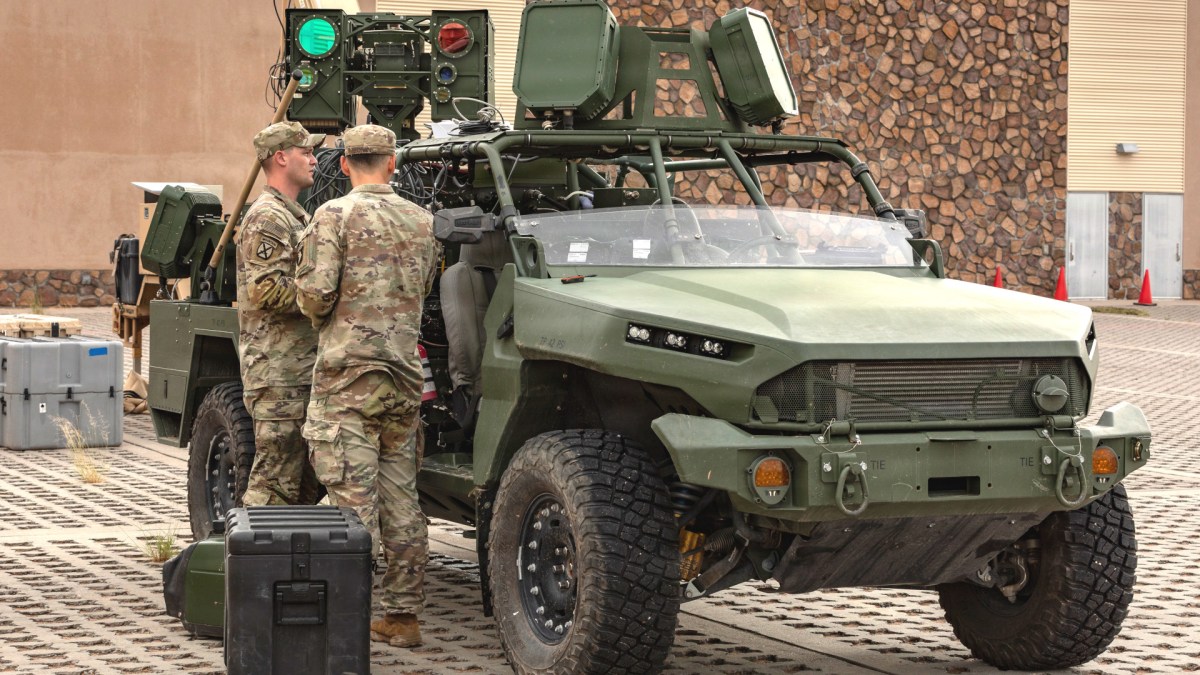
The Army does now have the aforementioned LOCUST systems, including versions mounted on 4×4 Joint Light Tactical Vehicles (JLTV) and Infantry Squad Vehicles (ISV), as well as the palletized types. Those systems appear to be currently fielded on a more ad hoc level to units at forward locations.
A LOCUST system seen integrated onto a JLTV. AeroVironment
LOCUST is well suited to the Army’s current vision for fielding E-HEL without being tied to specific vehicles or unit types. At the core of the system is a turret with the laser beam projector, as well as built-in electro-optical and infrared video cameras for target acquisition and tracking. Other sensors, such as small-form-factor high-frequency radars and passive radio frequency signal detection systems on host vehicles, as well as off-board radars and other capabilities positioned elsewhere, can be used to cue the turret.
A close-up look at the turret on an earlier palletized version of LOCUST acquired by the Army. US Army
With the 30-kilowatt power rating, the new X3 versions of LOCUST the Army is acquiring now are still at the lower end of the power spectrum for laser directed energy weapons. All versions of LOCUST to date are geared explicitly toward countering small drones.
It is possible that the Army could field other types of laser directed energy weapon systems through E-HEL in the future. The service, in cooperation with other branches of the U.S. military, is also pursuing designs with far higher power ratings through separate programs.
Just being able to field LOCUST X3 more broadly would still offer valuable additional layers of defense against drones across different types of Army units. More broadly speaking, the central benefit that laser directed energy weapons offer is the promise of functionally unlimited magazine depth, though this is dependent on there being sufficient power and cooling capacity. This, in turn, translates to a substantial reduction in the cost-per-intercept equation compared to traditional anti-air interceptors. All of this is especially advantageous for tackling drone threats, which do not have to be large or expensive to present real dangers.
By miniaturizing and ruggedizing lower-power systems like LOCUST, the Army could distribute these capabilities across a broad area, or deploy them in a more concentrated fashion, depending on the fight. Even a convoy with a number of the vehicles sprinkled in with them could help defend it from pop-up attacks
In this context, mobility and flexibility are also important boons. LOCUST systems mounted on light vehicles can be readily positioned and repositioned to respond to changes on the battlefield, as well as be brought to forward locations slung under helicopters. Palletized and containerized versions offer additional kinds of flexibility for providing point defense at sites on land, as well as installation on ships.
Army personnel assigned to Joint Task Force-Southern Border (JTF-SB) prepare to sling load a LOCUST-equipped Infantry Squad Vehicle (ISV) under a CH-47 Chinook helicopter during training as part of an Air Assault Sustainment Course at Fort Bliss, Texas, on July 16, 2025. US Army
At the panel on Monday, Brig. Gen. Yelverton stressed that when it comes to laser weapons systems, in general, the technology is no longer a matter of “science fiction” but has become “science reality.” The U.S. military says laser systems positioned along the border with Mexico have downed real targets , though many questions remain about those deployments . Regardless, challenges do clearly remain.
“Lasers are real. We can do it. We can go out. We can shoot things,” Kirk Williams, Chief Engineer at the Army’s Directed Energy Project Office, another one of the panelists, said. “But what we got to do now is make these systems reliable enough so that the soldiers have the faith in them when they need them, and that’s really the main point that we’re trying to go after right now.”
“We’re getting to the point where the systems are reliable enough, but we still have to make them maintainable and repairable because this is an Army system,” he continued. “It’s going to be on a battlefield. Things are going to break. We can break things in very creative ways, right? So if it’s not reliable, or if it’s not maintainable, if it’s not repairable, that’s a problem.”
“We’re also looking to reduce size, weight, and power,” he added. “JLTV has a lot better payload capacity than ISV. So we really need to be able to get something smaller if we want to have the same effectiveness on an ISV. So that same modular architecture will allow us to go in, take some of those components, make trade-offs.”
A JLTV-based LOCUST system seen deployed near the US-Mexico border. US Army
The focus on modular and open systems architectures will also help when it comes to integrating new and improved functionality down the line. It will also feed into the larger goal of having E-HEL options not tied to a particular vehicle or other platform.
“By going after the modular architecture, that gives us the flexibility to not only go after increases in reliability, but also increases in performance,” Williams further explained. “It gives us the way to inject new technology into existing systems, and then hopefully it also gives us a way of getting better prices out of some of our vendors.”
In addition, “one of the things we learned is you can have a really cool integrated system, and then when that truck needs an oil change, well, then your laser weapon system is down for the count,” he added. “So, trying to make it so that you can just pull it off of any vehicle, put it on any other vehicle is really one of the things that we’re trying to go after.”
The Army is also very cognizant of the basic fact that a single laser can only engage one target at once. The beam from any laser weapon system also drops in power as it gets further from the source, just because of the need to propagate through the atmosphere. Weather and other environmental conditions like smoke and dust then also become a factor. This has driven demand for more power (and cooling capacity) to improve effectiveness, especially at range. Developments in adaptive optics can also help overcome these issues to a degree, but lasers currently remain very short-range weapons overall.
A picture the US Army says shows an engagement of a drone using a laser directed energy weapon near the border with Mexico on August 25, 2026. US Army
“That’s why it’s important to us to get enough energy on the target to kill it as quickly as possible and move on to the next threat. Speaking about the magazine, you know I have battery power on there, so depending upon which system, around 80 seconds, 120 seconds, whatever that is, you know that’s the magazine depth I have,” Brig. Gen. Yelverton said on Monday. “The quicker I get on the target, kill it, and off the target, I start rebuilding, regenerating that magazine depth.”
“It’s the targeting system. It’s the optics system that lets you focus on the target,” Williams also chimed in at this point on the panel discussion. “I mentioned trying to make the trackers better and take some of the onus off of the operator. If we can do better aim point control and keep the laser in the same spot, it gives you a better and a quicker kill.”
Earlier on, Williams had highlighted how artificial intelligence-assisted targeting capabilities could be a particularly important addition to laser directed energy weapons. Networking multiple systems together could help with sorting and assigning targets as efficiently as possible.
When it comes to the actual operational employment of laser directed energy weapons, “as these systems get smaller, as they get more powerful, the quicker we could get them into our soldiers’ hands,” Army Col. Charles Kean, Deputy Commanding Officer for Support at the 7th Infantry Division at Joint Base Lewis-McChord in Washington state, another one of the panelists, said.
A promotional image showing JLTV-based and self-contained configurations of the LOCUST X3. AeroVironment
This, in turn, will open up important new opportunities to “operate with them forward, test them in the mud, the dirt, the humidity of the Pacific, test them down in the southern border where they’re different conditions, whether it’s in the Middle East and Europe, it’s applicable across the board,” Kean continued. “We have to understand it, get it in our hands as quickly as possible, so we could iterate it, iterate on it, and make it better and continue to iterate, because the adversaries continue to iterate in reverse against us.”
This last point is worth highlighting. The U.S. military’s chief global competitor, China, has been particularly active in the development and fielding of ground-based laser and other directed energy weapons , as well as designs for shipboard use . Chinese firms are selling laser weapon systems to foreign armed forces , as well. Other countries, including American allies and partners, are also very actively pursuing these capabilities .
Touted as the "world’s most powerful," China’s LY-1 ship-based laser air defense system was displayed on an eight-wheeled truck, with no specs released. pic.twitter.com/WalkQffaA9 — Polymarket Intel (@PolymarketIntel) September 3, 2025
Touted as the "world’s most powerful," China’s LY-1 ship-based laser air defense system was displayed on an eight-wheeled truck, with no specs released. pic.twitter.com/WalkQffaA9
Col. Kean also stressed that laser directed energy weapons would still only be one part of a larger layered air and missile defense ecosystem for the Army.
As it stands now, the Army hopes to have the first LOCUST X3 systems acquired through E-HEL in operational service by early 2028 . A similar timeframe has been put forward for the separate Joint Laser Weapon System (JLWS) program, which the Army is also involved in. JLWS is aiming to produce a viable containerized 150-kilowatt-class laser directed energy weapon, with plans to work toward 300- and 500-kilowatt-class designs. At the panel on Monday, Scott Keeney, CEO of laser systems developer nLIGHT, which has been working together with AeroVironment on LOCUST, among other projects, said he saw further scaling up of capabilities to the one-megawatt-class as being on the horizon. This is a power rating the U.S. Navy has also talked about as a future goal .
The Army clearly sees E-HEL already as a path to truly operationalizing laser directed energy capabilities across the system, but the service itself acknowledges that there is still significant work to be done to make this goal a reality.
Contact the author: joe@twz.com
Comments couldn’t be loaded. Please refresh the page.
作者:约瑟夫·特雷维西克
发布于美国东部时间2026年10月15日下午2:15
美国陆军正在研发一系列模块化、可扩展的激光定向能武器,这些武器可以安装在其现役的任何车辆上。陆军认为这是扩大激光武器作战应用范围的关键,尤其是在应对无人机威胁以及在专用部队之外提供额外防御方面。陆军已经在包括美墨边境在内的有限范围内部署了高能激光器,但近年来,这项技术在更广泛的应用方面仍然面临着诸多挑战。
本周,在全美陆军协会(AUSA)年度大会上,陆军官员和业界代表就目前被称为“持久高能激光”(E-HEL)的项目进行了小组讨论。TWZ也出席了此次大会。今年9月,AeroVironment公司获得了E-HEL项目的首份生产合同,为其30千瓦级的LOCUST X3激光定向能武器系统提供样机。陆军此前已通过一些实验性项目采购了LOCUST的早期型号,包括车载式和托盘式,这些系统目前已部署在南部边境。美国海军也至少测试过LOCUST的集装箱式舰载版本,这是其更大规模激光武器计划的一部分。
“我们关注的是车队中的所有车辆。我想尝试将高能激光的未来能力集成到其中,”陆军准将盖伊·耶尔弗顿(Guy Yelverton)在周一的小组讨论会上说道。耶尔弗顿是火力装备组合采购执行办公室防御火力能力项目主管。“因此,我们的高能激光武器安装在滑橇上。这样一来,我就可以考虑将其集成到多种不同的车辆上。”
“然后,当我考虑车辆兼容性时,如果我将视野放宽到不限军事职业专长(MOS),并确保易于训练、易于操作,我就不能只关注防空和导弹防御组织,”他继续说道。“我现在可以考虑任何类型的编队,以便为其配备高能激光能力,用于反无人机作战。”
“这让我有更多机会在所有陆军部队推广这项能力,并让我们的高级领导人最大限度地参与到系统部署方向、操作人员的选择等决策中来,我已经为他们提供了一个相当不错的解决方案,”他补充道。“如何部署所有这些能力,这的确是一个值得思考的难题。”
2022年,美国陆军在俄克拉荷马州锡尔堡重新启用第60防空炮兵团第4营(4-60th ADA),作为部署基于8×8“斯特瑞克”轻型装甲车的新型激光定向能机动近程防空(DE M-SHORAD)系统计划的一部分。然而,DE M-SHORAD车辆的可靠性及其他问题导致陆军调整了发展方向,4-60th ADA此后转而承担更为传统的防空任务。DE M-SHORAD系统的种种问题反映了美国军方激光定向能武器研发过程中长期存在的困境,并导致近年来多个相关项目被大幅缩减或彻底取消。
这是基于“斯特瑞克”装甲车的DE M-SHORAD系统原型车之一。美国陆军。这是陆军最初的DE M-SHORAD原型车之一。美国陆军
陆军目前确实拥有上述的“蝗虫”(LOCUST)系统,包括安装在4×4联合轻型战术车辆(JLTV)和步兵班组车辆(ISV)上的版本,以及托盘式版本。这些系统目前似乎以较为临时的方式部署到前沿阵地的部队。
图中可见LOCUST系统已集成到JLTV(联合轻型战术车辆)上。AeroVironment
LOCUST系统非常符合陆军目前部署电子高射炮的愿景,无需绑定特定车辆或部队类型。该系统的核心是一个炮塔,配备激光束投射器以及用于目标捕获和跟踪的内置光电和红外摄像机。其他传感器,例如安装在载车上的小型高频雷达和被动射频信号探测系统,以及部署在其他位置的外部雷达和其他设备,都可以用来引导炮塔。
近距离观察美国陆军早期采购的“蝗虫”导弹防御系统(LOCUST)的托盘式炮塔。美国陆军
陆军目前正在采购的新型 X3 型 LOCUST 激光制导武器功率为 30 千瓦,在激光定向能武器中仍属于功率较低的级别。迄今为止,所有型号的 LOCUST 激光制导武器都明确针对小型无人机而设计。
未来,陆军有可能通过E-HEL项目部署其他类型的激光定向能武器系统。陆军还与其他军种合作,通过其他项目研发功率更高的武器系统。
即使只是更广泛地部署“蝗虫X3”导弹,也能为陆军各类部队提供宝贵的额外防御手段,有效抵御无人机威胁。更广泛地说,激光定向能武器的核心优势在于其近乎无限的弹药储备,但这取决于足够的功率和冷却能力。反过来,与传统防空拦截器相比,这意味着每次拦截的成本将大幅降低。所有这些优势对于应对无人机威胁尤为重要,因为无人机并不一定体积庞大或造价昂贵,却能构成真正的威胁。
通过小型化和加固像“蝗虫”(LOCUST)这样的低功耗系统,陆军可以根据战况,将这些能力分散部署到广阔区域,或以更集中的方式部署。即使是一支车队,只要其中穿插部署了一些这样的车辆,也能帮助抵御突如其来的袭击。
在此背景下,机动性和灵活性也至关重要。安装在轻型车辆上的“蝗虫”系统可以快速部署和重新部署,以应对战场变化,还可以通过直升机吊运至前沿阵地。托盘式和集装箱式版本则提供了更多灵活性,可用于陆地点防御以及舰船部署。
2025年7月16日,在德克萨斯州布利斯堡,隶属于南部边境联合特遣部队(JTF-SB)的陆军人员正在准备将一辆配备“蝗虫”导弹系统的步兵班组车辆(ISV)吊装到一架CH-47“支奴干”直升机下方,这是空中突击保障课程训练的一部分。
在周一的小组讨论会上,耶尔弗顿准将强调,就激光武器系统而言,这项技术总体上已不再是“科幻小说”里的东西,而是“现实科学”。美军称,部署在美墨边境的激光系统已经击落了真实目标,尽管这些部署仍存在诸多疑问。无论如何,挑战依然存在。
“激光是真实存在的。我们能做到。我们可以出去。我们可以发射激光,”陆军定向能项目办公室首席工程师柯克·威廉姆斯(Kirk Williams)说道,他也是小组成员之一。“但我们现在必须做的是让这些系统足够可靠,让士兵在需要时能够信任它们,这才是我们目前努力的方向。”
“我们现在正努力让系统变得足够可靠,但我们仍然需要确保它们的可维护性和可修复性,因为这是陆军系统,”他继续说道。“它将被部署在战场上。设备肯定会出故障。我们可能会以各种意想不到的方式弄坏设备,对吧?所以,如果它不可靠,或者无法维护,或者无法修复,那就是个问题。”
他还补充道:“我们也在努力减小尺寸、重量和功耗。JLTV的有效载荷能力比ISV强得多。因此,如果我们想在ISV上达到同样的效能,就必须尽可能缩小尺寸。这种模块化架构将使我们能够对部分组件进行取舍。”
一支基于联合轻型战术车辆(JLTV)的“蝗虫”(LOCUST)导弹防御系统被部署在美国与墨西哥边境附近。美国陆军
注重模块化和开放的系统架构,将有助于未来集成新的和改进的功能。这也有助于实现更大的目标,即让E-HEL选项不再与特定车辆或其他平台绑定。
威廉姆斯进一步解释说:“采用模块化架构,不仅能让我们灵活地提高可靠性,还能提升性能。这使我们能够将新技术融入现有系统,而且有望帮助我们从一些供应商那里获得更优惠的价格。”
此外,他还补充道:“我们了解到,即使你拥有一个非常酷炫的集成系统,但如果卡车需要更换机油,那么你的激光武器系统就彻底罢工了。所以,我们努力的目标之一就是让它能够从任何车辆上拆卸下来,安装到任何其他车辆上。”
陆军也十分清楚一个基本事实:单束激光一次只能攻击一个目标。任何激光武器系统的光束功率都会随着距离光源的增加而衰减,这仅仅是因为光束需要穿过大气层。天气和其他环境因素,例如烟雾和灰尘,也会对激光武器的性能产生影响。因此,人们需要更大的功率(以及更强的冷却能力)来提高激光武器的效能,尤其是在远距离作战时。自适应光学技术的发展在一定程度上可以帮助克服这些问题,但总体而言,激光武器目前仍然是射程非常短的武器。
美国陆军称,一张照片显示,2026年8月25日,一架无人机在美墨边境附近使用激光定向能武器进行交战。
“这就是为什么对我们来说,尽快将足够的能量集中到目标上,将其消灭,然后转而应对下一个威胁至关重要。说到弹匣,你知道我用的是电池供电,所以根据不同的系统,大约80秒、120秒,或者其他什么时间,这就是我的弹匣容量,”耶尔弗顿准将周一说道。“我越快锁定目标、将其消灭并撤离,就能越快地补充弹药,恢复弹匣容量。”
“关键在于瞄准系统。正是这套光学系统让你能够聚焦目标,”威廉姆斯在小组讨论中插话道。“我之前提到过要改进追踪器,减轻操作员的负担。如果我们能更好地控制瞄准点,让激光始终保持在同一个位置,就能更快更好地击杀目标。”
威廉姆斯此前曾强调,人工智能辅助目标瞄准能力对于激光定向能武器而言是一项尤为重要的补充。将多个系统联网可以尽可能高效地对目标进行分类和分配。
谈到激光定向能武器的实际作战运用时,另一位小组成员、华盛顿州刘易斯-麦科德联合基地第7步兵师支援副指挥官查尔斯·基恩陆军上校表示:“随着这些系统变得越来越小,威力越来越大,我们就能越快地将它们送到士兵手中。”
一张宣传图片,展示了基于JLTV平台和独立式配置的LOCUST X3。AeroVironment
基恩继续说道:“反过来,这将为我们开辟重要的全新机遇,让我们能够‘在前线使用这些装备,在太平洋的泥泞、尘土和潮湿环境中进行测试,在南部边境的不同条件下进行测试,无论是在中东还是欧洲,这些装备都具有普适性。我们必须了解这些装备,尽快掌握它们,这样我们才能不断迭代、改进,因为对手也在不断地反向迭代,以应对我们。”
最后一点值得强调。美国军方的主要全球竞争对手中国,在研发和部署陆基激光武器和其他定向能武器以及舰载武器方面尤为活跃。中国企业也在向外国军队出售激光武器系统。其他国家,包括美国的盟友和伙伴,也在积极发展这些能力。
据称是“世界上最强大的”中国LY-1舰载激光防空系统被放置在一辆八轮卡车上展示,但并未公布任何具体参数。pic.twitter.com/WalkQffaA9 — Polymarket Intel (@PolymarketIntel) September 3, 2025
据称是“世界上最强大的”中国LY-1舰载激光防空系统被放置在一辆八轮卡车上展示,但并未公布任何具体参数。pic.twitter.com/WalkQffaA9
基恩上校还强调,激光定向能武器仍然只是陆军更大规模的多层防空和导弹防御体系的一部分。
目前,美国陆军希望通过E-HEL项目采购的首批LOCUST X3系统能在2028年初投入作战使用。陆军参与的另一个项目——联合激光武器系统(JLWS)也提出了类似的时间表。JLWS的目标是研发一种可行的集装箱式150千瓦级激光定向能武器,并计划进一步开发300千瓦和500千瓦级的设计。在周一的小组讨论会上,激光系统开发商nLIGHT的首席执行官斯科特·基尼表示,他认为将性能进一步提升至兆瓦级指日可待。nLIGHT曾与AeroVironment公司合作开发LOCUST等项目。美国海军也曾将这一功率等级作为未来的目标。
陆军显然已经将 E-HEL 视为在整个系统中真正实现激光定向能作战能力的途径,但陆军自身也承认,要实现这一目标,还有大量工作要做。
联系作者:joe@twz.com
评论加载失败,请刷新页面。