Canada’s Snowbirds Say Farewell To The CT-114 Tutor Jet加拿大雪鸟飞行表演队告别CT-114导师喷气式教练机
After 55 years with the Tutor, the aerobatic team faces an extended hiatus before transitioning to the PC-21 turboprop in the early 2030s. After 55 years with the Tutor, the aerobatic team faces an extended hiatus before transitioning to the PC-21 in the early 2030s.
新闻视频
Published Oct 16, 2026 2:35 PM EDT
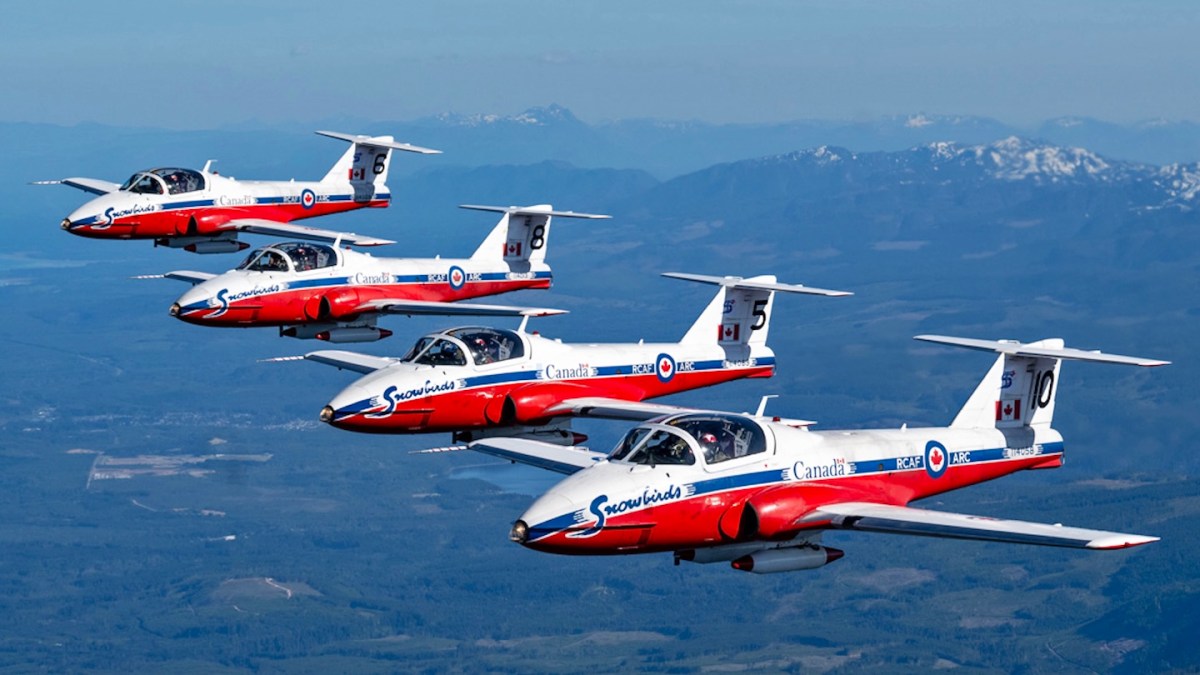
The Canadian Forces Snowbirds brought the Canadair CT-114 Tutor ’s aerobatic career to a close on Friday, October 16, with a final home-base demonstration at 15 Wing Moose Jaw, Saskatchewan. The private event, which was livestreamed, honored the Canadian-built jet trainer that defined the team for more than half a century , as well as the aircrew and support personnel who kept the increasingly demanding aircraft flying.
This Friday, join us in saying farewell to the CT-114 Tutors. Watch the last airshow on Friday, October 16, 2026 live on our Facebook page. The live stream will begin at 2 p.m. (EDT). pic.twitter.com/I2Tr3buq5D — Royal Canadian Air Force (@RCAF_ARC) October 13, 2026
This Friday, join us in saying farewell to the CT-114 Tutors. Watch the last airshow on Friday, October 16, 2026 live on our Facebook page. The live stream will begin at 2 p.m. (EDT). pic.twitter.com/I2Tr3buq5D
While Friday’s performance marks the end of the Tutor’s aerobatic display career with the team, a Grey Cup flyover in Calgary on November 15 remains on the schedule .
Speaking to MooseJawToday on October 15, Snowbirds team lead Maj. Maciej “Match” Hatta described the Tutor’s final season as an emotional milestone for the squadron, as well as an opportunity to recognize the families and support personnel who sustain the team during its annual touring season.
The Snowbirds taxi at Gowen Field, Boise, Idaho, during the Gowen Thunder Open House and Airshow, in 2017. Note the twin smoke tanks below the fuselage. U.S. Air National Guard photo by Master Sgt. Joshua C. Allmaras
Hatta has a long personal history with the aircraft. He flew with the Snowbirds from 2014 to 2017, subsequently worked on testing the Tutor’s avionics upgrades, and returned this year to lead the team through its final season with the jet. Despite having flown around 30 different aircraft as a test pilot, he has a particular attachment to the Tutor.
“This is still my favorite airplane to fly,” he said.
Hatta recalled flying a maintenance test sortie alone the previous day, enjoying the opportunity to look out over the wings without the near-constant radio communications involved in leading a formation display. He also noted the differences between individual aircraft in the fleet.
“They all have their own personality,” Hatta said. “Some of them howl a little more than others. Some get hotter inside. Some have poor air conditioning.”
Lt.-Col. Guillaume Paquet, commanding officer of No. 431 Air Demonstration Squadron, Royal Canadian Air Force (RCAF), said the final season has prompted strong reactions from spectators, many of whom have grown up watching the Snowbirds perform in the Tutor.
“The reality is we’ve been touring this country for 55 years, so everyone has a story, a childhood memory,” Paquet said.
Golden Hawks To Snowbirds
Canada’s military aerobatic tradition dates back to 1929, when the biplane Armstrong Whitworth Siskin helped establish the country’s formation-flying heritage. The modern era began in 1959 with the creation of the Golden Hawks, formed to mark the 50th anniversary of powered flight in Canada and the 35th anniversary of the RCAF. Flying gold-painted Canadair-built F-86 Sabre fighters, the team initially was intended to operate for a single season. Its popularity led to several more years of performances across Canada and the United States before it was disbanded after the 1963 season amid the high costs of maintaining it.
Canada’s centennial celebrations in 1967 brought a new demonstration team, the Golden Centennaires, which flew CT-114 Tutor jet trainers at 100 airshows across Canada and the United States. The Tutors would subsequently become the foundation of the Snowbirds. In 1969, Colonel O.B. Philp, newly appointed commander of No. 2 Canadian Forces Flying Training School at Moose Jaw, Saskatchewan, encouraged instructors to practice formation aerobatics using surplus Tutors left over from the Centennaires program. Initially presented as training and proficiency flying, the formations soon attracted public attention and gradually evolved into an established demonstration team.
The Golden Centennaires existed for only one year to celebrate the centennial of Canada in 1967. Canadian Forces
The formation grew from four aircraft in 1970 to seven in 1971, when the Snowbirds name was adopted following a competition among schoolchildren. Two solo aircraft were added in 1972, establishing the team’s familiar nine-aircraft format. That year, its pilots were assigned to demonstration flying on a full-time basis. The team’s Tutors were modified to support solo operation from the right-hand seat and the demands of inverted flight during aerobatic displays. In 1974, the Tutors received their distinctive red, white, and blue paint scheme, and the team was authorized to perform a fully aerobatic display.
Seven Canadian Forces Snowbirds jets perform an aerial demonstration earlier this year. U.S. Air National Guard photo by Tech. Sgt. Mikayla Gibbs
The Snowbirds subsequently achieved full squadron status as No. 431 Air Demonstration Squadron, becoming one of the most recognizable symbols of Canadian military aviation. Their officially stated mission was to demonstrate the professionalism, teamwork, and flying skills of the Canadian Armed Forces to audiences across North America.
The U.S. Navy Flight Demonstration Squadron, the Blue Angels, join their signature Delta formation with the Snowbirds for a scheduled photo shoot over Evansville, Indiana, in 2015. U.S. Navy photos by Mass Communication Specialist 1st Class Michael Lindsey/Released
However, the Tutor’s final years were marked by a series of serious accidents and renewed scrutiny of its aging systems.
In October 2019, a Snowbirds aircraft crashed in Georgia after an engine fuel-delivery failure, with the pilot surviving an ejection that was itself affected by a parachute malfunction. In May 2020, another Tutor crashed shortly after takeoff near Kamloops, British Columbia, killing the Snowbirds public affairs officer and seriously injuring the pilot; investigators determined that a bird strike had triggered an engine compressor stall. The fleet was temporarily grounded following that accident, with operations resuming under additional restrictions in August 2020.
A further accident at Fort St. John, British Columbia, in August 2022 prompted another fleet-wide operational pause after an engine failure during takeoff; investigators identified an improperly assembled oil filter as the cause. The aircraft returned to service the following month.
The Royal Canadian Air Force’s Snowbirds parked on the flight line at Peterson Air Force Base, Colorado, in 2018, during the North American Aerospace Defense Command’s 60th Anniversary Celebration. DoD photo by Staff Sgt. Emily Kenney, USAF
Subsequent safety measures included restrictions on certain aerobatic maneuvers and formations, minimum runway-length requirements, and limits on flying over water or performing some maneuvers outside gliding distance of a suitable landing surface.
At the same time, the persistent engineering challenges involving the Tutor’s airframe, engines, and ejection system were all factors in its retirement, with the RCAF concluding that further life-extension work was no longer practical.
Developing Canada’s Jet Trainer
Canadair Limited of Montreal began developing the CL-41A Tutor in the mid-1950s as a high-performance jet trainer to prepare RCAF pilots for the Canadair-built F-86 Sabre. The all-metal, low-wing, single-engine aircraft featured side-by-side seating and duplicate flight controls, allowing instructors to monitor students closely and take control when necessary. Two prototypes were built, with the first making its maiden flight on January 13, 1960, with Canadair test pilot Ian MacTavish at the controls.
Capt. Wes MacKay banks his Canadian Forces Tutor jet over downtown Toronto in a practice run before a performance at the Canadian National Exhibition in 1988. Photo by Boris Spremo/Toronto Star via Getty Images
Following an extensive testing and demonstration program, Canadian Minister of National Defence D.S. Harkness announced an order for 190 production aircraft on September 11, 1961. Deliveries began in 1963, with each aircraft reportedly costing approximately C$425,000 (around $394,000). Powered by a General Electric J85-CAN-40 turbojet built under licence by Orenda, the aircraft entered RCAF training service in late 1964 under the designation CT-114 Tutor.
As well as the RCAF, the Tutor found one other military operator in Malaysia. The Royal Malaysian Air Force received 20 examples designated the CL-41G Tebuan (meaning “Wasp” in the Malay language), which served between 1967 and 1986 in the ground-attack role.
A Royal Malaysian Air Force CL-41G Tebuan. The Aviation Historian Archive
The Tutor served as the RCAF’s primary jet trainer for decades, accumulating more than one million flight hours before its training role ended in 2000 . It was replaced by the CT-156 Harvard II and CT-155 Hawk . The aircraft nevertheless remained in military service with the Snowbirds.
The Tutor’s retirement will bring an end to a long chapter in Canadian military aviation, but the Snowbirds are expected to continue flying with a new aircraft type. In May of this year, the Department of National Defence announced plans to replace the CT-114 with the CT-157 Siskin II, based on the Pilatus PC-21 turboprop trainer. The new demonstration capability will remain at 15 Wing Moose Jaw and is expected to become operational in the early 2030s.
Today the Government of Canada announced a commitment to purchase a future RCAF air demonstration capability. After more than six decades of service 2026 will mark the final season for the CT‑114 Tutor aircraft fleet which has represented Canada with dignity and pride since 1971. pic.twitter.com/iqRNE8d8H3 — Royal Canadian Air Force (@RCAF_ARC) May 19, 2026
Today the Government of Canada announced a commitment to purchase a future RCAF air demonstration capability. After more than six decades of service 2026 will mark the final season for the CT‑114 Tutor aircraft fleet which has represented Canada with dignity and pride since 1971. pic.twitter.com/iqRNE8d8H3
The Siskin II has already been procured under Canada’s wider Future Aircrew Training (FAcT) program, for advanced fixed-wing and jet preparation. It is one of five aircraft types being procured under a 25-year, C$11.2-billion (approximately $7.9 billion) contract awarded to SkyAlyne in 2024. The other four types are the CT-102B Astra II (Grob G 120TP) for basic pilot training; CT-157 Siskin II for advanced fixed-wing and jet preparation; CT-145E Expeditor II (Beechcraft King Air 260) for multi-engine training; CT-153 Juno (Airbus H135) for helicopter training; and CT-142Q Citadel (De Havilland Canada Dash 8-400) for training air combat systems officers and airborne electronic sensor operators.
One of the first two Pilatus PC-21s departs Stans in Switzerland bound for Canada on September 14, 2026. These first aircraft mark the start of a new chapter in Canada’s Future Aircrew Training (FAcT) program. Pilatus
Paquet, the No. 431 Air Demonstration Squadron boss, said all Tutors are to be flown to IMP Aerospace in Trenton, Ontario, by March 31, 2027, where they will be disposed of. Some aircraft are expected to be preserved in museums or mounted on pedestals for public display, while others will be used as training aids for aircraft maintenance apprentices in Borden, Ontario.
“They’re not going to be flying. They’re not going to be flyable,” Paquet said.
Snowbirds team lead “Match” Hatta hopes to contribute his test-pilot experience to the transition, including testing the replacement aircraft and developing the new demonstration program.
“I would love to contribute to the team in terms of seeing them through the transition,” he said. “If I’m able to use my test background as well in helping that out, testing the new show, testing the new airplanes, and passing it on to a new boss down the road, then I’d love to do that.”
Royal Canadian Air Force CT-114 Tutor pilots with the Canadian Forces Snowbirds perform pre-flight checks during the Defenders of Liberty Air & Space Show at Barksdale Air Force Base, Louisiana, in 2019. U.S. Air Force photo by Airman Jacob B. Wrightsman
For Paquet, the immediate priority is completing the final display season without incident before turning to the next phase of the team’s history.
“I will definitely be emotional. The only thing I’m hoping for is that all the planes land safely, bring everybody home, and then we can check the box and say it was an extremely successful season. I brought everybody home, and we’ll move on to the next chapter.”
After more than six decades since its development began, the Tutor leaves behind a legacy spanning generations of military pilots and millions of spectators. Its final Snowbirds aerobatic display represents not simply the retirement of an aging aircraft, but the end of a long tradition in which the little jet trainer was one of the country’s most recognizable symbols of military flying and aerial performance.
Contact the author: thomas@thewarzone.com
Comments couldn’t be loaded. Please refresh the page.
发布于美国东部时间2026年10月16日下午2:35
10月16日星期五,加拿大空军雪鸟飞行表演队在萨斯喀彻温省穆斯乔市第15联队基地进行了最后一次飞行表演,为加拿大航空CT-114“导师”教练机的特技飞行生涯画上了句号。这场私人活动通过网络直播,旨在向这款加拿大制造的喷气式教练机致敬,它陪伴雪鸟飞行表演队走过了半个多世纪,同时也向那些让这架日益精密的飞机保持飞行状态的机组人员和后勤人员致敬。
本周五,请与我们一同向CT-114“导师”教练机告别。敬请收看2026年10月16日(星期五)在我们的Facebook主页上直播的最后一次飞行表演。直播将于美国东部时间下午2点开始。pic.twitter.com/I2Tr3buq5D — 加拿大皇家空军 (@RCAF_ARC) 2026年10月13日
本周五,让我们一起向CT-114“导师”教练机告别。敬请收看2026年10月16日(周五)在我们Facebook主页直播的最后一次飞行表演。直播将于美国东部时间下午2点开始。pic.twitter.com/I2Tr3buq5D
虽然周五的表演标志着 Tutor 号飞机与该队合作的特技飞行表演生涯的结束,但 11 月 15 日在卡尔加里举行的格雷杯飞行表演仍按计划进行。
10 月 15 日,雪鸟飞行表演队队长马切伊·“马奇”·哈塔少校在接受 MooseJawToday 采访时表示,Tutor 的最后一个赛季对于中队来说是一个充满情感的里程碑,也是一个感谢在每年巡回演出季中支持团队的家属和后勤人员的机会。
2017年,在爱达荷州博伊西市戈温机场举行的戈温雷霆开放日暨航展期间,雪鸟飞行表演队正在滑行。请注意机身下方的双烟雾罐。美国空军国民警卫队照片,由一级军士长约书亚·C·阿尔马拉斯拍摄。
哈塔与这架飞机有着很深的渊源。他曾于2014年至2017年效力于雪鸟飞行表演队,之后参与了Tutor教练机航电升级的测试工作,并在今年回归,带领团队完成了该机型的最后一个赛季。尽管作为试飞员他驾驶过大约30种不同的飞机,但他对Tutor教练机却有着特殊的感情。
“这仍然是我最喜欢的飞机,”他说。
哈塔回忆起前一天独自执行维护测试任务,他很享受这种无需像指挥编队飞行表演时那样几乎时刻保持无线电通讯,就能从机翼上方眺望天空的机会。他还注意到机队中不同飞机之间的差异。
“它们各有各的个性,”哈塔说。“有些车厢比其他车厢叫得更厉害。有些车厢内部更热。有些车厢空调不好。”
加拿大皇家空军第 431 飞行表演中队指挥官 Guillaume Paquet 中校表示,最后一个赛季引起了观众的强烈反响,其中许多人是看着雪鸟飞行表演队驾驶 Tutor 飞机进行表演长大的。
“事实上,我们已经在这个国家巡演了55年,所以每个人都有一段故事,一段童年回忆,”帕奎特说。
金鹰到雪鸟
加拿大的军事特技飞行传统可以追溯到1929年,当时阿姆斯特朗·惠特沃斯·西斯金双翼飞机帮助奠定了该国的编队飞行传统。现代特技飞行时代始于1959年,当时为了纪念加拿大动力飞行50周年和加拿大皇家空军成立35周年,加拿大成立了金鹰飞行表演队。该队驾驶着涂成金色的加拿大飞机公司制造的F-86佩刀战斗机,最初计划只运营一个赛季。由于其受欢迎程度,该队在加拿大和美国进行了数年的表演,直到1963赛季结束后,由于维持运营成本高昂而解散。
1967年加拿大百年庆典之际,一支名为“金禧飞行表演队”(Golden Centennaires)的全新飞行表演队应运而生。该队驾驶CT-114“导师”(Tutor)喷气式教练机,在加拿大和美国的100多场航展上进行了飞行表演。“导师”教练机后来成为“雪鸟”(Snowbirds)飞行表演队的雏形。1969年,新上任的萨斯喀彻温省穆斯乔市加拿大第二飞行训练学校校长O.B.菲尔普上校鼓励教官们利用“金禧飞行表演队”剩余的“导师”教练机进行编队特技飞行训练。最初,这些编队飞行训练仅用于训练和技能考核,但很快便吸引了公众的目光,并逐渐发展成为一支成熟的飞行表演队。
“金禧军团”仅存在了一年,是为了庆祝加拿大1967年建国一百周年。加拿大军队
1970年,该飞行表演队由四架飞机发展到1971年的七架,并在一次小学生竞赛中选出了“雪鸟”这个名字。1972年,又增加了两架单机,形成了如今我们熟悉的九架飞机的规模。同年,飞行员们开始全职从事飞行表演。为了满足右座单飞和特技飞行表演中倒飞的要求,飞行表演队的教练机(Tutor)进行了改装。1974年,教练机涂装了标志性的红、白、蓝三色,飞行表演队也获准进行完整的特技飞行表演。
今年早些时候,七架加拿大空军雪鸟飞行表演队的喷气式飞机进行了空中表演。美国空军国民警卫队技术军士米凯拉·吉布斯摄。
雪鸟飞行表演队随后升格为正式中队,番号为第431空中表演中队,成为加拿大军事航空界最具代表性的标志之一。他们的官方任务是向北美各地的观众展示加拿大武装部队的专业精神、团队合作和飞行技能。
2015年,美国海军飞行表演队“蓝天使”与“雪鸟”飞行表演队在印第安纳州埃文斯维尔上空进行预定的拍摄,他们标志性的三角队形也出现在镜头中。美国海军一级大众传播专家迈克尔·林赛拍摄/发布
然而,Tutor 的最后几年却发生了一系列严重事故,其老化的系统也受到了重新审视。
2019年10月,一架雪鸟飞行表演队的飞机在佐治亚州因发动机燃油供应故障坠毁,飞行员弹射逃生,但弹射过程本身也受到降落伞故障的影响。2020年5月,另一架Tutor教练机在加拿大不列颠哥伦比亚省坎卢普斯附近起飞后不久坠毁,造成雪鸟飞行表演队公共事务官员死亡,飞行员重伤;调查人员认定,鸟击引发了发动机压气机失速。事故发生后,雪鸟飞行表演队的机队暂时停飞,并于2020年8月在附加限制条件下恢复运营。
2022年8月,在加拿大不列颠哥伦比亚省圣约翰堡发生的另一起事故导致机队再次暂停运营。事故原因是起飞时发动机故障;调查人员认定故障原因是机油滤清器组装不当。该飞机于次月恢复运营。
2018年,在北美防空司令部成立60周年庆典期间,加拿大皇家空军雪鸟飞行表演队的飞机停在科罗拉多州彼得森空军基地的停机坪上。美国国防部照片,由美国空军参谋军士艾米丽·肯尼拍摄。
随后采取的安全措施包括限制某些特技飞行动作和队形、规定跑道的最小长度要求,以及限制飞越水面或在合适的着陆面滑翔距离之外进行某些特技飞行。
与此同时,Tutor 教练机的机身、发动机和弹射系统持续存在的工程难题也是导致其退役的因素,加拿大皇家空军最终认为进一步延长其使用寿命已不再可行。
加拿大喷气式教练机研发
位于蒙特利尔的加拿大飞机有限公司(Canadair Limited)于20世纪50年代中期开始研发CL-41A Tutor高性能喷气式教练机,旨在为加拿大皇家空军飞行员驾驶加拿大飞机公司自行制造的F-86佩刀战斗机做准备。这款全金属、下单翼、单引擎飞机采用并排双座布局和双套飞行控制系统,使教官能够密切监控学员并在必要时接管飞机。该机共制造了两架原型机,第一架于1960年1月13日首飞,由加拿大飞机公司的试飞员伊恩·麦克塔维什(Ian MacTavish)驾驶。
1988年,在加拿大国家展览会表演前,加拿大空军上尉韦斯·麦凯驾驶着他的“导师”喷气式飞机在多伦多市中心上空进行试飞。照片由鲍里斯·斯普雷莫/《多伦多星报》通过盖蒂图片社提供。
经过广泛的测试和演示计划后,加拿大国防部长哈克尼斯于1961年9月11日宣布订购190架生产型飞机。交付工作于1963年开始,据报道每架飞机的成本约为42.5万加元(约合39.4万美元)。该飞机由奥伦达公司获得许可生产的通用电气J85-CAN-40涡轮喷气发动机提供动力,并于1964年末以CT-114“导师”的名称加入加拿大皇家空军的训练服役。
除了加拿大皇家空军之外,Tutor教练机在马来西亚还有另一家军方用户。马来西亚皇家空军接收了20架Tutor教练机,型号为CL-41G Tebuan(马来语意为“黄蜂”),该机型于1967年至1986年间服役,执行对地攻击任务。
一架马来西亚皇家空军的CL-41G“特布安”运输机。航空历史学家档案馆
“导师”教练机曾作为加拿大皇家空军的主要喷气式教练机服役数十年,累计飞行时间超过一百万小时,直至2000年结束其训练任务。它被CT-156“哈佛II”和CT-155“鹰”式教练机取代。尽管如此,该型飞机仍然在加拿大皇家空军雪鸟飞行表演队服役。
“导师”教练机的退役将为加拿大军用航空史上一个漫长的篇章画上句号,但“雪鸟”飞行表演队预计将继续使用新型飞机进行飞行表演。今年5月,加拿大国防部宣布计划用基于皮拉图斯PC-21涡轮螺旋桨教练机的CT-157“西斯金II”教练机取代CT-114。新的演示能力将继续留在穆斯乔空军基地的第15联队,预计将于2030年代初投入使用。
加拿大政府今天宣布承诺采购一架未来加拿大皇家空军(RCAF)的飞行表演机。服役超过六十年后,2026年将是CT-114“导师”教练机机队的最后一个飞行季。自1971年以来,该机队一直代表加拿大,展现着尊严和荣耀。 pic.twitter.com/iqRNE8d8H3 — 加拿大皇家空军 (@RCAF_ARC) 2026年5月19日
今天,加拿大政府宣布承诺采购一架未来加拿大皇家空军(RCAF)的飞行表演机。服役超过六十年后,2026年将是CT-114“导师”教练机机队的最后一个飞行季。自1971年以来,这架飞机一直代表着加拿大,展现着尊严和荣耀。pic.twitter.com/iqRNE8d8H3
加拿大已根据其更广泛的未来飞行员训练(FAcT)计划采购了Siskin II飞机,用于高级固定翼和喷气式飞机训练。它是根据一份为期25年、价值112亿加元(约合79亿美元)的合同采购的五种机型之一,该合同于2024年授予SkyAlyne公司。其他四种机型分别是:用于基础飞行员训练的CT-102B Astra II(Grob G 120TP);用于高级固定翼和喷气式飞机训练的CT-157 Siskin II;用于多引擎训练的CT-145E Expeditor II(Beechcraft King Air 260);用于直升机训练的CT-153 Juno(Airbus H135);以及用于训练空中作战系统军官和机载电子传感器操作员的CT-142Q Citadel(De Havilland Canada Dash 8-400)。
首批两架皮拉图斯PC-21飞机中的一架于2026年9月14日从瑞士斯坦斯机场起飞,前往加拿大。这两架飞机标志着加拿大未来机组人员培训(FAcT)计划新篇章的开启。
第431飞行表演中队指挥官帕奎特表示,所有“导师”教练机将于2027年3月31日前运往位于安大略省特伦顿的IMP航空航天公司进行处置。部分飞机预计将被博物馆收藏或安装在基座上供公众参观,其余飞机则将用作安大略省博登市飞机维修学徒的培训教具。
“它们飞不起来,也飞不起来,”帕奎特说。
雪鸟飞行表演队队长“Match” Hatta 希望将他的试飞员经验贡献给过渡工作,包括测试替代飞机和开发新的演示计划。
“我非常乐意为团队贡献力量,帮助他们顺利完成过渡,”他说。“如果我还能运用我的测试背景来帮忙,比如测试新节目、测试新飞机,并将这些经验交接给未来的新领导,那我非常乐意。”
2019年,在路易斯安那州巴克斯代尔空军基地举行的“自由捍卫者”航空航天表演赛期间,加拿大皇家空军雪鸟飞行表演队的CT-114“导师”教练机飞行员正在进行飞行前检查。美国空军摄影师雅各布·B·赖特斯曼摄。
对于帕奎特来说,眼下的首要任务是顺利完成最后一个赛季的表演赛,然后再进入球队历史的下一个阶段。
“我肯定会很激动。我唯一的愿望就是所有飞机都能安全着陆,把每个人都带回家,然后我们就可以打卡,说这是一个非常成功的赛季。我把大家都带回家了,然后我们就可以开启新的篇章了。”
自研发至今已逾六十年,Tutor教练机留下了跨越数代军用飞行员和数百万观众的辉煌历史。它最后一次在雪鸟飞行表演队进行特技飞行表演,不仅标志着一架老旧飞机的退役,更象征着一段悠久传统的终结。在这段历史中,这款小型喷气式教练机曾是美国军事飞行和空中表演最具代表性的象征之一。
联系作者:thomas@thewarzone.com
评论加载失败,请刷新页面。