Russia has moved past ‘hybrid war.’ Why hasn’t Washington?俄罗斯已经不再打“混合战争”了。为什么华盛顿还没有?
Europe is adapting to Moscow’s increasingly brazen and kinetic operations. The US should catch up.
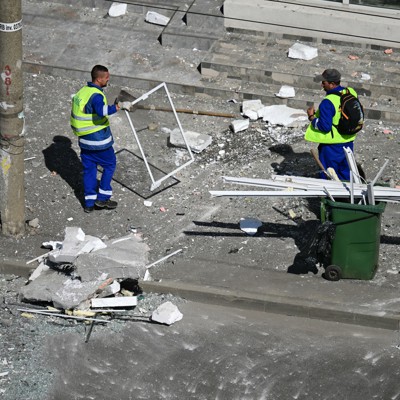
Municipal workers clear debris after a Russian drone struck an apartment building in Galati, Romania, a member of NATO, on May 29, 2026. Daniel MIHAILESCU / AFP via Getty Images
Europe is adapting to Moscow’s increasingly brazen and kinetic operations. The US should catch up.
Nikkie Lyubarsky
On a recent September afternoon, David Petraeus, the former CIA director, was heading home by train from a security conference in Kyiv. What should have been a routine trip into Poland was upended when the state railway, Ukrzaliznytsia, ordered passengers off the train. Fifteen minutes later, Russian drones were heard overhead, and the train was struck shortly after the last passengers had been evacuated.
The attack is just one of the indications that Russia’s decades-long campaign against the West has outgrown the label of “ hybrid war .” While Moscow’s efforts remain below the threshold of open war, they have grown more brazen and kinetic. And while European allies are moving quickly to counter Russia’s escalation, the United States lags behind.
The past few months have seen a striking number of Russian operations against Europe and a sharp change in tactics towards the United States. In August, a Russian drone carrying explosives struck the wing of a Ukrainian cargo plane at Germany’s Leipzig airport, a hub for NATO airlift to the eastern flank; the attack only failed due to a faulty detonator . That was just the most recent incursion into alliance airspace by Russian drones and even jets; IISS has tracked more than 100 confirmed or suspected incursions, including an explosive-laden drone shot down over Lithuania to a drone that struck an apartment building in Romania.
Of the train incident, Ukrzaliznytsia officials have said it was “entirely possible” that the drone had missed its intended target: a diplomatic train carrying two former prime ministers, Sweden’s Carl Bildt and the UK’s Boris Johnson, which had departed from Kyiv earlier than planned. Whether Petraeus was the intended target is irrelevant. The strike was a close call; injuring or killing a former U.S. official would have marked a sharp and reckless escalation in U.S.-Russian relations. This incident nevertheless reflects the Kremlin’s growing comfort with operations that put senior U.S. figures at risk.
Just days after that, the U.S. Justice Department announced a striking indictment that underscored how far the Kremlin’s escalation against the United States has gone. It charged five people connected to Russian intelligence with conspiracy to finance terrorism, and three of them with conspiracy to commit murder for hire. The network allegedly recruited people inside the United States to surveil and ultimately “eliminate” or “disappear” critics of Russia’s war in Ukraine. In one alleged plot, the network sought to have a Russian dissident killed on U.S. soil. Dozens of such plots have been uncovered in Europe but they have remained rare in the United States. This one places Russia alongside Iran, which has repeatedly plotted to kidnap or kill dissidents and former officials on American soil
Analysts have long believed that the Kremlin has sought to maintain deniability, plausible or implausible, when it moves against the West. Plausible deniability refers to a state’s ability to disclaim responsibility because the evidence is too ambiguous to act upon; implausible deniability refers to a state’s denial when attribution is obvious, often a way to signal with only a veneer of “escalation control” or aimed at its domestic audiences such as Russian-speaking communities rather than the targeted government. Yet the bold, sometimes sloppy character of the past year’s operations suggests the Kremlin is increasingly willing to forgo even that to continue to intimidate foreign governments and their citizens and to gather military intelligence. As the war in Ukraine has dragged on, economic pressure on the Kremlin has mounted, and Moscow appears to have entered a new phase in its conflict with the West. Raising the costs of Western support outweighs the value of deniability. At that point, these are no longer hybrid operations, but overt external operations.
European allies, for their part, have begun to escalate their own responses, even as diplomats and officials continue to describe the Russian threat as hybrid. Rather than simply announcing when a Russian drone or ship enters NATO territory, or summoning Russian diplomats, governments across Europe have begun shooting down drones and responding militarily. In late September, Poland’s Deputy Defense Minister Cezary Tomczyk announced that Polish fighter jets would no longer need visual confirmation from a pilot before downing a Russian drone; radar-based “positive identification” would now suffice.
The United States, by contrast, continues to treat the Russian threat as largely latent. To be fair, Russia’s tactics on the European continent remain more brazen and kinetic than those it employs against the United States. But Washington’s NATO commitments alone make Russia’s campaign against Europe an American concern, and Moscow is now escalating against the United States directly as well. If the pattern observed in Europe holds, its operations against the U.S. will grow only more brazen and openly hostile. While some U.S. agencies may recognize the rising threat, as the DOJ’s unsealing of charges against the Russian network and CIA Director John Ratcliffe’s August visit to Moscow could demonstrate, Washington still remains divided on how to classify it, and much of that division stems from the White House itself.
Messaging from the White House over the past month alone is mixed. On Sept. 15, Attorney General Todd Blanche stood in the White House Rose Garden to announce charges against a Russian intelligence network accused of plotting to murder a dissident in the Washington area. Eight days later, the administration invited Vladimir Putin to the G20 summit in Miami. The same month, President Trump signed the most significant Russia sanctions legislation since 2017, only for his administration to reportedly weigh sanctions relief days later.
The administration may view engagement with Russia as necessary to broker an end to the war in Ukraine, but these mixed signals leave agencies without a clear mandate and Russia without a clear message to de-escalate. Treating the Russian threat for what it is requires messaging from the top. A plot by Russian intelligence to commit murder on U.S. soil is a significant escalation, and it demands a clear response. Until Washington decides how it should view the threat from Russia, and respond accordingly, Moscow will continue to escalate until it finds a red line.
This commentary is published in coordination with the 2026 Global Security Forum , of which Defense One is a media partner.
Nikkie Lyubarsky is a Research Associate at The Soufan Center.
NEXT STORY: US withdrawal won’t end the region’s ISIS dilemma
2026年5月29日,一架俄罗斯无人机袭击了北约成员国罗马尼亚加拉茨的一栋公寓楼,市政工人正在清理现场废墟。图片来源:Daniel MIHAILESCU / AFP via Getty Images
欧洲正在适应莫斯科日益明目张胆且咄咄逼人的行动。美国也应该迎头赶上。
尼基·柳巴斯基
九月的一个下午,前中央情报局局长戴维·彼得雷乌斯从基辅参加完一个安全会议后乘火车返回美国。原本应该是一次例行的波兰之旅,却因乌克兰国家铁路公司(Ukrzaliznytsia)要求乘客下车而彻底改变。十五分钟后,人们听到头顶传来俄罗斯无人机的轰鸣声,在最后一批乘客撤离后不久,火车遭到袭击。
这次袭击只是表明俄罗斯针对西方长达数十年的行动已不再局限于“混合战争”范畴的众多迹象之一。尽管莫斯科的行动尚未达到公开战争的程度,但其肆无忌惮和行动化程度却日益加剧。欧洲盟友正迅速采取行动应对俄罗斯的升级行动,而美国却行动迟缓。
过去几个月,俄罗斯针对欧洲的军事行动数量惊人,其针对美国的策略也发生了显著变化。8月,一架携带炸药的俄罗斯无人机在德国莱比锡机场(北约向东翼空运的枢纽)袭击了一架乌克兰货机的机翼;袭击最终因引爆器故障而失败。这只是俄罗斯无人机乃至战机近期入侵北约领空事件中的最新一起;国际战略研究所(IISS)已追踪到100多起已确认或疑似入侵事件,其中包括一架载有炸药的无人机在立陶宛上空被击落,以及一架无人机在罗马尼亚撞击了一栋公寓楼。
关于火车事件,乌克兰铁路公司官员表示,无人机“完全有可能”偏离了预定目标:一列载有瑞典前首相卡尔·比尔特和英国前首相鲍里斯·约翰逊的外交专列,该列车比原计划提前从基辅出发。彼得雷乌斯是否是预定目标并不重要。这次袭击险些酿成大祸;如果造成美国前官员伤亡,将标志着美俄关系急剧且鲁莽地升级。然而,这一事件反映出克里姆林宫越来越乐于采取危及美国高级官员安全的行动。
就在几天后,美国司法部宣布了一项令人震惊的起诉书,凸显了克里姆林宫针对美国的升级行动已达到何种程度。起诉书指控五名与俄罗斯情报部门有关联的人员犯有资助恐怖主义阴谋罪,其中三人还被控犯有雇凶杀人阴谋罪。据称,该组织在美国境内招募人员,监视并最终“消灭”或“让”批评俄罗斯在乌克兰战争的人士消失。在一项据称的阴谋中,该组织试图在美国境内杀害一名俄罗斯异见人士。欧洲已破获数十起此类阴谋,但在美国却十分罕见。此次事件将俄罗斯与伊朗相提并论,伊朗曾多次策划在美国境内绑架或杀害异见人士和前官员。
分析人士长期以来认为,克里姆林宫在针对西方采取行动时,总是试图保持某种程度的否认,无论这种否认是合理的还是不合理的。合理的否认指的是,由于证据过于模糊,无法采取行动,因此一个国家可以免除责任;不合理的否认指的是,当责任归属显而易见时,一个国家仍然否认,这通常是一种仅以“控制升级”为幌子发出信号的方式,或者其目标受众是国内的俄语社区,而非被针对的政府。然而,过去一年来克里姆林宫行动的大胆且有时粗糙的特点表明,为了继续恐吓外国政府及其公民并收集军事情报,克里姆林宫越来越愿意放弃这种否认。随着乌克兰战争的持续,克里姆林宫面临的经济压力不断增加,莫斯科与西方的冲突似乎已经进入了一个新阶段。提高西方支持的成本已经超过了否认的价值。到那时,这些行动不再是混合行动,而是公开的境外行动。
欧洲盟国方面也开始升级应对措施,尽管外交官和官员们仍在将俄罗斯的威胁描述为混合威胁。欧洲各国政府不再仅仅在俄罗斯无人机或舰船进入北约领土时发布公告或召见俄罗斯外交官,而是开始击落无人机并采取军事行动。9月下旬,波兰国防部副部长塞扎里·托姆奇克宣布,波兰战斗机在击落俄罗斯无人机前不再需要飞行员的目视确认;基于雷达的“正面识别”现在就足够了。
相比之下,美国仍然将俄罗斯的威胁视为基本潜在的威胁。平心而论,俄罗斯在欧洲大陆的策略确实比其针对美国的策略更加肆无忌惮、更具侵略性。但仅凭华盛顿对北约的承诺,就足以让俄罗斯针对欧洲的行动成为美国的关注焦点,而且莫斯科现在也正在直接升级针对美国的行动。如果欧洲的模式持续下去,俄罗斯针对美国的行动只会变得更加肆无忌惮,更加公开敌对。尽管一些美国机构可能已经意识到威胁的日益加剧,例如司法部公开对俄罗斯网络的指控以及中央情报局局长约翰·拉特克利夫8月访问莫斯科,但华盛顿在如何界定这一威胁的问题上仍然存在分歧,而这种分歧很大程度上源于白宫内部。
仅过去一个月,白宫传递的信息就喜忧参半。9月15日,司法部长托德·布兰奇在白宫玫瑰园宣布对一个俄罗斯情报网络提起诉讼,指控其密谋在华盛顿地区谋杀一名异见人士。八天后,特朗普政府邀请弗拉基米尔·普京参加在迈阿密举行的二十国集团峰会。同月,特朗普总统签署了自2017年以来对俄罗斯实施的最重要制裁法案,但据报道,几天后,他的政府又开始考虑解除制裁。
美国政府或许认为与俄罗斯接触对于促成乌克兰战争的结束至关重要,但这些混乱的信号导致各机构缺乏明确的授权,也让俄罗斯无法获得明确的缓和信息。要正视俄罗斯的威胁,高层必须发出明确的信号。俄罗斯情报部门密谋在美国本土实施谋杀,这无疑是一次重大升级,必须做出明确的回应。在华盛顿决定如何看待俄罗斯的威胁并采取相应应对措施之前,莫斯科将继续升级冲突,直到触及其底线为止。
本文评论与 2026 年全球安全论坛联合发布,Defense One 是该论坛的媒体合作伙伴。
Nikkie Lyubarsky 是苏凡中心的研究员。
下一篇报道:美国撤军并不能结束该地区的ISIS困境