Aerial Drones Appear To Be Picking Up Wounded Off The Battlefield In Ukraine乌克兰战场上,无人机似乎正在运送伤员。
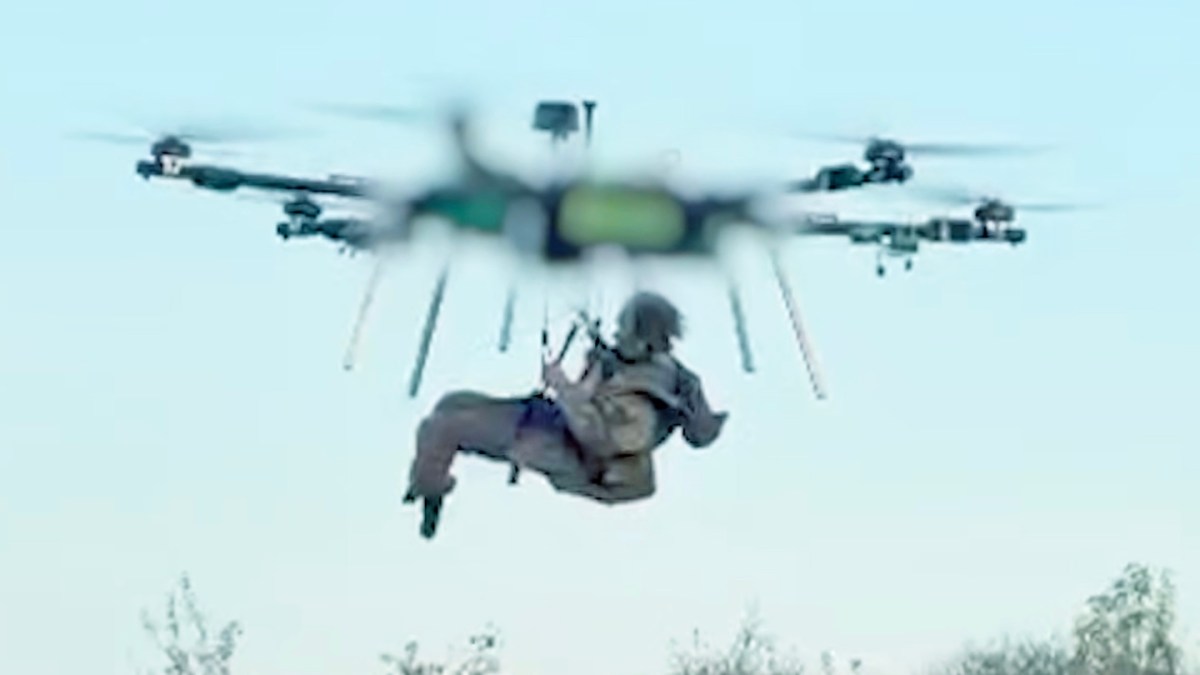
A heavy-lift hexacopter is shown pulling a wounded soldier from what Ukraine describes as a drone-saturated kill zone in what would be a world first. A heavy-lift hexacopter is shown pulling a wounded soldier from what Ukraine describes as a drone-saturated kill zone in what would be a world first.
新闻视频
Published Oct 19, 2026 12:47 PM EDT
92nd Assault Brigade/YouTube screencap
The Ukrainian Armed Forces say they have carried out the world’s first frontline evacuation of a wounded soldier by aerial drone. The soldier, from the 30th Mechanized Brigade, is said to have been recovered successfully and is undergoing treatment and rehabilitation.
“This is a historic event, at least for our unit for sure,” said “Napalm,” a squad commander and programmer with the 92nd Assault Brigade’s uncrewed ground vehicle (UGV) company. The precise date and location of the operation have not been disclosed, and the claim of a global first has not been independently verified. However, a video of the event has been published by the 92nd, which you can watch below:
At this point, it should be noted that the footage has not been independently verified and could depict a staged demonstration rather than an actual combat evacuation. It should, at least, be treated with a degree of caution.
According to accompanying reports, the infantryman was wounded while holding his position. Mines and intense Russian drone activity prevented a conventional ground evacuation, prompting the 92nd’s specialists to attempt an aerial extraction. The video shows the soldier clipping himself to the underside of the drone via a harness before being flown to safety. The extemporized nature of the platform is underscored by the fact that, while in the air, the soldier dangles below its rigid landing legs.
The soldier is seen hunched under the hexacopter before attaching his harness to the drone. 92nd Assault Brigade/YouTube screencap
The aircraft was a heavy hexacopter manufactured by Ukrainian company Gurzuf Defense, which provided it free of charge. A UAV operator from the 30th Mechanized Brigade piloted the drone. Throughout the recovery, the soldier remained in contact with the drone operator.
With the drone now airborne, the drone controllers monitor the flight from the ground. 92nd Assault Brigade/YouTube screencap
The operation involved the 92nd, 30th and 14th Mechanized Brigades, the 10th Army Corps and Gurzuf Defense.
Ukraine increasingly uses uncrewed ground vehicles to deliver supplies and evacuate casualties from exposed positions. According to Euromaidan Press , Ukrainian UGVs conducted approximately 112,000 logistics and evacuation missions between January and August 2026.
However, ground robots can struggle with mines, mud, and cratered terrain, while remaining vulnerable to drones and artillery. These obstacles make it especially difficult to conduct UGV operations in the battlefield’s “kill zone,” which can extend six to nine miles or more from the front line. You can read an in-depth account of Ukrainian UGV efforts in this previous story .
A video showing a Ukrainian UGV in action in the Donetsk region:
Aerial platforms are able to reach casualties in places where ground vehicles cannot safely travel, and can get there far quicker, without having to stick to specific routes.
The 92nd has not disclosed the evacuation distance or flight duration of the mission. If, as reported , the drone used was an Audag-6 model , this is stated to be capable of carrying a 200-pound payload over a distance of up to 15 miles.
Meanwhile, the recovery points to a growing trend in the Ukrainian Armed Forces.
Only days before the story of the evacuation broke, it emerged that Ukraine is also now testing the StarGate, a purpose-built aerial medical evacuation drone — also of the heavy hexacopter type — developed by the SkyFall company. This is a rather more tailored solution to the problem, with a covered, medical-grade stretcher slung below the drone. It has a reported payload capacity of around 330 pounds, uses AI-assisted navigation, and can also deploy nets against hostile drones attempting to intercept it.
The 92nd’s operation used a heavy-lift hexacopter adapted for an ad hoc casualty transport, rather than a more bespoke design. This means the soldier had to be adequately trained on how to strap in, and also had to be in a condition that they could actually perform this procedure. This would also be the case even if other soldiers were able to assist them in strapping in.
While these kinds of solutions may be new to the battlefield in Ukraine, using uncrewed aerial systems for personnel recovery and medical evacuation is far from new.
Back in 2016, the Army completed a demonstration of the Lockheed Martin K-Max helicopter in a casualty evacuation role. The K-Max can operate with and without a pilot and was used as a drone by the Marine Corps to deliver cargo in Afghanistan .
A U.S. Marine Corps K-Max helicopter. U.S. Marine Corps
“Unmanned and autonomous platforms have the potential to completely rewrite the medical doctrine,” Army Colonel Daniel Kral, head of the Army’s Advanced Technology Research Center (TATRC), explained during a conference at Fort Detrick in Maryland in 2017.
In 2019, TWZ reported on U.S. Army efforts to explore how uncrewed craft might speed up the casualty evacuation process. This work included evaluation of the Dragonfly Pictures, Inc. (DPI) DP-14 Hawk, a small, tandem-rotor drone with a 400-pound cargo capacity.
A DP-14 Hawk shown configured for casualty evacuation. Dragonfly Pictures, Inc.
The emergence of autonomous air vehicles, or uncrewed ‘flying taxis,’ with short or vertical take-off and landing capabilities in the urban air mobility sector has also generated military interest. The U.S. Air Force Research Laboratory, for example, has conducted studies into craft such as these could be adapted for combat search and rescue, with the idea that they would be airdropped to recover a fighter pilot shot down while operating over hostile territory.
Closer to the Ukrainian hexacopter concept is the Flowcopter FC-100, a heavy-lift quadcopter drone that the U.S. Army tested in a medical evacuation capacity in Poland during the large-scale Saber Strike exercise earlier this year . Carrying a 220-pound payload, the drone has a range of more than 60 miles.
U.S. Army soldiers run with a test dummy in a stretcher towards a Flowcopter FC-100 drone during an Autonomous Triage and Treatment Challenge taking place near Bemowo Piskie Training Area, Poland, May 10, 2026, as part of Exercise Saber Strike. U.S. Army Reserve photo by Spc. Thomas Madrzak
All of these concepts aim to address the inherent vulnerability of larger personnel recovery platforms in more contested environments.
In their favor, they offer the potential to rescue troops from more precarious situations, with the smaller drones touching down in relatively tight areas in mountainous, forested, or jungle environments. Autonomous navigation systems can guide the drones through smoke, dust, or bad weather, too.
On the other hand, these small craft have no space for a medic, pararescuemen, or other additional personnel. Bearing in mind their limited range and lower speeds, they also need to be in the right location to respond to emergencies as and when they occur.
For the Ukrainian Armed Forces, aerial medical evacuation drones are being rapidly developed and now fielded to help address another problem: the vulnerability of UGVs in areas of the battlefield that have long become far too hazardous for crewed medevac platforms to operate.
By now, both sides in the Ukraine war are relying heavily upon small, autonomous uncrewed aircraft to perform a wide variety of resupply, surveillance, communications, and strike roles on and around the front lines. With that in mind, the adaptation of these kinds of vehicles for casualty evacuation and personnel recovery missions is the next logical step.
Contact the author: thomas@thewarzone.com
Comments couldn’t be loaded. Please refresh the page.
发布于美国东部时间2026年10月19日下午12:47
第92突击旅/YouTube截图
乌克兰武装部队称,他们完成了世界上首次使用无人机从前线撤离受伤士兵的行动。据悉,这名来自第30机械化旅的士兵已被成功救出,目前正在接受治疗和康复。
“这绝对是一件历史性事件,至少对我们部队来说是这样,”第92突击旅无人地面车辆(UGV)连的班长兼程序员“凝固汽油弹”(Napalm)说道。行动的具体日期和地点尚未公布,其全球首创的说法也未经独立证实。不过,第92突击旅已发布了一段行动视频,您可以在下方观看:
需要指出的是,这段视频尚未经过独立核实,可能只是事先安排的演习,而非真实的战斗撤离。因此,至少应该谨慎对待。
据相关报道,这名步兵在坚守阵地时受伤。由于地雷和俄军无人机的密集活动,常规地面撤离行动受阻,第92空降师的专家们不得不尝试空中撤离。视频显示,这名士兵通过安全带将自己固定在无人机下方,随后被送往安全地带。由于这名士兵在空中悬挂在无人机坚硬的起落架下方,因此该撤离平台显得十分临时。
视频中可以看到,一名士兵弓着身子站在六旋翼无人机下方,将自己的安全带连接到无人机上。(第92突击旅/YouTube截图)
这架无人机是乌克兰古尔祖夫防务公司(Gurzuf Defense)生产的重型六旋翼无人机,该公司免费提供。来自第30机械化旅的一名无人机操作员操控了这架无人机。在整个救援过程中,这名士兵始终与无人机操作员保持联系。
无人机升空后,地面控制人员开始监控其飞行情况。第92突击旅/YouTube截图
此次行动涉及第 92、30 和 14 机械化旅、第 10 军和古尔祖夫防卫队。
乌克兰越来越多地使用无人地面车辆运送物资和从暴露位置撤离伤员。据欧洲广场新闻社报道,2026年1月至8月期间,乌克兰无人地面车辆执行了约11.2万次后勤和撤离任务。
然而,地面机器人难以应对地雷、泥泞和弹坑地形,同时还容易受到无人机和火炮的攻击。这些障碍使得在战场“杀伤区”(可能从前线延伸六到九英里甚至更远)开展无人地面车辆(UGV)行动尤为困难。您可以在之前的报道中详细了解乌克兰的UGV项目。
一段视频展示了乌克兰无人地面车辆在顿涅茨克地区的作业情况:
空中平台能够抵达地面车辆无法安全通行的伤员所在位置,而且到达速度更快,无需遵循特定路线。
第92空降师尚未透露此次任务的撤离距离或飞行时长。如果报道属实,所使用的无人机是Audag-6型,那么据称该型号无人机能够携带200磅的有效载荷飞行最远15英里。
与此同时,这种复苏趋势在乌克兰武装部队中日益明显。
就在撤离行动消息传出前几天,有消息称乌克兰也在测试一款名为“星门”(StarGate)的专用空中医疗救援无人机,该无人机同样属于重型六旋翼无人机,由SkyFall公司研发。这是一款针对医疗救援问题更为精准的解决方案,无人机下方悬挂着一个带盖的医用级担架。据报道,该无人机的有效载荷约为330磅(约150公斤),采用人工智能辅助导航,并且能够展开防护网来拦截试图拦截它的敌方无人机。
第92空降师的行动使用的是一架改装用于临时伤员运输的重型六旋翼无人机,而非专门设计的机型。这意味着士兵必须接受过如何系安全带的充分训练,并且自身身体状况也必须能够完成这项操作。即使有其他士兵协助他们系安全带,情况也是如此。
虽然这类解决方案对于乌克兰战场来说可能是新的,但使用无人空中系统进行人员救援和医疗后送却远非新鲜事。
早在2016年,美国陆军就完成了洛克希德·马丁公司K-Max直升机在伤员撤离任务中的演示。K-Max既可以有人驾驶也可以无人驾驶,海军陆战队还曾将其用作无人机在阿富汗运送货物。
一架美国海军陆战队的K-Max直升机。美国海军陆战队
“无人自主平台有可能彻底改写医疗理论,”陆军先进技术研究中心 (TATRC) 主任、陆军上校丹尼尔·克拉尔在 2017 年于马里兰州德特里克堡举行的一次会议上解释道。
2019年,TWZ报道了美国陆军探索如何利用无人飞行器加快伤员撤离进程的努力。这项工作包括评估蜻蜓图片公司(DPI)的DP-14“鹰”式无人机,这是一款小型串列旋翼无人机,有效载荷达400磅。
图中所示为一架已配置为伤员撤离用途的DP-14“鹰”式直升机。图片来源:蜻蜓图片公司(Dragonfly Pictures, Inc.)。
在城市空中交通领域,具备短距或垂直起降能力的自主飞行器,或称无人“飞行出租车”,其出现也引起了军方的关注。例如,美国空军研究实验室已对这类飞行器进行了研究,探讨其如何改装用于战斗搜救,设想将其空投至敌方领空,营救被击落的战斗机飞行员。
与乌克兰六旋翼无人机概念更为接近的是Flowcopter FC-100,这是一款重型四旋翼无人机,美国陆军今年早些时候在波兰举行的“军刀打击”大规模演习中对其进行了医疗后送能力测试。该无人机有效载荷达220磅,航程超过60英里。
2026年5月10日,在波兰贝莫沃皮斯基训练区附近举行的“军刀打击”演习中,美国陆军士兵抬着担架上的测试假人奔向一架Flowcopter FC-100无人机,参加自主分诊和治疗挑战赛。照片由美国陆军预备役下士托马斯·马德扎克拍摄。
所有这些概念都旨在解决大型人员救援平台在更具对抗性的环境中固有的脆弱性。
它们的优势在于,小型无人机能够在山区、森林或丛林等相对狭窄的区域降落,从而有可能从更危险的环境中营救部队。此外,自主导航系统还能引导无人机穿越烟雾、尘土或恶劣天气。
另一方面,这些小型艇没有空间容纳医护人员、伞降救援人员或其他额外人员。考虑到它们航程有限、速度较低,它们也需要随时待命,以便在紧急情况发生时迅速做出反应。
对于乌克兰武装部队来说,空中医疗后送无人机正在快速研发并投入使用,以帮助解决另一个问题:无人地面车辆在战场上某些区域(这些区域长期以来对有人驾驶的医疗后送平台来说过于危险)的脆弱性。
目前,乌克兰战争双方都高度依赖小型自主无人机在前线及其周边地区执行各种补给、侦察、通信和打击任务。鉴于此,将这类飞行器改装用于伤员撤离和人员救援任务是顺理成章的下一步。
联系作者:thomas@thewarzone.com
评论加载失败,请刷新页面。