DIU unveils next phase in unmanned vessel competitionDIU公布无人船竞赛下一阶段计划
The DIU solicitation said that it wants USVs outfitted with “mature hard-kill Counter-Air effectors and clutter-resilient sensor suites."
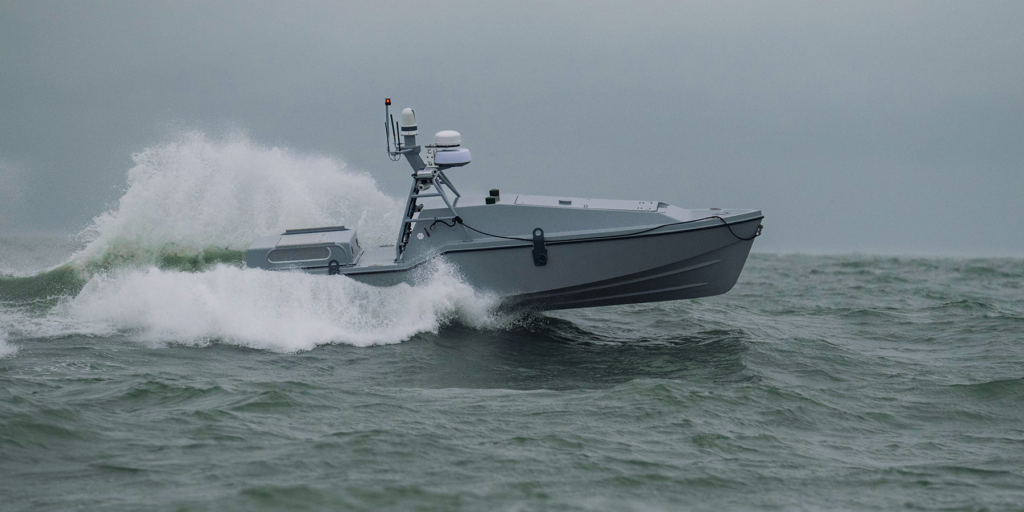
Saronic's Corsair was involved in strikes targeting an Iranian submarine and ship maintenance facility, CENTCOM said. (Saronic)
WASHINGTON — The Defense Innovation Unit (DIU) is launching the second phase of a prize challenge seeking “mature” unmanned surface vessels (USVs) the Pentagon can field in the next 120 days, offering up to $40 million in prize money.
The challenge, dubbed Suitable Warfighting Adaptive Payloads (SWAP)-USV, comes as the Navy relies on expensive and exquisite platforms to take on “low-cost, low-signature” threats, like explosive USVs and small unmanned aerial systems, according to a recent DIU solicitation.
“The current force packages lack sufficient persistent, distributed capability to search for, track, and defeat these threats at an economically sustainable cost,” the DIU solicitation, released Thursday, said.
Specifically, the DIU solicitation said that it wants USVs outfitted with “mature hard-kill Counter-Air effectors and clutter-resilient sensor suites” to identify and quash airborne threats for this phase of the competition, known as Sprint 2. The USV must also have a minimum operational range of 200 nautical miles and travel at a sustained speed of at least 10 knots, per the solicitation.
“Sprint 2 focuses specifically on detecting, tracking, and defeating hostile airborne threats in contested maritime environments,” the solicitation said. “Proposed solutions should combine proven USVs, mature hard-kill effectors, resilient sensor suites, and interoperable command-and-control architectures to provide affordable, scalable, and persistent capability while favorably shifting the cost-exchange ratio.”
The DIU said submissions’ counter-air effector proposals should have the capacity to engage Groups 1–3 UAS and rotary-wing aircraft — the smallest classes of unmanned systems. Having the capacity to engage the largest class of unmanned systems , Groups 4 and 5, “is highly desired” the solicitation said.
Submissions for Sprint 2 must be in by Nov. 30, with in-water testing expected to kick off in early 2027. Sprint 1 kicked off in July, with in-water testing expected this fall. Sprint 3, the final phase of the 12-month long competition, is expected to begin in the spring of 2027, with on-water testing to be completed that summer. Sprints 1 and 2 are each offering up to $40 million in prize money, while Sprint 3 will offer up to $20 million.
A leap in drone range and payloads come from a battery with different chemistry
Lithium-metal batteries are one way to break the weight and endurance limits of today’s unmanned systems.
The DIU, which launched the competition in partnership with the Direct Reporting Portfolio Manager for Unmanned Systems and the Direct Reporting Portfolio Manager for Robotic and Autonomous Systems , said that the government has earmarked $200 million for prototype or follow-on production contracts following the competition.
Breaking Defense Video
Hegseth talks autonomy at AUSA, a key show focus
Army doubles down on autonomy, stakes out Indo-Pacific role: AUSA Day 2
Telle talks ‘manufacturing rodeo,’ supply chain ‘weak links’: AUSA Day 1
New leaders, new drone command: What we expect from AUSA 2026
Unpacking Boeing’s F/A-XX win, plus a report from wartime Ukraine
How Hegseth envisions a new Autonomous Warfare Command
What Europe’s military air fleets will look like in 30 years
Riyadh gets closer to F-35s, Damascus presses sovereignty and an expert take on Iran
Drone-hunting on the border, plus turmoil at an Air Force think tank
The future of European airpower might be unmanned
美国中央司令部称,萨罗尼克公司的“海盗”战斗机参与了对伊朗潜艇和舰艇维修设施的袭击。(萨罗尼克公司)
华盛顿——国防创新部门 (DIU) 启动了第二阶段的奖金挑战赛,旨在寻找五角大楼可在未来 120 天内部署的“成熟”无人水面舰艇 (USV),奖金高达 4000 万美元。
根据国防情报部门 (DIU) 最近的一份招标书,海军正依靠昂贵而精密的平台来应对“低成本、低特征”的威胁,例如爆炸性无人水面艇和小型无人机系统,因此,这项名为“适用作战自适应有效载荷 (SWAP)-USV”的挑战应运而生。
国防情报部门周四发布的招标书称:“目前的部队装备缺乏足够的持久、分布式能力,无法以经济上可持续的成本搜索、跟踪和击败这些威胁。”
具体而言,国防情报部门 (DIU) 的招标书指出,他们希望无人水面艇 (USV) 配备“成熟的硬杀伤性反空袭效应器和抗杂波干扰传感器套件”,以便在被称为“冲刺 2”的这一阶段竞争中识别和压制空中威胁。根据招标书,USV 还必须具备至少 200 海里的最小作战半径和至少 10 节的持续航速。
“第二阶段重点在于探测、跟踪和击败敌方空中威胁,尤其是在竞争激烈的海上环境中,”招标书指出。“拟议的解决方案应结合成熟的无人水面艇、成熟的硬杀伤效应器、可靠的传感器套件以及可互操作的指挥控制架构,以提供经济实惠、可扩展且持久的能力,同时显著提高性价比。”
国防情报部门表示,提交的反空袭作战系统方案应具备对抗1-3类无人机和旋翼飞机(即最小的几类无人系统)的能力。征集文件中还指出,具备对抗最大几类无人系统(即4类和5类)的能力“尤为重要”。
第二阶段(Sprint 2)的参赛作品提交截止日期为11月30日,预计水下测试将于2027年初启动。第一阶段(Sprint 1)已于7月启动,预计将于今年秋季进行水下测试。第三阶段(Sprint 3)是为期12个月的竞赛的最后阶段,预计将于2027年春季启动,水下测试将于同年夏季完成。第一阶段和第二阶段的奖金总额最高可达4000万美元,而第三阶段的奖金总额最高可达2000万美元。
无人机航程和有效载荷的飞跃得益于采用不同化学成分的电池。
锂金属电池是突破当今无人系统重量和续航能力限制的一种方法。
国防工业部门 (DIU) 与无人系统直接报告项目经理和机器人与自主系统直接报告项目经理合作发起了这项竞赛。DIU 表示,政府已拨款 2 亿美元用于竞赛后的原型或后续生产合同。
突破性防御视频
Hegseth 在 AUSA 大会上谈到了自主性,这是本次大会的一个重点议题。
陆军加倍强调自主性,明确印太地区角色:AUSA第二天
特勒谈“制造业乱象”、供应链“薄弱环节”:AUSA第一天
新领导人,新无人机指挥部:我们对 AUSA 2026 的期待
深入剖析波音F/A-XX的竞标结果,以及来自战时乌克兰的报道
赫格塞斯设想的新型自主作战指挥部
30年后欧洲军用空军机队会是什么样子
利雅得距离F-35战机更近一步,大马士革强调主权,以及专家对伊朗的看法
边境无人机猎杀行动,以及空军智库的动荡
欧洲空军的未来或许在于无人化。