How The U.S. Army’s ‘Navy’ Aims To Go More Autonomous With Its Vessels In The Pacific美国陆军的“海军”如何计划在太平洋地区实现舰艇更高的自主化
The Army wants to buy up to 100 new USVs and add autonomous capabilities into existing crewed vessels.
By Joseph Trevithick
Published Oct 21, 2026 7:30 PM EDT
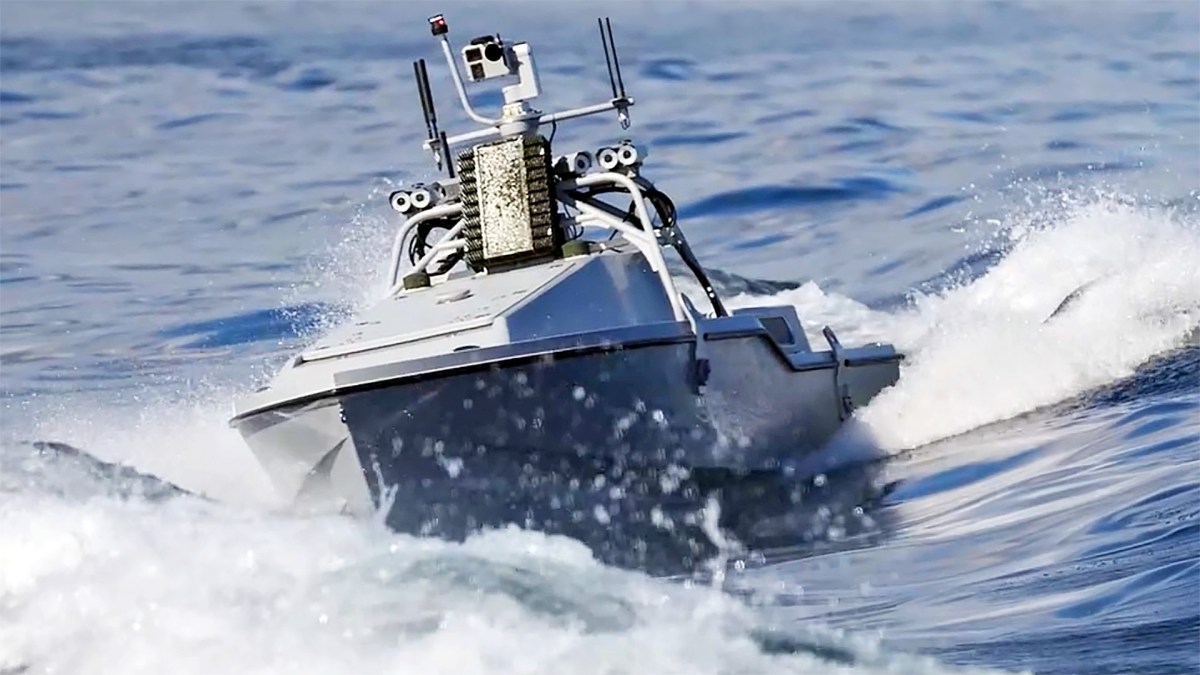
A Saronic Corsair USV takes part in a recent US Army exercise. US Army
The U.S. Army wants to infuse new autonomous capabilities into its current and future fleets of amphibious landing ships and other watercraft. The service is also aiming to acquire up to 100 new purpose-built uncrewed surface vessels (USV). The maritime assets the service has now , often referred to as ‘the Army’s Navy,’ are obscure and generally underappreciated . However, the small force offers an important additional set of naval logistics capabilities, especially for any future fight in the Pacific, which could be further bolstered with optionally-crewed or entirely uncrewed platforms.
Army Maj. Gen. Frederick Crist, head of 8th Theater Sustainment Command (TSC), issued plans for future autonomous watercraft capabilities during a talk last week during a talk at the Association of the U.S. Army’s (AUSA) main annual symposium . 8th TSC, which has its main headquarters at Fort Shafter in Hawaii, is one of the top formations tasked with managing U.S. military logistics across the Pacific.
An uncrewed surface vessel (USV) passes by the US Army’s General Frank S. Besson class Logistics Support Vessel USAV General Brehon B. Somervell . US Army
“In order to be able to increase theater distribution, we have the two composite watercraft companies, at end state there, west of the IDL [International Date Line],” Crist explained, referring to the Army’s future planned maritime force posture in the Pacific. “We continue partnering with industry to be able to move into autonomous watercraft systems to be able to conduct other means of maritime distribution.”
To take a step back quickly, as part of its broader regional role, 8th TSC also has forward-deployed elements in Japan. This includes the 5th Transportation Company, which is currently organized as what the Army calls a composite watercraft company. As of 2024, the unit had a pair of General Frank S. Besson class Logistics Support Vessels (LSV), as well as 10 smaller Landing Craft Utility (LCU) type vessels and four small tugs, according to the Government Accountability Office (GAO).
The Army has eight LSVs, in total, and these are by far its largest and most capable ships. The two youngest LSVs, which were acquired in the mid-2000s, also form a distinct subclass, and their design is optimized for long-distance open-ocean operations, as you can read more about here . It’s not immediately clear which LSVs are currently assigned to the 5th Transportation Company. The unit is also set to receive new Maneuver Support Vessel (Light) landing craft .
Examples of the original LSV design, at left, and the open-ocean-optimized design, at right. An LCU-type landing craft is also seen at far right. US Army
Until very recently, the 10th Support Group (Regional), headquartered in Okinawa, was more directly responsible for overseeing forward-deployed Army logistics units in Japan. Earlier this month, the Army performed a so-called ‘reflagging’ of that formation, a largely administrative process that transformed it into the 45th Sustainment Brigade .
As part of the reflagging of the 10th Support Group into the 45th Sustainment Brigade, the Army has also been pushing ahead with plans for “the standup of a second composite watercraft company in Yokohama North Dock,” in the port city of the same name on the Japanese home island of Honshu, Maj. Gen. Crist explained last week. “That end state will have two composite water[craft] companies west of the IDL [International Date Line] under the command and control of the 45th Sustainment Brigade.”
A US Army LSV at the pier in Japan. US Army
When it comes to the watercraft assigned to these units, “we’re also moving into the autonomous lane,” Crist added. “Just in August, USARPAC [U.S. Army Pacific] had an opportunity to conduct an experiment by retrofitting an existing commercial vessel, the HOS Resolute [sic; HOS Resolution ], with a kit to provide autonomous navigation.”
Maritime autonomy firm Sea Machines was able to integrate its SM300 software package on the HOS Resolution in just nine days for this demonstration. The ship is a 257-foot-long offshore support vessel more typically used to support oil and gas rigs. However, it features a stern ramp and four jack-up legs that also make it well suited to loading and unloading cargo at remote beaches.
A US Army truck drives off the HOS Resolution during the experimenting in August where the ship was fitted with the Sea Machines autonomy package. US Army
For years now, the U.S. Marine Corps has also been experimenting with the HOS Resolution and other similar ships more generally. That service has been using the vessels to help refine its new expeditionary and distributed concepts of operations , which are themselves heavily centered on future conflict scenarios in the Pacific . The Marines have brought those capabilities to Army demonstration exercises in the past, as well.
Another look at the HOS Resolution , in 2023, while operating under contract to the US Marine Corps. USMC
The Army sees the August experiment as a potential stepping stone to integrating increasing degrees into its existing watercraft fleets.
“You could increase the fleet of autonomous vessels by tapping into the existing manned fleet,” Maj. Gen. Crist said. “Put on retrofitting kits to be able to conduct navigation, and then eventually propulsion and engine room activities, and eventually get to a fully autonomous system.”
Even just adding in autonomous navigation capabilities could help reduce the workload for the human crews on Army vessels and provide added margins of safety. Blending autonomy with “propulsion and engine room activities” could improve reliability and reduce maintenance demands. Being able to operate those ships in a fully uncrewed mode, if desired, would open up additional operational possibilities, including just for repositioning ships across the broad expanses of the Pacific.
Army Maj. Gen. Frederick Crist, head of 8th Theater Sustainment Command (TSC), speaks at AUSA last week. US Army
Reduced manning requirements could be especially attractive for the Army’s ‘Navy,’ which is already a very small part of the service’s overall force structure. Last week, Maj. Gen. Crist also talked about further leveraging traditional crewed vessels owned and/or operated by contractors.
“It’s going to be a broad portfolio of systems of systems,” he said of the overall watercraft vision for the Pacific. “Army watercraft with Army Mariners will be, of course, one aspect of it. We also look for the opportunity to be able to leverage USTRANSCOM’s (U.S. Transportation Command) contracting capability to leverage operational support vessels that are commercially owned and commercially operated. We’re considering ways of being able to have commercial vessels that become manned by Army mariners.”
It is also interesting to note here how extremely similar this all sounds to the modifications the U.S. Navy made to the Spearhead class Expeditionary Fast Transport USNS Apalachicola ahead of its commissioning in 2023. However, despite tens of millions of dollars spent and successful demonstration of autonomous capabilities, the Navy curiously decided to put the Apalachicola into service without any plan to make use of these features operationally. There does not appear to have been any effort to integrate these capabilities more broadly within the Spearhead class since then, either.
The Spearhead class Expeditionary Fast Transport USNS Apalachicola . Austal USA USNS Apalachicola . Austal USA
Last year, the Navy struck the four oldest Spearhead class ships from its rolls entirely and has put several others on reduced operating status, ostensibly as a cost-saving measure . The service is still acquiring new Expeditionary Fast Transports, including members of the Expeditionary Medical Ship subclass that feature expanded medical facilities. The Spearhead class was born out of a program specifically to meet Army and Marine Corps requirements, and the ships are regularly used to support those services in the Pacific and elsewhere globally.
The Army also wants to expand its fleets of purpose-built uncrewed surface vessels (USV) for use in the Pacific, as well as elsewhere globally. Just earlier this year, Army Maj. Gen. Gavin Gardner, who preceded Maj. Gen. Crist as head of the 8th Theater Sustainment Command, said he wanted to rapidly acquire as many as 100 drone boats. His vision included larger USVs capable of carrying eight to 10 standardized shipping containers.
“I could see those operating in the U.S. PACOM area of responsibility,” Gardner told reporters at a roundtable in June, according to Military Times . “I think that gives you a ton of operations, inventory in motion, easy to respond. And then because they’re autonomous, and we can work with our partner nations forward, you have those berthed up everywhere from Korea to Japan, the Philippines, Australia, Singapore, Thailand, etc.”
“Clearly, [the autonomous vessels] would be forward in the theater, kind of moving supplies, because we have a constant demand for Army watercraft time now, to deliver equipment and supplies forward in the theater,” Gardner added at that time.
One of the inherent benefits of the Army watercraft fleets, and its LSVs in particular, is their ability to help alleviate the need for the U.S. Navy to meet more localized littoral logistics needs, if they are even available to help in the first place. Navy amphibious and military sealift ships would already be heavily strained by high demand during any major conflict in the Pacific or elsewhere globally. This could easily be further exacerbated by threats to those supply lines . All of this has already been underscored this year by pressure on maritime logistics chains in the context of the war with Iran. The Army’s ‘Navy’ also offers valuable additional capabilities and capacity in non-combat contingencies, such as responding to natural disasters .
Marine vehicles drive off an Army LCU landing craft during an exercise. USMC/Cpl. Ernesto Lagunes
More generally, the Army has been working to expand its use of smaller USVs, including speedboat-like designs, in various roles. The service has clearly been paying close attention to Ukraine’s very successful use of drone boats in one-way kamikaze attacks , as well as ones armed with guns and rockets and examples configured as launch platforms for surface-to-air missiles and weaponized uncrewed aerial systems (UAS) .
The 7th Infantry Division, one of the Army’s main maneuver combat formations in the Pacific, just recently experimented with a Ukrainian-developed Magura-series USV during an exercise in Michigan . That particular USV was configured to launch a quadcopter-type drone. Another member of the Magura family was observed being used in a one-way-attack configuration by U.S. Army Green Berets from the 1st Special Forces Group during the annual Balikatan exercise in the Philippines earlier this year.
A Magura-series USV seen in use at the annual Balikatan exercise this year. US Army
Another Magura-series USV in use during Exercise Bayonet Quest 2026 in Michigan. US Army
The Magura USV launches a quadcopter-type drone during Exercise Bayonet Quest 2026. US Army
The Army has also been experimenting with American-designed USVs. The aforementioned recent exercise in Michigan also featured a Saronic Corsair , the same type of USV that the Navy used to rescue the crew of an Army AH-64 Apache attack helicopter that went down in the Gulf of Oman in June. Explosive-laden Corsairs were also used to carry out the first known U.S. kamikaze USV attack , which was launched against a coastal target in Iran in July.
A stock picture of a Saronic Corsair. Saronic
During another separate exercise in the Philippines this year, Salaknib 2026, Army forces used unarmed Rampage USVs from U.S. firm Havoc , as seen below. As part of that exercise, the USVs escorted a crewed General Frank S. Besson class LSV to its destination, heading out in front to help spot potential hazards.
“There’s all the work that the Department’s already doing with autonomy and autonomous systems that we look to take advantage of in the [Pacific] theater, as well,” Maj. Gen. Crist said at AUSA.
The Navy and the Marine Corps have both been working to grow their operational fleets of smaller USVs , as well as larger ones, in recent years. At the same time, the Navy has suffered years of setbacks and shakeups in its efforts to operationalize bigger and more capable designs. The service awarded contracts for a total of 30 new medium-sized USVs last month in its latest attempt to reverse that trend.
In September, Secretary Pete Hegseth also announced several new initiatives aimed at further expanding use of uncrewed platforms and advanced autonomous capabilities across the U.S. military and all domains. The Pentagon is presently laying the groundwork for the establishment of an all-new top-level Autonomous Warfare Command (AUTOWARCOM), which it hopes to see come to fruition next year.
What is clear now is that the Army’s vision for future watercraft operations, especially in the Pacific, is increasingly autonomous.
Contact the author: joe@twz.com
Comments couldn’t be loaded. Please refresh the page.
作者:约瑟夫·特雷维西克
发布于美国东部时间2026年10月21日晚上7:30
一艘萨罗尼克海盗式无人水面艇参加了美国陆军最近的一次演习。美国陆军
美国陆军希望为其现有和未来的两栖登陆舰及其他水面舰艇注入新的自主能力。该军种还计划采购多达100艘新型专用无人水面舰艇(USV)。陆军目前拥有的海上力量,通常被称为“陆军海军”,鲜为人知,其价值也普遍被低估。然而,这支规模不大的部队能够提供一套重要的海军后勤保障能力,尤其是在未来太平洋战事中,而可选有人或完全无人平台的部署将进一步增强其后勤保障能力。
美国陆军少将弗雷德里克·克里斯特是第八战区保障司令部(TSC)的司令,他上周在美国陆军协会(AUSA)年度研讨会上发表讲话,阐述了未来自主水上航行器的发展计划。第八战区保障司令部总部位于夏威夷的沙夫特堡,是负责管理美国在太平洋地区军事后勤的顶级部队之一。
一艘无人水面艇(USV)驶过美国陆军“弗兰克·S·贝松”级后勤支援舰“布雷洪·B·萨默维尔”号(USAV General Brehon B. Somervell)。
克里斯特解释说:“为了扩大战区物资分发范围,我们在国际日期变更线以西的最终部署阶段部署了两个综合水上舰艇连队。”他指的是陆军未来在太平洋地区规划的海上力量部署。“我们将继续与业界合作,推进自主水上舰艇系统的发展,以便开展其他海上物资分发活动。”
简单回顾一下,作为其更广泛的区域任务的一部分,第8战区支援司令部(8th TSC)在日本也部署了前沿部队。其中包括第5运输连,该连目前被编为陆军所称的复合水上舰艇连。根据美国政府问责局(GAO)的数据,截至2024年,该部队拥有两艘“弗兰克·S·贝松将军”级后勤支援舰(LSV)、10艘小型通用登陆艇(LCU)以及4艘小型拖船。
陆军共有八艘登陆支援艇(LSV),它们是目前陆军最大、性能最强的舰艇。其中两艘较新的LSV于2000年代中期购置,它们构成了一个独立的子类,其设计针对远洋作战进行了优化,详情请点击此处。目前尚不清楚哪些LSV配属给第五运输连。该部队还将接收新型轻型机动支援艇(MSV)。
左侧为原始LSV设计示例,右侧为针对远洋航行优化的设计示例。最右侧还可以看到一艘LCU型登陆艇。美国陆军
直到不久前,总部设在冲绳的第10支援大队(区域)还直接负责监督驻日美军前沿部署的后勤部队。本月初,陆军对该部队进行了所谓的“重新编组”,这是一个主要由行政程序完成的过程,将其改组为第45后勤保障旅。
上周,克里斯特少将解释说,作为将第10支援大队重新编入第45后勤旅的一部分,陆军也在推进“在横滨北码头组建第二个综合水上舰艇连”的计划,横滨位于日本本州岛的同名港口城市。“最终目标是在第45后勤旅的指挥和控制下,在国际日期变更线以西拥有两个综合水上舰艇连。”
一艘美国陆军登陆艇停泊在日本码头。美国陆军
克里斯特补充说,就分配给这些部队的水上舰艇而言,“我们也正在向自主航行方向发展”。“就在8月份,美国陆军太平洋司令部有机会对一艘现有的商用船舶HOS Resolute(原文如此;HOS Resolution)进行改装,为其配备自主导航套件,从而开展了一项试验。”
海事自主系统公司Sea Machines仅用了九天时间就将其SM300软件包集成到HOS Resolution号上,用于此次演示。该船是一艘长257英尺的近海支援船,通常用于支援石油和天然气钻井平台。然而,它配备的船尾坡道和四个自升式起重臂使其也非常适合在偏远海滩装卸货物。
8月份,在“决心号”(HOS Resolution)测试舰安装“海上机器”(Sea Machines)自主航行套件期间,一辆美国陆军卡车驶离该舰。
多年来,美国海军陆战队一直在试验“决心号”(HOS Resolution)及其他类似舰艇。该军种利用这些舰艇来完善其新的远征和分布式作战概念,这些概念本身就高度聚焦于未来太平洋地区的冲突场景。海军陆战队过去也曾将这些能力带到陆军的演示演习中。
再次审视 HOS 决议,2023 年,在与美国海军陆战队签订合同期间运营。美国海军陆战队
陆军将8月份的试验视为一个潜在的垫脚石,以便将越来越多的高级技术整合到其现有的水上舰艇舰队中。
克里斯特少将说:“你可以通过利用现有的有人驾驶船队来增加自主船舶的数量。加装改装套件,使其能够进行导航,然后最终实现推进和机舱作业,最终建成一个完全自主的系统。”
即使仅仅增加自主导航能力,也能帮助减轻陆军舰艇上船员的工作负担,并提高安全系数。将自主导航与“推进和机舱作业”相结合,可以提高可靠性并减少维护需求。如果需要,这些舰艇能够在完全无人模式下运行,这将开辟更多作战可能性,例如在广阔的太平洋上进行舰艇调动。
美国陆军第8战区保障司令部司令弗雷德里克·克里斯特少将上周在美国陆军协会(AUSA)发表讲话。
减少人员需求对陆军的“海军”来说尤其具有吸引力,因为“海军”在陆军整体兵力结构中所占比例本来就很小。上周,克里斯特少将还谈到要进一步利用承包商拥有和/或运营的传统有人驾驶舰艇。
“这将是一个涵盖众多系统的庞大组合,”他在谈到太平洋地区的整体水上作战愿景时说道。“陆军水上舰艇和陆军海员当然是其中的一个方面。我们也在寻求机会,利用美国运输司令部(USTRANSCOM)的合同能力,利用商业所有和商业运营的作战支援船舶。我们正在考虑如何让这些商用船舶配备陆军海员。”
值得注意的是,这一切与美国海军在2023年“先锋”级远征快速运输舰“阿巴拉契科拉”号服役前所做的改装极为相似。然而,尽管投入了数千万美元并成功演示了自主能力,海军却出人意料地决定让“阿巴拉契科拉”号投入使用,而没有制定任何在作战中使用这些功能的计划。此后,似乎也没有采取任何措施将这些能力更广泛地整合到“先锋”级舰艇中。
“先锋”级远征快速运输舰 USNS Apalachicola。美国奥斯塔造船厂 USNS Apalachicola。美国奥斯塔造船厂
去年,海军彻底退役了四艘最老的“矛头”级舰艇,并将其他几艘舰艇降级服役,表面上是为了节省开支。海军仍在采购新的远征快速运输舰,其中包括配备扩建医疗设施的远征医疗舰子级舰艇。“矛头”级舰艇是专门为满足陆军和海军陆战队的需求而建造的,这些舰艇经常用于支援这些军种在太平洋地区及其他地区的行动。
陆军还希望扩大其专用无人水面艇(USV)的规模,用于太平洋地区以及全球其他地区。就在今年年初,曾任第八战区保障司令部司令的加文·加德纳少将(克里斯特少将的前任)表示,他希望迅速采购多达100艘无人艇。他的设想包括建造能够运载8至10个标准集装箱的大型无人水面艇。
据《军事时报》报道,加德纳在6月份的一次圆桌会议上告诉记者:“我可以看到这些舰艇在美国太平洋司令部责任区内作战。我认为这能带来大量的作战行动、快速调动的舰艇资源,以及便捷的响应能力。而且由于它们是自主作战的,我们可以与伙伴国家在前线协同作战,因此从韩国到日本、菲律宾、澳大利亚、新加坡、泰国等等,这些舰艇都可以部署在各地。”
“显然,(这些自主船只)将在战区前线运送物资,因为我们现在对陆军船只的使用时间有着持续的需求,以便将设备和物资运送到战区前线,”加德纳当时补充道。
陆军水面舰艇舰队,尤其是其近岸支援船(LSV),其固有优势之一在于,它们能够帮助减轻美国海军满足局部近岸后勤需求的压力——前提是海军本身能够提供支援。在太平洋或其他地区发生任何重大冲突时,海军的两栖舰艇和军用海运舰艇都会因高需求而承受巨大压力。而补给线受到威胁,则很容易使情况进一步恶化。今年,在与伊朗的战争背景下,海上后勤链所面临的压力已经凸显了这一点。此外,陆军的“海军”在应对自然灾害等非战斗突发事件中也能提供宝贵的额外能力和运力。
演习期间,海军陆战队车辆驶离陆军LCU登陆艇。美国海军陆战队下士埃内斯托·拉古内斯
更广泛地说,陆军一直在努力扩大小型无人水面艇(包括类似快艇的设计)在各种任务中的应用。陆军显然密切关注乌克兰在单向自杀式袭击中成功使用无人水面艇,以及装备火炮和火箭弹的无人水面艇,还有被改装成地对空导弹和武装无人机系统(UAS)发射平台的无人水面艇。
美国陆军第七步兵师是太平洋地区的主要机动作战部队之一,最近在密歇根州的一次演习中试用了乌克兰研制的“马古拉”(Magura)系列无人水面艇。该艇被改装用于发射四旋翼无人机。今年早些时候,在菲律宾举行的年度“肩并肩”(Balikatan)联合军演中,美国陆军第一特种部队群的“绿色贝雷帽”特种部队也曾使用“马古拉”系列的另一款无人水面艇进行单向攻击。
今年在“肩并肩”联合军演中出现的是一艘马古拉系列无人水面艇。美国陆军
在密歇根州举行的“刺刀探索2026”演习中,另一艘Magura系列无人水面艇正在使用。美国陆军
在2026年“刺刀探索”演习中,美国陆军的“马古拉”无人水面艇发射了一架四旋翼无人机。
陆军也一直在试验美国设计的无人水面艇(USV)。前文提到的最近在密歇根州举行的演习中,就出现了萨罗尼克海盗式无人水面艇(Saronic Corsair),海军曾用这种无人水面艇营救今年6月在阿曼湾坠毁的陆军AH-64阿帕奇武装直升机的机组人员。装载炸药的海盗式无人水面艇还被用于执行美国已知的首次神风特攻队无人水面艇袭击,该袭击于7月针对伊朗沿海目标发动。
一张萨罗尼克海盗式战斗机的库存照片。萨罗尼克
在今年于菲律宾举行的另一项名为“Salaknib 2026”的演习中,陆军部队使用了美国Havoc公司生产的无武装“Rampage”无人水面艇(如下图所示)。作为演习的一部分,这些无人水面艇护送一艘载有船员的“弗兰克·S·贝松将军”级登陆艇前往目的地,并在前方航行以协助发现潜在危险。
“国防部已经在自主性和自主系统方面做了很多工作,我们也希望在(太平洋)战区利用这些工作,”克里斯特少将在美国陆军协会上说。
近年来,海军和海军陆战队都在努力扩大其小型和大型无人水面艇(USV)的作战规模。与此同时,海军在部署更大、性能更强的无人水面艇方面却遭遇了多年的挫折和动荡。为了扭转这一局面,海军上个月授予了共计30艘新型中型无人水面艇的合同。
9月,国防部长皮特·赫格塞斯宣布了几项新举措,旨在进一步扩大美国军方及所有领域无人平台和先进自主能力的使用。五角大楼目前正在为建立全新的顶级自主作战司令部(AUTOWARCOM)奠定基础,并希望明年能够实现。
现在很明显的是,陆军对未来水上作战,尤其是在太平洋地区的作战的愿景,越来越倾向于自主化。
联系作者:joe@twz.com
评论加载失败,请刷新页面。