Unmanned systems take center stage at Turkish Ateş Serbest military demonstration在土耳其阿特什·塞尔贝斯特军事演习中,无人系统成为焦点。
The highlight of the exercise may have been the Turkish military showing off a new drone for the first time: Turkish Aerospace Industries’ Ayaz, a turbojet-powered one-way attack unmanned aerial vehicle.
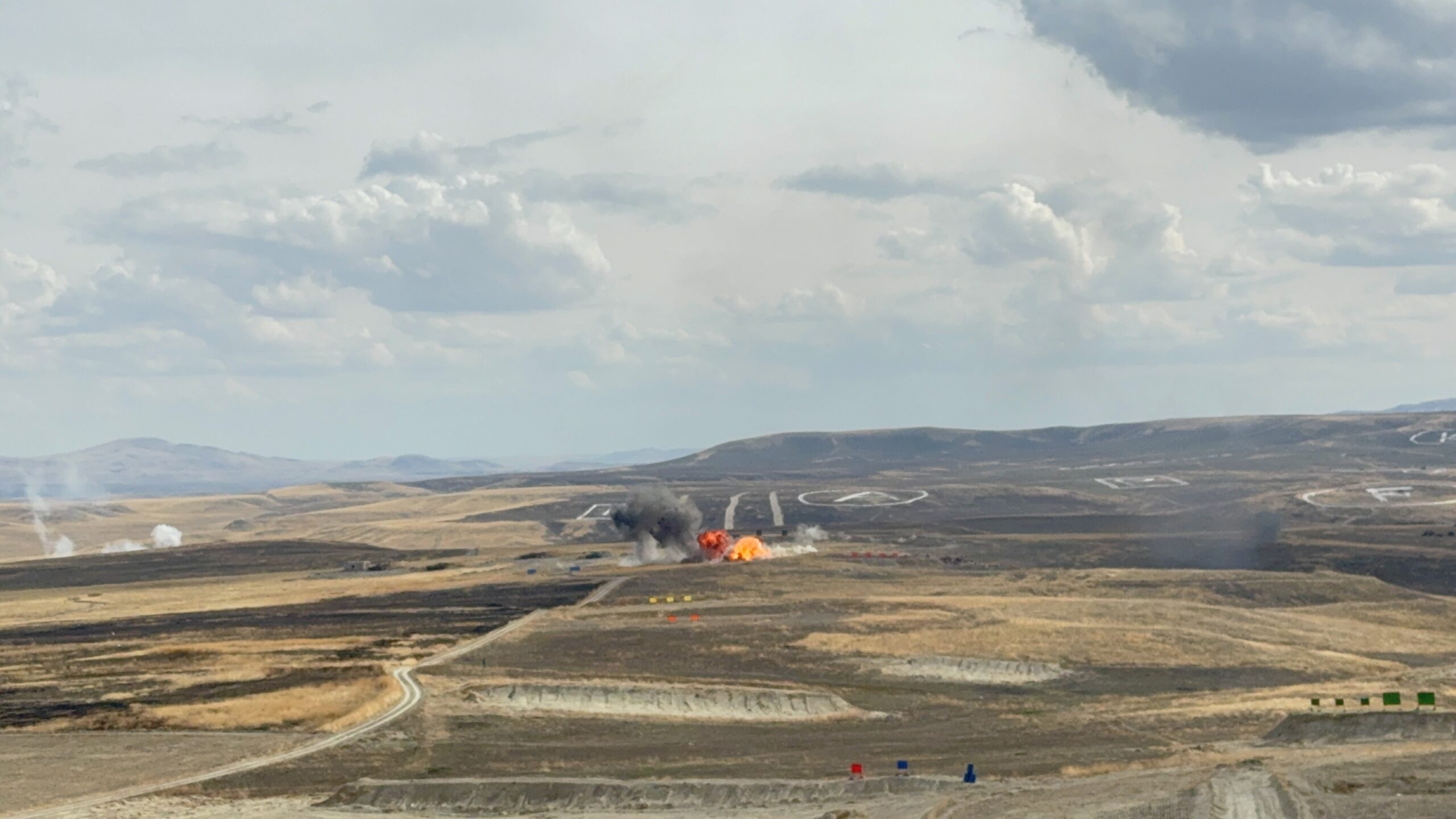
Artillery hits targets, creating smoke plumes in the distance at Ates Serbest exercise in Ankara, Turkey. (Agnes Helou/Breaking Defense)
ANKARA — Turkish F-16 fighter jets flew overhead, dropping bombs perfectly aimed at targets below, the ground shaking as journalists and visitors alike watched on from a distance.
Drones buzzed around conducting missions while smoke plumes erupted from every direction as targets were hit. If it weren’t for the civilians walking around taking notes the scene could easily be mistaken for a battlefield. Instead, all of this took place at the Ateş Serbest exercise in Ankara earlier this month.
Translated as “Free Fire” in Turkish, the exercise, which took place at the General Nahit Şenoğul Firing and Exercise Area, showed off layered live-fire capabilities, air defense platforms, fighter jet strike capabilities and more. (Breaking Defense, like other outlets, accepted travel and accommodations from the Turkish Ministry of Defense to cover the event.)
The exercise aims to improve “coordination of fire support between forces,” to “introduce weapons and systems in the inventory and demonstrate the effect of the weapons on the target,” and “to provide deterrence” through the firepower, according to a brochure distributed to journalists by the Turkish Ministry of Defense.
At the forefront of the exercise were unmanned systems, many of which were also viewed in various stages of production by Breaking Defense during a series of industry visits to Aselsan, Turkish Aerospace, Asfat, MKE and Roketsan. In discussions during those visits, company officials across the board emphasized the importance of unmanned systems both for Turkey’s domestic use and as potential export items.
The highlight of the exercise may have been the Turkish military showing off a new drone for the first time: Turkish Aerospace Industries’ Ayaz, a turbojet-powered one-way attack unmanned aerial vehicle.
Breaking Defense saw a nearly completed Ayaz drone on the assembly line. On that same tour, the company also showed off its Super Simsek UAV on the assembly line. The exercise marked the first time the Super Simsek flew with a warhead after its maiden voyage in 2023.
Localizing tactical communications for sovereign, NATO-ready C3I
Beyond foreign sales, Rafael’s model enables tech transfer, local engineering, and is a template for NATO partners.
Both the Ayaz and the Super Simsek “successfully conducted dive attacks and struck their targets during the Atış Serbest exercise, marking their first use with live warheads,” a company official told Breaking Defense during the tour.
Another highlight was watching as 20 Kargu one-way attack drones from STM hit their targets simultaneously. The drones, which flew in swarms, shared real-time data with each other and the operator, and when they got closer to the enemy infantry, the platforms were divided into two categories and headed towards their targets.
The unmanned systems aren’t just used for attacking. On the far right side of the exercise, a Puhu UAV, which is produced by DASAL Aviation and Space Technologies, was seen carrying medical aid to help snipers injured in the simulated battlefield. A Palem unmanned ground vehicle provided medical evacuations as well.
Throughout the exercise, soldiers used artificial intelligence to control the unmanned systems as well as conduct intelligence, surveillance and reconnaissance missions. For example, battlefield information collected from ISR drones was gathered at the Mobile Command System to help soldiers decide whether to strike or not.
As drones become a more prominent part of the warfield, countries have been giving more attention to developing counter-drone systems — and Turkey is no exception. Drones were used heavily in the recent war between Iran, US and Israel where Shahed UAVs were used extensively by Iran to strike neighboring Gulf states. The US also used one-way attack drones similar to the Shahed, dubbed the Low-Cost Unmanned Combat Attack System , to attack targets in Iran. Further, it used unmanned surface vessels to monitor the Gulf seas and to attack Iranian ports.
Other scenarios carried out during the exercise included Atak helicopters flying overhead, releasing flares and firing Cirit and UMTAS missiles.
The industrial tours did not result in any new revelations of technology about to break through, but taken as a whole, gave the sense that Turkey’s defense companies are trying to meet the global demand, both domestically and for export. Here are a few notes:
At Roketsan’s factory, Cirit and UMTAS missiles were shown moving through the assembly line, starting from small parts and finishing as completed missiles. There were also models of the company’s other weapons on display. A company official told Breaking Defense that the latest conflicts in the Middle East and Ukraine have led to doubling production of missiles, on average, although they did not provide more detailed numbers.
Counter-drone systems seem a priority for a number of companies. At the exercise, Aselsan’s Ejderha microwave platforms and Gokberk laser systems could be seen shooting down drones. Additionally, MKE’s Tolga . which is a short-range air defense system, could be seen striking targets, with drones falling out of the sky leaving a black trail in their wake.
At Aselsan’s factory, Breaking Defense saw the Gokberk system sitting completed in the final assembly line, looking as if it was ready to be delivered to a customer. However, no comment was made about what the customer may be. The factory also had air defense systems in two colors — a dark green camouflage, and a yellow camouflage, the latter of which company officials said were for unspecified Middle East customers.
The tour also included a visit to ASFAT , a Turkish state-owned defense contractor. The firm operates twenty seven military factories and ten naval shipyards across Turkey. Company officials said that the firm has started building the first TF200 guided missile destroyer, Turkey’s ambitious air defense destroyer project.
At the tour of ASFAT, helicopters from different origins at different stages of refurbishment and MRO could be seen. That meant an unusual sight: Russian built MI-17 helicopters used by the Janderma (armed general law enforcement organization) were sitting next to US-built Sikorsky S-70 and French Cougar H215 helicopters, used by the military.
As Breaking Defense previously reported , TAI has completed a second production line of its Anka 3 unmanned vehicle.
Breaking Defense Video
Army’s tech chief talks autonomy, acquisition and the future of drones
Drones take over AUSA, plus the Army’s plan to bring in new vendors
Hegseth talks autonomy at AUSA, a key show focus
Army doubles down on autonomy, stakes out Indo-Pacific role: AUSA Day 2
Telle talks ‘manufacturing rodeo,’ supply chain ‘weak links’: AUSA Day 1
New leaders, new drone command: What we expect from AUSA 2026
Unpacking Boeing’s F/A-XX win, plus a report from wartime Ukraine
How Hegseth envisions a new Autonomous Warfare Command
What Europe’s military air fleets will look like in 30 years
Riyadh gets closer to F-35s, Damascus presses sovereignty and an expert take on Iran
在土耳其安卡拉举行的“阿特斯·塞尔贝斯特”演习中,火炮击中目标,远处升起缕缕硝烟。(Agnes Helou/Breaking Defense)
安卡拉——土耳其F-16战斗机从头顶飞过,投下精准的炸弹,击中下方目标,地面震动,记者和游客们在远处观看。
无人机嗡嗡盘旋执行任务,目标被击中时,四面八方都冒出滚滚浓烟。如果不是周围有平民在做笔记,这场景很容易被误认为是战场。然而,这一切都发生在本月初于安卡拉举行的“阿特什·塞尔贝斯特”联合军演中。
此次演习在土耳其语中译为“自由射击”,在纳希特·谢诺古尔将军射击演习场举行,展示了多层次实弹射击能力、防空平台、战斗机打击能力等。(与其它媒体一样,《防务新闻》接受了土耳其国防部提供的差旅和住宿安排,对此次演习进行了报道。)
根据土耳其国防部向记者分发的小册子,此次演习旨在提高“部队间火力支援的协调性”,“引入库存武器和系统并演示武器对目标的效果”,并通过火力“提供威慑”。
此次演习的重点是无人系统,Breaking Defense 在对 Aselsan、Turkish Aerospace、Asfat、MKE 和 Roketsan 等公司进行一系列行业访问期间,也看到了许多处于不同生产阶段的无人系统。在这些访问的讨论中,各公司高管一致强调了无人系统对于土耳其国内应用以及作为潜在出口产品的重要性。
此次演习的亮点可能是土耳其军方首次展示了一款新型无人机:土耳其航空航天工业公司的 Ayaz,这是一款涡轮喷气式单向攻击无人机。
Breaking Defense 记者在装配线上看到了一架几乎组装完成的 Ayaz 无人机。在同一次参观中,该公司还在装配线上展示了其 Super Simsek 无人机。此次飞行是 Super Simsek 自 2023 年首飞以来首次携带弹头进行飞行测试。
为主权、符合北约标准的C3I系统实现战术通信本地化
除了对外销售,拉斐尔的模式还实现了技术转让和本地工程,并为北约合作伙伴提供了一个模板。
一位公司官员在参观期间告诉《防务新闻》,“阿亚兹”和“超级西姆塞克”两款导弹“在‘阿蒂什·塞尔贝斯特’演习中成功进行了俯冲攻击并击中了目标,这是它们首次使用实弹弹头。”
另一大亮点是目睹了STM公司20架卡尔古单向攻击无人机同时攻击目标。这些无人机以集群方式飞行,彼此之间以及与操作员实时共享数据。当它们接近敌方步兵时,无人机被分成两组,分别向目标飞去。
无人系统并非仅用于攻击。在演习的最右侧,一架由DASAL航空航天技术公司生产的“普胡”(Puhu)无人机被拍到携带医疗物资,用于救助在模拟战场上受伤的狙击手。此外,一架“帕莱姆”(Palem)无人地面车辆也参与了医疗后送任务。
在整个演习过程中,士兵们利用人工智能控制无人系统,并执行情报、监视和侦察任务。例如,从情报、监视和侦察无人机收集的战场信息被整合到移动指挥系统中,以帮助士兵决定是否发起攻击。
随着无人机在战场上扮演的角色日益重要,各国都更加重视研发反无人机系统——土耳其也不例外。在近期伊朗、美国和以色列之间的战争中,无人机被大量使用。伊朗广泛使用“沙赫德”(Shahed)无人机袭击邻近的海湾国家。美国也使用了与“沙赫德”类似的单向攻击无人机,即所谓的“低成本无人作战攻击系统”(Low-Cost Unmanned Combat Attack System),对伊朗境内的目标进行攻击。此外,美国还使用无人水面舰艇监视海湾海域并袭击伊朗港口。
演习期间进行的其他场景包括阿塔克直升机在空中飞行、释放照明弹以及发射西里特和UMTAS导弹。
此次工业参观并未揭示任何即将突破性新技术,但总体而言,给人的感觉是土耳其国防企业正努力满足全球需求,无论是国内市场还是出口市场。以下是一些要点:
在罗克特桑公司的工厂里,Cirit和UMTAS导弹的装配线全程展示,从小型零部件开始,最终组装成完整的导弹。现场还展出了该公司其他武器的模型。一位公司官员告诉《防务新闻》,中东和乌克兰最近的冲突导致导弹产量平均翻了一番,但他们没有提供更详细的数字。
反无人机系统似乎是多家公司的优先发展方向。在演习中,可以看到阿塞尔桑公司的“埃杰德哈”(Ejderha)微波平台和“戈克别克”(Gokberk)激光系统击落无人机。此外,MKE公司的“托尔加”(Tolga)短程防空系统也击中了目标,无人机坠落后留下一道黑色轨迹。
在阿塞尔桑公司的工厂里,《防务新闻》记者看到戈克贝尔克防空系统已经组装完毕,摆放在总装线上,看起来随时可以交付给客户。然而,工厂方面并未透露客户是谁。此外,工厂里还有两种颜色的防空系统——一种是深绿色迷彩,另一种是黄色迷彩。公司官员表示,后者是为中东地区未指明的客户准备的。
此次考察还包括参观土耳其国有国防承包商ASFAT公司。该公司在土耳其境内运营着27家军工厂和10家海军造船厂。公司官员表示,ASFAT已开始建造土耳其雄心勃勃的TF200导弹驱逐舰项目,该项目旨在建造土耳其首艘TF200型导弹驱逐舰。
在参观ASFAT期间,可以看到来自不同产地、处于不同翻新和维修阶段的直升机。这造成了一种不寻常的景象:俄罗斯制造的米-17直升机(由武装执法机构Janderma使用)与美国制造的西科斯基S-70和法国制造的美洲狮H215直升机(由军方使用)并排停放着。
据 Breaking Defense 此前报道,TAI 已完成其 Anka 3 无人驾驶车辆的第二条生产线。
突破性防御视频
陆军技术主管谈无人机的自主性、采购和未来
无人机主导了美国陆军协会(AUSA)的会议,此外,陆军还计划引入新的供应商。
Hegseth 在 AUSA 大会上谈到了自主性,这是本次大会的一个重点议题。
陆军加倍强调自主性,明确印太地区角色:AUSA第二天
特勒谈“制造业乱象”、供应链“薄弱环节”:AUSA第一天
新领导人,新无人机指挥部:我们对 AUSA 2026 的期待
深入剖析波音F/A-XX的竞标结果,以及来自战时乌克兰的报道
赫格塞斯设想的新型自主作战指挥部
30年后欧洲军用空军机队会是什么样子
利雅得距离F-35战机更近一步,大马士革强调主权,以及专家对伊朗的看法