This Serbian Truck Carries A Truly Massive Mortar这辆塞尔维亚卡车运载着一门威力巨大的迫击炮。
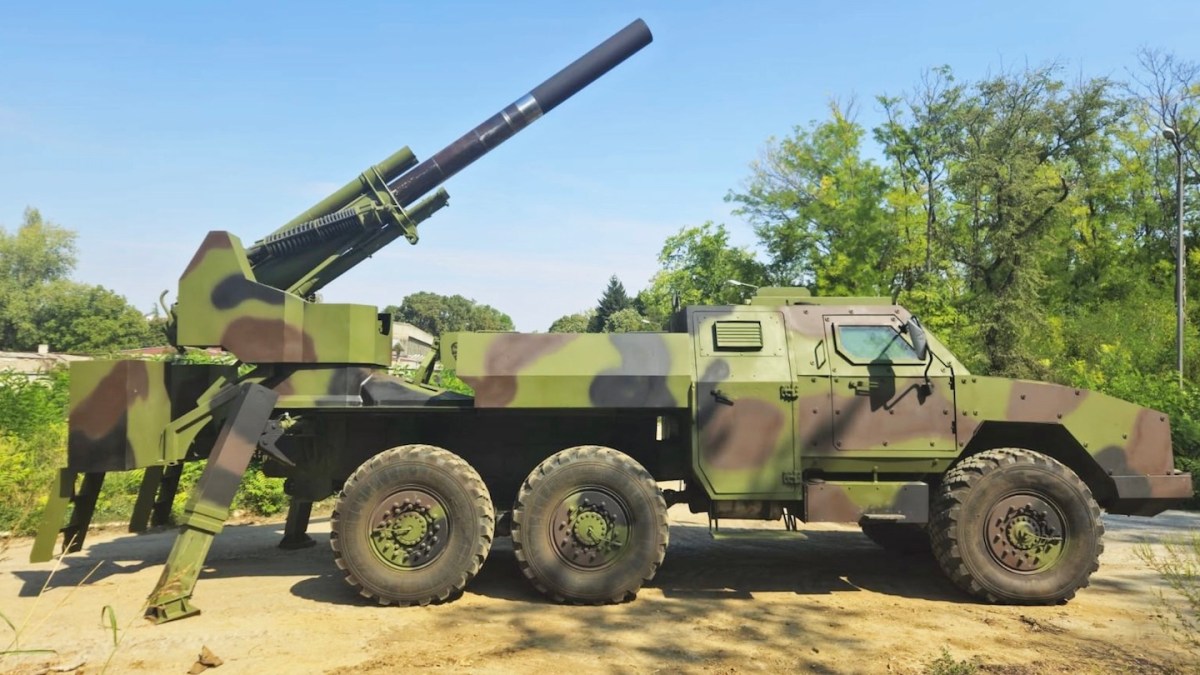
The TSMB M-25 represents a modern attempt to combine great destructive potential with very high mobility.
新闻视频
Published Oct 27, 2026 6:18 PM EDT
Serbian Ministry of Defense
Serbia has released the first footage of its TSMB M-25 heavy self-propelled mortar in action, revealing an unusual artillery system that puts a massive 203mm weapon on a comparatively light, six-wheeled truck. The system is designed to hurl projectiles weighing around 220 pounds at targets up to approximately seven-and-a-half miles away, bringing super-heavy firepower to a platform that looks surprisingly modest for the job.
The Serbian Ministry of Defense published the brief footage in a larger video montage, seen immediately below, but has not disclosed when or where the firing tests took place or what they demonstrated. Regardless, the M-25’s configuration alone makes it stand out.
A TSMB M-25 heavy self-propelled mortar in a firing position. Serbian Ministry of Defense/screencap
The Teški Samohodni Minobacač (TSMB, translated as heavy self-propelled mortar) M-25 was developed by Serbia’s state-owned Military Technical Institute and first appeared publicly at the Partner 2025 defense exhibition in Belgrade. Its design lineage stretches back to the Yugoslav M-65 155mm howitzer, itself a licensed copy of the widely used American M114 , first introduced in World War II.
Artillerymen of the 24th Infantry Division, U.S. Army, fire 155mm howitzers in the Korean War. Public Domain
The M-25 takes that heritage in a different direction, with a 203mm barrel measuring 24 calibers in length and an automated loading mechanism for mortar projectiles. The mortar barrel has an elevation range from 0° to 75°, and the barrel must return to 0° in elevation for the next round to be loaded from the muzzle end.
The standard 203mm mortar bomb weighs around 220 pounds, including approximately 60 pounds of explosive material. This results in a claimed destruction radius of around 250 feet, using impact fuzing.
The system is intended to fire both high-explosive and concrete-piercing ammunition, making it particularly suited to attacking hardened positions and fortifications. Developers have also provided for rocket-assisted projectiles to extend its range and precision guidance kits to improve the accuracy of compatible rounds.
The weapon is mounted on a FAP 2026 three-axle truck in a 6×6 configuration, a general-purpose off-road type made by Serbian vehicle manufacturer Fabrika automobila Priboj. This platform provides a range of 500 miles and a top speed of 50 miles per hour on the road. The vehicle has an armored cab for a crew of four, while its fire-control suite includes an inertial navigation system, a ballistic computer, communications equipment, and a dedicated gunner’s computer. The same truck has also been adapted to mount a 152mm gun/howitzer, under the name NORA B-39 .
The NORA B-39 mounts a 152mm gun/howitzer on the same FAP 2026 three-axle truck chassis. Serbian Ministry of Defense
The wheeled chassis is the defining feature of the M-25. While a weapon of this size would normally be either towed or mounted on a large tracked vehicle, Serbia has opted for a lighter truck-based arrangement. This offers advantages in road mobility and makes the system easier to move between firing positions, using “shoot and scoot” tactics. A general-purpose truck is cheaper to acquire and operate, and easier to maintain. It can also be more easily transported by air, although out-of-area operations are not generally on the Serbian Armed Forces’ agenda. However, its cross-country performance and overall survivability will be reduced compared to a tracked chassis.
TSMB M-25 heavy self-propelled mortar firing a round. Serbian Ministry of Defense/screencap
The M-25 is intended to deliver heavy fire against targets such as bunkers and other fortified positions, then relocate before an opponent can respond. Its relatively short stated range compared with many modern 155mm howitzers makes it a specialized system rather than a direct replacement for conventional long-range artillery. Its appeal lies instead in combining a very large projectile with a comparatively compact and mobile platform.
Mortars have a long and grim history in the Balkans, particularly during the wars that accompanied the breakup of Yugoslavia in the 1990s. The steep trajectories of mortar rounds made them useful in the region’s mountainous terrain and in fighting around fortified positions and during sieges, while their ability to deliver indirect fire meant crews could engage targets without a direct line of sight.
A visitor looks at infantry mortars at an exhibition of Serbia’s armed forces in Nis, southern Serbia, on February 14, 2024. Photo by SASA DJORDJEVIC / AFP SASA DJORDJEVIC
As far as we know, the M-25 is the only 203mm mortar in current development and/or production. There are a few larger mortars on mobile platforms, notably Russia’s 2S4 Tyulpan , a 240mm self-propelled mortar, but this is on a significantly bigger tracked chassis.
At approximately 19 metric tons, the M-25 is substantially lighter than the 2S4 Tyulpan, which weighs around 27.5 metric tons. Its tracked platform reflects a very different approach to moving super-heavy mortar firepower around the battlefield. The Tyulpan can deliver a 300-pound standard mortar round to a range of around six miles, or up to 11 miles away when using rocket-assisted rounds.
A Belarusian-operated 2S4 Tyulpan (nearest camera) during joint maneuvers with the Russian military. Russian Ministry of Defense
Russian artillerymen fire a 2S4 Tyulpan during a live-fire exercise. Russian Ministry of Defense
Serbia claims the M-25 has a rate of fire of up to three rounds per minute, thanks to the automated loading mechanism. In contrast, the Tyulpan can hurl a maximum of one round every 62 seconds. Indeed, its sluggish rate of fire is one of the reasons that saw it fall from more widespread Russian use.
There are still important unknowns. The newly released footage does not establish whether the advertised firing rate was achieved, how the weapon performs under sustained fire, or whether the system has entered operational service. Serbia has shown the M-25 at an exhibition and now in live-fire footage, but detailed test results have not been made public.
Still, the concept is striking: a high-mobility wheeled truck carrying a 203mm mortar is a distinctly different take on super-heavy firepower, but one that might just find a niche in the Balkan environment.
Contact the author: thomas@thewarzone.com
Comments couldn’t be loaded. Please refresh the page.
发布于美国东部时间2026年10月27日下午6:18
塞尔维亚国防部
塞尔维亚首次公开了其TSMB M-25重型自行迫击炮的实战视频,展示了这款不同寻常的火炮系统:它将一门203毫米的巨型火炮安装在一辆相对轻便的六轮卡车上。该系统旨在向约7.5英里(约12公里)外的目标发射重约220磅(约100公斤)的炮弹,将超强的火力集成到一个看起来相对低调的平台上。
塞尔维亚国防部在下方视频剪辑中发布了这段简短的射击片段,但并未透露射击测试的时间、地点或测试内容。尽管如此,M-25 的设计本身就足以引人注目。
一门处于发射位置的TSMB M-25重型自行迫击炮。塞尔维亚国防部/截图
塞尔维亚国营军事技术研究所研制的M-25型重型自行迫击炮(Teški Samohodni Minobacač,简称TSMB)首次公开亮相于贝尔格莱德举行的“合作伙伴2025”防务展。其设计渊源可以追溯到南斯拉夫的M-65型155毫米榴弹炮,而M-65型榴弹炮本身又是二战时期广泛使用的美国M114型榴弹炮的特许仿制版。
美国陆军第24步兵师的炮兵在朝鲜战争中使用155毫米榴弹炮进行射击。公共领域
M-25型迫击炮沿袭了这一传统,但方向有所不同。它配备一根203毫米长的炮管(24倍径),并采用自动装填机构。该迫击炮炮管的仰角范围为0°至75°,装填下一发炮弹前,炮管必须回到0°仰角。
标准的203毫米迫击炮弹重约220磅,其中包括约60磅的炸药。使用撞击引信时,其据称的杀伤半径约为250英尺。
该系统旨在发射高爆弹和穿甲弹,因此特别适用于攻击坚固阵地和工事。开发人员还提供了火箭助推弹丸以扩展射程,以及精确制导组件以提高兼容弹药的精度。
该武器安装在塞尔维亚普里博伊汽车制造厂(Fabrika automobila Priboj)生产的FAP 2026型三轴卡车上,采用6×6驱动配置,是一款通用型越野卡车。该平台公路行驶里程达500英里,最高时速为50英里/小时。车辆配备可容纳四名乘员的装甲驾驶室,其火控系统包括惯性导航系统、弹道计算机、通信设备和专用炮手计算机。同一款卡车还经过改装,可搭载152毫米火炮/榴弹炮,型号为NORA B-39。
NORA B-39型火炮/榴弹炮安装在与FAP 2026相同的三轴卡车底盘上。塞尔维亚国防部
M-25 的轮式底盘是其最显著的特征。虽然这种尺寸的武器通常会被牵引或安装在大型履带车辆上,但塞尔维亚选择了更轻便的卡车底盘方案。这在公路机动性方面具有优势,并且使该系统更容易在射击阵地之间移动,从而能够执行“打了就跑”的战术。通用卡车的购置和运营成本更低,维护也更简便。它也更容易空运,尽管塞尔维亚武装部队通常不会进行境外作战。然而,与履带底盘相比,其越野性能和整体生存能力会有所下降。
TSMB M-25重型自行迫击炮正在发射炮弹。塞尔维亚国防部/截图
M-25榴弹炮旨在对碉堡和其他防御工事等目标进行猛烈火力打击,然后在敌方反应过来之前迅速转移阵地。与许多现代155毫米榴弹炮相比,其标称射程相对较短,因此它是一种专用系统,而非传统远程火炮的直接替代品。它的优势在于将大口径炮弹与相对紧凑且机动性强的平台相结合。
迫击炮在巴尔干地区有着漫长而残酷的历史,尤其是在 20 世纪 90 年代南斯拉夫解体期间的战争中。迫击炮弹的陡峭弹道使其在该地区多山的地形、防御工事周围的战斗以及围攻战中非常有用,而其间接射击的能力意味着炮组人员可以在没有直接视线的情况下攻击目标。
2024年2月14日,在塞尔维亚南部城市尼什,一名参观者正在观看塞尔维亚武装部队展览上的步兵迫击炮。照片由SASA DJORDJEVIC/法新社提供。
据我们所知,M-25是目前唯一正在研发和/或生产的203毫米迫击炮。虽然也有一些口径更大的迫击炮安装在移动平台上,例如俄罗斯的2S4“秋尔潘”(Tyulpan)240毫米自行迫击炮,但它的履带底盘尺寸要大得多。
M-25 的重量约为 19 公吨,比重约 27.5 公吨的 2S4 Tyulpan 轻得多。其履带式平台体现了在战场上运输超重型迫击炮火力方面截然不同的理念。Tyulpan 可以将 300 磅重的标准迫击炮弹投送到约 6 英里(约 9.7 公里)的射程,使用火箭增程弹时射程可达 11 英里(约 18 公里)。
在与俄罗斯军队的联合演习中,一台由白俄罗斯方面操作的2S4“秋尔潘”(最近的摄像头)雷达。俄罗斯国防部
俄罗斯炮兵在实弹演习中发射2S4“秋兰”自行榴弹炮。俄罗斯国防部
塞尔维亚声称,得益于自动装弹机构,M-25 的射速可达每分钟三发。相比之下,Tyulpan 的射速最高只能达到每 62 秒一发。事实上,其缓慢的射速正是导致其未能被俄罗斯广泛采用的原因之一。
目前仍存在一些重要未知数。新发布的视频并未证实该武器是否达到了宣传的射速,也未说明其在持续射击下的性能如何,更未说明该系统是否已投入实战使用。塞尔维亚曾在展览会上展示过M-25,如今又发布了实弹射击视频,但详细的测试结果尚未公开。
不过,这个概念很引人注目:一辆高机动性轮式卡车运载一门 203 毫米迫击炮,这是一种截然不同的超重型火力,但它或许能在巴尔干地区找到一席之地。
联系作者:thomas@thewarzone.com
评论加载失败,请刷新页面。