Startup Biosphere wins Pentagon contract to scale up production of key chemicals初创公司Biosphere赢得五角大楼合同,将扩大关键化学品的生产规模。
The biomanufacturing facility will boast 20,000 liters of UV-sterilized vats, able to brew anything from “bio-cement" for helipads to explosives for Hellfire missiles.
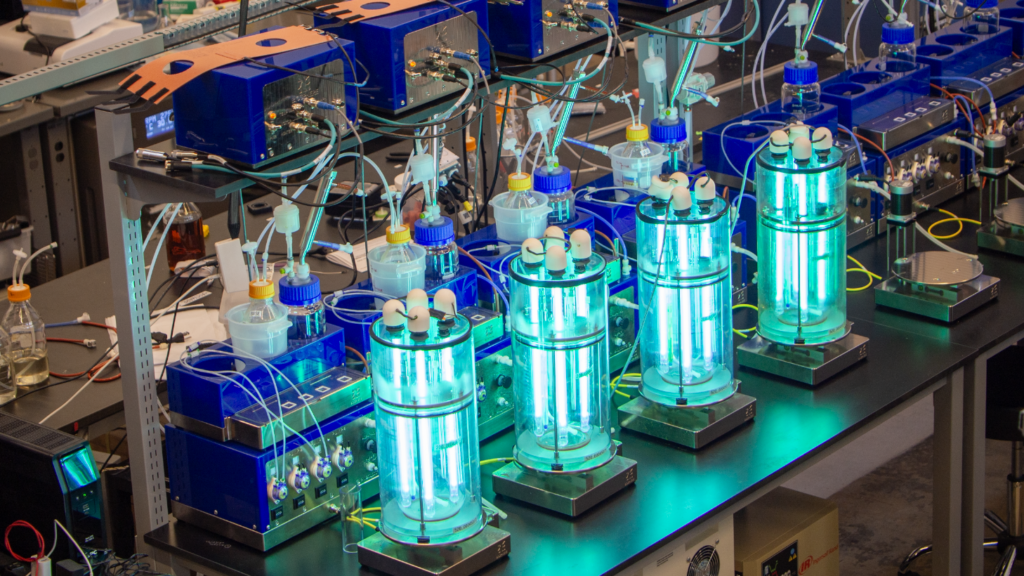
Biosphere uses UV light to sterilize its bio-reactors, where genetically engineered microorganisms produce valuable chemicals for industrial and military use. (Photo courtesy of Biosphere)
WASHINGTON — The Pentagon has awarded $21 million to California-based biotech startup Biosphere to build a high-tech, 20,000-liter brewery, where genetically engineered microbes will produce essential chemicals for military supplies.
“America’s ability to compete with China depends in part on our ability to manufacture the materials that underpin our economy and national defense,” Biosphere CEO Brian Heligman said in a press release today . “Instead of relying on complex global supply chains and highly specialized production facilities, we can use biology to manufacture a broad range of critical chemicals from domestically available feedstocks.”
Potential products range from a “bio-cement” mixture, which turns loose sand to solid landing surfaces for helicopters, to polymer-bonded explosives (PBX) for weapons like the Hellfire missile, Heligman told Breaking Defense in an interview.
While he declined to disclose more specifics on the products, Heligman said that “we’ve had some detailed discussions around two or three fine chemicals which should be quite a good fit for the facility [and] the government priorities they’ve articulated.”
Biomanufacturing uses vats of microorganisms, genetically engineered to produce a desired substance: It’s essentially a high-tech version of how breweries use yeast to turn grain into alcohol. The bio approach is technologically trickier than traditional industrial chemistry in many ways: Biosphere, for instance, uses UV light to sterilize miles of piping, so they don’t grow the wrong microorganisms by mistake. But biomanufacturing can also produce things petrochemistry can’t, or it can produce the same things with less energy consumption and pollution.
Biosphere’s new $21 million facility is slated for commissionin g in the fourth quarter of 2027. At 20,000 liters, it is one of the largest Defense-funded bio factories to date, about the size of a thriving microbrewery, Heligman told Breaking Defense. Its projected output, about 100 tons of chemicals a year is tiny compared to an industrial petrochemical plant producing bulk plastics, he said , but it’s ten times the size of 1,000-liter systems currently standard in military labs to brew experimental batches of new chemicals.
The new mid-sized facility represents a “sweet spot” for defense needs in particular, Heligman argued. It can make sufficient quantities for munitions and other military programs, without the overhead of a traditional bulk-manufacturing facility.
Three exercises that proved a new approach to C-UAS
Architecture that linked sensors, C2, RF effects, and lasers into a distributed c-UAS kill chain.
“They don’t need massive-scale, commodity-plastic volumes,” Heligman said of the military. “A small, specialty-chemical production line is a useful asset for them.”
That’s because the military needs a lot of bespoke chemicals, like the advanced energetics used in explosive warheads, for which there’s little civilian demand. Right now, Pentagon demand is high as the military rushes to restock munitions expended against Iran , but there’ve historically been dramatic peaks and valleys in Defense Department funding for energetics. Those two factors combined make it hard to convince traditional chemical manufacturers to invest in production capacity for these “critical chemicals” in the US, as both industry and government officials lamented Tuesday at a Hudson Institute conference .
That said, Heligman isn’t averse to scaling up, either. “We are using this as a demonstration asset to also show that our cost advantage translates to even the very large facilities as well,” Heligman told Breaking Defense. And with rapid advances in genetic engineering and AI simulation of biological processes, he predicted, the potential will just keep growing.
Today’s contract announcement comes less than six months after an earlier Pentagon award to Biosphere , worth up to $9 million if all options are exercised, to develop a portable, electrically powered bio-brewery that can make protein out of water and air. (The water and air feed the microorganisms, which make the protein).
Both awards are part of a larger Pentagon push to shore up its supply chains and rebuild American manufacturing of vital components and chemicals that has been offshored to foreign suppliers, especially China . Much of this effort involves rebuilding traditional industrial capabilities in the US — but the military is also exploring emerging technologies like biomanufacturing.
To date, biomanufacturing has been overwhelmingly employed by the pharmaceuticals industry, which has built massive facilities in the US and abroad. But it’s increasingly possible to make microbes brew chemical ingredients for products of interest to the military, from high explosives to anti-corrosion coatings. Pentagon CTO Emil Michael himself elevated biomanufacturing to one of his top six “Critical Technology Areas” last year, even as he downgraded other priorities.
Breaking Defense Video
A more flexible way to defend maneuver forces from drones that doesn’t tie them down [Sponsored]
What’s haunting the Pentagon this Halloween?
The new must-have capabilities for drones [Sponsored]
Army’s tech chief talks autonomy, acquisition and the future of drones
Drones take over AUSA, plus the Army’s plan to bring in new vendors
Hegseth talks autonomy at AUSA, a key show focus
Army doubles down on autonomy, stakes out Indo-Pacific role: AUSA Day 2
Telle talks ‘manufacturing rodeo,’ supply chain ‘weak links’: AUSA Day 1
New leaders, new drone command: What we expect from AUSA 2026
Unpacking Boeing’s F/A-XX win, plus a report from wartime Ukraine
生物圈利用紫外线对生物反应器进行消毒,其中经过基因工程改造的微生物生产用于工业和军事用途的重要化学品。(图片由生物圈提供)
华盛顿——五角大楼已向位于加利福尼亚州的生物技术初创公司 Biosphere 拨款 2100 万美元,用于建造一座高科技的 20000 升啤酒厂,该啤酒厂将利用基因工程微生物生产军事用品所需的重要化学品。
“美国与中国竞争的能力部分取决于我们生产支撑经济和国防所需材料的能力,”生物圈公司首席执行官布莱恩·赫利格曼今天在一份新闻稿中表示。“我们无需依赖复杂的全球供应链和高度专业化的生产设施,而是可以利用生物学,以国内可获得的原料生产各种关键化学品。”
赫利格曼在接受《防务新闻》采访时表示,潜在产品包括“生物水泥”混合物(可将松散的沙子变成直升机的坚固着陆面)以及用于地狱火导弹等武器的聚合物粘合炸药 (PBX)。
虽然他拒绝透露更多关于产品的具体细节,但赫利格曼表示,“我们已经就两三种精细化学品进行了一些详细的讨论,这些化学品应该非常适合该工厂[以及]他们所阐明的政府优先事项。”
生物制造利用装满微生物的培养罐,这些微生物经过基因工程改造,可以生产所需的物质:它本质上是啤酒厂利用酵母将谷物转化为酒精的高科技版本。在许多方面,生物制造的技术难度都高于传统的工业化学:例如,生物圈公司使用紫外线对数英里的管道进行消毒,以避免误培养出错误的微生物。但生物制造也能生产石油化工无法生产的物质,或者以更低的能耗和污染生产出相同的物质。
生物圈公司耗资2100万美元新建的生物工厂预计将于2027年第四季度投入使用。据赫利格曼向《防务新闻》透露,该工厂容量达2万升,是迄今为止国防部资助的最大生物工厂之一,规模与一家蓬勃发展的微型啤酒厂相仿。他表示,该工厂预计每年可生产约100吨化学品,与生产散装塑料的工业石化工厂相比微不足道,但却是目前军方实验室用于酿造实验性新化学品的标准1000升系统的十倍。
赫利格曼认为,这座新建的中型工厂完美契合了国防需求。它既能生产足够数量的弹药和其他军事项目所需的物资,又无需承担传统大型制造工厂的巨额开支。
三个演习证明了反无人机系统(C-UAS)的一种新方法。
将传感器、C2、射频效应和激光连接成分布式 c-UAS 杀伤链的架构。
“他们不需要大规模的通用塑料,”赫利格曼谈到军方时说。“一条小型特种化学品生产线对他们来说就很有用。”
这是因为军方需要大量定制化学品,例如爆炸性弹头中使用的先进高能材料,而这些化学品在民用领域的需求量很小。目前,由于军方急于补充对伊朗消耗的弹药,五角大楼的需求量很高,但历史上国防部对高能材料的拨款一直存在剧烈的波动。正如周二在哈德逊研究所会议上,行业和政府官员所感叹的那样,这两个因素加在一起,使得说服传统化学品制造商在美国投资建设这些“关键化学品”的生产能力变得十分困难。
尽管如此,赫利格曼也不排斥扩大规模。“我们正利用这个项目作为示范资产,以证明我们的成本优势同样适用于规模庞大的设施,”赫利格曼告诉《防务新闻》。他预测,随着基因工程和生物过程人工智能模拟技术的飞速发展,其潜力只会不断增长。
今天的合同公告距离五角大楼此前授予生物圈公司一份价值高达900万美元的合同还不到六个月。该合同旨在开发一种便携式、电力驱动的生物啤酒厂,该啤酒厂可以利用水和空气生产蛋白质。(水和空气为微生物提供养分,微生物则负责生产蛋白质。)
这两项奖项都是五角大楼加强供应链、重建美国关键零部件和化学品制造业(这些制造业此前已外包给外国供应商,尤其是中国)的更大规模举措的一部分。这项工作的大部分内容涉及重建美国的传统工业能力,但军方也在探索生物制造等新兴技术。
迄今为止,生物制造技术主要应用于制药行业,该行业已在美国和海外建立了规模庞大的设施。但利用微生物生产军方所需的化学成分也日益成为可能,这些成分可用于生产从高爆炸药到防腐涂料等各种产品。五角大楼首席技术官埃米尔·迈克尔去年将生物制造技术提升为六大“关键技术领域”之一,尽管他同时降低了其他一些优先事项的优先级。
突破性防御视频
一种更灵活的防御机动部队免受无人机攻击的方式,不会限制其行动[赞助]
今年万圣节,五角大楼究竟闹鬼?
无人机必备的新功能 [赞助内容]
陆军技术主管谈无人机的自主性、采购和未来
无人机主导了美国陆军协会(AUSA)的会议,此外,陆军还计划引入新的供应商。
Hegseth 在 AUSA 大会上谈到了自主性,这是本次大会的一个重点议题。
陆军加倍强调自主性,明确印太地区角色:AUSA第二天
特勒谈“制造业乱象”、供应链“薄弱环节”:AUSA 第一天
新领导人,新无人机指挥部:我们对 AUSA 2026 的期待
深入剖析波音F/A-XX的中标,以及来自战时乌克兰的报道