Australia pushes to beef up air defenses澳大利亚力图加强防空能力
Australia expects to select the winning platform for LAND 6504 in late 2027 following a RFP that is expected in the early part of the year.
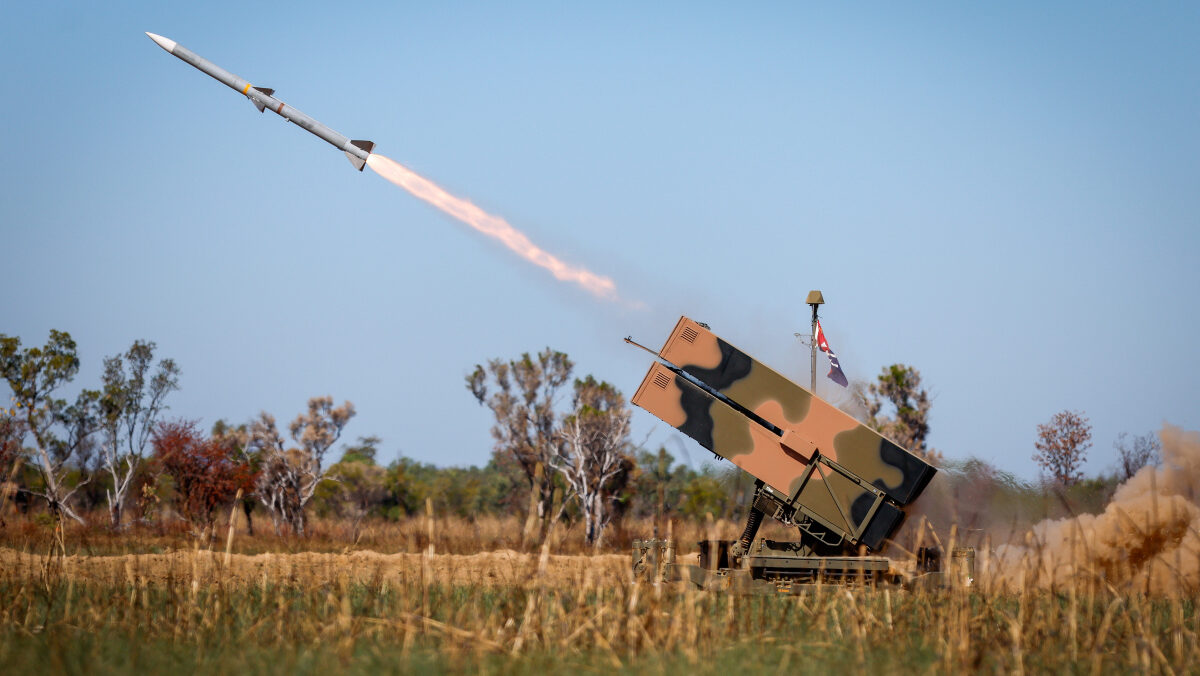
An Australian Army National Advanced Surface to Air Missile System (NASAMS) from the 16th Regiment, Royal Australian Artillery firing an AIM-120 missile during Exercise Talisman Sabre 2025 at Bradfield Training Area. (Photo: Australian Department of Defence)
SINGAPORE — Despite Australia’s recent moves to strengthen its land- and sea-based air defenses, more needs to be done to protect the country in times of conflict, an expert told Breaking Defense.
Canberra on Oct. 13 announced it is seeking Expressions of Interest from interested vendors for a land-based system under Project LAND 6504 – Medium Range Ground Based Air Defence .
Slides from an industry briefing for LAND 6504 at the recent Land Forces defense show in western Australia indicate that the country is running an “acceleration project” seeking a medium-range air defense system “focused on rapid capability delivery,” prioritizing “proven Military-Off-The-Shelf (MOTS) solutions” and a “clearly defined and achievable Concept of Employment.”
Further, according to the briefing the system must be mobile, deployable, and integrated with Australia’s CEA Technologies’ radars and existing IAMD infrastructure.
It must also be able to intercept ballistic missiles in their terminal phase along with subsonic air-breathing missiles. Capabilities listed as “highly desirable” for the system include being able to intercept maneuvering hypersonic and high-speed cruise missile targets.
Australia expects to select the winning platform for LAND 6504 in late 2027 following a RFP that is expected in the early part of the year. The system is expected to conduct a live firing at the biennial Talisman Sabre multinational exercise, typically held in July or August, in 2029.
Meanwhile, for sea-based air defenses, the Very Short Range Air and Surface Defence (VSRASD) program is looking for a system to protect the Royal Australian Navy’s upcoming Hunter-class frigates from air- and sea-borne drone threats.
An RFP posted Sept. 29 on the Australian government’s tenders website called for a system that “should be able to identify multiple threats at a distance of up to 5,000 metres” and can function as a standalone system but also able “to be integrated into the ship systems.”
The RFP added that each Hunter-class frigate will be equipped with one or two of the systems, with a possibility that the system could be fitted on other classes of Australian naval vessels.
Australia also awarded a contract to Lockheed Martin in September to expand Australia’s joint air battle management system. The country’s military also test-fired a naval SM-2 air defense missile from an adapted ground launcher in July, utilizing a CEA Technologies radar and a virtual Aegis combat system.
Despite these recent efforts, Euan Graham, an expert associate at Australia’s National Security College, told Breaking Defense that recent events in the Middle East and elsewhere show that Integrated Air and Missile Defense (IAMD) capabilities need to go hand in hand with efforts to harden bases and other military targets.
“Iran has revealed the limitations of US IAMD in the Middle East, as well as depleting its defensive arsenal,” Graham said. “China’s capabilities are orders of magnitude greater.”
The accelerated timeline for the LAND 6504 program is welcome, Graham said, given that “it is well known that Australia’s Ground Based Air Defense (GBAD) capabilities lags behind its air and sea-based systems.”
However he warned that the acquisition will “still be unlikely to fill the gap, given Australia’s parallel need to protect expeditionary forces and military bases and critical infrastructure in Australia.”
Australia must thus harden its military targets in addition to building up its IAMD capabilities, noting that its geographic isolation was no longer the defensive advantage it once was in a contemporary conflict. “Distance does give Australia defensive advantages over, for example, Japan,” Graham explained. “But China’s development of cruise missile submarines would give it the ability to mount surprise attacks on targets in Australia such as its submarine base HMAS Stirling, Naval Communications Station Harold Holt (a joint Australian and US naval communication station), and the Jindalee Over-the-Horizon Radar Network infrastructure.”
Breaking Defense Video
A more flexible way to defend maneuver forces from drones that doesn’t tie them down [Sponsored]
What’s haunting the Pentagon this Halloween?
The new must-have capabilities for drones [Sponsored]
Army’s tech chief talks autonomy, acquisition and the future of drones
Drones take over AUSA, plus the Army’s plan to bring in new vendors
Hegseth talks autonomy at AUSA, a key show focus
Army doubles down on autonomy, stakes out Indo-Pacific role: AUSA Day 2
Telle talks ‘manufacturing rodeo,’ supply chain ‘weak links’: AUSA Day 1
New leaders, new drone command: What we expect from AUSA 2026
Unpacking Boeing’s F/A-XX win, plus a report from wartime Ukraine
在布拉德菲尔德训练区举行的“护身军刀2025”演习中,澳大利亚皇家炮兵第16团的一门澳大利亚陆军先进地对空导弹系统(NASAMS)正在发射一枚AIM-120导弹。(图片:澳大利亚国防部)
新加坡——一位专家告诉《防务新闻》,尽管澳大利亚最近采取措施加强其陆基和海基防空力量,但在冲突时期,仍需采取更多措施来保护国家。
10 月 13 日,堪培拉宣布,正在向有兴趣的供应商征集陆基系统的意向书,项目代号为 LAND 6504 – 中程地面防空系统。
在最近于西澳大利亚举行的陆军防务展上,LAND 6504 行业简报的幻灯片显示,该国正在开展一项“加速项目”,寻求一种“以快速交付能力为重点”的中程防空系统,优先考虑“经过验证的现成军用解决方案 (MOTS)”和“明确定义且可实现的运用概念”。
此外,根据简报,该系统必须具备移动性、可部署性,并且能够与澳大利亚 CEA Technologies 的雷达和现有的综合防空导弹防御系统 (IAMD) 基础设施集成。
它还必须能够在弹道导弹末段以及亚音速吸气式导弹的拦截阶段进行拦截。该系统“非常理想”的能力包括能够拦截机动性强的超音速和高速巡航导弹目标。
澳大利亚预计将于2027年底选定LAND 6504项目的中标平台,此前预计将于今年年初发布招标书。该系统预计将于2029年参加两年一度的“护身军刀”多国联合演习(通常在7月或8月举行),并进行实弹射击测试。
与此同时,在海基防空方面,“超短程空中和水面防御”(VSRASD)计划正在寻找一种系统,以保护澳大利亚皇家海军即将建造的“猎人”级护卫舰免受空中和海上无人机的威胁。
9 月 29 日,澳大利亚政府在其招标网站上发布了一份 RFP,要求开发一种“能够识别 5000 米范围内的多种威胁”的系统,该系统既可以作为独立系统运行,也可以“集成到船舶系统中”。
RFP还补充说,每艘猎人级护卫舰都将配备一到两个系统,该系统也有可能安装在澳大利亚海军的其他舰艇上。
澳大利亚于9月与洛克希德·马丁公司签订合同,以扩展其联合空中作战管理系统。此外,澳大利亚军方于7月使用CEA技术公司的雷达和虚拟宙斯盾作战系统,从改装后的地面发射器上试射了一枚SM-2舰载防空导弹。
尽管最近做出了这些努力,但澳大利亚国家安全学院的专家助理尤安·格雷厄姆告诉《防务新闻》,中东和其他地方最近发生的事件表明,综合防空和导弹防御 (IAMD) 能力需要与加强基地和其他军事目标的努力齐头并进。
格雷厄姆说:“伊朗已经暴露了美国在中东部署综合反导系统的局限性,同时也削弱了美国的防御武库。中国的防御能力要强得多。”
格雷厄姆表示,考虑到“众所周知,澳大利亚的陆基防空(GBAD)能力落后于其空中和海上系统”,LAND 6504 项目的加速推进令人欣慰。
但他警告说,鉴于澳大利亚同样需要保护其远征部队、军事基地和关键基础设施,此次收购“仍然不太可能填补这一空白”。
因此,澳大利亚除了加强综合防空导弹系统(IAMD)能力外,还必须强化其军事目标的防御能力。澳大利亚指出,其地理上的孤立性在当今冲突中已不再像过去那样具有防御优势。“距离确实赋予了澳大利亚相对于日本等国的防御优势,”格雷厄姆解释说,“但中国巡航导弹潜艇的发展将使其有能力对澳大利亚的目标发动突袭,例如其潜艇基地斯特林号(HMAS Stirling)、哈罗德·霍尔特海军通信站(澳大利亚和美国联合海军通信站)以及金达利超视距雷达网络基础设施。”
突破性防御视频
一种更灵活的防御机动部队免受无人机攻击的方式,不会限制其行动[赞助]
今年万圣节,五角大楼究竟闹鬼?
无人机必备的新功能 [赞助内容]
陆军技术主管谈无人机的自主性、采购和未来
无人机主导了美国陆军协会(AUSA)的会议,此外,陆军还计划引入新的供应商。
Hegseth 在 AUSA 大会上谈到了自主性,这是本次大会的一个重点议题。
陆军加倍强调自主性,明确印太地区角色:AUSA第二天
特勒谈“制造业乱象”、供应链“薄弱环节”:AUSA 第一天
新领导人,新无人机指挥部:我们对 AUSA 2026 的期待
深入剖析波音F/A-XX的中标,以及来自战时乌克兰的报道