Edge computing fails when the mission hardware can’t evolve当任务硬件无法升级时,边缘计算就会失败。
The payoff is quicker tech insertion, avoiding vendor lock, and more room for autonomy, sensors, weapons, and mission growth.
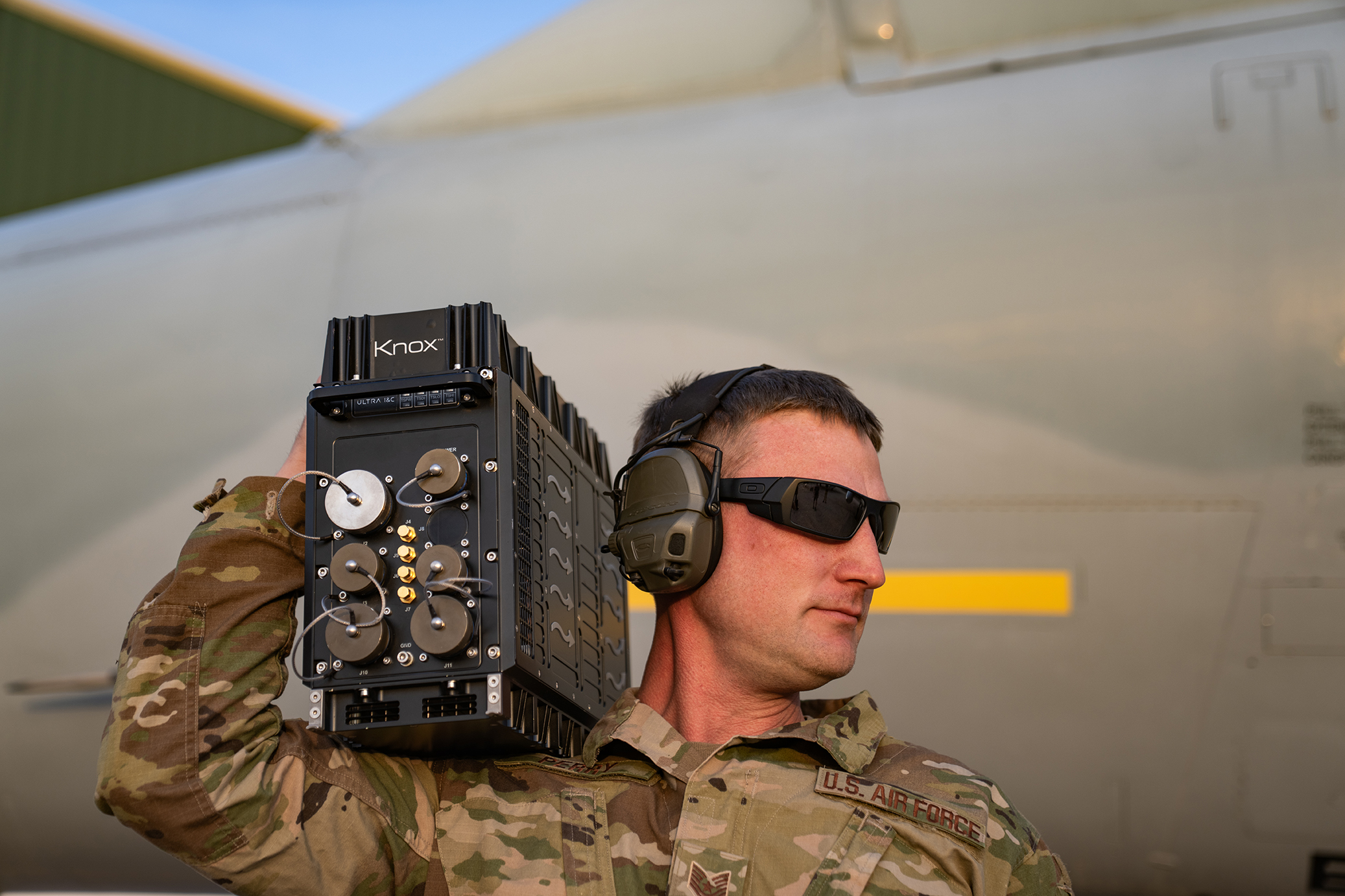
Ultra I&C’s Knox processor can be installed into legacy platforms to enable faster processing and future upgrades without vendor lock. (Photo courtesy of Ultra I&C.)
Across aviation, ground systems, and surface and subsurface maritime platforms, the demand for edge computing power relentlessly and exponentially moves in one direction: more data processed closer to the mission. Operators need new communications pathways, autonomy tools and AI-enabled mission applications, alongside faster software-driven upgrades at the tactical edge.
There’s a problem, though, as the hardware architectures inside many of those air, ground, and naval systems – the boxes, in other words – were designed for an era where it commonly took years for upgrades and capability integrations to reach the battlefield.
That reality is no longer acceptable. To leap ahead, Ultra I&C developed the Knox family of processors to meet evolving challenges. The company isn’t just making a case for more compute; rather, it’s a case for a different kind of computing architecture to keep pace with changing mission needs without forcing costly, complex and time-consuming upgrades every time a new mission capability is identified.
“We’re enabling the rapid tech insertion of new capabilities into legacy airframes that are often vendor locked. That lock is slowing down our ability as a nation to deliver capabilities at the speed of innovation,” said Ultra I&C Chief Technology Officer and Edge Compute General Manager, Randy Fields.
The issue is not that the various services lack ideas for new capability. It’s that legacy architectures often make new capabilities too difficult to field. When platforms are tied to original hardware specs, vendors and interfaces, even relatively modest upgrades can trigger expensive redesign work, new testing, and delays.
Merely having a faster processor is not enough if the surrounding architecture cannot absorb change. Once cables are run, interfaces are fixed, and front-panel decisions are made, programs can become effectively trapped inside the original design of the box. Even if a platform has years of life left, the lack of flexibility in the mission system architecture limits mission impact.
To avoid that problem, Ultra I&C developed Knox processors to break the cycle by modernizing the inside of the mission system while leaving the surrounding platform intact.
Tech insertion matters most when it happens in the field
Knox uses what Fields describes as a flexible backplane and commercial off‑the‑shelf Modular Open Systems Approach (MOSA)/Sensor Open Systems Architecture (SOSA)-aligned cards. This allows platforms to upgrade processing, communications and mission applications in place, without costly chassis replacement or aircraft re-cabling.
That approach is the unlock. Knox processors support unlimited backplane and card upgrades, allowing programs to keep inserting new capability as mission needs change instead of redesigning the box every time the mission evolves.
The front panel preserves the platform’s connections to sensors, radars, weapons and communications, while the backplane routes data internally to the processing layer and mission applications that turn raw inputs into actionable information for the operator.
Fields describes Knox as the central processing “brain” for the mission system. It can route data from sensors, weapons and communications links such as Starlink or Starshield through a configurable backplane to mission applications, cockpit displays or common-operating-picture displays. It supports rapid field insertion of new waveforms, RF capabilities, high-performance embedded computing VPX GPUs, and other mission cards.
The Knox processor is designed for aviation, ground and maritime platforms, enabling more processing power without the need for complete system overhauls. (Photo courtesy of Ultra I&C.)
The US Marine Corps is already applying that capability to improve its medium-altitude, long-endurance MQ-9B Reapers flying ISR, target acquisition and maritime domain awareness. Earlier this year, the USMC ordered Knox-5 processors to improve edge processing for mission-critical data on its MQ-9Bs. The Knox-5 is specifically optimized for size-constrained unmanned platforms.
The same modular approach applies across crewed and uncrewed aircraft, ground vehicles, and surface and subsurface maritime platforms, enabling common components and autonomy stacks to be deployed across domains. The outside form factor can remain stable while the internal systems evolve, allowing the warfighter to add capability without costly system rip and replace or delays for platform integration.
This is what separates Knox from more rigid systems that are modular in theory but constrained in practice. While they may allow cards to be swapped, the systems still rely on a fixed internal architecture that makes real change expensive and disruptive. “Our flexible backplane approach enables us to upgrade indefinitely,” Fields said.
For the government, that changes the buying decision. “The government is not just buying a box that works today,” he said. “It’s buying a foundation it can keep using as mission needs change.”
That same approach extends to the supply chain. Built from commercial products and supported by a diversified US defense industrial base, Knox systems can be sourced from multiple pre-qualified vendors for processors and switches, enabling fixed-price delivery at scale and reducing schedule, cost, and risk compared to single-source solutions.
Together, the commercial MOSA/SOSA foundations, flexible backplane design and open government data rights combination helps break vendor lock, supports government reference architectures, and delivers a sustained edge-computing advantage through in-theater upgrades.
SWaP matters because warfighters need the room back
Legacy multi-level security setups often require separate boxes, switches, and power supplies that add weight, take up space, burn power. Knox compresses that burden into fewer systems, and in some cases into a single flight certified unit capable of handling multiple security domains and mission functions internally.
That means improved size, weight and power (SWaP), more room for sensors and weapons, and less fuel requirements and logistics burdens for the warfighter.
“The ability to actually do multi-level security inside of one box, that’s the kind of thing that saves you fuel,” said Fields. “It also gives you more space in the aircraft to put things that matter. More weapons, more sensors. We’re giving back space inside of these airframes, and that’s what the warfighter needs right now – more capability, less constraint, and additional capacity to deliver success on tonight and tomorrow’s missions.”
That same logic applies to lifecycle cost. Knox is not only reducing the number of systems a platform needs today, it is also creating an upgrade path for what the mission may require tomorrow. If a system can consolidate multiple functions now and can accept new internals tomorrow or later, the government is not forced to choose between obsolescence and paying for another disruptive integration cycle.
For example, the Knox-10 processor brings MLS processing with 100 gigabit Ethernet switching into a single unit, a capability that previously required three separate systems. Rapid tech insertion without starting over is the proverbial game changer for all platforms.
Capabilities like Starlink and Starshield were not part of the equation a few years ago, Fields noted, but are now mission-relevant. With a modular compute architecture in place, those capabilities can be inserted as they become relevant. The same is true for the next waveform, RF card, communications solution, allied interoperability system, AI application or autonomy capability moving to the edge.
Ultra I&C’s Knox processors have obvious applications in aerospace, but the same basic architecture applies across air, land, and maritime missions that depend on communications, networking, switching, compute and mission applications. Ultra I&C sees that as an opportunity to give the government a common foundation it can adapt across platforms and domains without abandoning its core architecture.
Turning openness into supply chain agility
“Speed is a weapon,” Fields said. In this case, that means speed in sourcing, production, delivery and field upgrades, not raw compute alone.
Knox’s commercial, MOSA-based approach gives Ultra I&C more flexibility to source key components from multiple pre-qualified suppliers across the defense industrial base (DIB). That makes Knox processors built to scale, with a supply chain designed to support urgent delivery – especially as a new Knox production line standing up in Columbus, Ohio.
That flexibility is what openness is meant to deliver. An open system should not only make future tech insertion easier, but it should also bring resilience to the DIB by avoiding chokepoints and allowing qualified components to come from a broader industrial base.
“We are a company that is breaking vendor lock, meeting the urgency of the moment and focusing on US manufacturing to deliver at the speed of mission need,” said Fields. “We can upgrade in the field. That’s a capability advantage versus having to take it out of theater to get back to the factory to get an upgrade.”
Knox is not only a faster processor, it is a way for the Pentagon to keep pace by reducing SWaP, adding options, updating in place, expanding allied interoperability, and fielding capability faster than traditional architectures allow. In a Pentagon increasingly focused on speed, openness, and adaptability, more compute is not enough. The architecture has to keep up, too.
Ultra I&C 的 Knox 处理器可以安装到传统平台上,从而实现更快的处理速度和未来的升级,且不受厂商锁定。(图片由 Ultra I&C 提供。)
在航空、地面系统以及水面和水下海上平台领域,对边缘计算能力的需求正以惊人的速度呈指数级增长,并且朝着同一个方向发展:更多的数据需要在更靠近任务地点的地方进行处理。操作人员需要新的通信路径、自主工具和人工智能驱动的任务应用,以及在战术边缘更快的软件驱动升级。
但问题在于,许多空中、地面和海军系统(换句话说,就是这些“盒子”)内部的硬件架构是为升级和功能集成通常需要数年时间才能到达战场的时代而设计的。
这种现状已不再可接受。为了实现跨越式发展,Ultra I&C 开发了 Knox 系列处理器,以应对不断变化的挑战。该公司并非仅仅追求更强大的计算能力,而是倡导一种全新的计算架构,以适应不断变化的任务需求,而无需每次发现新的任务能力时都进行成本高昂、复杂且耗时的升级。
“我们正在推动新技术快速融入到通常受供应商锁定的传统飞机机身中。这种锁定正在减缓我们国家以创新速度交付能力的速度,”Ultra I&C首席技术官兼边缘计算总经理兰迪·菲尔兹表示。
问题不在于各个服务缺乏新功能的想法,而在于传统的架构往往使得新功能的部署过于困难。当平台与原始硬件规格、供应商和接口绑定时,即使是相对较小的升级也可能引发昂贵的重新设计工作、新的测试以及延误。
仅仅拥有更快的处理器是不够的,如果周围的架构无法适应变化。一旦线缆铺设完毕、接口固定、前面板设计确定,程序实际上就被困在了最初的设计框架内。即使平台还有数年的使用寿命,任务系统架构缺乏灵活性也会限制任务的影响。
为了避免这个问题,Ultra I&C 开发了 Knox 处理器,通过对任务系统内部进行现代化改造,同时保持周围平台完好无损,从而打破了这一循环。
技术植入在现场进行时最为重要。
Knox 采用 Fields 所描述的灵活背板和商用现成模块化开放系统方法 (MOSA)/传感器开放系统架构 (SOSA) 兼容的卡。这使得平台能够在不进行昂贵的机箱更换或飞机重新布线的情况下,就地升级处理、通信和任务应用程序。
这种方法就是关键所在。Knox处理器支持无限次的背板和扩展卡升级,使得程序能够随着任务需求的变化不断添加新功能,而无需每次任务变更都重新设计整个系统。
前面板保持平台与传感器、雷达、武器和通信的连接,而背板则将数据内部路由到处理层和任务应用程序,这些应用程序将原始输入转换为操作员可操作的信息。
菲尔兹将诺克斯描述为任务系统的中央处理“大脑”。它可以通过可配置的背板将来自传感器、武器和通信链路(例如星链或星盾)的数据路由到任务应用程序、驾驶舱显示器或通用作战图显示器。它支持快速现场插入新的波形、射频功能、高性能嵌入式计算VPX GPU和其他任务卡。
Knox处理器专为航空、地面和海上平台设计,无需对系统进行全面改造即可提升处理能力。(图片由Ultra I&C提供。)
美国海军陆战队已开始应用这项技术来提升其中空长航时MQ-9B“死神”无人机在情报、监视与侦察(ISR)、目标捕获和海上态势感知方面的性能。今年早些时候,美国海军陆战队订购了Knox-5处理器,以增强MQ-9B无人机上关键任务数据的边缘处理能力。Knox-5处理器专为尺寸受限的无人平台而优化。
这种模块化设计同样适用于有人和无人驾驶飞机、地面车辆以及水面和水下海上平台,使得通用组件和自主系统能够跨领域部署。外部结构可以保持稳定,而内部系统则可以不断发展,从而使作战人员能够在无需耗费巨资进行系统拆卸更换或因平台集成而延误的情况下,快速增加作战能力。
这正是Knox系统区别于那些理论上模块化但实际应用中受限的更为僵化的系统的关键所在。虽然这些系统可能允许更换卡,但它们仍然依赖于固定的内部架构,这使得真正的变更成本高昂且会造成干扰。“我们灵活的背板方案使我们能够无限升级,”菲尔兹说道。
对政府而言,这会改变采购决策。“政府不仅仅是购买一个今天能用的设备,”他说,“而是购买一个可以随着任务需求变化而持续使用的基础架构。”
这种理念同样适用于供应链。Knox系统基于商用产品构建,并依托美国多元化的国防工业基础,其处理器和交换机可从多家预先认证的供应商处采购,从而实现大规模固定价格交付,与单一来源解决方案相比,能够降低工期、成本和风险。
商业 MOSA/SOSA 基础架构、灵活的背板设计和开放的政府数据权利相结合,有助于打破供应商锁定,支持政府参考架构,并通过战区升级提供持续的边缘计算优势。
SWaP之所以重要,是因为作战人员需要腾出空间。
传统的多层安全系统通常需要单独的设备、交换机和电源,这会增加重量、占用空间并消耗电力。Knox 将这些繁琐的功能压缩到更少的系统中,在某些情况下,甚至可以压缩到一个经过飞行认证的单元中,该单元能够在内部处理多个安全域和任务功能。
这意味着尺寸、重量和功率 (SWaP) 的提高,传感器和武器的更多空间,以及更少的燃料需求和作战人员的后勤负担。
“能够在一个机舱内实现多层安全防护,这本身就能节省燃料,”菲尔兹说道。“它还能为飞机腾出更多空间,用来放置更重要的东西,比如更多武器、更多传感器。我们正在释放机身内部的空间,而这正是作战人员现在所需要的——更强的能力、更少的限制,以及更大的运力,从而确保今晚和明天的任务取得成功。”
同样的逻辑也适用于生命周期成本。诺克斯方案不仅减少了平台当前所需的系统数量,还为未来任务可能需要的升级创造了路径。如果一个系统现在能够整合多种功能,并且能够在未来或将来兼容新的内部组件,那么政府就不必被迫在系统过时和支付另一次破坏性的集成费用之间做出选择。
例如,Knox-10处理器将MLS处理和100千兆以太网交换功能集成到单个单元中,而此前这项功能需要三个独立的系统才能实现。无需从头开始即可快速引入新技术,这对于所有平台而言都是一项颠覆性的变革。
菲尔兹指出,像星链和星盾这样的功能几年前还不在考虑范围内,但现在它们与任务息息相关。有了模块化计算架构,这些功能就可以在需要时随时添加。对于下一代波形、射频卡、通信解决方案、盟军互操作系统、人工智能应用或自主功能等向边缘端迁移的技术来说,情况也是如此。
Ultra I&C 的 Knox 处理器在航空航天领域有着显而易见的应用前景,但其基本架构同样适用于依赖通信、网络、交换、计算和任务应用的空中、陆地和海上任务。Ultra I&C 认为这是一个契机,可以为政府提供一个通用基础架构,使其能够在不改变核心架构的前提下,跨平台和跨领域进行调整。
将开放性转化为供应链敏捷性
“速度是一种武器,”菲尔兹说道。在这里,速度指的是采购、生产、交付和现场升级的速度,而不仅仅是原始的计算能力。
Knox基于MOSA的商业化方案,使Ultra I&C能够更灵活地从国防工业基地(DIB)多家预认证供应商处采购关键组件。这使得Knox处理器具备规模化生产能力,其供应链设计也能够支持紧急交付——尤其是在俄亥俄州哥伦布市新建一条Knox生产线之际。
这种灵活性正是开放性旨在带来的。开放系统不仅应使未来的技术引入更加便捷,还应通过避免瓶颈、允许合格组件来自更广泛的产业基础,来增强国防工业基地的韧性。
“我们是一家打破供应商垄断、满足当前紧迫需求并专注于美国制造以快速响应任务需求的公司,”菲尔兹说道。“我们可以在现场进行升级。这比必须将设备从战区运回工厂进行升级更具优势。”
Knox不仅是一款速度更快的处理器,它还通过降低尺寸、重量和功耗(SWaP)、增加选项、就地升级、扩展盟国互操作性以及比传统架构更快地部署能力,帮助五角大楼跟上时代步伐。在五角大楼日益注重速度、开放性和适应性的今天,仅仅增加计算能力是不够的,架构也必须与之匹配。