Trump’s Russian diesel deal benefits Moscow more than US consumers, experts say专家称,特朗普与俄罗斯达成的柴油交易对莫斯科的益处大于对美国消费者的益处。
Trump’s diesel deal gives Moscow cash and leverage, while Ukraine is pressed to give up one of its few advantages on the battlefield and in negotiations, experts and U.S. lawmakers said.
Share on Facebook (Opens in new window) Facebook
Share on X (Opens in new window) X
Share on Bluesky (Opens in new window) Bluesky
Share on Reddit (Opens in new window) Reddit
Share on LinkedIn (Opens in new window) LinkedIn
Share using Native tools Share Copied to clipboard
Share on Mail (Opens in new window) Mail
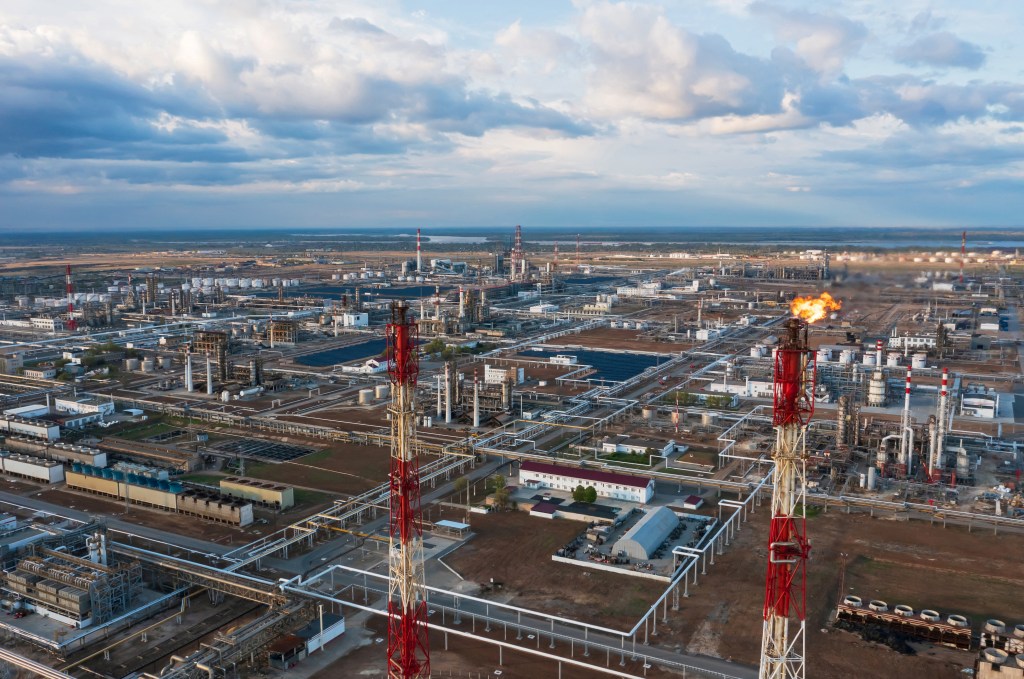
The Lukoil refinery in Volgograd, Russia, on April 22, 2022. (Reuters)
KYIV, Ukraine — American diesel prices rose for a second straight week as Russia’s seaborne crude exports reached their highest weekly value since the country launched its full-scale invasion of Ukraine. The price hike comes weeks after U.S. President Donald Trump moved to ease restrictions on Russian diesel and pressure Kyiv to spare Russian refineries ahead of the U.S. midterm elections.
Diesel averaged $6.35 a gallon on Monday, just below the record $6.53 set in September, according to data from the U.S. Energy Information Administration .
The economy is the top issue heading into the Nov. 3 midterms, with 84% of registered voters calling it “very important” to their vote and 54% saying the same of energy policy, according to a Pew Research Center survey conducted Sept. 28 to Oct. 4.
“The president decided to pin this problem not on Putin, but on me. Explaining to his people that because of this, diesel prices in America are going up. That is completely untrue,” Ukrainian President Volodymyr Zelenskyy said of Trump’s recent claims that Ukraine’s attacks on Russian refineries were to blame for the price increases.
Trends in federal data back up the Ukrainian president, showing that the steep initial rise in diesel prices followed the start of the Iran war — not Ukrainian strikes on Russian production infrastructure.
U.S. diesel stayed below $3.90 a gallon from August 2025 until the U.S. and Israeli strikes on Iran began Feb. 28, then jumped nearly 25% in a week to $4.86, according to the Energy Information Administration.
“This crisis has its roots in the Middle East. Everyone understands that perfectly well. Everyone knows how to do the math,” Zelenskyy said on Oct. 12, quoting his remarks to the Warsaw Security Forum. “If Russia accounts for 2.2% of global diesel supplies, what impact can it have on the price? That’s how negligible it is.”
Even Moscow’s senior officials agree.
“The key guarantee of full stabilization of this market is the speediest normalization of the situation around the Persian Gulf, overcoming the conflict around Iran,” Russian Deputy Foreign Minister Georgy Borisenko told reporters Oct. 12.
The International Energy Agency confirmed in an Oct. 14 report that easing Russia’s diesel export ban is unlikely to materially change global supplies because Russia lacks the working refinery capacity.
The diesel sales will barely move American prices before the vote, but the deal would benefit Russia disproportionately and cost Kyiv one of its few levers against the Kremlin, according to the Institute for the Study of War and the Carnegie Russia Eurasia Center .
The current situation gives Moscow deeper diplomatic ties with Washington — economic cooperation that continues despite Russia’s attacks on Ukraine’s more vulnerable energy grid — as well as more money for its war chest and the prospect that U.S. pressure will halt Ukraine’s strikes on its refineries that help fund the war, experts at both institutions said.
“The diesel agreement gives Putin an opportunity to advance economic cooperation with Washington before any settlement in Ukraine,” Carnegie senior fellow Tatiana Stanovaya wrote on Oct. 14. “Economic agreements can coexist with unchanged demands on Ukraine and continued military pressure.”
The Kremlin is also using the deal to win U.S. support for its negotiating position with Ukraine, part of a recurring effort to offer Washington economic incentives it claims are unrelated to the war “in order to extract concessions from the U.S. regarding the war,” ISW said.
Agioi Fanendes, a Malta-flagged medium-sized tanker, transits the Bosphorus in Istanbul, Turkey, April 11, 2024. The tanker, loaded with diesel fuel, departed Russia on Friday, Oct. 23, 2026, headed for the United States. (Yoruk Isik/Reuters)
Critics in Kyiv and Washington, including members of Trump’s own party, warn the deal will put more oil money in Russian hands and disproportionately impact Ukraine. Zelenskyy told the Warsaw Security Forum that the country has “just one oil refinery,” while Russia has 32 major refineries, according to the International Energy Agency.
Four Republican and three Democratic senators urged the Trump administration Oct. 11 to “immediately reverse course,” saying in a joint statement that “the United States should not provide Putin with a financial lifeline while Russia continues to kill Ukrainian civilians.”
Two days later, 12 senators from both parties, including Republicans Mitch McConnell, R-Ky., and John Cornyn, R-Texas, wrote to Trump in a letter that the deal will have “a negligible impact on fuel prices” and “is a gift to our adversary and a betrayal of our Allies.”
“Putin is looking for a way to get the United States to pressure Ukraine to stop striking those refineries,” Rep. Don Bacon, R-Neb., wrote the day the deal was announced.
Not enough to offset losses
Ukraine’s strikes have taken some Russian diesel off the market.
Russian diesel production fell by nearly 30% as attacks on refineries intensified, the International Energy Agency said in a Sept. 17 analysis .
The estimated gross value of Russia’s seaborne crude shipments hit a wartime high of $2.76 billion this week, up roughly $430 million from the week before, Bloomberg reported.
No strikes on Russian refineries were reported last week, and the lull has allowed Moscow to boost processing rates, likely diverting crude that would otherwise have been exported, the outlet reported.
But the Gulf’s losses are far larger. Diesel exports from the region dropped to 390,000 barrels a day in August, just over a quarter of prewar levels, according to International Energy Agency figures .
Russia’s promised deliveries won’t close that gap.
The first shipment equals just about 2% of U.S. diesel demand over a month, CNBC reported. Goldman Sachs estimated the first two months of deliveries would cut wholesale prices on the U.S. Gulf Coast by just $1 to $2 a barrel, or roughly 2 to 5 cents a gallon.
“Now we can see how cash will start flowing back into Russia through the diesel deal,” Zelenskyy told reporters at a European Union summit in Brussels on Oct. 16, according to Reuters .
“This diesel deal will never be enough to offset the impact of the Strait of Hormuz on global markets. But it will put more money straight into Putin’s pocket to fund this war.”
Trump eased sanctions on Russian diesel after an Oct. 9 call with Russian President Vladimir Putin, saying in a Truth Social post that Russia would supply hundreds of thousands of tons of diesel fuel “immediately” and that diesel prices would come down “IN RECORD NUMBERS, AND FAST!”
The same day, U.S. envoys Steve Witkoff and Jared Kushner told Ukrainian negotiators in Miami that the White House hoped the diesel deal would soften Moscow’s stance on peace talks. Witkoff met Putin for in-person negotiations last week for the ninth time since February 2025.
Kyiv offered to refrain from striking Russian refineries if Moscow stopped hitting Ukraine’s energy infrastructure, Zelenskyy said Oct. 11.
The current price of diesel fuel is displayed at a gas station in Encinitas, California, on Oct. 21, 2026. (Mike Blake/Reuters)
Ukraine paused refinery strikes at Trump’s request, but Russia kept hitting Ukraine’s energy infrastructure, prompting Kyiv to resume its own counterattacks, Zelenskyy told the Financial Times on Oct. 15.
“We’re done,” he said.
Within days of Trump’s sanction announcement, Ukrainian officials accused Washington of pressuring Kyiv to capitulate by withholding missile warnings and throttling the military’s essential Starlink connectivity , intelligence that Zelenskyy said “helps save people’s lives.”
Trump denied any interruption in missile warnings or Starlink service, but Ukrainian officials have stood by their account, prompting Zelenskyy to say he felt betrayed by the U.S.
Both have since been restored, Zelenskyy said Saturday, but Russia’s attacks have not let up.
Russia fired 16 ballistic missiles and more than 280 drones at Ukraine overnight Monday into Tuesday, targeting “energy, logistics and ordinary urban infrastructure” almost everywhere, Zelenskyy said .
The barrage came as the U.N. Independent International Commission of Inquiry on Ukraine concluded that Russian authorities had committed war crimes and crimes against humanity through attacks on Ukraine’s energy infrastructure.
Katie Livingstone is the Ukraine correspondent for Defense News and Military Times. Based in Kyiv, she has covered Russia’s full-scale invasion since its first days. She is a former Fulbright fellow whose award-winning work has appeared in outlets across Europe and the U.S.
分享至 Facebook(在新窗口中打开) Facebook
分享至 X(在新窗口中打开)X
在 Bluesky 上分享(在新窗口中打开)Bluesky
分享到 Reddit(在新窗口中打开)
在领英上分享(在新窗口中打开)领英
使用原生工具分享 已复制到剪贴板
分享至邮件(在新窗口中打开)邮件
2022年4月22日,位于俄罗斯伏尔加格勒的卢克石油炼油厂。(路透社)
乌克兰基辅——由于俄罗斯海运原油出口量达到自俄罗斯全面入侵乌克兰以来的最高周值,美国柴油价格连续第二周上涨。此前数周,美国总统特朗普曾试图放松对俄罗斯柴油的限制,并向基辅施压,要求其在即将到来的美国中期选举前保护俄罗斯炼油厂。
根据美国能源信息署的数据,周一柴油平均价格为每加仑 6.35 美元,略低于 9 月份创下的每加仑 6.53 美元的历史最高纪录。
根据皮尤研究中心 9 月 28 日至 10 月 4 日进行的一项调查显示,经济是 11 月 3 日中期选举的首要议题,84% 的注册选民认为经济对他们的投票“非常重要”,54% 的选民对能源政策持相同看法。
“总统决定把这个问题归咎于我,而不是普京。他向民众解释说,正因为如此,美国的柴油价格才上涨。这完全是无稽之谈。”乌克兰总统泽连斯基就特朗普最近声称乌克兰袭击俄罗斯炼油厂是导致油价上涨的原因一事如此说道。
联邦数据显示,柴油价格最初大幅上涨是在伊朗战争爆发后发生的,而不是乌克兰对俄罗斯生产基础设施的袭击之后发生的。
据美国能源信息署称,从 2025 年 8 月到 2 月 28 日美国和以色列开始对伊朗发动袭击之前,美国柴油价格一直低于每加仑 3.90 美元,然后在一周内上涨了近 25%,达到每加仑 4.86 美元。
“这场危机的根源在于中东。每个人都非常清楚这一点。每个人都知道如何计算,”泽连斯基10月12日援引他在华沙安全论坛上的讲话说道。“如果俄罗斯只占全球柴油供应量的2.2%,它对价格又能产生什么影响呢?影响微乎其微。”
就连莫斯科的高级官员也同意这一点。
俄罗斯副外长格奥尔基·鲍里先科10月12日对记者表示:“确保该市场全面稳定的关键在于尽快实现波斯湾周边局势正常化,克服伊朗冲突。”
国际能源署在 10 月 14 日的一份报告中证实,放松对俄罗斯柴油出口的禁令不太可能从根本上改变全球供应,因为俄罗斯缺乏运转中的炼油能力。
据战争研究所和卡内基俄罗斯欧亚中心称,柴油销售在投票前几乎不会对美国油价产生影响,但该协议将使俄罗斯获得不成比例的利益,并使基辅失去对抗克里姆林宫的少数几个手段之一。
两家机构的专家表示,目前的局势使莫斯科与华盛顿建立了更深层次的外交关系——尽管俄罗斯袭击了乌克兰更为脆弱的能源网络,但经济合作仍在继续——同时也为俄罗斯的战争储备提供了更多资金,并且美国施压有望阻止乌克兰对其炼油厂的袭击,这些炼油厂有助于为战争提供资金。
卡内基高级研究员塔蒂亚娜·斯塔诺瓦娅10月14日写道:“柴油协议让普京有机会在乌克兰问题达成任何协议之前,推进与华盛顿的经济合作。经济协议可以与对乌克兰不变的要求和持续的军事压力并存。”
ISW表示,克里姆林宫还利用这项协议来赢得美国对其与乌克兰谈判立场的支持,这是其反复向华盛顿提供经济激励措施的一部分,声称这些激励措施与战争无关,“目的是为了从美国那里获得与战争相关的让步”。
2024年4月11日,悬挂马耳他国旗的中型油轮“阿吉奥伊·法内德斯”号(Agioi Fanendes)驶过土耳其伊斯坦布尔的博斯普鲁斯海峡。这艘装载柴油的油轮于2026年10月23日(星期五)从俄罗斯启航,目的地是美国。(Yoruk Isik/路透社)
基辅和华盛顿的批评人士,包括特朗普所在政党的成员,警告称这项协议将使更多石油资金落入俄罗斯手中,并对乌克兰造成不成比例的影响。泽连斯基在华沙安全论坛上表示,乌克兰“只有一座炼油厂”,而根据国际能源署的数据,俄罗斯拥有32座大型炼油厂。
10 月 11 日,四名共和党参议员和三名民主党参议员敦促特朗普政府“立即改变路线”,他们在联合声明中表示,“在俄罗斯继续杀害乌克兰平民的情况下,美国不应该向普京提供财政生命线”。
两天后,包括共和党参议员米奇·麦康奈尔(肯塔基州)和约翰·科宁(德克萨斯州)在内的两党 12 名参议员联名致信特朗普,称该协议“对燃油价格的影响微乎其微”,并且“是送给对手的礼物,是对我们盟友的背叛”。
“普京正在寻找一种方法,让美国向乌克兰施压,迫使其停止袭击这些炼油厂,”内布拉斯加州共和党众议员唐·培根在协议宣布当天写道。
不足以弥补损失
乌克兰的空袭导致部分俄罗斯柴油退出市场。
国际能源署在9月17日的一份分析报告中指出,随着对炼油厂的袭击加剧,俄罗斯柴油产量下降了近30%。
据彭博社报道,本周俄罗斯海运原油总价值估计达到战时最高水平 27.6 亿美元,比前一周增加了约 4.3 亿美元。
据该媒体报道,上周没有俄罗斯炼油厂发生罢工,这段平静期让莫斯科得以提高炼油厂的加工速度,这很可能将原本用于出口的原油转移到了其他地区。
但海湾地区的损失要大得多。据国际能源署的数据显示,该地区8月份的柴油出口量降至每天39万桶,仅为战前水平的四分之一多一点。
俄罗斯承诺的交付量无法弥补这一差距。
据CNBC报道,首批交付的柴油量仅相当于美国一个月柴油需求的约2%。高盛估计,前两个月的交付只会使美国墨西哥湾沿岸的批发价格每桶下降1至2美元,或每加仑下降约2至5美分。
据路透社报道,泽连斯基10月16日在布鲁塞尔举行的欧盟峰会上告诉记者:“现在我们可以看到,通过柴油交易,资金将开始回流俄罗斯。”
“这项柴油交易永远不足以抵消霍尔木兹海峡对全球市场的影响。但它会直接给普京的口袋里带来更多资金,用于这场战争。”
特朗普在10月9日与俄罗斯总统弗拉基米尔·普京通话后放松了对俄罗斯柴油的制裁。他在Truth Social上发帖称,俄罗斯将“立即”供应数十万吨柴油,柴油价格将“以创纪录的速度”下降!
同一天,美国特使史蒂夫·威特科夫和贾里德·库什纳在迈阿密告诉乌克兰谈判代表,白宫希望柴油协议能够软化莫斯科在和平谈判中的立场。威特科夫上周与普京举行了自2025年2月以来的第九次面对面会谈。
泽连斯基10月11日表示,如果莫斯科停止打击乌克兰的能源基础设施,基辅方面将不会打击俄罗斯炼油厂。
2026年10月21日,加利福尼亚州恩西尼塔斯一家加油站的柴油价格牌。(迈克·布莱克/路透社)
泽连斯基10月15日告诉《金融时报》,乌克兰应特朗普的要求暂停了对炼油厂的袭击,但俄罗斯继续袭击乌克兰的能源基础设施,促使基辅恢复了自己的反击。
“我们完成了,”他说。
在特朗普宣布制裁后的几天内,乌克兰官员指责华盛顿通过扣留导弹警告和限制军方至关重要的星链连接来向基辅施压,迫使其屈服。泽连斯基表示,这些情报“有助于拯救人们的生命”。
特朗普否认导弹预警或星链服务有任何中断,但乌克兰官员坚持他们的说法,这促使泽连斯基表示他感到被美国背叛。
泽连斯基周六表示,这两个地方都已恢复,但俄罗斯的袭击并未停止。
泽连斯基表示,俄罗斯周一晚至周二凌晨向乌克兰发射了16枚弹道导弹和280多架无人机,几乎在所有地方都以“能源、物流和普通城市基础设施”为目标。
就在联合国乌克兰问题独立国际调查委员会得出结论,认为俄罗斯当局通过袭击乌克兰能源基础设施犯下了战争罪和反人类罪之际,这轮猛烈抨击随之而来。
凯蒂·利文斯通是《防务新闻》和《军事时报》的乌克兰特派记者。她常驻基辅,自俄罗斯全面入侵乌克兰之初便开始报道此事。她曾是富布赖特学者,其获奖作品发表于欧洲和美国的多家媒体。