Taiwan 2027 conflict window remains valid, Army Pacific commander says太平洋陆军司令称,台湾2027年冲突窗口仍然有效。
Army Pacific is positioning personnel and equipment across the Pacific to meet the 2027 “Davidson window” benchmark and deter a potential Chinese attack on Taiwan, Gen. Ronald Clark said.
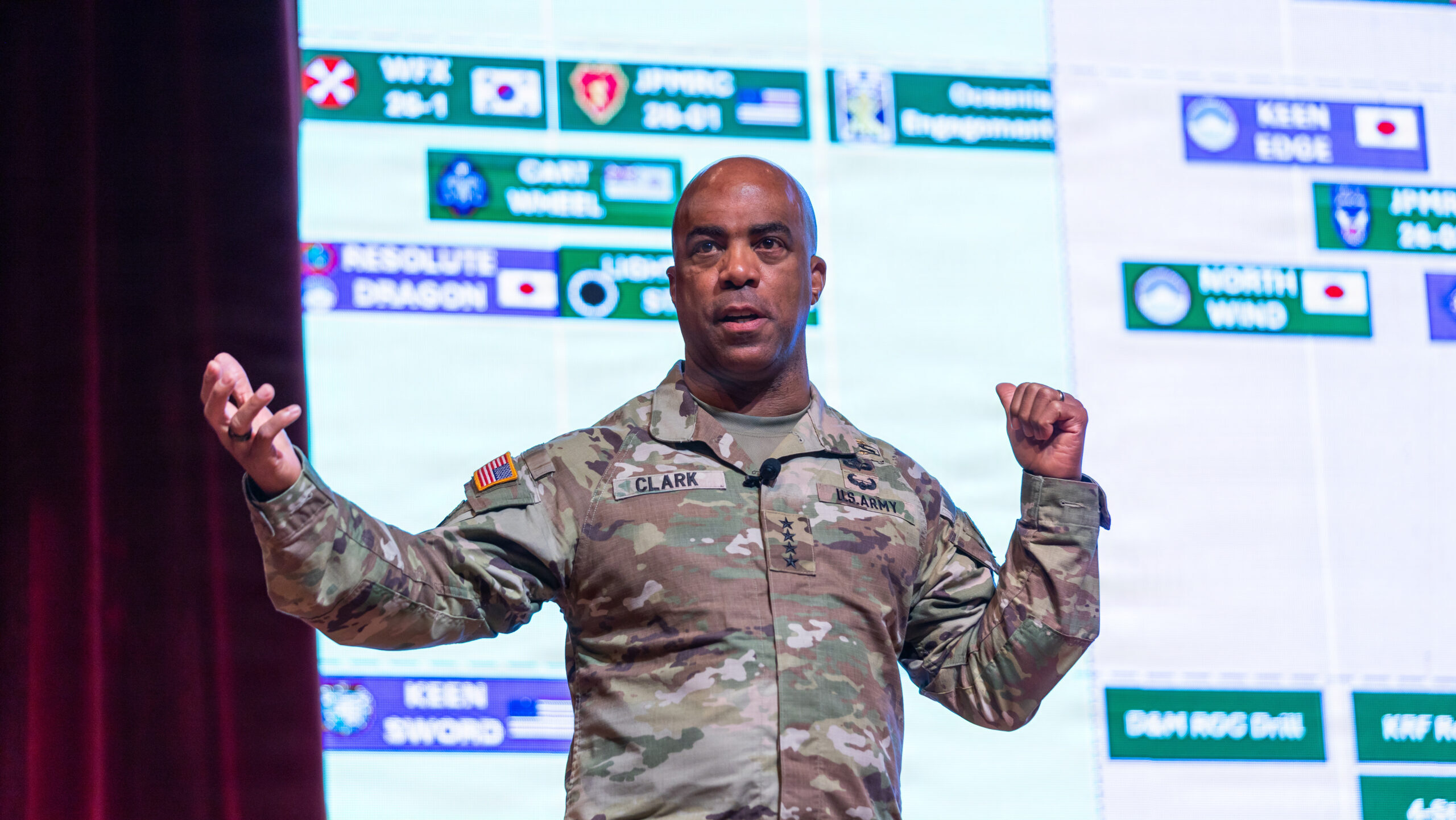
Gen. Ronald P. Clark Commanding General United States Army Pacific (USARPAC), delivers a presentation on "Land Forces: The Foundation of Pacific Stability" during the first day of the annual Maneuver Warfighter Conference Sept. 15, 2026, in Marshall Auditorium at Fort Benning, Georgia. (U.S. Army photo by Daniel Marble)
WASHINGTON — The head of US Army Pacific says his command is still preparing for the potential Chinese invasion of Taiwan that US officials have warned could occur as early as next year.
“The question is, is the window still valid? The answer for us at USARPAC is yes,” Gen. Ronald Clark said Tuesday at AFCEA’s TechNet Indo-Pacific conference in Hawaii.
Known as the “Davidson window,” the timeline is named for retired Adm. Phil Davidson, former head of US Indo-Pacific Command. In 2021, Davidson told the Senate Armed Services Committee that China could develop the capability to invade Taiwan within the following six years.
The 2027 date has since served as a planning benchmark for US and allied forces preparing to deter potential Chinese aggression against the self-governed island, which Beijing claims as its territory.
Clark, who served as Davidson’s chief of staff when he made the proclamation, said Army Pacific is working to move forces and equipment in the region to deter conflict during that period.
“We’ve embarked upon a strategic approach to setting the theater that we refer to as Army Ready Forward,” Clark said. The effort involves positioning equipment, materiel and personnel on a rotational basis across the first and second island chains west of the international date line.
The goal is to be ready by April 2, 2027, he said.
“Again, it’s not a date that we think that conflict will happen. It is a period of time for which we’re snapping the chalk line to say we need to be ready by this date,” Clark added. “But we’ll continue to prepare, we’ll continue to modernize, we’ll continue to posture ourselves for the business of deterring war well beyond [2027].”
Asked about what operational challenges industry could help address over the next six months, Clark pointed to the need for both advanced capabilities and affordable systems that can be produced at scale.
The military has largely relied on bespoke and tailored equipment in recent decades, but developing and procuring such systems can be expensive and cause significant delays in getting gear to the front lines.
As a result, the Defense Department has begun emphasizing a commercial-first approach, trying to adopt good enough solutions that soldiers can immediately use during operations. That approach also calls for fielding capabilities at scale, including large numbers of low-cost drones that can overwhelm an adversary.
“We need the right balance between exquisite, high-end systems and affordable, mass-producible alternatives. Meeting that requirement demands that the industrial base adapt to provide the surge capability and capacity required in crisis,” Clark said. “Our operational requirement is clear: we must develop resilient, affordable and scalable ways to sustain forces at the tactical edge when traditional infrastructure is disrupted or unavailable. This requirement underscores an urgent need for industry partnership.”
Breaking Defense Video
How General Atomics views Europe’s unmanned future
A more flexible way to defend maneuver forces from drones that doesn’t tie them down [Sponsored]
What’s haunting the Pentagon this Halloween?
The new must-have capabilities for drones [Sponsored]
Army’s tech chief talks autonomy, acquisition and the future of drones
Drones take over AUSA, plus the Army’s plan to bring in new vendors
Hegseth talks autonomy at AUSA, a key show focus
Army doubles down on autonomy, stakes out Indo-Pacific role: AUSA Day 2
Telle talks ‘manufacturing rodeo,’ supply chain ‘weak links’: AUSA Day 1
New leaders, new drone command: What we expect from AUSA 2026
美国太平洋陆军司令罗纳德·P·克拉克将军于2026年9月15日在佐治亚州本宁堡马歇尔礼堂举行的年度机动作战人员大会首日发表了题为“陆军:太平洋稳定的基础”的演讲。(美国陆军照片,摄影:丹尼尔·马布尔)
华盛顿——美国太平洋陆军司令表示,他的指挥部仍在为中国可能入侵台湾做准备,美国官员警告称,这种情况最早可能在明年发生。
“问题是,这个窗口期是否仍然有效?对于我们美国陆军太平洋司令部来说,答案是肯定的,”罗纳德·克拉克将军周二在夏威夷举行的美国空军工程协会(AFCEA)印太技术网络会议上表示。
这一时间线被称为“戴维森窗口期”,以美国印太司令部前司令、退役海军上将菲尔·戴维森的名字命名。2021年,戴维森在参议院军事委员会作证时表示,中国可能在未来六年内发展出入侵台湾的能力。
2027 年这一日期此后一直被美国及其盟军视为规划基准,以阻止中国可能对这个自治岛屿发动的侵略,北京声称该岛屿是其领土。
克拉克在戴维森宣布这一消息时担任他的参谋长,他表示,太平洋陆军正在努力向该地区调动部队和装备,以阻止这一时期的冲突。
克拉克说:“我们已经启动了一项战略部署计划,我们称之为‘陆军前沿部署’。”这项计划包括将装备、物资和人员轮流部署在国际日期变更线以西的第一和第二岛链上。
他说,目标是在2027年4月2日之前做好准备。
克拉克补充道:“再次强调,这并不是说我们认为冲突一定会发生。我们只是划定了一个时间段,表明我们需要在这个日期前做好准备。但我们将继续做好准备,继续推进现代化建设,继续调整自身态势,以应对远超2027年的战争威慑任务。”
当被问及未来六个月内行业可以帮助解决哪些运营挑战时,克拉克指出,既需要先进的能力,也需要能够大规模生产的负担得起的系统。
近几十年来,军方主要依靠定制和量身打造的装备,但开发和采购此类系统可能成本高昂,并导致装备运抵前线的时间大幅延迟。
因此,国防部开始强调“商业优先”的策略,力求采用足够好的解决方案,以便士兵在作战行动中能够立即使用。这种策略还要求大规模部署相关能力,包括大量能够压制对手的低成本无人机。
克拉克表示:“我们需要在精良的高端系统和价格合理、可大规模生产的替代方案之间找到合适的平衡点。要满足这一需求,工业基础必须进行调整,以提供危机时期所需的应急能力和产能。我们的作战需求很明确:我们必须开发出具有韧性、价格合理且可扩展的方式来保障在传统基础设施中断或无法使用时,处于战术前沿的部队。这一需求凸显了与业界合作的迫切性。”
突破性防御视频
通用原子公司如何看待欧洲的无人化未来
一种更灵活的防御机动部队免受无人机攻击的方式,不会限制其行动[赞助]
今年万圣节,五角大楼究竟被什么鬼魂萦绕?
无人机必备的新功能 [赞助内容]
陆军技术主管谈无人机的自主性、采购和未来
无人机主导了美国陆军协会(AUSA)的会议,此外,陆军还计划引入新的供应商。
Hegseth 在 AUSA 大会上谈到了自主性,这是本次大会的一个重点议题。
陆军加倍强调自主性,明确印太地区角色:AUSA第二天
特勒谈“制造业乱象”、供应链“薄弱环节”:AUSA第一天
新领导人,新无人机指挥部:我们对 AUSA 2026 的期待