He helped grow Guangzhou Metro. Now he’s lending his expertise in S’pore他曾助力广州地铁发展壮大。如今,他正将自己的专业知识贡献给新加坡。
Guangzhou Metro veteran Cai Changjun shares rail innovation lessons as one of his inventions is being tested for Singapore’s MRT network. Read more at straitstimes.com.
This rail industry veteran came to Singapore in the early 2000s to study its trains. Today, he sits on two public transport advisory panels here, and says the learning still goes both ways
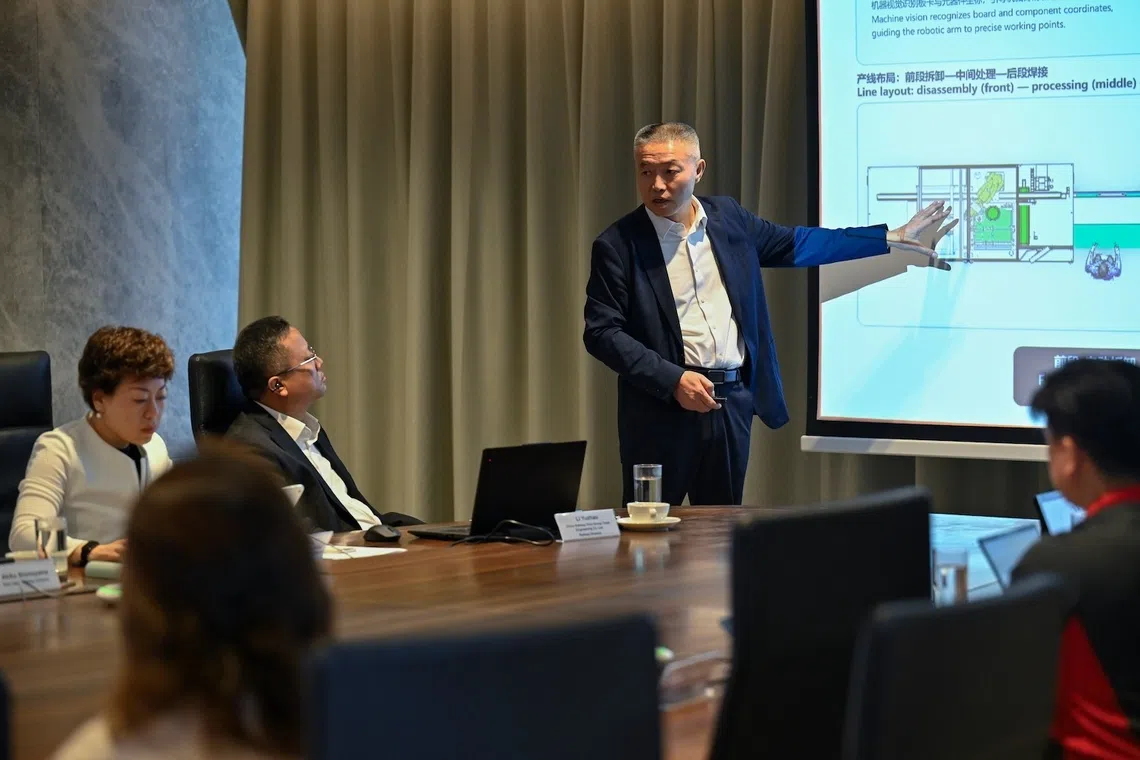
Railway industry veteran Cai Changjun sharing about the automation solutions for railway maintenance at SMRT’s Technical Advisory Panel held from Oct 14 to 16.
PHOTO: CAROLINE CHIA
Kareyst Lin, Brand Newsroom
Published Oct 30, 2026, 04:00 AM
In 2013, a diagnostic computer at Guangzhou Metro broke down. It was worth tens of thousands of yuan. The quote to replace it: 1 million yuan (S$192,300).
The machine contained software for checking the on-board signalling systems of 21 trains. Back then, suppliers often sold the device and its software only as a bundle.
Guangzhou Metro did not pay. Instead, that episode – a “painful experience” – pushed Cai Changjun, then the general manager of its operations division, to develop creative solutions.
One of them, Suiteng OS, is being adapted and tested in Singapore at the SMRT-Guangzhou Metro Rail Innovation Laboratory, launched at Bishan Depot on June 3, 2026.
Suiteng OS was first deployed at Guangzhou Metro in September 2019. It is a rail operating system that can be updated the same way as a smartphone’s operating system.
Today, Cai, 61, is lending his expertise in Singapore. He advises SMRT on a range of technical matters, including making the MRT network easier to upgrade and maintain, and improving rail operations and commuter experiences.
He sits on the public transport operator’s Technical Advisory Panel (TAP), and is one of five members of the Land Transport Authority’s Independent Advisory Panel.
Components of railway systems used to be built like sealed products, explains Cai, who retired last year as deputy general manager of Guangzhou Metro. He joined in 1995, before its first line opened in June 1997.
The metro network is now one of the largest in the world, with 19 lines spanning 780km of track and nearly 400 stations.
“When the hardware breaks, (operators cannot simply) replace the hardware and reinstall the software,” Cai explains in Mandarin.
“It’s like buying an old feature phone (that’s not a smartphone),” he adds. “Whatever functions it has when you first buy it, is what you have.”
Now, hardware and software can be decoupled, and software development is modular. This makes it simpler for public transport operators to upgrade their systems.
Cai’s career spanned some of Guangzhou Metro’s most complex operational and technological upgrades. He holds 36 invention patents, including the building blocks of Suiteng OS – such as one that lets the system automatically recognise new equipment once it is installed, and a system that can track train speed and location.
In an interview on the sidelines of the 13th TAP held from Oct 14 to 16 at SMRT’s headquarters, Cai reflects on learning on the job, what he thinks about Singapore’s MRT network, and what a commuter-centric public transport experience looks like.
Cai (middle) speaking with SMRT leaders on the sidelines of SMRT’s Technical Advisory Panel on Oct 16. PHOTO: CAROLINE CHIA
Cai (middle) speaking with SMRT leaders on the sidelines of SMRT’s Technical Advisory Panel on Oct 16.
How does it feel to see Suiteng OS being tested in Singapore?
A: I feel very gratified and proud to see it being trialled here.
Metros in different cities share some things in common, but passengers’ travel patterns, cultures and service needs differ. SMRT will have to (build applications on Suiteng OS that) suit its own operations and service needs in Singapore.
Suiteng OS was not created for one specific scenario. It was built on a more fundamental, service-oriented philosophy, so it’s adaptable and not a fixed product.
Because the train network is like a living organism. It keeps growing; it doesn’t stay at just one line. What passengers want changes too. But once the system is fixed, it can’t meet these changing requirements.
In the early 2000s, you came to Singapore to learn about rail operations from SMRT. What stood out for you?
A: I was here to learn about the Bukit Panjang LRT, as Guangzhou Metro was looking into building similar automated train systems at that point.
Two things left a deep impression on me.
First, whenever the train passed in front of a residential block, the windows automatically turned opaque. What this showed me is that the city’s train systems were built on a people-centred design philosophy.
Second, there was a self-service counter between the paid and unpaid areas, so the stations could run without staff. That was considered very advanced at the time.
Cai (front) at Guangzhou Metro’s Xilang Depot in November 2024, inspecting the overhaul of its trains. PHOTO: COURTESY OF CAI CHANGJUN
Cai (front) at Guangzhou Metro’s Xilang Depot in November 2024, inspecting the overhaul of its trains.
PHOTO: COURTESY OF CAI CHANGJUN
Why is it important for train operators to learn from each other?
A: When China first began building urban rail, we learnt from the most advanced train operators at that time: Germany, France, Hong Kong and Singapore.
While we have made progress, it doesn’t mean we can start being complacent. If others have been through challenges that you might face in future, you can save a great deal of work by learning about it now.
As an international city, Singapore has a quality captured by the Chinese idiom: “a sea that takes in a hundred rivers”. The city is willing to learn from everyone else, and I believe that is what gives it an advantage.
What does public transport mean to you?
A: The basic function of public transport is getting people to their destinations.
But in a big city, a person can spend an hour a day or more on the metro. Part of their life gets woven into that journey, so the service can’t simply be about getting them from point A to point B; it also has to meet other needs, such as convenience, food and even entertainment.
Rapid transit can also expand a city’s space by shortening distances in space and time. If transport isn’t convenient or efficient, everyone will end up living close to where they work, which can strain the city’s living environment.
Public transport, especially rapid transit, opens up more living space. That’s good for the city’s development, and good for improving where residents live.
Cai (first on the right) at the site of an electrical system upgrade for Guangzhou Metro Line 1’s oldest trains in April 2024. PHOTO: COURTESY OF CAI CHANGJUN
Cai (first on the right) at the site of an electrical system upgrade for Guangzhou Metro Line 1’s oldest trains in April 2024.
Looking back, what are you proudest of?
A: Being part of such a magnificent wave of rail construction, which is now serving Guangzhou’s nearly 20 million residents.
Every year, Guangzhou Metro carries 3.3 billion passenger trips. Making residents feel the metro is reliable, and making it part of their daily lives, is something worth being proud of.
Once, a reporter asked me: if you could do it all again, how would you have built the metro differently? I replied that I have already given it my best shot. Not many people get to be part of such a large project – Guangzhou Metro built 19 lines in span of 30 years – over the course of their career.
My colleagues and I kickstarted it; those who come after will continue to make it even better.
Experts behind the tracks
Guangzhou Metro veteran Cai Changjun, 61, is one of nine experts invited to be part of SMRT’s 13th annual Technical Advisory Panel (TAP) held from Oct 14 to 16, 2026.
Experts who attended this year’s TAP include:
Lee Kang-kuen, professor of Practice (Transportation) at Hong Kong Polytechnic University, who has over 50 years of experience in trains and railway design, maintenance, and upgrading projects; and
Tsuyoshi Tabuchi, president of Osaka-headquartered rail construction and engineering firm JR West Railtec, and an expert in track infrastructure.
Set up in 2013, the annual TAP brings together international and local experts to exchange insights on rail engineering capabilities, people, processes and technology.
The aim: To improve SMRT’s operational performance and strengthen engineering expertise. SMRT notes that past TAP sessions have led to improvements in rail assets maintenance programmes and more adoption of condition monitoring on train and signalling systems.
At the session on Oct 16, Cai shared automation solutions that he implemented at Guangzhou Metro before retiring last year. These include:
360-degree multi-camera systems that scan every train entering or leaving the depot for defects;
Robots that inspect the underside of trains; and
Inspection systems mounted on rail vehicles that survey tunnel walls at up to 80 km/h, a job once done by workers on foot in the early-morning hours.
Topics presented by other experts at the same session include robotics in rail construction and maintenance, artificial intelligence and cybersecurity for rail systems.
Cai is also one of five members of the Land Transport Authority’s Independent Advisory Panel (IAP).
“Being able to come to Singapore and serve on both the TAP and the IAP is truly an honour,” he says. “(It is) a recognition of my career.”
Because Guangzhou Metro both owns its rail assets and runs its network, Cai has worked on both sides of the table. This lets him see issues from the perspectives of both the asset owner and the operator.
Ultimately, he adds, “the goals are the same: to provide the city with public transport people can trust.”
This article was produced in partnership with SMRT.
这位铁路行业资深人士在2000年代初来到新加坡考察当地的火车系统。如今,他担任新加坡两个公共交通咨询委员会的成员,并表示这种学习仍然是双向的。
铁路行业资深人士蔡长军在 SMRT 技术咨询小组会议上分享了铁路维护自动化解决方案(10 月 14 日至 16 日)。
照片:卡罗琳·基亚
Kareyst Lin,品牌新闻编辑室
发布于 2026 年 10 月 30 日 上午 4:00
2013年,广州地铁一台诊断电脑发生故障,价值数万元人民币。更换报价:100万元人民币(约合19.23万新元)。
这台机器包含用于检查21列火车车载信号系统的软件。当时,供应商通常将设备和软件捆绑销售。
广州地铁没有支付赔偿金。相反,那次“痛苦的经历”促使时任运营部总经理蔡长军寻求创造性的解决方案。
其中一款操作系统 Suiteng OS 正在新加坡的 SMRT-广州地铁创新实验室进行适配和测试,该实验室于 2026 年 6 月 3 日在碧山车辆段启动。
Suiteng OS 于 2019 年 9 月首次在广州地铁部署。它是一款轨道交通操作系统,可以像智能手机操作系统一样进行更新。
现年61岁的蔡先生目前在新加坡发挥其专业知识。他为SMRT提供一系列技术方面的建议,包括如何使地铁网络更易于升级和维护,以及如何改善铁路运营和乘客体验。
他是公共交通运营商技术咨询小组 (TAP) 的成员,也是陆路交通管理局独立咨询小组的五名成员之一。
蔡先生解释说,过去铁路系统的部件都是像密封产品一样制造的。他去年从广州地铁副总经理的职位上退休,1995年加入广州地铁,当时广州地铁的第一条线路尚未开通(1997年6月)。
该地铁网络目前是世界上最大的地铁网络之一,拥有 19 条线路,总长 780 公里,设有近 400 个车站。
“当硬件出现故障时,(运营商不能简单地)更换硬件并重新安装软件,”蔡用普通话说。
“这就像买一部老式功能手机(不是智能手机)一样,”他补充道。“你刚买来的时候它有哪些功能,你就拥有它有哪些功能。”
如今,硬件和软件可以分离,软件开发也采用模块化设计。这使得公共交通运营商更容易升级系统。
蔡先生的职业生涯涵盖了广州地铁一些最复杂的运营和技术升级项目。他拥有36项发明专利,其中包括Suiteng操作系统的基础模块——例如,使系统能够在新设备安装后自动识别该模块,以及能够追踪列车速度和位置的系统。
在 10 月 14 日至 16 日于 SMRT 总部举行的第 13 届 TAP 会议间隙,蔡先生接受了采访,回顾了他在工作中学习的经历,谈到了他对新加坡地铁网络的看法,以及以通勤者为中心的公共交通体验是什么样的。
蔡(中)于10月16日在SMRT技术咨询小组会议间隙与SMRT领导层交谈。照片:CAROLINE CHIA
10 月 16 日,蔡(中)在 SMRT 技术咨询小组会议间隙与 SMRT 领导人交谈。
看到Suiteng OS在新加坡进行测试,你有什么感受?
A:看到它在这里进行试验,我感到非常欣慰和自豪。
不同城市的地铁有一些共同之处,但乘客的出行模式、文化和服务需求各不相同。SMRT 必须基于 Suiteng 操作系统开发符合其在新加坡运营和服务需求的应用程序。
Suiteng OS 并非为某个特定场景而设计。它基于更根本的、面向服务的理念构建,因此具有很强的适应性,而不是一个固定的产品。
因为铁路网络就像一个活的有机体,它会不断发展壮大,不会停留在一条线路上。乘客的需求也在不断变化。但一旦系统固定下来,就无法满足这些不断变化的需求。
2000年代初期,你来到新加坡向SMRT学习铁路运营。当时最让你印象深刻的是什么?
A:我来这里是为了了解武吉班让轻轨,因为当时广州地铁正在考虑建设类似的自动化列车系统。
有两件事给我留下了深刻的印象。
首先,每当列车经过居民楼前时,窗户就会自动变成不透明的。这让我意识到,这座城市的轨道交通系统是按照以人为本的设计理念建造的。
其次,付费区和非付费区之间设有自助服务柜台,这样车站就可以无需工作人员运营。这在当时被认为是非常先进的做法。
2024年11月,蔡长军(前)在广州地铁西浪车辆段视察列车检修情况。照片由蔡长军提供。
2024 年 11 月,蔡(前)在广州地铁西浪车辆段视察列车检修情况。
照片:蔡长军提供
为什么列车运营者之间互相学习很重要?
答:中国最初开始建设城市轨道交通时,我们向当时最先进的轨道交通运营商学习:德国、法国、香港和新加坡。
虽然我们取得了一些进展,但这并不意味着我们可以沾沾自喜。如果其他人曾经经历过你将来可能面临的挑战,那么现在就去了解这些挑战可以为你节省大量精力。
作为一座国际化大都市,新加坡拥有中国成语“百川汇流”所概括的特质。这座城市乐于向世界各地学习,我认为这正是它的优势所在。
公共交通对你来说意味着什么?
答:公共交通的基本功能是把人们送到目的地。
但在大城市里,人们每天可能要花一个小时甚至更长时间乘坐地铁。他们生活的一部分已经融入到这段旅程中,因此地铁服务不能仅仅是把他们从A点送到B点;它还必须满足其他需求,例如便利性、餐饮甚至娱乐。
快速交通系统还能缩短空间和时间上的距离,从而拓展城市空间。如果交通不便捷或效率低下,人们最终都会住在工作地点附近,这会给城市的居住环境带来压力。
公共交通,尤其是快速交通,能够释放更多居住空间。这有利于城市发展,也有利于改善居民的居住环境。
2024年4月,蔡长军(右一)在广州地铁1号线老旧列车电气系统升级改造现场。照片由蔡长军提供。
蔡(右一)于 2024 年 4 月在广州地铁 1 号线最老列车电气系统升级现场。
回首过去,你最引以为豪的是什么?
答:能够参与到如此宏伟的铁路建设浪潮中,为广州近2000万居民提供服务,我感到非常荣幸。
广州地铁每年运送乘客33亿人次。让居民感受到地铁的可靠性,并使其成为他们日常生活的一部分,是一件值得骄傲的事情。
有一次,一位记者问我:如果让你重新来过,你会如何建造广州地铁?我回答说,我已经尽力了。很少有人能在职业生涯中参与如此庞大的项目——广州地铁在30年间建成了19条线路。
我和我的同事们启动了这个项目;后来者将继续努力,让它变得更好。
幕后专家
广州地铁资深员工蔡长军(61岁)是受邀参加SMRT第13届年度技术咨询小组(TAP)的九位专家之一,该小组于2026年10月14日至16日举行。
出席今年TAP会议的专家包括:
李康权,香港理工大学交通运输实践教授,在列车和铁路设计、维护和升级项目方面拥有超过50年的经验;
田渕刚,JR西日本铁路技术有限公司(JR West Railtec)总裁,铁路基础设施专家,该公司总部位于大阪。
TAP 成立于 2013 年,每年举办一次,汇聚国际和本地专家,交流有关铁路工程能力、人员、流程和技术的见解。
目标:提升SMRT的运营效率并加强工程技术实力。SMRT指出,以往的TAP会议已促成轨道交通资产维护计划的改进,并推动了列车和信号系统状态监测技术的更广泛应用。
在10月16日的研讨会上,蔡先生分享了他去年退休前在广州地铁实施的自动化解决方案,其中包括:
360 度多摄像头系统,扫描进出车库的每一列火车,检查是否存在缺陷;
用于检查列车底部的机器人;
安装在轨道车辆上的检查系统可以以高达 80 公里/小时的速度勘测隧道壁,这项工作以前是由工人在清晨步行完成的。
在同一会议上,其他专家提出的主题包括铁路建设和维护中的机器人技术、铁路系统的人工智能和网络安全。
蔡也是陆路交通管理局独立咨询小组(IAP)的五名成员之一。
“能够来到新加坡,同时在TAP和IAP任职,我深感荣幸,”他说。“这(是)对我职业生涯的认可。”
由于广州地铁既拥有轨道资产又运营其网络,蔡先生曾同时在资产所有者和运营商两个层面工作过。这使他能够从资产所有者和运营商的角度看待问题。
他最后补充道,“目标是一致的:为城市提供人们可以信赖的公共交通。”
本文由SMRT合作撰写。