Singapore firms eyeing China market should target smart tech, green economy: EnterpriseSG新加坡企业发展局(EnterpriseSG)表示,有意进军中国市场的新加坡企业应重点关注智能技术和绿色经济。
China's manufacturing network, technological capabilities and research and development offer Singapore firms opportunities to improve their products, lower costs and expand internationally.
新闻视频
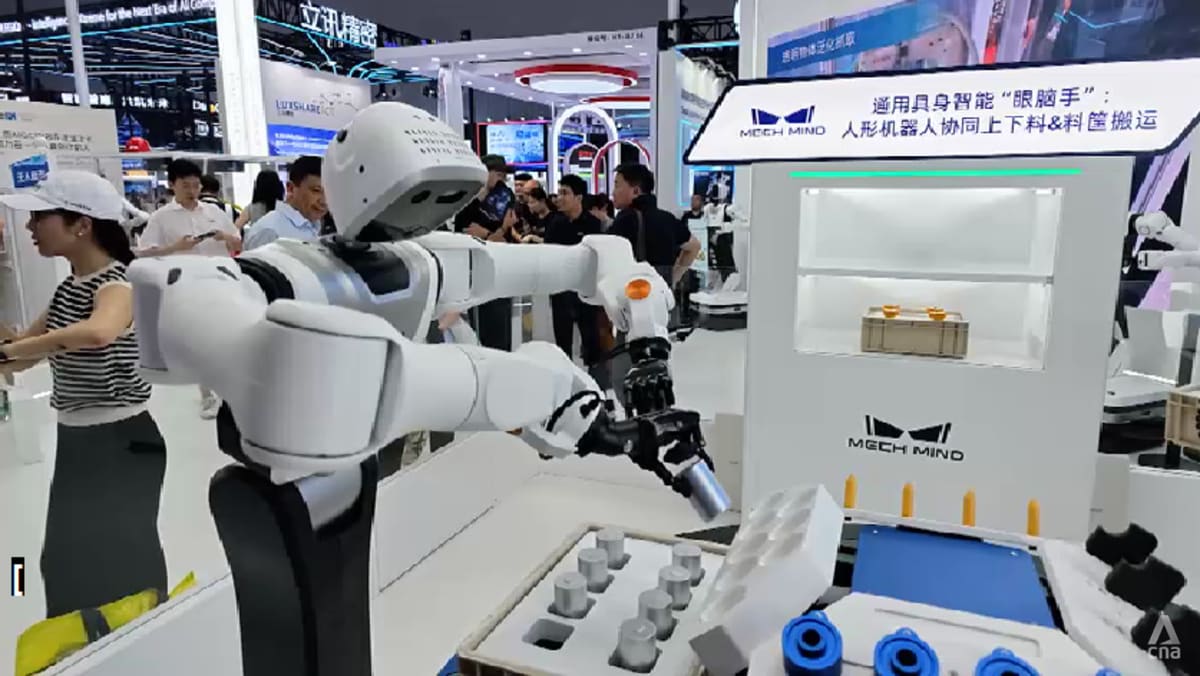
China's manufacturing network, technological capabilities and research and development offer Singapore firms opportunities to improve their products, lower costs and expand internationally.
China installed 354,000 industrial robots in 2025, accounting for about 60 per cent of global installations. (Image: CNA)
This audio is generated by an AI tool.
SUZHOU, Jiangsu: Singapore companies looking to expand into China should focus on growth sectors such as smart technology, advanced manufacturing and the green economy, said Enterprise Singapore (EnterpriseSG).
Mr Kow Juan Tiang, the statutory board's executive director for China, said opportunities remain abundant for firms offering innovative solutions.
He added that China's vast market, manufacturing capabilities and supply chains could also serve as a springboard for expansion into Southeast Asia and beyond.
“(China) is a very large market that is still showing significant growth, and that represents a lot of opportunities for Singapore companies to expand,” he said during a media trip organised by the agency.
CNA Games Guess Word Crack the word, one row at a time Buzzword Create words using the given letters Mini Sudoku Tiny puzzle, mighty brain teaser Mini Crossword Small grid, big challenge Word Search Spot as many words as you can Show More Show Less “It’s very important for us to know our core capabilities and the value proposition that we have.” One Singapore company tapping into China's rapidly growing robotics sector is Xnergy, which develops contactless charging solutions for autonomous robots. As factories, warehouses and other industries increasingly deploy robots, keeping large fleets charged and operational has become a growing challenge. Most robots rely on contact charging, which requires physical docking and can lead to wear and tear over time. Xnergy's technology works like universal chargers, allowing robots of different brands and models to charge without needing to be physically plugged in. Robots can automatically return to a charging station when their batteries run low, with charging beginning once they are correctly positioned. Since entering China in 2021, Xnergy has witnessed what its co-founder and CEO Chin Foong Tong described as "exponential growth" in the robotics industry. According to the International Federation of Robotics, China installed 354,000 industrial robots in 2025, accounting for about 60 per cent of global installations.
“It’s very important for us to know our core capabilities and the value proposition that we have.”
One Singapore company tapping into China's rapidly growing robotics sector is Xnergy, which develops contactless charging solutions for autonomous robots.
As factories, warehouses and other industries increasingly deploy robots, keeping large fleets charged and operational has become a growing challenge.
Most robots rely on contact charging, which requires physical docking and can lead to wear and tear over time.
Xnergy's technology works like universal chargers, allowing robots of different brands and models to charge without needing to be physically plugged in.
Robots can automatically return to a charging station when their batteries run low, with charging beginning once they are correctly positioned.
Since entering China in 2021, Xnergy has witnessed what its co-founder and CEO Chin Foong Tong described as "exponential growth" in the robotics industry.
According to the International Federation of Robotics, China installed 354,000 industrial robots in 2025, accounting for about 60 per cent of global installations.
A robot approaches a Xnergy charging station. The technology allows robots of different brands and models to charge wirelessly. (Image: CNA)
Mr Chin said developing a universal charging solution is technically challenging, given the different software, designs and docking capabilities of robots.
But China's vast customer base and established supply chains have helped Xnergy develop and scale its technology.
“China is one of the biggest homogeneous robotic markets in the world,” said Mr Chin, adding that the country offers both a strong supplier network and a large customer base that is open to adopting new technologies.
The company currently manufactures several thousand chargers annually but aims to increase production by as much as 100 times in the coming years.
To support that expansion, Xnergy is stepping up its sales and marketing efforts while seeking fresh capital.
China will remain its manufacturing base, even as the company serves overseas markets including South Korea, Japan and the United States.
ANOTHER GROWTH AVENUE: GREEN ECONOMY
Sustainability is another growth sector, supported by China's push towards a lower-carbon economy.
It is among the priorities in China's 15th Five-Year Plan , which outlines the country's economic and industrial development goals for 2026 to 2030.
China has also pledged to peak its carbon dioxide emissions before 2030 and achieve carbon neutrality before 2060.
“That represents a commitment by the country, and that's why there's a lot of opportunities in this sector,” said EnterpriseSG’s Mr Kow.
“Beyond renewable energy generation, you have power efficiency, carbon services, etc. The entire ecosystem represents opportunities for Singapore companies to participate in.”
One company expanding in this space is SP Group, drawing on two decades of experience operating Singapore's Marina Bay district cooling system.
The utilities provider is expanding its district cooling network in Guangzhou Knowledge City, including a system serving a 53-storey tower. The first phase of the project spans 80ha. The system also provides heating during colder months.
Unlike the densely built-up Marina Bay financial district, Guangzhou Knowledge City covers a larger area that is still developing.
Mr Michael Lim, SP Group’s deputy managing director of sustainable solutions China, said he sees growing demand for energy-efficient infrastructure as China places greater emphasis on sustainability.
“In the past, projects in China were mainly driven by policy. Now, it's a little bit different. We're moving into more of a hybrid structure where there's a lot more emphasis on sustainable solutions, reducing carbon emissions, but of course (with) regulatory support,” he said.
Mr Lim said the company is prioritising cost-effective, low-carbon energy solutions rather than simply pursuing projects with the largest capacity.
SP Group plans to triple its capacity across China by 2030, targeting industrial and healthcare developments, including semiconductor suppliers supporting the artificial intelligence boom.
CHINA AS A SPRINGBOARD FOR GLOBAL GROWTH
China's economy was worth about US$20 trillion in 2025. At annual growth of around 5 per cent, that translates to roughly US$1 trillion in additional economic output each year.
Still, it is a tougher market than before, with a prolonged property slump, cautious consumer spending and intensifying competition.
But EnterpriseSG said Singapore firms can still carve out opportunities by targeting expanding sectors and leveraging their strengths.
Mr Kow identified advanced manufacturing, biomedical sciences and sustainability as key growth areas.
He added that Singapore is generally regarded as trustworthy, with reliable products and solutions.
However, Mr Kow cautioned that China remains a large and complex market, urging firms to understand local regulations and take steps to mitigate risks.
Beyond its domestic market, China's manufacturing network, supply chains and technological advances could help Singapore companies develop products and services for international markets.
“China's manufacturing capability, supply chain and technology development are (what) Singapore companies can tap upon. They can utilise this to expand within China, to other countries in Southeast Asia, or even globally,” said Mr Kow.
Get our pick of top stories and thought-provoking articles in your inbox
Stay updated with notifications for breaking news and our best stories
Join our channel for the top reads for the day on your preferred chat app
中国的制造业网络、技术能力和研发能力为新加坡企业提供了改进产品、降低成本和拓展国际市场的机会。
到2025年,中国将安装35.4万台工业机器人,约占全球安装量的60%。(图片来源:中央社)
这段音频是由人工智能工具生成的。
江苏苏州:新加坡企业发展局(EnterpriseSG)表示,有意拓展中国市场的新加坡企业应重点关注智能技术、先进制造业和绿色经济等增长领域。
中国法定机构执行董事高娟天表示,为提供创新解决方案的公司提供的机会仍然很多。
他还补充说,中国庞大的市场、制造能力和供应链也可以成为向东南亚及其他地区扩张的跳板。
“(中国)是一个非常大的市场,而且仍然呈现显著的增长,这为新加坡公司提供了许多扩张的机会,”他在该机构组织的一次媒体考察之旅中说道。
CNA游戏 猜词游戏 逐行破解单词 流行词游戏 用给定的字母组成单词 迷你数独 小小的谜题,强大的脑力挑战 迷你填字游戏 小方格,大挑战 单词搜索 尽可能多地找出单词 显示更多 显示更少 “了解我们的核心能力和价值主张对我们来说非常重要。” 新加坡公司Xnergy正积极开拓中国快速增长的机器人领域,该公司开发用于自主机器人的非接触式充电解决方案。随着工厂、仓库和其他行业越来越多地部署机器人,如何保持庞大的机器人队伍电量充足并正常运行已成为日益严峻的挑战。大多数机器人依赖接触式充电,这需要物理对接,并且随着时间的推移会导致磨损。Xnergy的技术就像通用充电器一样,允许不同品牌和型号的机器人无需物理插电即可充电。当机器人电量不足时,它们可以自动返回充电站,并在正确就位后开始充电。自2021年进入中国市场以来,Xnergy见证了其联合创始人兼首席执行官陈凤彤所描述的机器人行业的“指数级增长”。据国际机器人联合会预测,到2025年,中国将安装35.4万台工业机器人,约占全球安装量的60%。
“了解我们的核心能力和价值主张对我们来说非常重要。”
新加坡公司 Xnergy 正在进军中国快速增长的机器人行业,该公司为自主机器人开发非接触式充电解决方案。
随着工厂、仓库和其他行业越来越多地部署机器人,保持庞大的机器人车队正常运行已成为一个日益严峻的挑战。
大多数机器人依靠接触式充电,这需要物理对接,并且随着时间的推移会导致磨损。
Xnergy 的技术就像通用充电器一样,可以让不同品牌和型号的机器人无需实际插电即可充电。
当机器人电池电量不足时,它们可以自动返回充电站,并在正确就位后开始充电。
自 2021 年进入中国市场以来,Xnergy 见证了其联合创始人兼首席执行官 Chin Foong Tong 所描述的机器人行业的“指数级增长”。
根据国际机器人联合会的数据,到 2025 年,中国将安装 354,000 台工业机器人,约占全球安装量的 60%。
一台机器人接近Xnergy无线充电站。这项技术使不同品牌和型号的机器人能够进行无线充电。(图片:中央社)
陈先生表示,考虑到机器人的软件、设计和对接能力各不相同,开发通用充电解决方案在技术上具有挑战性。
但中国庞大的客户群体和成熟的供应链帮助Xnergy开发并扩大了其技术规模。
“中国是世界上最大的同质化机器人市场之一,”秦先生说,并补充道,中国既拥有强大的供应商网络,又拥有庞大的客户群,这些客户都乐于接受新技术。
该公司目前每年生产数千个充电器,但目标是在未来几年内将产量提高 100 倍。
为了支持这一扩张,Xnergy正在加大销售和营销力度,同时寻求新的资金。
中国仍将是其制造基地,即使该公司服务于包括韩国、日本和美国在内的海外市场。
另一条增长途径:绿色经济
可持续发展是另一个增长领域,这得益于中国向低碳经济转型的战略。
这是中国“十五”规划中的优先事项之一,该规划概述了中国2026年至2030年的经济和工业发展目标。
中国还承诺在 2030 年前实现二氧化碳排放达峰,并在 2060 年前实现碳中和。
“这代表了国家的承诺,这也是为什么这个行业有很多机会的原因,”新加坡企业发展局的Kow先生说。
“除了可再生能源发电之外,还有电力效率、碳排放服务等等。整个生态系统为新加坡企业提供了参与的机会。”
SP集团是该领域扩张的一家公司,它拥有二十年运营新加坡滨海湾区域供冷系统的经验。
这家公用事业公司正在广州知识城扩建其区域供冷网络,其中包括为一座53层高的摩天大楼供冷的系统。该项目一期工程占地80公顷。该系统在寒冷月份也提供供暖。
与人口密集的滨海湾金融区不同,广州知识城占地面积更大,目前仍在开发建设中。
新加坡能源集团(SP Group)中国区可持续解决方案副总经理林先生表示,随着中国越来越重视可持续发展,他对节能基础设施的需求也在不断增长。
他说:“过去,中国的项目主要由政策驱动。现在情况有所不同。我们正在转向一种混合型结构,更加注重可持续解决方案和减少碳排放,当然,监管支持也必不可少。”
林先生表示,公司优先考虑的是具有成本效益的低碳能源解决方案,而不是仅仅追求产能最大的项目。
SP集团计划到2030年将其在中国的产能提高三倍,目标是工业和医疗保健领域的发展,包括为人工智能蓬勃发展提供支持的半导体供应商。
中国作为全球增长的跳板
到2025年,中国经济总量约为20万亿美元。按每年约5%的增长率计算,这意味着每年将新增约1万亿美元的经济产出。
然而,由于房地产市场长期低迷、消费者支出谨慎以及竞争加剧,目前的市场形势比以前更加严峻。
但新加坡企业发展局表示,新加坡企业仍然可以通过瞄准不断扩张的行业并发挥自身优势来创造机会。
Kow先生认为先进制造业、生物医学和可持续发展是关键增长领域。
他还补充说,新加坡普遍被认为是值得信赖的,拥有可靠的产品和解决方案。
然而,高先生提醒说,中国仍然是一个庞大而复杂的市场,他敦促企业了解当地法规并采取措施降低风险。
除了国内市场,中国的制造业网络、供应链和技术进步还可以帮助新加坡公司开发面向国际市场的产品和服务。
“中国的制造业能力、供应链和技术发展是新加坡企业可以利用的优势。他们可以利用这些优势在中国境内、东南亚其他国家乃至全球范围内扩张业务,”高先生说。
订阅我们的邮件,即可获取精选热点新闻和引人深思的文章。
订阅通知,第一时间获取突发新闻和精彩报道。
加入我们的频道,即可在您常用的聊天应用上获取当日热门文章。