‘Open the hives’ — Why France is turning tank gunners into FPV pilots“打开蜂巢”——为什么法国要把坦克炮手变成FPV飞行员
Cpl. Igor started a new job this year, swapping the sights of a 105 mm gun on the French Army's AMX 10 RC reconnaissance vehicle for first-person view goggles and a handheld controller.
Share on Facebook (Opens in new window) Facebook
Share on X (Opens in new window) X
Share on Bluesky (Opens in new window) Bluesky
Share on Reddit (Opens in new window) Reddit
Share on LinkedIn (Opens in new window) LinkedIn
Share using Native tools Share Copied to clipboard
Share on Mail (Opens in new window) Mail
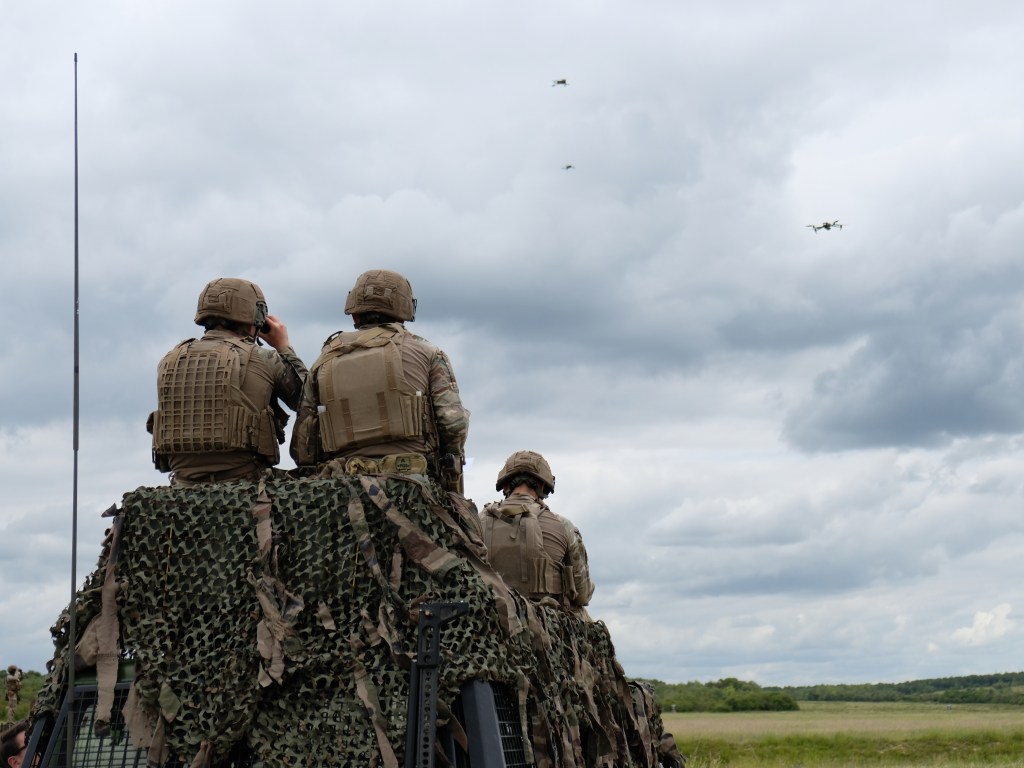
Reconnaissance troops from the French Army’s 1st Marine Infantry Regiment observe the Mailly-le-Camp training grounds during an exercise on June 11, 2026. (Rudy Ruitenberg/staff)
MAILLY-LE-CAMP, France — Corporal Igor started a new job this year, swapping the sights of a 105 mm gun on the French Army’s AMX 10 RC reconnaissance vehicle for first-person view goggles and a handheld controller.
The 21-year-old is now a strike pilot in France’s first dedicated drone-combat squadron, crouching in nettles and tall grass as he guided an FPV drone down a forest path at the Mailly-le-Camp training area east of Paris during a June exercise of the 1st Marine Infantry Regiment, or 1er RIMa.
“We’re switching specialties, we’re keeping up with the times,” said the corporal, who last year still manned the gunner seat in the AMX 10 RC armored car.
Inspired by the war in Ukraine, the 1er RIMa converted one of its three light cavalry squadrons into an experimental all-drone unit, with results so convincing that the Army is rushing more drone formations into service. The aim is for around 15 drone-combat units by summer 2027 and more by the end of next year, Army Chief of Staff Gen. Jacques de Montgros said this month.
France deployed a drone-combat unit to Romania for the first time in recent weeks as part of Mission Aigle, the French-led mission to strengthen NATO’s eastern flank, and will deploy a second unit to Poland for an exercise next month, de Montgros told lawmakers in an Oct. 14 hearing. “So we’re really at a point of scaling up our efforts in these areas.”
Cpl. Igor of the French Army’s 1st Marine Infantry Regiment operates an FPV drone during a training exercise at Mailly-le-Camp on June 11, 2026. (Rudy Ruitenberg/staff)
The 1er RIMa’s experimental squadron has provided a blueprint to create more tactical drone formations, while offering the French Army a lesson in the vulnerability of NATO-style combined-arms tactics to drone threats. During exercises this year, the regiment’s pilots hunted armored vehicles and command posts of the opposing force, disrupting maneuver and force buildup.
Mixing surveillance drones, FPV one-way attack drones and loitering munitions, the 1er Escadron de Drones de Chasse, which roughly translates as 1st Hunter-Drone Squadron, has also been a test bed for the Army, partnering with French firms to work on swarming technology, autonomous terminal guidance and launch canisters.
France’s first drone squadron grew from an idea within the 1er RIMa’s training and operations office in late 2023, to develop a way of fighting with drones that went beyond just adding them to existing units. The concept built on a proposal by Capt. Guillaume, an open-source intelligence specialist who had been studying the war in Ukraine.
When the office tested an experimental drone unit in a tactical exercise, the drones created “a crazy amount of disruption,” said Col. Aymeric Caussin, commander of the 1er RIMa, who headed the office at the time. “So we said, right, let’s go for it.”
Drawing on the regiment’s light cavalry heritage, the squadron was designed as a mobile force with drones as its weapons system, said Lt. Col Remi, who worked to implement the idea during a two-year stint in the 1er RIMa. Light cavalry principles still applied: gather intelligence, then fix, outflank and ultimately destroy the enemy, with a focus on mobility, dispersion and stealth.
“We needed a squadron that evoked the light cavalry: ‘drone’ because that’s its primary weapon system, and ‘hunter’ because that’s what we actually do in the field.”
The regiment tested the concept during Exercise Hedgehog in Estonia in May 2025, sending some 10 drone pilots as part of a French combined-arms tactical group. The U.S. 5th squadron, 7th Cavalry Regiment served as the designated opposing force during the exercise, with dismounted soldiers and M2A4 Bradley Fighting Vehicles.
The Wall Street Journal previously reported how Ukrainian operators taking part in the exercise exposed the vulnerability of NATO troops to drone warfare. The French team equally showed the impact of drones on an opponent unprepared for the threat.
The French pilots, who made up around 5% of the tactical group’s active strength, accounted for 20% of the attrition inflicted on the opposing force of American troops with Bradleys in a single day of combat, said Maj. Sylvain, head of operations at the 1er RIMa, who attended the exercise.
The virtual devastation convinced French Army leaders to scale up the experiment. Within two months, the drone squadron was made official, and in early April 2026 the Army staff declared it “ fully operational .”
“It was the proof of concept,” Maj. Sylvain said. “Everything falls into place, everyone is supportive of the project, and the regiment decides to transform the first squadron into a hunter-drone squadron.”
The drone team also brought several startups to Estonia for Hedgehog 25, including Alta Ares and Icarus Swarms, while Naval Group joined at its own expense. The 1er RIMa works with Alta Ares on AI-enabled detection and reconnaissance, Icarus Swarms on autonomous navigation and computer-assisted piloting, and Naval Group on drone-launch canisters.
The drone squadron has continue to rack up the virtual kills since Hedgehog. During France’s large-scale exercise Orion 2026, the 1er RIMa’s drone pilots tallied four regimental command posts, a number of logistics convoys and anti-drone and air-defense units, according to Caussin.
‘Quite a bit of damage’
What made the drone-combat unit stand out was its responsiveness, with FPV drones able to quickly close gaps in the lines and attack the main axis of enemy efforts, and its ability to disrupt the enemy command structures, particularly by directly targeting command posts, Caussin said.
“Through the drone, we’ll seek to disrupt the enemy’s chain of command. We’re influencing decision-making.”
Orion 2026 showed that distance no longer protects. The squadron’s intelligence, surveillance and reconnaissance drones detected tactical command posts several kilometers from the front line, then called in artillery or directed FPV drones to attack, said Staff Sgt. Tristan, who leads a platoon of FPV pilots after about 12 years on the AMX 10 RC.
Troops of the French Army’s 1st Marine Infantry Regiment launch an FPV drone from a canister during an exercise at the Mailly-le-Camp training grounds on June 11, 2026. (Rudy Ruitenberg/staff)
The regiment inflicted “quite a bit of damage” with drones and artillery, “but had it been the other way around, it would have been the same,” Staff Sgt. Tristan said. “If we’d been facing a unit like ours and we would have stayed in the AMX 10 RC, well, we would’ve been wiped out a lot too, right? So you have to put things in perspective.”
During an exercise in March at Mailly-le-Camp, the 1er RIMa acted as the opposing force during the combat preparation of another French light-cavalry regiment. The drone squadron’s pilots attacked and virtually destroyed enemy armor, or would track vehicles to command posts or troop concentrations before striking, paralyzing enemy movement.
The result was “severe,” said FPV pilot Igor, who participated in the exercise. The opposing force was neutralized, at least virtually.
For the Army, the takeaway was that it wanted to equip five more regiments with an all-drone squadron, to be operational in 2027. With the Army accelerating its drone effort, the six combat-drone units will be operational by the year, said Gen. Bruno Baratz, head of Future Combat Command, at an innovation day organized by France’s 6th Armored Brigade in September.
The brigade, which was assigned to set up two of the five drone squadrons, decided to create a third drone-combat unit using its own resources, 6th Armored Brigade commander Gen. Maxime do Tran said at the innovation day. One of the brigade’s infantry regiments is now deployed to Romania with a drone-combat unit.
“The trial conducted by the 1st Marine Infantry Regiment demonstrated the value of this capability,” Do Tran said. “We didn’t wait.”
With the drone-combat squadron of the 1er RIMa “more of a cavalry, reconnaissance” unit, Do Tran says the 6th Armored Brigade has taken a slightly different approach for its infantry regiments, ensuring that drone pilots previously trained on the Akeron antitank missile or 81-millimeter mortars retain those skills through dual training.
He said the brigade staff realized that whenever the weather was unfavorable for drone operations, those dual capabilities were needed to retain lethality. Creating drone units also created a problem of mass, according to Do Tran.
During the brigade’s first combat-preparation exercises with combat-drones, commanders found that even if their drone pilots achieved initial saturation, a numerically strong enemy would still break through lines that lacked ground troops to stop a large force.
“We quickly get overwhelmed if we don’t also have men behind them with rifles or other weapons,” Do Tran said. “We need to maintain a certain balance between human mass and drone pilots.”
Combat-drone units will have different uses based on the regiment they’re part of, according to the general.
He said that for a light cavalry regiment such as the 1st RIMa, drones contribute to reconnaissance and intelligence gathering, while for an infantry regiment, the primary role will be delivering lethal firepower. For a regiment of Leclerc main battle tanks, the combat drone unit’s primary role is to protect the armored column, Do Tran said.
“ It’s an entirely new set of rules to learn, an entirely new combination of capabilities to reinvent,” said Baratz. “The Army’s task today is to reinvent itself to be effective in this modern combat.”
Drone vulnerabilities
“ We shouldn’t think that drones will make the old systems obsolete. Drones do have vulnerabilities: weather conditions, electronic jamming, other counter-drone systems being put in place. We still need our older systems for deep-strike operations, close-contact maneuvers and direct engagement.”
Officers of the 1er RIMa cautioned against over-interpreting the March exercise, with Maj. Sylvain saying the opposing regiment lacked adequate anti-drone capabilities and had few drones of its own, making an effective response difficult. Caussin likewise noted that during Orion, the exercise in free terrain limited realistic use of jamming by the opposing force.
Equipment used by the French Army’s 1st Marine Infantry Regiment is on display during an exercise at the Mailly-le-Camp training grounds on June 11, 2026. (Rudy Ruitenberg/staff)
“If we’re back in a tank tomorrow and opposite of us we have another drone unit, it’s going to be tough for us as well,” Staff Sgt. Tristan said. “So we need all this feedback to figure out how to fight back against that.”
For its own combat preparation in June, the 1er RIMa asked the Centac combined-arms training center that runs the exercises at Mailly-le-Camp to step up the challenge, particularly by creating a contested electronic warfare environment.
The training center also added 12-gauge shotguns to the infantry kit and emphasized camouflage. Soldiers unfolded camouflaged umbrellas bought at sporting goods store Decathlon whenever they were on the move, seeking to obscure their visual signature.
The umbrellas slowed the 1er RIMa’s drone operators, forcing them to spend more time identifying targets to avoid confusion with the numerous deer or boars at Mailly-le-Camp, said Lt. Col. Guillaume, head of training at the 1st Light Infantry Battalion that staffs the center.
The opposing force also remained more dispersed, avoided grouped movement and kept vehicles farther back, bringing them forward only when the situation was considered sufficiently safe. The transparency provided by drones clearly changed how the exercise unfolded and affected the conduct of operations, Lt. Col. Guillaume said.
While the drone advantage was less pronounced in June than in March, the 1er RIMa’s drone squadron obtained the best score of the roughly 30 Army units that passed through the Mailly-le-Camp training center over a 12-month period, Lt. Col. Guillaume said. The June exercise provided a better assessment of how the drone squadron fares against a more capable adversary, according to Caussin.
The regiment explored what might happen if the tactical deadlock observed in Ukraine were broken and maneuver is restored, with Caussin saying the drone squadron’s mobility would allow it to move rapidly between different parts of the battlefield, using drones to understand the tactical situation and fill gaps.
But the exercise also showed the battlefield overview provided by drones, while necessary to win an engagement, is not enough by itself. The speed at which intelligence can be converted into action is as important as the number of drones in the air, and traditional infantry elements remained necessary to provide direct kinetic action, Lt. Col. Guillaume said.
Electronic warfare reduced drone effectiveness on several occasions, allowing the opposing force to bring in armor to create a temporary advantage and secure objectives, said Lt. Col. Guillaume, describing a constant “game of cat and mouse.”
Because of the energy requirements of electronic warfare, jamming is not necessarily continuous. The regiment learned it needed to become better at determining when it was actually being jammed by the adversary, and when a failed maneuver was due to its own poor execution, according to Caussin.
For the regimental commander, the exercise confirmed the drone squadron complements rather than replaces armored formations, an additional layer to combined-arms warfare than a revolution. With the opponent better prepared for the drone threat, the June exercise forced the 1er RIMa to change how it employed drones, picking priority targets rather than observing and striking at will.
In a drone-saturated environment, advantage will come more from controlling the pace of events rather than simply holding ground, by combining drones and highly mobile forces to observe, adapt, and act faster than the adversary, according to Caussin.
He called the stand-out quality of the drone-combat unit its ability “manipulate the enemy’s decision-making time, really to overwhelm them” and allow the regiment to seize the initiative.
“Will the drone’s enemy be another drone?” Caussin said. “We’re starting to implement this to some extend in small-scale exercises, particularly at the regimental level.”
“It’s always difficult to talk about game-changers. What’s certain today is that this is the reality of the battlefield and it enables us to achieve tactical effects that have a decisive impact on the enemy.”
In the 1er RIMa, FVP pilots are teamed with a driver, a vehicle commander and optionally a fourth crew member operating a drone by Paris-based vendor Parrot, or other ISR system to designate targets. Cpl. Igor said he often works with one crew member as a spotter. The teams still carry Heckler & Koch rifles, a heavy machine gun to defend against enemy infantry, and an AT4 shoulder-fired antitank weapon.
With the 105 mm gun of the AMX 10 RC, “we had reach, but we were much more visible,” Staff Sgt. Tristan said. Now, “we hole up in a corner with our vehicle and launch our drones from hiding, so the enemy can’t see us. With an AMX 10 RC, we can’t do that.”
The regiment’s drone squadron retained the structure of an armored reconnaissance unit, with a command and logistics platoon and four combat platoons: an ISR unit, two FPV drone units and one platoon operating longer-range loitering munitions.
With around 100 drone pilots in a unit of 120 personnel, the squadron can provide intelligence and strike across an area typically covered by a formation several times larger, with an operational reach approaching that of a full combined-arms tactical group, according to Lt. Col. Remi.
A team from the French Army’s 1st Marine Infantry Regiment operates an FPV drone during an exercise at the Mailly-le-Camp training grounds on June 11, 2026. (Rudy Ruitenberg/staff)
The large number of drone operators changes logistics. Supply vehicles carry drones rather than ammunition, and the unit needs battlefield energy generation to keep batteries topped up. FPV pilot Igor said that during a day of exercise and simulated strikes, he might go through 10 or 20 drones.
Both Caussin and Maj. Sylvain emphasized drones alone will not decide a battle. The squadron is designed to operate alongside conventional units and slot into larger formations, with interoperability with French Army units and NATO allies built in from the start, said Maj. Sylvain.
In addition to developing doctrine, the regiment’s mandate is to work with industrial partners on technologies to make the drone squadron more effective. Once concept, described by officers and pilots as “queen and workers,” involves an operator controlling a mother drone, or queen, which in turn steers multiple worker drones launched from a “hive,” or canister.
The goal is essentially fire-and-forget autonomous engagement, according to Maj. Sylvain. An operator assigns a mission, the queen autonomously seeks and identifies the designated target, then directs worker drones to destroy it without further operator intervention.
With the squadron conceived as a mobile force rather than one dug in like Ukrainian operators, the idea is to have four hives at the back of a vehicle, with a stock of drones ready to deploy, Staff Sgt. Tristan said.
“Just open the hives, send out four drones on autopilot, and let them carry out their mission.”
While “not everything works perfect,” the squadron and its industry partners have figured out queen-worker communications and terminal guidance, Maj. Sylvain said.
FPV drone hit rates might be 5% to 10% for a novice pilot and 30% for an experienced one, compared with a more than 90% chance to land a shot with the AMX 10 RC cannon, according to Staff Sgt. Tristan. The regiment is counting on autonomous terminal guidance to increase drone hit rates to around 80% to 90%.
The squadron’s doctrinal goals include FPV strikes at a distance of 10 kilometers, and communication range is the main practical obstacle, Maj. Sylvain said. The ISR platoon uses several drone models from Parrot and is starting to achieve the ranges of up to 20 kilometers called for in the doctrine.
Officers in the 1er RIMa shied away from comparisons with Ukrainian drone units, which Maj. Sylvain said are battle-hardened after several years of war.
“It’s obvious that we’d learn a lot from an exercise against them,” he said. “We’re not naive. We’re fully aware of our current level of capability, and we know we still have a lot of work to do to be ready to deploy the drone-combat squadron in a high-intensity conflict.”
The June exercise was also an opportunity to work on defense against enemy UAVs.
“Camouflage ourselves, take cover, and make sure there’s always someone listening out for drones, either to destroy them with certain weapons or simply to hide,” Staff Sgt. Tristan said. “In the heat of battle, chasing down a vehicle, also staying alert for anti-drone is difficult.”
The constant drone threat changes daily life for soldiers on exercise. Rather than having fixed meal times, “you have to snack throughout the day,” said Staff Sgt. Tristan. Sleep also becomes fragmented, with drone surveillance continuing through the night.
The 1er RIMa itself has adapted its command structure to the drone presence, dividing up command posts and deploying in the same armored vehicles as combat units to avoid detection.
“We question ourselves, we wonder how we can protect ourselves from this too,” said Cpl. Igor, the FPV pilot. “If we’re capable of doing it, we’re not the only ones who know how. So we’re going to try to find ways to protect ourselves from drones, because they’re really effective.”
Rudy Ruitenberg is a Europe correspondent for Defense News. He started his career at Bloomberg News and has experience reporting on technology, commodity markets and politics.
分享至 Facebook(在新窗口中打开) Facebook
分享至 X(在新窗口中打开)X
在 Bluesky 上分享(在新窗口中打开)Bluesky
分享到 Reddit(在新窗口中打开)
在领英上分享(在新窗口中打开)领英
使用原生工具分享 已复制到剪贴板
分享至邮件(在新窗口中打开)
2026年6月11日,法国陆军第一海军陆战步兵团的侦察部队在演习期间观察迈伊勒坎普训练场。(鲁迪·鲁伊滕贝格/工作人员摄)
法国马伊勒坎普——今年,下士伊戈尔开始了一份新工作,他用第一人称视角护目镜和手持控制器取代了法国陆军 AMX 10 RC 侦察车上 105 毫米火炮的瞄准器。
这位 21 岁的年轻人现在是法国第一个专门的无人机作战中队的一名攻击飞行员。在 6 月份法国海军陆战队第一步兵团(1er RIMa)的一次演习中,他蹲在荨麻和高草丛中,引导一架 FPV 无人机沿着巴黎东部马伊勒坎普训练区的一条森林小路飞行。
“我们正在转换专业,与时俱进,”这位下士说道,他去年还在 AMX 10 RC 装甲车上担任炮手。
受乌克兰战争的启发,第1轻骑兵团将其三个轻骑兵中队中的一个改装成一支实验性的全无人机部队,其成果令人信服,以至于陆军正加快组建更多无人机部队。陆军参谋长雅克·德·蒙格罗斯将军本月表示,目标是在2027年夏季之前拥有约15个无人机作战部队,并在明年年底之前增加更多。
法国最近几周首次向罗马尼亚部署了一支无人机作战部队,作为法国领导的旨在加强北约东翼的“鹰行动”的一部分。法国外长德蒙格罗斯在10月14日的听证会上告诉议员们,下个月还将向波兰部署第二支部队参加演习。“因此,我们正处于加大这些领域投入的阶段。”
2026年6月11日,法国陆军第一海军陆战步兵团下士伊戈尔在马伊勒坎普的一次训练演习中操作FPV无人机。(鲁迪·鲁伊滕贝格/工作人员摄)
第1皇家印度陆军航空团(1er RIMa)的实验中队为创建更具战术性的无人机编队提供了蓝图,同时也让法国陆军认识到北约式诸兵种合成战术在无人机威胁下的脆弱性。在今年的演习中,该团的飞行员对敌方装甲车辆和指挥所进行侦察,扰乱了敌方的机动和兵力集结。
第 1 猎杀无人机中队(1er Escadron de Drones de Chasse,大致翻译为 1st Hunter-Drone Squadron)将侦察无人机、FPV 单向攻击无人机和巡飞弹混合在一起,也成为了陆军的试验场,与法国公司合作,研究集群技术、自主终端制导和发射筒。
法国首个无人机中队源于2023年末第一皇家海军陆战队航空团(1er RIMa)训练作战办公室的一个构想,旨在开发一种超越简单将无人机添加到现有部队之外的作战方式。这一构想建立在吉约姆上尉的提议之上,他是一位开源情报专家,曾研究过乌克兰战争。
当时负责该办公室的艾默里克·考辛上校(第1皇家海军陆战队航空团指挥官)说,该办公室在一次战术演习中测试了一套实验性无人机装置,这些无人机造成了“巨大的混乱”。“所以我们说,好吧,那就放手一搏吧。”
雷米中校说,该中队借鉴了该团的轻骑兵传统,被设计成一支以无人机为武器系统的机动部队。雷米中校曾在第1皇家轻骑兵团服役两年,参与了这一理念的实施。轻骑兵的作战原则仍然适用:收集情报,然后锁定目标,绕到侧翼,最终消灭敌人,重点在于机动性、分散性和隐蔽性。
“我们需要一支能让人联想到轻骑兵的飞行中队:‘无人机’是因为无人机是它的主要武器系统,‘猎人’是因为这正是我们在战场上实际执行的任务。”
该团于2025年5月在爱沙尼亚举行的“刺猬”演习中测试了这一概念,派出约10名无人机飞行员作为法国联合兵种战术小组的一部分。美国陆军第7骑兵团第5中队在演习中担任指定假想敌部队,配备了徒步士兵和M2A4布雷德利步兵战车。
《华尔街日报》此前曾报道,参与此次演习的乌克兰部队暴露了北约部队在无人机战争面前的脆弱性。法国队同样展现了无人机对毫无防备的对手的威力。
参加演习的法国皇家海军航空兵第一团作战主管西尔万少校表示,法国飞行员约占该战术小组现役兵力的 5%,但在一天的战斗中,他们给美军布雷德利战车部队造成的损失却占到了 20%。
虚拟的破坏效果促使法国陆军领导人决定扩大试验规模。两个月内,无人机中队正式成立,2026年4月初,陆军参谋部宣布其“全面投入使用”。
“这是概念验证,”西尔万少校说。“一切都水到渠成,每个人都支持这个项目,于是该团决定将第一个中队改造成一个猎杀无人机中队。”
无人机团队还邀请了多家初创公司参加在爱沙尼亚举办的 Hedgehog 25 大会,其中包括 Alta Ares 和 Icarus Swarms,而法国海军集团则自费参与了此次大会。第一研发机构(1er RIMa)与 Alta Ares 合作开发人工智能辅助探测和侦察技术,与 Icarus Swarms 合作开发自主导航和计算机辅助飞行技术,并与法国海军集团合作开发无人机发射筒。
自“刺猬”演习以来,无人机中队持续取得虚拟击杀战果。据考辛称,在法国大规模“猎户座2026”演习期间,第1皇家海军航空团的无人机飞行员摧毁了四个团级指挥所、多支后勤车队以及反无人机和防空部队。
“损失相当严重”
考辛表示,无人机作战部队的突出之处在于其反应速度,FPV 无人机能够迅速填补防线上的缺口,攻击敌军的主要行动轴线,并能够扰乱敌军的指挥结构,特别是通过直接攻击指挥所。
“我们将通过无人机来扰乱敌方的指挥系统。我们正在影响他们的决策。”
“猎户座2026”演习表明,距离不再能起到保护作用。中队的侦察、监视和监视无人机探测到距离前线数公里外的战术指挥所,然后呼叫炮兵支援或指挥FPV无人机进行攻击。在AMX 10 RC上服役约12年后,领导一个FPV飞行员排的参谋军士特里斯坦说道。
2026年6月11日,法国陆军第一海军陆战步兵团的士兵在马伊勒坎普训练场进行演习时,从发射筒中发射了一架FPV无人机。(Rudy Ruitenberg/工作人员摄)
该团利用无人机和火炮造成了“相当大的破坏”,“但如果情况反过来,结果也一样,”中士特里斯坦说。“如果我们面对的是我们这样的部队,而我们却待在AMX 10 RC里,那么我们也会被歼灭很多,对吧?所以你必须正确看待问题。”
三月份在马伊勒坎普举行的一次演习中,第1皇家轻骑兵团(1er RIMa)扮演假想敌部队,协助另一支法国轻骑兵团进行战斗准备。无人机中队的飞行员攻击并几乎摧毁了敌方装甲车辆,或者追踪车辆直至指挥所或部队集结地,然后发动攻击,瘫痪敌军的行动。
参与演习的FPV飞行员伊戈尔表示,结果“非常惨重”。至少在理论上,敌方力量已被完全压制。
对于陆军而言,其主要目标是为另外五个团配备全无人机中队,以便在 2027 年投入作战。未来作战司令部司令布鲁诺·巴拉茨将军在 9 月份由法国第六装甲旅组织的一次创新日活动上表示,随着陆军加快无人机发展步伐,这六个作战无人机部队将在当年投入作战。
第6装甲旅旅长马克西姆·多·特兰将军在创新日活动上表示,该旅负责组建五个无人机中队中的两个,但决定利用自身资源组建第三个无人机作战部队。目前,该旅的一个步兵团已随一个无人机作战部队部署到罗马尼亚。
“第一海军陆战步兵团进行的试验证明了这项能力的价值,”杜特兰说。“我们没有犹豫。”
杜陈表示,第1步兵团的无人机作战中队更像是一支骑兵侦察部队,因此第6装甲旅对其步兵团采取了略有不同的方法,确保之前接受过阿克龙反坦克导弹或81毫米迫击炮训练的无人机飞行员通过双重训练保留这些技能。
他表示,旅部参谋人员意识到,一旦天气不利于无人机作战,就需要兼具这两种能力以保持杀伤力。杜陈指出,组建无人机部队也带来了规模问题。
在旅部首次使用作战无人机进行作战准备演习期间,指挥官们发现,即使他们的无人机飞行员实现了初步的饱和攻击,数量强大的敌人仍然能够突破缺乏地面部队来阻止大部队的防线。
“如果我们没有配备步枪或其他武器的人员支援,很快就会被无人机压制,”杜特兰说。“我们需要在人员数量和无人机飞行员数量之间保持一定的平衡。”
这位将军表示,作战无人机部队将根据其所属团的不同而有不同的用途。
他表示,对于像第一皇家印度陆军轻骑兵团这样的轻骑兵团来说,无人机有助于侦察和情报收集;而对于步兵团来说,其主要作用是提供致命火力。杜陈说,对于装备勒克莱尔主战坦克的团来说,作战无人机部队的主要任务是保护装甲纵队。
巴拉茨说:“这是一套全新的规则需要学习,也是一套全新的能力组合需要重新构建。如今,陆军的任务就是重塑自身,以在现代战争中发挥有效作用。”
无人机漏洞
“我们不应该认为无人机会使旧系统过时。无人机确实存在弱点:天气状况、电子干扰、其他反无人机系统的部署等等。我们仍然需要旧系统来进行纵深打击行动、近距离机动和直接交战。”
第1皇家意大利团的军官们告诫不要过度解读3月份的演习,西尔万少校指出,对方团缺乏足够的反无人机能力,自身无人机数量也很少,因此难以做出有效的反制措施。考辛也指出,在“猎户座”演习中,由于是在开阔地形进行,对方部队实际运用干扰手段的能力有限。
2026年6月11日,法国陆军第一海军陆战步兵团在迈伊勒坎普训练场进行演习时,其装备正在展出。(鲁迪·鲁伊滕贝格/工作人员摄)
“如果我们明天又坐上坦克,对面又有一支无人机部队,那对我们来说也同样艰难,”中士特里斯坦说。“所以我们需要所有这些反馈,才能弄清楚如何反击。”
为了在 6 月份进行自己的作战准备,第 1 皇家海军陆战队要求在马伊勒坎普进行演习的 Centac 联合兵种训练中心加大挑战力度,特别是要创造一个对抗性的电子战环境。
训练中心还在步兵装备中增加了12号口径霰弹枪,并强调了伪装的重要性。士兵们在行军时都会撑开从迪卡侬体育用品商店购买的迷彩伞,以尽可能地隐藏自身的视觉特征。
驻扎在该中心的陆军第1轻步兵营训练主管纪尧姆中校表示,雨伞减缓了陆军第1轻步兵营无人机操作员的速度,迫使他们花费更多时间来识别目标,以避免与马伊勒坎普的众多鹿或野猪混淆。
敌方部队也保持了更为分散的部署,避免集结行动,并将车辆保持在较远的后方,只有在认为形势足够安全时才将其调往前线。吉约姆中校表示,无人机提供的透明度显然改变了演习的进行方式,并影响了作战行动的开展。
陆军中校吉约姆表示,虽然无人机在6月份的优势不如3月份那么明显,但第1皇家海军陆战队航空团的无人机中队在过去12个月里,在马伊勒坎普训练中心接受训练的约30个陆军单位中取得了最佳成绩。考辛认为,6月份的演习更好地评估了无人机中队在面对更强大的对手时的表现。
该团探讨了如果打破在乌克兰观察到的战术僵局并恢复机动性会发生什么,考辛表示,无人机中队的机动性将使其能够在战场的不同部分之间快速移动,利用无人机了解战术形势并填补空白。
但演习也表明,无人机提供的战场态势感知虽然对赢得战斗至关重要,但仅靠无人机本身并不足以取胜。情报转化为行动的速度与空中无人机的数量同等重要,而传统的步兵部队仍然是提供直接军事行动所必需的,吉约姆中校说道。
中校吉约姆表示,电子战多次降低了无人机的效能,使敌方得以调集装甲部队,从而取得暂时优势并夺取目标,他形容这是一场持续不断的“猫捉老鼠的游戏”。
由于电子战需要消耗大量能量,干扰并非持续不断。据考辛称,该团认识到,他们需要提高判断能力,以便更好地确定何时是敌方干扰,何时是自身执行不力导致行动失败。
对于团长而言,此次演习证实了无人机中队是对装甲部队的补充而非取代,是联合兵种作战的又一补充,而非革命性的变革。由于对手对无人机威胁的防范更加充分,6月份的演习迫使第1皇家印度陆军团改变了无人机的使用方式,开始优先选择目标,而不是随意观察和打击。
考辛认为,在无人机泛滥的环境中,优势更多地来自于控制事态发展的速度,而不是仅仅守住阵地,而是要将无人机与高度机动的部队结合起来,比对手更快地观察、适应和行动。
他称无人机作战部队最突出的特点是能够“操纵敌人的决策时间,真正压倒他们”,从而使该团能够掌握主动权。
“无人机的敌人会是另一架无人机吗?”考辛问道。“我们正在小规模演习中,尤其是在团级演习中,开始在一定程度上实施这项技术。”
“谈论改变战局的因素总是很困难。但如今可以肯定的是,这就是战场上的现实,它使我们能够取得对敌人具有决定性影响的战术效果。”
在第1步兵侦察中队(1er RIMa)中,FVP飞行员与一名驾驶员、一名车辆指挥官组成小组,可选的还有第四名乘员,该乘员操作由巴黎供应商Parrot公司提供的无人机或其他ISR系统来指示目标。下士伊戈尔说,他经常与一名乘员担任观察员。小组仍然配备赫克勒-科赫步枪、一挺重机枪用于防御敌方步兵,以及一挺AT4肩扛式反坦克武器。
“AMX 10 RC 的 105 毫米火炮虽然射程远,但暴露程度也高得多,”中士特里斯坦说道。“现在,我们可以把车停在角落里,然后从隐蔽处放飞无人机,这样敌人就看不到我们了。但 AMX 10 RC 就做不到这一点。”
该团的无人机中队保留了装甲侦察部队的结构,包括一个指挥后勤排和四个作战排:一个 ISR 单位、两个 FPV 无人机单位和一个操作远程巡飞弹的排。
据雷米中校称,该中队拥有约 100 名无人机飞行员,人员总数为 120 人,能够提供情报并打击通常需要数倍于此规模的编队才能覆盖的区域,其作战范围接近完整的联合兵种战术小组。
2026年6月11日,法国陆军第一海军陆战步兵团的一个小组在马伊勒坎普训练场进行演习时操作FPV无人机。(Rudy Ruitenberg/工作人员摄)
大量无人机操作员的加入改变了后勤保障。补给车辆不再运送弹药,而是运载无人机,部队需要战场能源供应来维持电池电量。FPV飞行员伊戈尔表示,在一天的演习和模拟打击中,他可能要用到10到20架无人机。
科辛和西尔万少校都强调,单凭无人机无法决定战局。西尔万少校表示,该中队的设计旨在与常规部队协同作战,并融入更大规模的编队,从一开始就具备与法国陆军部队和北约盟军部队的互操作性。
除了制定作战理论外,该团的任务还包括与工业伙伴合作,研发能够提升无人机中队作战效能的技术。其中一种概念被军官和飞行员们称为“蜂后与工蜂”,即由一名操作员控制一架母无人机(或称蜂后),母无人机再操控从“蜂巢”(或称容器)中发射的多架工无人机。
据西尔万少校介绍,其目标本质上是实现发射后不管的自主作战。操作员发出任务指令后,蚁后会自主搜索并识别指定目标,然后指挥工蚁将其摧毁,无需操作员进一步干预。
中士特里斯坦说,该中队被构想为一支机动部队,而不是像乌克兰部队那样固守阵地,其理念是在车辆后部设置四个蜂巢,里面存放着随时可以部署的无人机。
“只需打开蜂箱,放出四架自动驾驶的无人机,让它们执行任务即可。”
西尔万少校表示,虽然“并非一切都完美无缺”,但该中队及其行业合作伙伴已经解决了蜂后与工蜂之间的沟通以及终端引导问题。
据中士特里斯坦称,新手飞行员操控FPV无人机的命中率可能只有5%到10%,经验丰富的飞行员也能达到30%,而AMX 10遥控炮的命中率则超过90%。该团正指望通过自主终端制导将无人机的命中率提高到80%到90%左右。
西尔万少校表示,该中队的作战目标包括10公里外的第一视角(FPV)打击,而通信距离是主要的实际障碍。情报、监视与侦察(ISR)排使用Parrot公司的几种无人机型号,并已开始达到作战理论要求的20公里作战距离。
第 1 皇家海军陆战队第 1 团的军官们不愿将他们与乌克兰无人机部队进行比较,西尔万少校表示,乌克兰无人机部队在经历了数年的战争后,身经百战。
“很显然,我们能从与他们进行的演习中学到很多东西,”他说。“我们并非天真。我们完全清楚我们目前的能力水平,也知道我们还有很多工作要做,才能做好在高强度冲突中部署无人机作战中队的准备。”
6 月份的演习也是一次演练防御敌方无人机的机会。
“做好伪装,寻找掩体,并确保始终有人监听无人机动向,以便用特定武器将其摧毁或仅仅是为了躲避,”中士特里斯坦说道。“在激烈的战斗中,追击车辆的同时还要保持对反无人机的警惕,这非常困难。”
无人机的持续威胁改变了演习士兵的日常生活。中士特里斯坦说,士兵们不再有固定的用餐时间,“而是得全天吃零食”。睡眠也变得支离破碎,因为无人机的监视活动会持续到夜间。
第 1 皇家印度陆军第 1 团已调整其指挥结构以适应无人机的存在,将指挥所划分开来,并与作战部队一起部署在相同的装甲车辆中,以避免被发现。
“我们一直在反思,也在思考如何保护自己免受无人机的侵害,”FPV飞行员伊戈尔下士说道。“如果我们有能力做到这一点,那么知道方法的肯定不止我们。所以我们会努力寻找保护自己免受无人机侵害的方法,因为它们确实非常有效。”
鲁迪·鲁伊滕贝格是《防务新闻》的欧洲记者。他的职业生涯始于彭博新闻社,拥有报道科技、大宗商品市场和政治方面的经验。