Bilateral no more: PACOM officials highlight multi-national data sharing network双边合作不再是问题:太平洋司令部官员强调多国数据共享网络
“For the first time, PACOM and several key allies and partners communicated, collaborated, planned, and executed with common tools, common data flows and language translation,” PACOM deputy commander Lt. Gen. George Rowell, said.
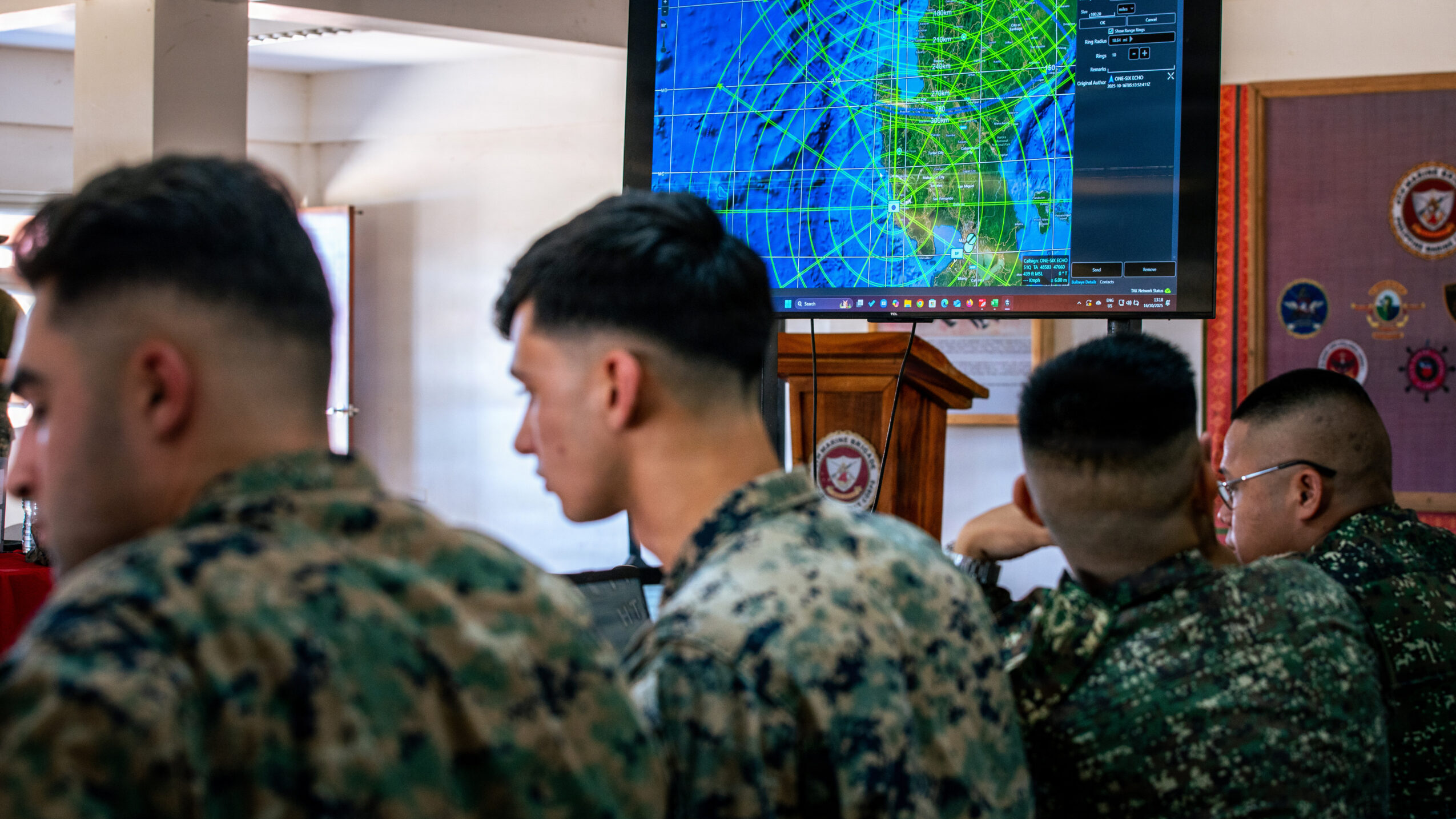
U.S. Marines assigned to 1st Air Naval Gunfire Liaison Company, I Marine Expeditionary Force Information Group, and Philippine Marines assigned to 173rd Marine Company, 4th Marine Brigade, analyze geospatial data using a tactical assault kit during Marine Air Support Activity 2025 at Marine Base Camp Cape Bojeador, Philippines, Oct. 16, 2025. (U.S. Marine Corps photo by Cpl. Brian Knowles)
WASHINGTON — On the Pentagon’s long journey towards the real-time sharing of data between allies, a key official said 2026 marked the year in which partners in the Pacific, at least, were able to see the battlefield with a common operational picture (COP) and act as one.
“This was really the first year that all of our capabilities are in a multilateral environment where our partners are using those warfighting applications and tools with the US and we have a single COP to conduct warfighting,” Brig. Gen. Michael Smith, director for command, control, communications, computers and cyber at Indo-Pacific Command said Thursday at the TechNet Indo-Pacific Conference.
Smith was referencing what he and other officials called the PACOM Mission Network, a system that allows US forces and partners to share data and mission planning tools securely, across classification to jointly conduct operations or prosecute targets.
US officials for years have discussed the notion and need for so-called mission partner networks or environments to enable multiple nations to plan together. That effort, like other pieces of the even larger Combined Joint All-Domain Command and Control initiative, is made difficult by different data sources, standards and classification.
But officials noted those challenges are being overcome in the Pacific.
“What’s the so what? So what is our partners are now doing warfighting functions in our mission partner environment,” Smith said. “We’ve had a lot of legacy bilat[eral] systems and networks. Some of those still exist, but now we have a common operational environment that’s multilateral, data-centric, zero trust -enabled. … And the partners are really excited about that.”
The system was used during “several major exercises” over the last year, Lt. Gen. George Rowell, PACOM’s deputy commander, said Thursday at the conference. While he didn’t specify how many exercises it participated in, he noted the command conducted 17 exercises across nine host nations and incorporating 35 countries.
“For the first time, PACOM and several key allies and partners communicated, collaborated, planned, and executed with common tools, common data flows and language translation,” he said. “The real story of these exercises was more than the missiles on the rails. It was our ability to pass that sensor-to-shooter targeting information, data, and the evolving science of the pipes connecting everything across that vast tyranny of distance.”
Smith provided one example in which for the first time Japanese partners used the Maven Smart System, an artificial intelligence-enabled platform used for planning and targeting, which is embedded into the mission network. Using Maven, Japanese are contributing to joint strikes and close kill chains, he said.
Rowell equated these collaboration abilities to deterrence.
“This deterrent capability becomes credible when we prove to any potential adversary that our commanders can execute without missing a beat, even when primary systems are jammed or disabled,” he said. “Assured command and control is inseparable from the concept of deterrence here in the Pacific.”
Breaking Defense Video
Qatar’s domestic weapons, Turkey’s drone arsenal and the Mecca pact’s next test
3 congressional races that matter for defense
How General Atomics views Europe’s unmanned future
A more flexible way to defend maneuver forces from drones that doesn’t tie them down [Sponsored]
What’s haunting the Pentagon this Halloween?
The new must-have capabilities for drones [Sponsored]
Army’s tech chief talks autonomy, acquisition and the future of drones
Drones take over AUSA, plus the Army’s plan to bring in new vendors
Hegseth talks autonomy at AUSA, a key show focus
Army doubles down on autonomy, stakes out Indo-Pacific role: AUSA Day 2
2025年10月16日,在菲律宾博耶阿多尔角海军陆战队基地举行的“海军陆战队空中支援活动2025”期间,隶属于美国海军陆战队第一远征部队信息大队第一航空海军炮火联络连的美国海军陆战队员和隶属于菲律宾海军陆战队第四旅第173海军陆战队连的菲律宾海军陆战队员正在使用战术突击工具包分析地理空间数据。(美国海军陆战队下士布莱恩·诺尔斯摄)
华盛顿——五角大楼在实现盟友间实时数据共享的漫长征程中,一位重要官员表示,2026 年标志着至少在太平洋地区的合作伙伴能够通过共同的作战图 (COP) 看到战场并像一个整体一样行动。
“今年是我们所有能力真正处于多边环境的第一年,我们的合作伙伴正在与美国一起使用这些作战应用和工具,我们有一个统一的作战指挥中心来开展作战,”印太司令部指挥、控制、通信、计算机和网络主管迈克尔·史密斯准将周四在印太技术网会议上表示。
史密斯指的是他和一些官员所称的太平洋司令部任务网络,该系统允许美国军队和合作伙伴安全地共享数据和任务规划工具,跨越机密级别,以联合开展行动或打击目标。
多年来,美国官员一直在讨论建立所谓的任务伙伴网络或环境的概念和必要性,以便多国能够共同制定计划。这项工作,如同规模更大的联合全域指挥与控制计划的其他部分一样,都因数据来源、标准和保密级别的差异而面临重重困难。
但官员们指出,太平洋地区正在克服这些挑战。
“所以呢?所以说,我们的合作伙伴现在正在我们的任务伙伴环境中执行作战职能,”史密斯说。“我们过去有很多传统的双边系统和网络。其中一些仍然存在,但现在我们拥有一个通用的、多边的、以数据为中心、零信任的作战环境……合作伙伴对此感到非常兴奋。”
太平洋司令部副司令乔治·罗威尔中将周四在会议上表示,该系统在过去一年中参与了“多次重大演习”。他没有具体说明参与了多少次演习,但他指出,太平洋司令部在九个东道国组织了17次演习,涉及35个国家。
他说:“太平洋司令部及其几个重要盟友和伙伴首次使用通用工具、通用数据流和语言翻译进行沟通、协作、计划和执行。这些演习的真正意义远不止导弹发射。更重要的是,我们能够跨越遥远的距离,将传感器到射手的目标信息、数据以及连接一切的管道技术有效传递出去。”
史密斯举例说,日本合作伙伴首次使用了Maven智能系统,这是一个用于规划和目标定位的人工智能平台,它被嵌入到任务网络中。他表示,日本正利用Maven系统参与联合打击和近距离杀伤链行动。
罗威尔将这些协作能力等同于威慑力。
他说:“当我们向任何潜在对手证明,即使主要系统受到干扰或瘫痪,我们的指挥官也能毫不费力地执行任务时,这种威慑能力就具有可信度了。在太平洋地区,可靠的指挥和控制与威慑理念密不可分。”
突破性防御视频
卡塔尔的国产武器、土耳其的无人机武库以及麦加条约的下一次测试
3场对国防至关重要的国会选举
通用原子公司如何看待欧洲的无人化未来
一种更灵活的防御机动部队免受无人机攻击的方式,不会限制其行动[赞助]
今年万圣节,五角大楼究竟闹鬼?
无人机必备的新功能 [赞助内容]
陆军技术主管谈无人机的自主性、采购和未来
无人机主导了美国陆军协会(AUSA)的会议,此外,陆军还计划引入新的供应商。
Hegseth 在 AUSA 大会上谈到了自主性,这是本次大会的一个重点议题。
陆军加倍强调自主性,明确印太地区角色:AUSA第二天