Australia unveils secretive Ghost Shark underwater drone payloads澳大利亚揭开神秘“幽灵鲨”水下无人机载荷的神秘面纱
The Australian Navy recently lifted the veil on some payloads the service is fielding on its Ghost Shark extra-large autonomous underwater vehicles.
Share on Facebook (Opens in new window) Facebook
Share on X (Opens in new window) X
Share on Bluesky (Opens in new window) Bluesky
Share on Reddit (Opens in new window) Reddit
Share on LinkedIn (Opens in new window) LinkedIn
Share using Native tools Share Copied to clipboard
Share on Mail (Opens in new window) Mail
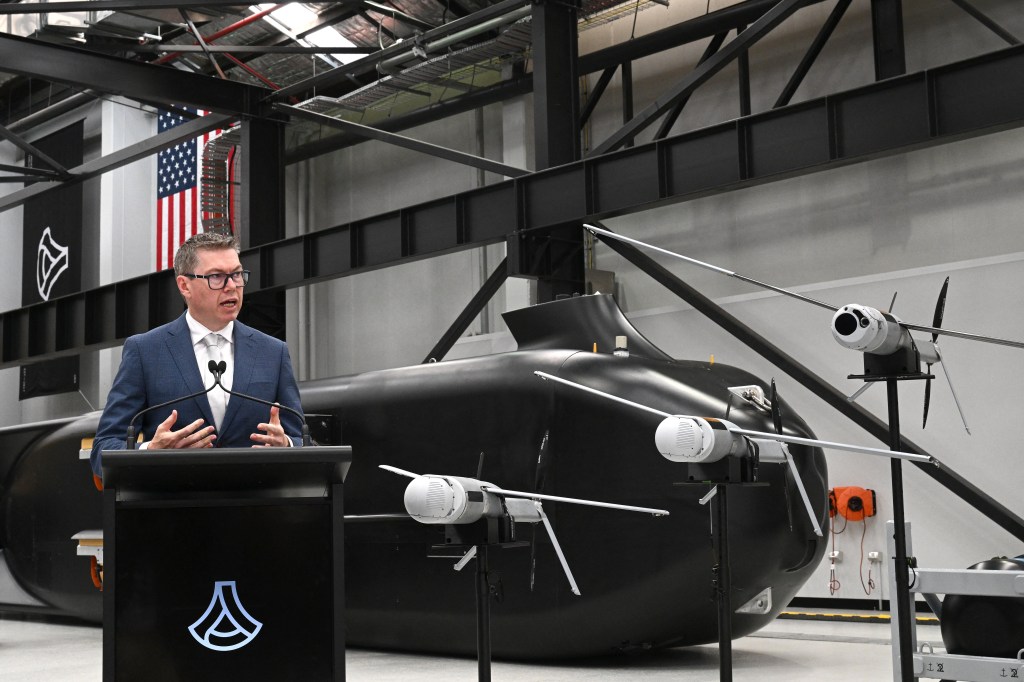
Australia’s Minister for Defence Industry, Pat Conroy, speaks to the media in front of the autonomous undersea vehicle Ghost Shark at an Anduril facility in Sydney on Oct. 19, 2026. (Saeed Khan / AFP via Getty Images)
CHRISTCHURCH, New Zealand — Australian military officials have been furtive about how they will use Anduril-developed Ghost Shark extra-large autonomous underwater vehicles – or XLAUVs. However, they recently lifted the lid on some payloads the Royal Australian Navy is fielding.
In an official unveiling at Anduril Australia’s manufacturing center in Sydney on Oct. 19, three Ghost Shark payloads were revealed.
One entailed sea mines, another was a swarm of Altius-600 loitering munitions, and the third was logistics supply caches.
In other words: Two of the three payloads comprise kinetic effectors to give the Ghost Shark greater bite.
This means a single XLAUV can clandestinely deploy a dozen sea mines, perhaps in maritime chokepoints during a conflict.
Meanwhile, Anduril’s Altius weapons can perform both surveillance and strike.
Regarding the supply caches, an official said, “Let’s just say, people can use their imagination about the sort of forces that would use these on deployment.”
The Department of Defence said in a press release: “The modular design of these platforms allows them to operate a range of different payloads, customized to the required mission.”
Other payloads are being developed for the Ghost Shark, likely involving lightweight and heavyweight torpedoes, as well as electronic warfare.
Ghost Sharks can deploy from shipping containers, off the stern of relatively small ships or from wharves, Minister for Defence Industry Pat Conroy explained.
“It places question marks in adversaries’ minds,” he said.
With Australia having to wait years for nuclear-powered submarines to arrive, autonomous underwater systems like the Ghost Shark can fill capability gaps as six aging Collins-class diesel-electric submarines continue to plod along.
Anduril Australia opened its factory less than a year ago, and “Ghost Sharks capable of a range of complex missions operating far from our shores are now rolling off the line at an increasing rate into the hands of the Australian navy,” Conroy said.
Canberra is spending A$1.7 billion (US$1.2 billion) on its fleet of Ghost Sharks. This amounts to “dozens and dozens” of XLAUVs, but Australia is not saying how many exactly.
The Royal Australian Navy is also fielding the smaller Speartooth XLAUV from Australian firm C2 Robotics.
Navy Chief Vice Adm. Matt Buckley said: “In terms of our platforms themselves, of course they must continue to evolve, and the evolution of modular payloads that we can fit to uncrewed vessels like the Ghost Shark … creates enormous flexibility for us and allows us to adapt these systems to future missions and future requirements.”
He added: “Our purpose is clear – we need to deliver capability at the speed of relevance, strengthen our ability to conduct undersea warfare and seabed operations, contribute to sea denial and help protect our critical undersea infrastructure.”
The Ghost Shark and its payloads have participated in the past few Maritime Big Play Pacific events, including one in San Diego in October.
The first Ghost Shark was handed over to the Australian Navy for testing and acceptance in early 2026.
Gordon Arthur is an Asia correspondent for Defense News. After a 20-year stint working in Hong Kong, he now resides in New Zealand. He has attended military exercises and defense exhibitions in about 20 countries around the Asia-Pacific region.
分享至 Facebook(在新窗口中打开) Facebook
分享至 X(在新窗口中打开)X
在 Bluesky 上分享(在新窗口中打开)Bluesky
分享到 Reddit(在新窗口中打开)
在领英上分享(在新窗口中打开)领英
使用原生工具分享 已复制到剪贴板
分享至邮件(在新窗口中打开)邮件
2026年10月19日,澳大利亚国防工业部长帕特·康罗伊在悉尼安杜里尔公司的一处设施内,在无人水下航行器“幽灵鲨”前向媒体发表讲话。(图片来源:Saeed Khan / AFP via Getty Images)
新西兰基督城——澳大利亚军方官员一直对如何使用安杜里尔公司开发的“幽灵鲨”超大型自主水下航行器(XLAUV)讳莫如深。然而,他们最近透露了澳大利亚皇家海军正在部署的一些有效载荷。
10 月 19 日,在 Anduril Australia 位于悉尼的制造中心举行的正式发布会上,三款“幽灵鲨”有效载荷亮相。
其中一项涉及水雷,另一项涉及大量 Altius-600 巡飞弹,第三项涉及后勤补给库。
换句话说:三个有效载荷中有两个是动能效应器,使幽灵鲨拥有更大的咬合力。
这意味着一艘 XLAUV 可以秘密部署十几枚水雷,或许可以在冲突期间部署在海上咽喉要道。
与此同时,安都瑞尔的阿尔提乌斯武器既可以执行侦察任务,也可以执行打击任务。
关于补给库,一位官员表示:“这么说吧,大家可以想象一下哪些部队会在部署中使用这些补给库。”
美国国防部在一份新闻稿中表示:“这些平台的模块化设计使其能够搭载一系列不同的有效载荷,并可根据所需任务进行定制。”
幽灵鲨正在开发其他有效载荷,可能包括轻型和重型鱼雷,以及电子战武器。
国防工业部长帕特·康罗伊解释说,“幽灵鲨”无人机可以从集装箱、相对较小的船只的船尾或码头部署。
他说:“这会在对手心中留下疑问。”
由于澳大利亚需要等待数年才能拥有核动力潜艇,像“幽灵鲨”这样的自主水下系统可以填补能力上的空白,而六艘老旧的柯林斯级柴电潜艇仍在缓慢地服役。
安杜里尔澳大利亚公司不到一年前就开设了工厂,“幽灵鲨”战机能够执行一系列复杂的任务,在远离我们海岸的地方作战,现在正以越来越快的速度下线,交付给澳大利亚海军,”康罗伊说。
堪培拉斥资17亿澳元(12亿美元)建造其“幽灵鲨”级无人水下航行器(XLAUV)船队。这相当于“数十艘”XLAUV,但澳大利亚并未透露具体数量。
澳大利亚皇家海军也正在使用澳大利亚 C2 Robotics 公司生产的较小的 Speartooth XLAUV。
海军中将马特·巴克利表示:“就我们自身的平台而言,它们当然必须不断发展,而我们可以安装在像‘幽灵鲨’这样的无人舰艇上的模块化有效载荷的不断发展……为我们创造了巨大的灵活性,使我们能够调整这些系统以适应未来的任务和未来的需求。”
他补充道:“我们的目标很明确——我们需要以最快的速度提供相应的能力,加强我们进行水下作战和海底作业的能力,为海上拒止做出贡献,并帮助保护我们关键的海底基础设施。”
“幽灵鲨”及其有效载荷曾参加过几届太平洋海事大型活动,包括 10 月份在圣地亚哥举行的一次活动。
第一架“幽灵鲨”于 2026 年初交付给澳大利亚海军进行测试和验收。
戈登·阿瑟是《防务新闻》的亚洲特派记者。在香港工作20年后,他现居新西兰。他曾到访亚太地区约20个国家,参加过军事演习和防务展览。