Stealthy GJ-21 Drone Has Launched And Recovered From Type 076 Amphibious Assault Ship, China Claims中国声称,一架隐形GJ-21无人机已从076型两栖攻击舰上起飞并回收。
Signs that the PLAN has been building up to this significant milestone in naval airpower have been growing for more than a year.
新闻视频
By Joseph Trevithick
Published Oct 30, 2026 5:32 PM EDT
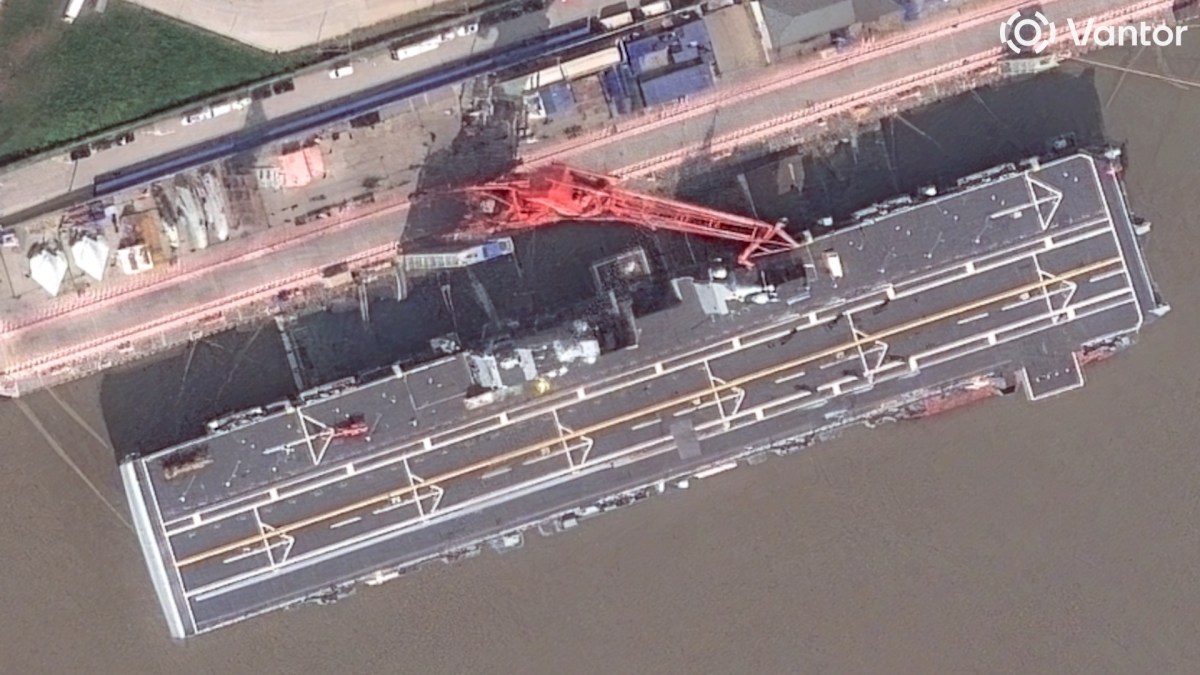
Satellite image ©2026 Vantor
A GJ-21 stealthy flying-wing uncrewed combat air vehicle (UCAV) has successfully launched from and recovered aboard the Type 076 amphibious assault ship Sichuan , according to China’s People’s Liberation Army (PLA). Visual confirmation of this milestone has yet to emerge, but there have been steady signs of preparations for flight trials from the Sichuan , which features an electromagnetic catapult. GJ-21s have already been spotted flying from airfields on land.
A picture of a GJ-21 drone that previously emerged online. Chinese internet
The GJ-21 and the land-based GJ-11 Mysterious Dragon it is based on are prime examples of China’s major investments in UCAVs and other flying-wing-type drones. These developments stand in particular contrast to the U.S. military’s eschewing of such designs , at least publicly . This is despite significant past U.S. achievements in this arena, including in the development of carrier-based UCAVs. The PLA Navy (PLAN) now looks to be on track to be the first country to field an operational capability of this kind.
A stock picture of the Type 076 amphibious assault ship Sichuan . PLA
“China’s first ship-borne stealth reconnaissance and attack drone ‘GJ-21’ recently made its first successful take-off and landing on [the Type] 076 amphibious assault ship, the ‘Sichuan’ (Hull 51),” according to a post today from the China Military Bugle account on X, an official PLA mouthpiece. “This is another significant breakthrough in the development of China’s amphibious assault ship, indicating that the Chinese Navy now has the capability to operate fixed-wing stealth drones from large maritime combat platforms.”
At the time of writing, neither the PLA nor Chinese state media have shared where or when these trials occured or provided any other additional details, including how many total launches and recoveries were conducted. No official pictures or videos from the testing have been released so far.
A graphic that accompanied the post on the China Military Bugle’s account on X regarding the GJ-21 and the Type 076. PLA/China Military Bugle
Unconfirmed claims that a GJ-21 had been launched from Sichuan had already begun circulating on social media earlier this month. As an aside, the GJ-21 is readily discernible from the land-based GJ-11 by the catapult bar on its nose landing gear strut.
Two interesting Type 076 News: 2. Via Temstar/SDF: "Yankee confirmed on tonight's Chahuahui that 076 has launched a GJ-21. He said it in a very straight forward way too, basically "you guys can stop guessing, I can tell you straight: yes they launched a GJ-21"." pic.twitter.com/ODkl6Kki9A — @Rupprecht_A (@RupprechtDeino) October 15, 2026
Two interesting Type 076 News: 2. Via Temstar/SDF: "Yankee confirmed on tonight's Chahuahui that 076 has launched a GJ-21. He said it in a very straight forward way too, basically "you guys can stop guessing, I can tell you straight: yes they launched a GJ-21"." pic.twitter.com/ODkl6Kki9A
A review of satellite imagery from Planet Labs does show Sichuan was at its usual berth at Hudong-Zhonghua in Shanghai as of October 13, but absent four days later. When exactly it left port is unclear. The one-of-a-kind Type 076 does not appear to have returned until October 26. TWZ has also obtained a satellite image of Hudong-Zhonghua taken just today from Vantor, with the ship still seen sitting at the pier, as seen at the top of this story and below. GJ-21 drones, or more likely mockups thereof, have also been present on the pier for some time.
The Type 076 amphibious assault ship Sichuan at the Hudong-Zhonghua shipyard on October 10, 2026. What is widely assessed to be a mothership for large uncrewed underwater vehicles (UUV) is also seen at right. Satellite image ©2026 Vantor
Even while Sichuan was still under construction, there were growing signs that a navalized version of the GJ-11, as well as other uncrewed platforms, would be major components of its future air wing . With its electromagnetic catapult and notably large overall size, the Type 076 is unlike any other big-deck amphibious warship in service today globally, as TWZ has previously explored in depth .
A pair of apparent GJ-11 mockups at a test and/or training site on Changxing Island in Shanghai in May 2024, near where the Type 076 was under construction at the time. Google Earth
As mentioned, there have been further signs that the PLA has been preparing Sichuan for real launches and recoveries, especially of GJ-21s, since last year. Pictures emerged online in October 2025 showing a red-colored test ‘truck’ on the ship’s flight deck, indicating the start of catapult testing. Video from those tests has since been released. Weighted trucks like this have long been used to test catapults on aircraft carriers during construction or following maintenance . The Type 076 left port for the first time in November 2025.
小紅車上線了 pic.twitter.com/zrptPDwu2X — 🔪飞刀🔪 (@chaoyinsukandao) October 28, 2025
小紅車上線了 pic.twitter.com/zrptPDwu2X
Weighted carts catapult test on Type 076 LHD three lines marked directly under and outside the wheels of the Red cart to ensure it is centered the parallel alignment markings flanking the catapult slot serve as visual tips for precise positioning https://t.co/KJkC2ZrLgS pic.twitter.com/pZa0Vx56jG — David Wang (@DavidWangPLA) August 1, 2026
Weighted carts catapult test on Type 076 LHD three lines marked directly under and outside the wheels of the Red cart to ensure it is centered the parallel alignment markings flanking the catapult slot serve as visual tips for precise positioning https://t.co/KJkC2ZrLgS pic.twitter.com/pZa0Vx56jG
“Two GJ-21 aircraft were displayed at the victory parade in September 2025, reportedly having entered PLAN service in mid-2025,” according to Andreas Rupprecht , an expert on Chinese aviation and contributor to TWZ . “By late 2025, several GJ-21 aircraft were reportedly undergoing simulated EMALS launches and arrested landings at the PLAN’s land-based facility at Huangdicun .”
In February of this year, GJ-21 mockups were spotted on Sichuan ’s flight deck and riding on the ship’s port-side elevator to the hangar deck as part of what appeared to be deck-handling trials.
After the first Type 076 LHD/LAH "Sichuan" was seen yesterday with a GJ-21 UCAV mock-up on deck, the GJ-21 was seen for the first time with its wings folded and later lowered to the hangar deck on one of the elevators. (Images @鼎盛大彪 from Weibo) pic.twitter.com/eMyz2QLHQX — @Rupprecht_A (@RupprechtDeino) February 1, 2026
After the first Type 076 LHD/LAH "Sichuan" was seen yesterday with a GJ-21 UCAV mock-up on deck, the GJ-21 was seen for the first time with its wings folded and later lowered to the hangar deck on one of the elevators. (Images @鼎盛大彪 from Weibo) pic.twitter.com/eMyz2QLHQX
More recent satellite imagery had shown that the Type 076’s flight deck had received additional markings in line with progress toward real flight operations. Fittings for three arresting cables also became plainly visible. Those cables are also notably depicted in the graphic that the China Military Bugle shared online today.
The arresting gear fittings as seen in the October 30, 2026 satellite image from Vantor, at left, as well as how they are depicted in the graphic from the China Military Bugle. Satellite image ©2026 Vantor/PLA
The GJ-21 will of course not be the only aircraft in the Type 076’s future air wing. The ship is also expected to carry a variety of other uncrewed aircraft, as well as crewed helicopters. China has shown a range of other combat drone designs in recent years. Navalized versions could well be developed for deployment on Sichuan , as well as PLAN’s growing fleet of traditional carriers and other suitable configured vessels.
Loading the Type 076 with operational UCAVs would only underscore the significance of this particular ship. As we have previously written :
“The potential value to the PLAN of having a fleet of very large deck amphibious assault ships that are highly capable of large-scale drone operations as well as traditional amphibious assaults is clear. These ships could be used to launch and recover UCAVs like the GJ-11 and other types of drones to perform a host of missions from maritime strike to intelligence, surveillance, and reconnaissance (ISR). They could be used to provide additional ‘mass’ in support of the operations of larger carrier strike groups and help to free the air wings of flattops like Fujian up for tasks they might be better suited for. In addition, they could provide a lower tier of naval aviation support that could be employed independently.”
“Simply having more naval aviation capacity overall would give the PLAN added flexibility for various operations closer to the mainland, including a potential military intervention against Taiwan or defending its expansive and largely unrecognized territorial claims in places like the South China Sea . Type 076s could also help project naval and air power further from China’s shores, something that has also been a driving factor behind the country’s broader carrier ambitions .”
“The Type 076 could help provide support during humanitarian assistance and disaster relief operations. Big deck amphibious warfare ships, in general, provide their operators with immensely valuable platforms for projecting both hard and soft power .”
Last year, the PLA separately confirmed that the GJ-11 had entered at least limited operational service. That followed a steady ramp-up in testing of that drone based on what could be seen in satellite imagery and video clips that had emerged online. This included evidence of near-daily flights at Malan Air Base, a major hub for testing uncrewed platforms . GJ-11s had also been spotted at an operational air base in China’s Tibet Autonomous Region.
New video out from the People's Liberation Army Air Force (PLAAF) of China shows the new GJ-11 stealth drone (UCAV), and also the J-20 stealth fighter firing a live PL-15 air-to-air missile: pic.twitter.com/wraDqyMOht — The STRATCOM Bureau (@OSPSF) November 11, 2025
New video out from the People's Liberation Army Air Force (PLAAF) of China shows the new GJ-11 stealth drone (UCAV), and also the J-20 stealth fighter firing a live PL-15 air-to-air missile: pic.twitter.com/wraDqyMOht
Basically GJ-11 seems in limited operation and has been seen at multiple bases now including tibet and testing near daily at Mulan
As mentioned earlier, the continued development of the GJ-11 and GJ-21 are reflective of the PLA’s broader pursuit of stealthy flying-wing drones, which is not limited to UCAVs. Several larger designs that look most immediately suited to high-altitude, long-endurance ISR missions have also broken cover in the country in the past few years.
There is something of a trend in this regard globally, with Russia , India , Turkey , and France also pursuing flying-wing drone designs. The U.S. military continues to be markedly absent from this space, at least that we know , despite major investments and real demonstrations of relevant capability, before various programs were abandoned for reasons that still remain largely unclear . In the late 2010s, the U.S. Navy notably looked to be right on the edge of fielding a carrier-based UCAV, before changing course entirely to an uncrewed tanker instead. There are some signs now that the service may be taking another look at the capabilities it passed over.
It is still to be seen how quickly the PLA’s official statement today will be followed by real confirmation of the launching and recovery of a GJ-21 from the Sichuan .
Contact the author: joe@twz.com
Comments couldn’t be loaded. Please refresh the page.
作者:约瑟夫·特雷维西克
发布于美国东部时间2026年10月30日下午5:32
卫星图像 ©2026 Vantor
据中国人民解放军消息,一架GJ-21隐形飞翼无人作战飞行器(UCAV)已成功从076型两栖攻击舰“四川”号上起飞并回收。虽然目前尚未有目击者证实这一里程碑事件,但种种迹象表明,“四川”号(配备电磁弹射器)一直在为GJ-21的飞行试验做准备。此前已有目击者看到GJ-21从陆地机场起飞。
一张此前在网上流传的GJ-21无人机照片。中国互联网
GJ-21及其陆基原型机GJ-11“神秘龙”无人机,是中国在无人作战飞行器(UCAV)和其他飞翼式无人机领域投入巨资的典型例证。这些发展与美国军方(至少在公开场合)对这类设计的冷漠态度形成了鲜明对比。尽管美国过去在该领域取得了显著成就,包括舰载无人作战飞行器的研发。如今,中国人民解放军海军(PLAN)似乎有望成为首个具备此类作战能力的国家。
一张076型两栖攻击舰“四川”号的示意图。中国人民解放军
据解放军官方媒体“中国军号”今日在X平台上发布消息称,“中国首款舰载隐形侦察攻击无人机‘GJ-21’近日在076型两栖攻击舰‘四川’号(舷号51)上成功完成首次起降。这是中国两栖攻击舰发展进程中的又一重大突破,表明中国海军已具备从大型海上作战平台操作固定翼隐形无人机的能力。”
截至发稿时,解放军和中国官方媒体均未透露这些试验的地点和时间,也未提供任何其他细节,包括发射和回收的总次数。目前尚未发布任何试验的官方图片或视频。
中国军号在X平台上发布的关于GJ-21和076式导弹的配图。PLA/中国军号
本月初,社交媒体上就开始流传未经证实的关于四川发射GJ-21导弹的说法。顺便一提,GJ-21与陆基GJ-11的区别在于其前起落架支柱上的弹射杆。
两条关于076型潜艇的有趣消息:2. 来自Temstar/SDF:“Yankee在今晚的Chahuahui节目中确认,076型潜艇已经发射了一枚GJ-21导弹。他的表述非常直接,基本上就是‘你们不用再猜了,我可以直截了当地告诉你们:是的,他们发射了一枚GJ-21导弹’。” pic.twitter.com/ODkl6Kki9A — @Rupprecht_A (@RupprechtDeino) October 15, 2026
两条关于076型导弹的有趣消息:2. 来自Temstar/SDF:“Yankee在今晚的《茶花会》节目中证实,076型导弹已经发射了一枚GJ-21导弹。他的表述非常直接,基本上就是‘你们不用再猜了,我可以直截了当地告诉你们:是的,他们发射了一枚GJ-21导弹’。” pic.twitter.com/ODkl6Kki9A
Planet Labs提供的卫星图像显示,四川号驱逐舰于10月13日停靠在上海沪东中华港的常规泊位,但四天后便不见踪影。其确切离港时间尚不清楚。这艘独一无二的076型驱逐舰似乎直到10月26日才返回。TWZ还获得了Vantor卫星今天拍摄的沪东中华港卫星图像,图像显示该舰仍停泊在码头,如本文开头和下方所示。此外,GJ-21无人机(更可能是其模型)也已在码头停留了一段时间。
2026年10月10日,076型两栖攻击舰“四川”号停泊在沪东中华造船厂。图中右侧可见一艘被广泛认为是大型无人水下航行器(UUV)母舰的舰艇。卫星图像©2026 Vantor
四川号还在建造期间,种种迹象表明,舰载版GJ-11以及其他无人平台将成为其未来舰载机联队的重要组成部分。正如TWZ此前深入探讨的那样,076型两栖攻击舰凭借其电磁弹射器和显著庞大的舰体尺寸,与当今全球现役的任何其他大型两栖攻击舰都截然不同。
2024年5月,在上海长兴岛的测试和/或训练场地,两架疑似GJ-11型战机的模型机停放在那里,当时076型战机正在附近建造。(图片来自谷歌地球)
如前所述,有更多迹象表明,解放军自去年以来一直在四川进行实弹发射和回收的准备工作,特别是GJ-21弹射器的弹射。2025年10月,网上流传出的照片显示,一艘红色测试“卡车”停放在该舰的飞行甲板上,表明弹射器测试已经开始。此后,相关测试视频也已发布。这种加重卡车长期以来一直被用于在航母建造或维护期间测试弹射器。076型航母于2025年11月首次离港。
小红车上线了 pic.twitter.com/zrptPDwu2X — 🔪飞刀🔪 (@chaoyinsukandao) 2025 年 10 月 28 日
小红车上线了 pic.twitter.com/zrptPDwu2X
在076型左轮攻击舰上进行加重小车弹射试验时,红色小车车轮正下方外侧标记了三条线,以确保其居中;弹射槽两侧的平行对准标记可作为精确定位的视觉提示。https://t.co/KJkC2ZrLgS pic.twitter.com/pZa0Vx56jG — David Wang (@DavidWangPLA) August 1, 2026
在076型左舵舰上进行加重小车弹射试验时,红色小车车轮正下方外侧标记了三条线,以确保其居中;弹射槽两侧的平行对准标记可作为精确定位的视觉提示。https://t.co/KJkC2ZrLgS pic.twitter.com/pZa0Vx56jG
据中国航空专家、TWZ撰稿人安德烈亚斯·鲁普雷希特(Andreas Rupprecht)称,“两架GJ-21飞机在2025年9月的胜利阅兵式上亮相,据报道已于2025年中期加入中国海军服役。到2025年底,据报道,数架GJ-21飞机正在中国海军位于黄地村的陆基训练基地进行模拟电磁弹射起飞和拦阻着陆训练。”
今年 2 月,有人在四川号航母的飞行甲板上发现了 GJ-21 的模型,并看到它们乘坐该舰左舷的升降机前往机库甲板,这似乎是甲板操作试验的一部分。
继昨日首艘076型两栖攻击舰/两栖攻击舰“四川”号甲板上搭载GJ-21无人作战飞行器模型后,GJ-21首次以折叠机翼的姿态亮相,随后通过升降机降至机库甲板。(图片来自微博用户@鼎盛大彪) pic.twitter.com/eMyz2QLHQX — @Rupprecht_A (@RupprechtDeino) February 1, 2026
继昨日首艘076型两栖攻击舰“四川”号甲板上搭载GJ-21无人作战飞行器模型后,GJ-21首次以折叠机翼的姿态亮相,随后通过升降机被送至机库甲板。(图片来自微博用户@鼎盛大彪) pic.twitter.com/eMyz2QLHQX
最新的卫星图像显示,076型航母的飞行甲板上增加了新的标记,表明其正朝着实际飞行作业的方向发展。三根阻拦索的接口也清晰可见。这些阻拦索在今天中国军号网站发布的图片中也有明显的展示。
图左侧为2026年10月30日Vantor卫星图像中显示的阻拦装置配件,以及《中国军号》图片中所示的配件。卫星图像©2026 Vantor/PLA
当然,GJ-21无人机不会是076型航母未来舰载机联队中唯一的机型。该舰预计还将搭载多种其他无人机以及有人驾驶直升机。近年来,中国展示了一系列其他作战无人机设计。这些无人机的舰载版本很可能会被研发出来,部署在四川号航母以及中国海军日益壮大的传统航母舰队和其他合适的舰艇上。
为076型护卫舰装载作战型无人作战飞机,只会更加凸显这艘舰艇的重要性。正如我们之前所写:
“中国海军拥有一支具备大规模无人机作战能力以及传统两栖突击能力的大型两栖攻击舰舰队的潜在价值显而易见。这些舰艇可用于发射和回收GJ-11等无人作战飞行器以及其他类型的无人机,执行从海上打击到情报、监视和侦察(ISR)等一系列任务。它们可以为大型航母打击群的作战行动提供额外的兵力支援,并帮助解放像福建号这样的航母舰载机联队,使其能够执行更适合的任务。此外,它们还可以提供独立作战的低层级海军航空支援。”
“仅仅是提升海军航空兵的整体实力,就能让中国海军在靠近大陆的各种行动中拥有更大的灵活性,包括对台湾的潜在军事干预,或捍卫其在南海等地广泛且大多未被承认的领土主张。076型航母还有助于将海空力量投射到更远的海域,这也是中国大力发展航母的重要驱动因素之一。”
“076型两栖攻击舰可以为人道主义援助和救灾行动提供支持。一般来说,大型甲板两栖作战舰艇为操作人员提供了极其宝贵的平台,用于投射硬实力和软实力。”
去年,解放军单独证实,GJ-11无人机已至少有限度地投入使用。此前,根据网上流传的卫星图像和视频片段,该无人机的测试工作一直在稳步推进。其中包括在马兰空军基地(无人机测试的重要枢纽)几乎每天都有GJ-11的飞行测试。此外,GJ-11还被发现在中国西藏自治区的一个现役空军基地。
中国人民解放军空军发布的新视频展示了新型GJ-11隐形无人机(无人作战飞机)以及歼-20隐形战斗机实弹发射PL-15空空导弹的画面:pic.twitter.com/wraDqyMOht — STRATCOM Bureau (@OSPSF) November 11, 2025
中国人民解放军空军发布的新视频展示了新型GJ-11隐形无人机(无人作战飞机)以及歼-20隐形战斗机实弹发射PL-15空空导弹的画面:pic.twitter.com/wraDqyMOht
基本上,GJ-11似乎已投入有限使用,目前已在多个基地出现,包括西藏,并在木兰基地几乎每天都进行测试。
如前所述,GJ-11和GJ-21的持续研发反映了解放军对隐身飞翼无人机的更广泛追求,而不仅仅局限于无人作战飞行器(UCAV)。过去几年里,国内也出现了几款尺寸更大的无人机,它们似乎最适合执行高空、长航时情报、监视与侦察(ISR)任务。
在全球范围内,这方面似乎呈现出某种趋势,俄罗斯、印度、土耳其和法国也在积极研发飞翼无人机。尽管美国军方曾投入巨资并实际展示过相关能力,但至少据我们所知,他们在这个领域仍然明显缺席。后来,一些项目因至今仍不甚明了的原因而被放弃。值得注意的是,在2010年代末期,美国海军一度似乎即将部署舰载无人作战飞机(UCAV),但随后却彻底改变方向,转而研发无人加油机。现在有迹象表明,美国海军可能正在重新审视之前放弃的那些能力。
解放军今天的官方声明能否很快得到四川舰艇发射和回收 GJ-21 导弹的真正确认,还有待观察。
联系作者:joe@twz.com
评论加载失败,请刷新页面。