Highlights From North Korea’s Drone-A-Palooza朝鲜无人机狂欢节精彩回顾
Here’s what Pyongyang put on display as it showcased a growing arsenal of recon and attack drones, including a very-aspirational stealthy UCAV concept. Here’s what Pyongyang put on display as it showcased a growing arsenal of reconnaissance, attack, and loitering drones.
By Thomas Newdick , Tyler Rogoway
Published Oct 30, 2026 4:34 PM EDT
North Korean leader Kim Jong Un presided over a major exhibition of uncrewed aerial vehicles (UAVs) on Thursday. A mockup of an apparent new large stealth drone was displayed prominently alongside an increasingly diverse collection of reconnaissance drones, armed UAVs, loitering munitions , and small attack drones . While there is no evidence that North Korea is capable of getting a stealthy flying-wing drone flying, let alone operating as a operationally relevant low-observable platform, there are no doubts that the country has an increasingly impressive uncrewed aircraft arsenal , with the smaller, lower-end types being of greatest importance.
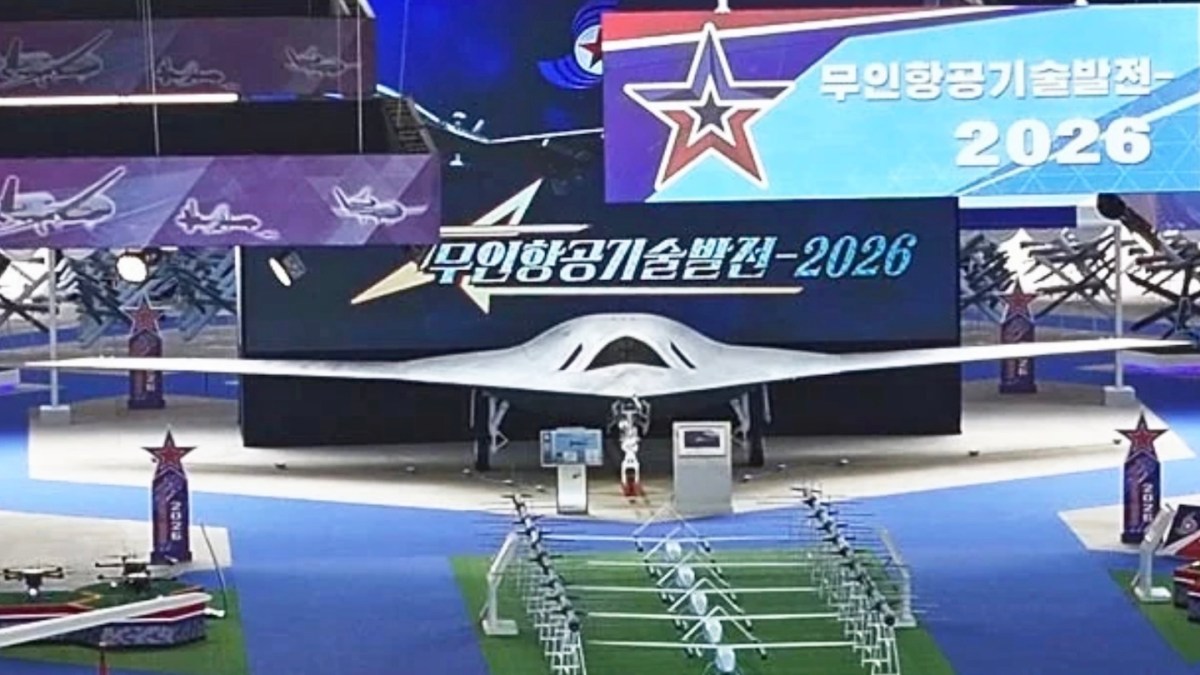
An overview of the Unmanned Aeronautical Technology Development-2026 exhibition, with the “stealth drone” in pride of place. KCNA
As for the “stealth drone,” photographs released by North Korean state media show a mockup of a tailless flying-wing design. In terms of appearance, there are clear parallels with advanced uncrewed combat aerial vehicles (UCAVs) developed by the United States, China, and Russia.
However, huge questions remain as to what degree the mockup is part of a realistic program. We have no details of the program’s development status and planned capabilities. It is highly questionable if Pyongyang is able to produce a functional prototype. Even if it can get it into the air, there is no evidence that it possesses the capabilities to master meaningful stealth technologies, let alone the command-and-control functions and other elements needed for it to operate in a tactically relevant manner.
The exhibition, titled Unmanned Aeronautical Technology Development-2026, was held on Thursday, with images published by the ruling Workers’ Party newspaper Rodong Sinmun today. Kim called for the country to achieve “absolute superiority” in drone technology and announced unspecified measures to accelerate the development of uncrewed aviation systems and military artificial intelligence.
Kim Jong Un walks past rows of quadcopter drones at the exhibition. Rodong Sinmun
An Ambitious New Flying-Wing Design
The mockup of the new aircraft was positioned prominently in the exhibition hall, suggesting that Pyongyang considers it at least indicative of its broader ambitions.
Based on the available photographs, Hong Min, a senior research fellow at the Korea Institute for National Unification, interviewed by NK News , estimated the wingspan at roughly 56 to 66 feet and its height at around 10 to 11.5 feet. Standout features include a dorsal air intake, a relatively large center fuselage section integrated into the flying wing, and retractable tricycle landing gear.
Another view of North Korea’s apparent new stealth drone. KCTV
In terms of general arrangement, there are similarities to Northrop Grumman’s X-47B , the U.S. Navy’s experimental carrier-based UCAV. There are also visual similarities with China’s GJ-11 Sharp Sword and Russia’s S-70 Okhotnik , two other large flying-wing UCAV designs.
X-47B during carrier operations. U.S. Navy
GJ-11 Sharp Sword UCAV. via Chinese internet
At this point, North Korea has not provided any technical information about the aircraft’s propulsion system, payload, intended mission, or flight performance.
Critically, while the external shape is consistent with a stealthy UCAV, a flying-wing configuration on its own is only one part of a far more complex puzzle in achieving a genuinely low radar signature. Other factors include the engine inlet and exhaust arrangements, radar-absorbing materials, surface treatments, manufacturing tolerances, and the alignment of individual edges and surfaces, low probability of intercept communications and much more.
Officials inspect the new flying-wing UCAV design. Rodong Sinmun
The Iranian RQ-170 Precedent
Overall, there are many good reasons to be extremely cautious about North Korea’s apparent ambitions in this area.
Iran is another country that has displayed a drone that resembles an advanced Western stealth platform, without actually reproducing its capabilities. It has, however, gotten a UCAV-lookalike into the air.
After recovering a U.S. RQ-170 Sentinel reconnaissance drone that came down inside Iranian territory in 2011, Tehran announced that it had successfully reverse-engineered the aircraft. In 2014, Iranian authorities displayed what they presented as a domestically produced copy of the American drone, claiming that it would soon undertake a test flight.
The actual RQ-170 Sentinel Iran recovered on display. Iranian State Media
Outside observers questioned whether the displayed aircraft was anything more than a non-functional replica, noting apparent shortcomings in its construction and the use of components inconsistent with a sophisticated operational aircraft.
Iran subsequently presented a family of aircraft derived from the RQ-170 concept, including the Shahed-171 Simorgh and the smaller Shahed-191 . Iran has demonstrated flying examples of these designs, but they fall far short of replicating the RQ-170’s actual low-observable qualities, let alone its sensors and avionics.
Iran’s self-proclaimed RQ-170-like long-range UCAVs. AP
In the case of Pyongyang, however, the possibility of Russian assistance is at least worth considering.
North Korea’s burgeoning military relationship with Moscow , including the deployment of North Korean troops to support Russia’s war in Ukraine , could provide a chance for the exchange of technical knowledge and operational experience from Moscow. Russia has developed and flown the S-70 Okhotnik UCAV, exposing it to some operational trials in Ukraine , and could have passed related information on to Pyongyang.
An S-70 taxiing after landing. Russian Ministry of Defense
In particular, North Korea would welcome Russian assistance in developing and manufacturing propulsion, flight control, sensor, and materials technologies.
However, there is so far no proof of technology transfer from Russia. Even if it were to be provided, it is far from clear that this would suffice to get a true UCAV into the air anytime soon, although an Iran-style knockoff with far reduced capabilities cannot be ruled out entirely. It’s also worth noting that Russia’s own UCAV program has been anything but a smooth and rapid advancement to an operational state.
Overall, the new flying-wing concept does not represent a realistic technological undertaking — at least for now. Very few countries have managed to develop and fly drones in this class, and fewer still have been able to field them operationally.
North Korea’s Drone Development Effort
The flying-wing aircraft was only one part of a much larger display. More than 30 types of UAVs reportedly appeared at the exhibition, reflecting North Korea’s efforts to diversify its uncrewed aviation capabilities.
Some of these designs had been seen before, including the Saetbyol-4 and Saetbyol-9. These were first displayed in 2023 and are, in terms of appearance, clones of the U.S. RQ-4 Global Hawk and MQ-9 Reaper , respectively.
Kim Jong Un inspects an armed Saetbyol-9. Rodong Sinmun
Imagery released of the Saetbyol-9 showed it carrying — and firing — several types of air-to-ground weapons. These include a Hellfire-like laser-guided missile, along with smaller rockets and other possible guided munitions.
Saetbyol-9 fires a rocket or missile. Rodong Sinmun
Other exhibits included loitering munitions resembling Israel’s Harop and Russia’s Lancet , as well as smaller drones with configurations similar to the U.S.-made Switchblade family.
Kim Jong Un inspecting Switchblade-style loitering munitions. Rodong Sinmun
Hundreds of small quadcopter drones were also displayed on storage racks. Some appeared to carry cylindrical containers associated with fiber-optic control systems , a technology that has become increasingly prominent in the Russia-Ukraine war. Unlike conventional radio-controlled drones, fiber-optic systems are largely immune to conventional radio-frequency jamming of their control links. These drones would be a major feature in a cross-DMZ conflict.
North Korean interest in artificial intelligence was another recurring theme. Kim called for the development of increasingly intelligent uncrewed weapons, although there is no indication of how advanced the country’s existing autonomous navigation, target recognition , or engagement systems actually are.
The exhibition was accompanied by live-fire demonstrations involving UAVs, cruise missiles, and multiple rocket launchers. North Korean state media claimed that missiles launched from drones and other systems struck an island target “with 100 percent accuracy.”
A barrage of rockets fired by a large-caliber multiple rocket launcher. Rodong Sinmun
From Ambition To Operational Capabilities
North Korea’s rapidly expanding interest in drones should also be seen against the shortcomings of its aging crewed combat aviation fleet. Relatively inexpensive UAVs offer opportunities for reconnaissance and attacks against military infrastructure without exposing pilots to enemy air defenses. At the same time, Pyongyang has failed to introduce new crewed combat aircraft to modernize its air force, the capabilities of which are thoroughly outmatched by those of South Korea.
The war in Ukraine (as well as lessons from conflicts in the Middle East) also provides Pyongyang with an opportunity to study the use of drones on a large scale. North Korean troops deployed to Russia will have gained first-hand experience of drone warfare, including the integration of reconnaissance UAVs, FPV attack drones , and electronic warfare systems.
That experience could help accelerate the development of North Korea’s own uncrewed platforms, particularly relatively simple systems that can be produced in large quantities.
An attack drone in the Shahed/Geran class , for example, could be produced relatively easily in very large numbers (and that is likely already happening to some degree) and could saturate South Korean air defenses, which are generally tailored to address more conventional threats. North Korea doesn’t need the long range that the Shahed/Geran typically provides, since many of its primary targets are much closer. The shorter distances involved could permit a greater proportion of a drone’s weight to be allocated to its warhead, depending on the design. Alternatively, a drone with the roughly 1,000-mile reach of the Shahed/Geran could fly a very complex route to reach targets in the South, including approaching via the coast. At the very least, expanding North Korean efforts in this area could tilt the balance of power on the peninsula, providing Seoul with a major interdiction problem and forcing the development of new countermeasures, such as directed-energy weapons and cheap interceptors.
A typical Russian Shahed-136/Geran-2-series kamikaze drone over Ukraine. via X
The possibility of Russian assistance via its own Geran development effort is likely bringing enhanced technologies within reach of North Korea. Indeed, that kind of expertise is already being gained by tens of thousands of North Korean workers who have been sent to Russia as additional labor for its drone-production efforts .
A look inside a Russian factory where licensed production of Iranian Shahed-series one-way attack drones is taking place. via X
And once again, it’s these one-way attack munitions and smaller drones that can be mass-produced and rapidly iterated upon that pose a real threat to South Korea. It is likely that North Korea will continue to ramp-up its investment in these systems, building them in very large tranches in order to create an asymmetric advantage — one that has proven challenging to counter in real conflicts around the globe. At the same time, they will also continue to build high-tech-looking clones of far more advanced systems which will have little tactical or strategic impact but work well for propaganda purposes.
Contact the author: thomas@thewarone.com
Comments couldn’t be loaded. Please refresh the page.
作者:托马斯·纽迪克、泰勒·罗戈威
发布于美国东部时间2026年10月30日下午4:34
朝鲜领导人金正恩周四主持了一场大型无人机(UAV)展览。一架疑似新型大型隐形无人机的模型与种类日益丰富的侦察无人机、武装无人机、巡飞弹和小型攻击无人机一同醒目展出。虽然目前尚无证据表明朝鲜有能力研制出隐形飞翼无人机,更遑论将其作为具有作战意义的低可探测性平台,但毫无疑问,朝鲜拥有日益强大的无人机武库,其中小型、低端机型尤为重要。
2026年无人机技术发展展概览,其中“隐形无人机”占据显著位置。(朝中社)
至于所谓的“隐形无人机”,朝鲜官方媒体发布的照片显示的是一种无尾飞翼设计的模型。从外观上看,它与美国、中国和俄罗斯开发的先进无人作战飞行器(UCAV)有着明显的相似之处。
然而,该模型究竟在多大程度上属于一个切实可行的项目,仍然存在诸多疑问。我们对该项目的研发进展和计划能力一无所知。平壤是否有能力制造出功能齐全的原型机,这一点也令人高度怀疑。即便它能够成功试飞,也没有证据表明它具备掌握真正意义上的隐身技术的能力,更遑论掌握使其能够以战术方式运行所需的指挥控制功能和其他要素。
这场名为“无人机技术发展-2026”的展览于周四举行,朝鲜劳动党机关报《劳动新闻》今日刊登了展览图片。金正恩呼吁朝鲜在无人机技术方面取得“绝对优势”,并宣布了加快发展无人航空系统和军事人工智能的措施,但未具体说明。
金正恩走过展览会上成排的四轴飞行器。(劳动新闻)
一种雄心勃勃的新型飞翼设计
新飞机的模型被醒目地放置在展厅内,这表明平壤认为它至少象征着其更广泛的雄心壮志。
根据现有照片,韩国统一研究院高级研究员洪敏(Hong Min)在接受NK News采访时估计,该机翼展约为56至66英尺,高度约为10至11.5英尺。其显著特征包括背部进气口、与飞翼一体化的较大中央机身部分以及可收放式三点起落架。
朝鲜疑似新型隐形无人机的另一视角。(KCTV)
从总体布局来看,它与诺斯罗普·格鲁曼公司的X-47B(美国海军的实验性舰载无人作战飞机)有相似之处。此外,它在外观上也与中国的GJ-11“利剑”和俄罗斯的S-70“猎人”这两款大型飞翼无人作战飞机设计有相似之处。
X-47B 在航母作战期间。美国海军
GJ-11“利剑”无人作战飞行器。图片来自中国互联网
目前,朝鲜尚未提供任何关于该飞机推进系统、有效载荷、预期任务或飞行性能的技术信息。
至关重要的是,虽然其外部外形符合隐形无人作战飞机的特征,但飞翼布局本身只是实现真正低雷达反射截面积的众多复杂因素之一。其他因素包括发动机进气口和排气口的布置、雷达吸波材料、表面处理、制造公差、各个边缘和表面的对准、低截获通信概率等等。
官员视察新型飞翼无人作战飞行器设计。(劳动新闻)
伊朗RQ-170先导型
总而言之,有很多充分的理由让我们对朝鲜在这一领域显而易见的野心保持高度警惕。
伊朗是另一个展示过类似西方先进隐形平台无人机的国家,但并未真正复制其性能。不过,伊朗已经成功将一架外形酷似无人作战飞行器(UCAV)的无人机升空。
2011年,一架美国RQ-170“哨兵”侦察无人机坠毁在伊朗境内,伊朗方面回收了该无人机后宣布已成功对其进行逆向工程。2014年,伊朗当局展示了据称是国产仿制的美国无人机,并声称即将进行试飞。
伊朗回收的RQ-170“哨兵”无人机实物正在展出。(伊朗国家媒体)
外界观察人士质疑展出的飞机是否仅仅是一架无法使用的复制品,并指出其构造存在明显的缺陷,且使用的部件与一架精密的作战飞机不符。
伊朗随后展示了一系列基于RQ-170概念的飞机,包括“沙赫德-171·西莫格”和较小的“沙赫德-191”。伊朗已经展示了这些设计的飞行样机,但它们远未达到RQ-170实际的低可探测性,更不用说其传感器和航空电子设备了。
伊朗自称拥有类似RQ-170的远程无人作战飞行器。(美联社)
但就平壤而言,俄罗斯提供援助的可能性至少值得考虑。
朝鲜与莫斯科日益密切的军事关系,包括朝鲜向俄罗斯派遣军队支持其在乌克兰的战争,可能为朝鲜与莫斯科交流技术知识和作战经验提供契机。俄罗斯已研制并试飞了S-70“猎人”无人作战飞行器,并在乌克兰进行了一些作战试验,很可能已将相关信息传递给了平壤。
一架S-70防空导弹系统着陆后正在滑行。俄罗斯国防部
特别是,朝鲜将欢迎俄罗斯在推进系统、飞行控制、传感器和材料技术开发和制造方面提供援助。
然而,目前尚无证据表明俄罗斯进行了技术转让。即便真的进行了技术转让,也很难说这足以让真正的无人作战飞机(UCAV)在短期内投入使用,尽管也不能完全排除伊朗仿制、性能大幅缩水的可能性。此外,值得注意的是,俄罗斯自身的无人作战飞机项目也并非一帆风顺,进展缓慢。
总体而言,这种新型飞翼无人机概念目前还不具备现实的技术可行性。只有极少数国家成功研发并试飞了此类无人机,而能够将其投入实际作战使用的国家则更是寥寥无几。
朝鲜的无人机研发工作
这架飞翼飞机只是规模更大的展品的一部分。据报道,此次展览展出了30多种无人机,反映出朝鲜致力于使其无人航空能力多元化的努力。
这些设计中有些以前就出现过,包括 Saetbyol-4 和 Saetbyol-9。它们于 2023 年首次亮相,从外观上看,分别是美国 RQ-4 全球鹰和 MQ-9 死神无人机的克隆版。
金正恩视察武装的“新兵9号”装甲车。《劳动新闻》
公布的“卫星-9”无人机图像显示,它携带并发射了多种空对地武器,其中包括类似“地狱火”的激光制导导弹,以及小型火箭弹和其他可能的制导武器。
Saetbyol-9发射火箭或导弹。劳动新闻
其他展品包括类似以色列的“哈罗普”和俄罗斯的“柳叶刀”的巡飞弹,以及配置类似于美国制造的“弹簧刀”系列的小型无人机。
金正恩视察“弹簧刀”式巡飞弹。《劳动新闻》
数百架小型四旋翼无人机也陈列在货架上。其中一些似乎携带着与光纤控制系统相关的圆柱形容器,这项技术在俄乌战争中日益普及。与传统的无线电遥控无人机不同,光纤系统在很大程度上不受传统射频干扰的影响。这些无人机将在跨越非军事区的冲突中发挥重要作用。
朝鲜对人工智能的兴趣是另一个反复出现的主题。金正恩呼吁发展日益智能化的无人武器,但目前尚无迹象表明该国现有的自主导航、目标识别或交战系统究竟有多先进。
展览期间还进行了实弹演示,动用了无人机、巡航导弹和多管火箭炮。朝鲜官方媒体声称,从无人机和其他系统发射的导弹“百分之百准确地”击中了岛屿目标。
一门大口径多管火箭炮发射的火箭弹雨。《劳动新闻》
从雄心壮志到实际作战能力
朝鲜对无人机的迅速增长的兴趣,也应与其老旧的有人驾驶作战航空部队的不足之处联系起来看待。相对廉价的无人机为侦察和攻击军事基础设施提供了机会,而且飞行员无需暴露在敌方防空系统之下。与此同时,平壤未能引进新型有人驾驶作战飞机来实现空军现代化,其空军能力远逊于韩国。
乌克兰战争(以及中东冲突的经验教训)也为平壤提供了一个大规模研究无人机使用的机会。部署到俄罗斯的朝鲜军队将获得无人机作战的第一手经验,包括侦察无人机、FPV攻击无人机和电子战系统的整合。
该经验有助于加快朝鲜自主无人平台的发展,特别是能够大规模生产的相对简单的系统。
例如,沙赫德/格朗级攻击无人机可以相对容易地大量生产(而且这种情况可能已经在一定程度上发生),并可能使韩国的防空系统饱和,而韩国的防空系统通常是为应对更传统的威胁而设计的。朝鲜并不需要沙赫德/格朗级通常具备的远距离作战能力,因为其许多主要目标都位于更近的距离。较短的作战距离可能允许将无人机更大比例的重量分配给弹头,具体取决于设计。或者,拥有沙赫德/格朗级约1000英里(约1600公里)射程的无人机可以飞行非常复杂的航线来攻击韩国的目标,包括沿海岸线接近。至少,朝鲜在这一领域加大投入可能会改变朝鲜半岛的力量平衡,给首尔带来严重的拦截难题,并迫使其研发新的反制措施,例如定向能武器和廉价拦截器。
一架典型的俄罗斯“沙赫德-136”/“格朗-2”系列自杀式无人机飞越乌克兰上空。(图片来自X)
俄罗斯通过其“格朗”无人机研发项目提供的援助,很可能使朝鲜获得更先进的技术。事实上,数万名被派往俄罗斯参与无人机生产的朝鲜工人已经掌握了这类技术。
探访一家俄罗斯工厂,这里正在获得许可生产伊朗“沙赫德”系列单向攻击无人机。 via X
再次强调,正是这些单向攻击弹药和小型无人机,由于可以大规模生产并快速迭代,对韩国构成了真正的威胁。朝鲜很可能会继续加大对这些系统的投资,大规模建造,以建立不对称优势——这种优势在世界各地的实际冲突中已被证明难以应对。与此同时,他们还会继续制造外观高科技的仿制品,这些仿制品虽然战术或战略影响甚微,但却能很好地用于宣传目的。
联系作者:thomas@thewarone.com
评论加载失败,请刷新页面。