Iran Used Limpet Mine Placed On Ship’s Hull In Latest Strait Of Hormuz Attack: Report据报道,伊朗在最近一次霍尔木兹海峡袭击中使用了放置在船只船体上的吸附式水雷。
More U.S. air defense systems, ships, troops, ammunition and supplies are flowing into the Middle East as the clock ticks down to the potential start of a new air campaign against Iran.
新闻视频
Published Oct 30, 2026 2:33 PM EDT
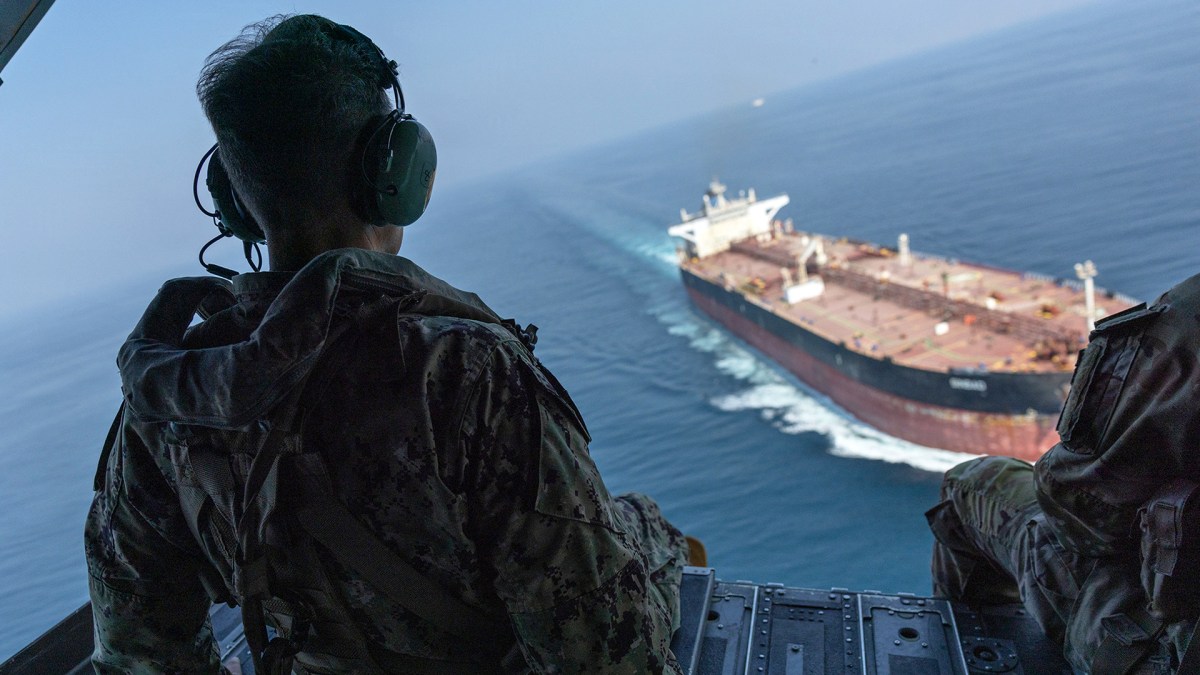
U.S. Navy Adm. Brad Cooper, commander of U.S. Central Command, observes a commercial vessel transiting the Strait of Hormuz while flying in a U.S. Army CH-47 Chinook over the international waterway, Oct. 25, 2026. (Senior Chief Petty Officer Amanda Dunford)
A small boat in the Strait of Hormuz approached a tanker and placed two explosive devices on the hull above the waterline, causing a blast that started a fire in the engine room, the United Kingdom Maritime Trade Operations (UKMTO) center reported . The attack on the Dubai-owned tanker Louise 1 was carried out by Iranians using limpet mines , Financial Times reported . The incident took place Thursday and was the first of its kind since June 2019, when a Japanese and a Norwegian ship were hit with limpets, the publication noted.
This is the first indication of the successful use of these mines during the current Islamic Revolutionary Guard Corps’ (IRGC) wave of strikes against shipping in the Strait of Hormuz following Operation Epic Fury. The attack also highlights the challenges of keeping ships safe in a busy and complex littoral.
“The apparent ability of a small craft to approach a transiting tanker, deploy explosive devices and withdraw presents a significant security concern, particularly in the Strait’s congested shipping lanes,” Greece-based maritime risk management group Marisks said on Friday, Reuters reported .
TWZ covered the 2019 attacks extensively , including sharing the following video showing an Iranian Navy or IRGC fast boat going back to remove a dud limpet mine from the Japanese-owned Kokuka Courageous’s damaged hull.
Earlier Friday morning, U.S. Central Command (CENTCOM) commander Adm. Brad Cooper said the waterway was cleared of sea mines. He was not addressing the limpet mine claim.
He stated on X that after “we sank Iran’s navy earlier this year, we also successfully cleared the strait’s internationally recognized primary transit routes of Iranian sea mines, and today U.S. forces remain highly vigilant and present to ensure that all primary transit routes in the Strait of Hormuz remain free and clear.”
“This week we reached a significant milestone, having now assisted Gulf partners in exporting more than 1.5 billion barrels of crude oil since summer,” Cooper added.
Recalling a recent flight over the Strait of Hormuz, Cooper noted that he “saw our U.S. assets in the air and on the water, including a squadron of advanced sea drones that were on patrol supporting a defensive layer. Here’s what I didn’t see: I didn’t see the IRGC out there at all.”
Also known as uncrewed surface vessels (USVs), the sea drones are part of an increasingly uncrewed armada of air, land and sea assets that are supporting the safe coordior through the Strait.
The USV type shown in the following video, a Saronic Corsair, made history twice in the battle against Iran. In July, the USVs were used as a strike weapon in combat for the first time by the U.S. A month earlier, a Saronic Corsair USV rescued the crew of a U.S. Army AH-64 Apache that crashed in the Gulf of Oman after it was downed by Iran .
Update from CENTCOM Commander: pic.twitter.com/oipZRRCJuE — U.S. Central Command (@CENTCOM) October 30, 2026
Update from CENTCOM Commander: pic.twitter.com/oipZRRCJuE
Despite the heavy presence of CENTCOM forces, this month is turning out to be particularly dangerous for shipping in the region.
“October has seen the highest number of ship attacks on record,” Noam Raydan, a senior fellow at the Washington Institute for Near East Policy, said last week, according to the BOE Report , an oil industry publication. “Raydan, who maintains the institute’s interactive shipping incident map, has recorded 28 confirmed and reported attacks in the Strait of Hormuz and surrounding waterways in October and 113 since the US-Israeli war with Iran began on February 28.”
These strikes, combined with ongoing Houthi attacks on Saudi Arabia’s oil infrastructure, have already placed tremendous pressure on a global economy relying heavily on fossil fuel from the region. As of Friday morning, Brent crude topped $117 per barrel, the highest level in more than four years, according to OilPrice.com .
The American oil industry, meanwhile, is making a fortune on this situation.
“The war with Iran has been very lucrative for American oil companies, which have earned more than $130 billion in profit as people pay much higher prices for gasoline, diesel and other fuel,” The New York Times reported on Friday . “That is a conservative estimate based on the performance of more than 50 large U.S. oil and gas companies, most of them producers or refiners, in the six months from April through September. It does not reflect profits earned in March, the first month of the war, or in October.”
“The United States oil and gas business is making hundreds of billions of dollars,” Trump said at an Oct. 24 campaign rally, describing how the war is affecting the industry.
TRUMP on HIGH GAS PRICES: We’re making money like we’ve never made before. They’ll say: President Trump is bragging about all the money they're making while people are suffering at the pump. I don’t give a damn. We’re making a freaking fortune. pic.twitter.com/KZ2pYsTPyR — Acyn (@Acyn) October 25, 2026
TRUMP on HIGH GAS PRICES: We’re making money like we’ve never made before. They’ll say: President Trump is bragging about all the money they're making while people are suffering at the pump. I don’t give a damn. We’re making a freaking fortune. pic.twitter.com/KZ2pYsTPyR
Qatari mediators returned to Tehran on Friday in another bid to try to pull the Middle East region back from the brink of war. The visit takes place as the U.S. and Israel are gearing up for a possible new round of strikes against Iran that could come as soon as next week after America’s midterm elections.
U.S. President Donald Trump has frequently stated that he could order new strikes, likely with Israeli assistance, after control of the next Congress is settled. While Trump could be gearing up to hit Iran again, leaks about war planning could also be messaging to compel Tehran back to the bargaining table.
“It’s going to get wrapped up soon,” Trump said Friday morning in an interview with Kansas City radio station KCMO . “We need a guarantee there’ll never be a nuclear weapon.”
Whether this latest Qatari effort can stop the clock winding down toward a resumption of hostilities remains questionable. Washington and Tehran seem far apart in their goals for achieving an agreement to stave off war.
The U.S. wants nuclear issues included from the start of negotiations while Tehran demands that the US first end its port blockade and lift oil export sanctions, Reuters reported on Friday .
A senior Iranian official has already dismissed a plan presented by Qatar as “unacceptable,” the outlet added. “The proposal presented by Qatar sets a seven-day timeline addressing both Tehran’s and Washington’s concerns, laying out daily confidence-building steps that each side must take,” the news outlet reported on Oct. 28 , citing an official briefed on the negotiations.
The Qatari mediation is the latest diplomatic effort to prevent new fighting. On Monday, major regional powers met in Tehran to find a peaceful way forward.
Regardless, American forces are locked and loaded for a possible new round of strikes against Iran . Israel also continues ramping up attack plans in coordination with the U.S. in the wake of a so-far inconclusive national election that could result in the end of Prime Minister Benjamin Netanyahu’s career.
“Cooper rarely briefs Trump in person, so the meeting could signal that the U.S. is moving closer to significant military operations,” the publication stated. “He met with the president in July , when the two huddled with Hegseth and Caine on Air Force One in Delaware.”
U.S. Navy Adm. Brad Cooper, commander of U.S. Central Command (left), and U.S. Army Maj. Gen. Brandon Tegtmeier, 82nd Airborne Division commander (right), observe commercial traffic transiting the Strait of Hormuz while flying over the international waterway in a U.S. Army CH-47 Chinook, Oct. 25, 2026. (U.S. Central Command photo) Senior Chief Petty Officer Amanda Dunford
CENTCOM declined comment when we asked to confirm the meeting as described. The Pentagon referred us to the White House, and the White House did not respond to our request for comment.
While the Journal offered no specific details about the plans discussed at the White House meeting, previous reporting has suggested Trump is seeking a short, intense bombing campaign.
“According to several people familiar with the war plans, any new US-Israeli assault would be intense, lasting some three days and targeting nuclear facilities, regime assets and civilian infrastructure including power plants,” Financial Times reported on Thursday .
A top Democratic senator said he was briefed on plans and was shocked by what he heard.
“I will just say this: their plan is insane,” Sen. Chris Murphy, of Connecticut said. “It will lead to devastating escalation and the likely destruction of our commitment to the rule of law.”
“There’s been open reporting as to what we may be planning and the civilian infrastructure that we may be targeting,” Murphy added. “The plan that they have developed will lead, in my view, to a prolongment and an escalation of this war that will be devastating for our security interests.”
Trump is reportedly planning to restart war with Iran after the election. Some of us have been briefed on the war plan. And while I cannot disclose any details, I can say this: the plan is insane. It will not achieve objectives and will set off a new cycle of escalation. pic.twitter.com/adWJfHVIok — Chris Murphy 🟧 (@ChrisMurphyCT) October 29, 2026
Trump is reportedly planning to restart war with Iran after the election. Some of us have been briefed on the war plan. And while I cannot disclose any details, I can say this: the plan is insane. It will not achieve objectives and will set off a new cycle of escalation. pic.twitter.com/adWJfHVIok
As the White House continues to put the finishing touches on new attack plans, the U.S. is bolstering its forces in the Middle East as we noted at the top of this story.
“The U.S. military is sending an additional Patriot system to Israel from Texas to beef up its missile defenses in the country, according to flight-tracking data and two officials with knowledge of the movement,” the Journal reported on Wednesday. “The U.S. has also moved troops off bases in the Middle East where they were vulnerable in preparation for an escalation.”
“U.S. forces in the region have been restocking their munitions, and bomber aircraft and jet fighters are preparing for strikes, some of the officials said.”
The U.S. is reportedly sending an additional Patriot system to Israel. (U.S. Army photo by Capt. Russell Shirley-Jones) Capt. Russell Shirley-Jones
As we previously noted , there have been other signs that a major new round of U.S. and/or Israeli strikes on Iran might be looming on the horizon. Fox News reported that the Nimitz class aircraft carrier USS Theodore Roosevelt and the rest of its carrier strike group, as well as the Makin Island Amphibious Ready Group carrying the 13th Marine Expeditionary Unit (MEU), are heading to the Middle East, citing unnamed U.S. officials.
“The ships will arrive in the Middle East by the end of November,” the officials said, according t o a post on X from Fox ’s Jennifer Griffin on Tuesday. “These new deployments will add about 10,000 sailors and Marines to the Middle East.”
You can find out more about the locations of the U.S. Navy’s fleet of flattops in our “ Where Are The Aircraft Carriers? ” feature .
Nimitz-class aircraft carrier USS Theodore Roosevelt (CVN 71) is reportedly heading to the Middle East. (U.S. Navy photo by Mass Communication Specialist 1st Class Luke McCall) Petty Officer 1st Class Luke McCall
There have been indications of increased U.S. military air activity in the Middle East recently, as well. Observers have called attention to the particularly significant influx of aerial refueling tankers to bases in the region, as well as in Europe, which would be critical to any new major air campaign .
US Tanker Fleet Update 21/OCT/2026 #IranWar Overall numbers across CENTCOM and Europe have now stabilised back to the levels they were at back at the start of September, around 190-195. There are a few tankers dotted around at other sites temporarily (Glasgow Prestwick and… pic.twitter.com/taKi8op7Tv — DefenceGeek 🇬🇧 (@DefenceGeek) October 21, 2026
US Tanker Fleet Update 21/OCT/2026 #IranWar Overall numbers across CENTCOM and Europe have now stabilised back to the levels they were at back at the start of September, around 190-195. There are a few tankers dotted around at other sites temporarily (Glasgow Prestwick and… pic.twitter.com/taKi8op7Tv
America and Israel struck hard at Iranian logistics during Operation Epic Fury, and the U.S. Navy maintains a blockade on Iranian ports . Still, the IRGC has managed to bring in materiel critical to its drone and missile programs.
A new Reuters investigation examines how .
“Iran has created a secret network of military agencies with global reach to import at least $2 billion in hardware, explosives and heavy-duty trucks since January 2025, evading both the US naval blockade and Western sanctions,” the investigation found. “Hidden behind names starting with the letters MOD, for the Ministry of Defense, are more than 5,000 agencies that form a formidable financial and military machine. Their financial footprints are on bills of lading and other shipping data dating back to 2016. Some are tied to the Islamic Revolutionary Guard Corps and to business conglomerates known as bonyads that are controlled by Iran’s elite .”
“The findings offer a window into one of the war’s great mysteries,” the outlet explained. “How is the IRGC replenishing its missile and drone arsenals while firing them in their thousands?”
Amid events in the Persian Gulf region, fighting between the Iranian-backed Houthi rebels of Yemen and Saudi Arabia rages on.
On Friday, Saudi Arabia said it intercepted and destroyed a Houthi drone near Islam’s holiest city, a claim the Houthis denied .
On Thursday, the Houthis claimed attacks on a half dozen targets across the kingdom, including oil facilities and airports. Saudi officials, for their part, said they intercepted ballistic missiles .
Adding to regional jitters, there were fresh reports of explosions near Iran’s Qeshm Island in the Strait of Hormuz Thursday night. However, these incidents often turn out to be air defense activity, warning shots fired at ships or nothing at all.
CENTCOM on Friday pushed back against claims that the command acknowledged attacks on Iranian targets.
“The reported notion that CENTCOM claimed any recent attacks is false,” Capt. Tim Hawkins, the command’s spokesman, told TWZ .
For now, the world is waiting nervously to see whether the Middle East again erupts into war. We should have a clearer picture in the coming days.
Contact the author: howard@twz.com
Comments couldn’t be loaded. Please refresh the page.
发布于美国东部时间2026年10月30日下午2:33
2026年10月25日,美国中央司令部司令、海军上将布拉德·库珀乘坐美国陆军CH-47“支奴干”直升机飞越霍尔木兹海峡,观察一艘商船通过该海峡。(高级士官长阿曼达·邓福德摄)
据英国海事贸易行动中心(UKMTO)报告,霍尔木兹海峡一艘小船靠近一艘油轮,并在其水线以上的船体上放置了两枚爆炸装置,引发爆炸并导致机舱起火。《金融时报》报道称,此次袭击迪拜所有的“路易丝一号”油轮是由伊朗人使用吸附式水雷实施的。该报指出,这起事件发生在周四,是自2019年6月以来首次发生此类事件,当时一艘日本船只和一艘挪威船只也遭到了吸附式水雷袭击。
这是伊斯兰革命卫队(IRGC)在“史诗狂怒行动”后,对霍尔木兹海峡船只发动的一系列袭击中,首次成功使用这些水雷的迹象。此次袭击也凸显了在繁忙且复杂的近岸海域保障船只安全所面临的挑战。
据路透社报道,总部位于希腊的海事风险管理集团 Marisks 周五表示:“小型船只似乎能够接近过境油轮,投放爆炸装置并撤离,这构成了一个重大的安全隐患,尤其是在海峡拥挤的航道上。”
TWZ 对 2019 年的袭击事件进行了广泛报道,包括分享了以下视频,视频显示一艘伊朗海军或伊朗伊斯兰革命卫队的快艇返回日本所有的“国华勇气”号受损船体,移除了一枚未引爆的吸附式水雷。
周五清晨,美国中央司令部司令布拉德·库珀海军上将表示,该水道已清除水雷。他并未就吸附式水雷的说法作出回应。
他在 X 上表示,“今年早些时候我们击沉了伊朗海军,我们也成功清除了霍尔木兹海峡国际公认的主要航道上的伊朗水雷,如今美军仍然保持高度警惕并驻守,以确保霍尔木兹海峡所有主要航道畅通无阻。”
库珀补充道:“本周我们达到了一个重要的里程碑,自夏季以来,我们已经协助海湾合作伙伴出口了超过15亿桶原油。”
库珀回忆起最近一次飞越霍尔木兹海峡的飞行,他指出:“我看到了我们美国的空中和海上力量,包括一个正在巡逻支援防御层的先进海上无人机中队。但我没看到的是:我根本没看到伊朗伊斯兰革命卫队。”
海上无人艇,也称为无人水面舰艇(USV),是日益壮大的空中、陆地和海上无人舰队的一部分,这些舰队正在支持海峡的安全协调工作。
以下视频中展示的萨罗尼克海盗式无人水面艇(USV)在对伊战争中两次创造历史。7月,美军首次将这种无人水面艇用作打击武器。一个月前,一架萨罗尼克海盗式无人水面艇在阿曼湾救起了被伊朗击落的美国陆军AH-64阿帕奇武装直升机的机组人员。
美国中央司令部司令最新消息:pic.twitter.com/oipZRRCJuE — 美国中央司令部 (@CENTCOM) 2026年10月30日
中央司令部司令最新消息:pic.twitter.com/oipZRRCJuE
尽管中央司令部部队部署了大量兵力,但本月对于该地区的航运而言却格外危险。
据石油行业刊物《BOE报告》报道,华盛顿近东政策研究所高级研究员诺姆·雷丹上周表示:“10月份的船舶袭击事件数量创历史新高。”雷丹负责维护该研究所的互动式航运事件地图,他记录到10月份霍尔木兹海峡及其周边水域共发生28起已确认和报告的袭击事件,自2月28日美以对伊战争爆发以来,已发生113起袭击事件。
这些袭击,加上胡塞武装持续对沙特阿拉伯石油基础设施的袭击,已经给严重依赖该地区化石燃料的全球经济带来了巨大压力。据OilPrice.com网站报道,截至周五上午,布伦特原油价格突破每桶117美元,创四年多来新高。
与此同时,美国石油行业正从中大赚一笔。
《纽约时报》周五报道称:“与伊朗的战争给美国石油公司带来了巨额利润,由于民众不得不为汽油、柴油和其他燃料支付更高的价格,这些公司已获利超过1300亿美元。这只是基于50多家美国大型石油和天然气公司(其中大多数是生产商或炼油商)在4月至9月这六个月的业绩得出的保守估计。该数据并未反映战争爆发首月——3月份以及10月份的利润。”
特朗普在10月24日的一次竞选集会上说:“美国的石油和天然气行业正在创造数千亿美元的收入”,他描述了战争如何影响该行业。
特朗普谈高油价:我们赚的钱比以往任何时候都多。他们会说:特朗普总统在吹嘘他们赚了多少钱,而人们却在加油站苦苦挣扎。我才不在乎。我们赚得盆满钵满。 pic.twitter.com/KZ2pYsTPyR — Acyn (@Acyn) October 25, 2026
特朗普谈高油价:我们赚的钱比以往任何时候都多。他们会说:特朗普总统在吹嘘他们赚了多少钱,而人们却在加油站苦苦挣扎。我才不在乎。我们赚得盆满钵满。pic.twitter.com/KZ2pYsTPyR
卡塔尔调解员周五重返德黑兰,再次尝试将中东地区从战争边缘拉回来。此次访问正值美国和以色列准备对伊朗发动新一轮打击之际,打击行动最早可能在下周美国中期选举后展开。
美国总统唐纳德·特朗普曾多次表示,一旦确定下一届国会的控制权,他可能会下令发动新的打击,以色列很可能提供协助。虽然特朗普可能正在准备再次打击伊朗,但有关战争计划的泄露也可能是为了迫使德黑兰重返谈判桌。
“这件事很快就会结束,”特朗普周五上午在接受堪萨斯城电台KCMO采访时说。“我们需要保证永远不会有核武器。”
卡塔尔的最新努力能否阻止战争重燃,目前仍是未知数。华盛顿和德黑兰在达成避免战争的协议目标上似乎存在巨大分歧。
路透社周五报道称,美国希望从谈判一开始就将核问题纳入其中,而德黑兰则要求美国首先结束港口封锁并解除石油出口制裁。
该媒体补充说,一位伊朗高级官员已经驳斥了卡塔尔提出的方案,称其“不可接受”。该新闻媒体10月28日援引一位了解谈判情况的官员的话报道称:“卡塔尔提出的方案设定了一个为期七天的时间表,旨在解决德黑兰和华盛顿双方的关切,并列出了双方必须采取的每日建立信任的步骤。”
卡塔尔的斡旋是为防止新的冲突而做出的最新外交努力。周一,主要地区大国在德黑兰举行会议,寻求和平解决之道。
无论如何,美军已做好充分准备,随时可能对伊朗发动新一轮打击。与此同时,以色列也在与美国协调,继续加强打击计划,以应对迄今为止尚未决出胜负的全国大选,此次大选结果可能导致总理内塔尼亚胡的政治生涯终结。
该报道指出:“库珀很少亲自向特朗普汇报情况,因此这次会面可能预示着美国正朝着重大军事行动迈进。他曾在7月份与总统会面,当时两人与赫格塞斯和凯恩在特拉华州的空军一号上进行了会谈。”
2026年10月25日,美国中央司令部司令、海军上将布拉德·库珀(左)和美国陆军第82空降师师长、陆军少将布兰登·泰格特迈尔(右)乘坐美国陆军CH-47“支奴干”直升机飞越霍尔木兹海峡,观察往来于该海峡的商业交通。(美国中央司令部照片)高级士官长阿曼达·邓福德
当我们要求中央司令部确认此次会面是否属实时,对方拒绝置评。五角大楼让我们联系白宫,但白宫没有回应我们的置评请求。
虽然《华尔街日报》没有提供白宫会议上讨论的计划的具体细节,但之前的报道表明,特朗普正在寻求一场短暂而猛烈的轰炸行动。
据《金融时报》周四报道,“几位熟悉战争计划的人士透露,任何新的美以联合进攻都将是猛烈的,持续约三天,目标是核设施、政权资产和包括发电厂在内的民用基础设施。”
一位民主党高级参议员表示,他听取了相关计划的简报,并对所听到的内容感到震惊。
“我只想说:他们的计划简直疯了,”康涅狄格州参议员克里斯·墨菲说。“这将导致灾难性的局势升级,并可能摧毁我们对法治的承诺。”
墨菲补充说:“关于我们可能正在计划的行动以及我们可能瞄准的民用基础设施,已经有公开报道。在我看来,他们制定的计划将导致这场战争的延长和升级,这将对我们的安全利益造成毁灭性打击。”
据报道,特朗普计划在大选后重启对伊朗的战争。我们当中有些人已经了解了这项战争计划。虽然我不能透露任何细节,但我可以肯定地说:这个计划简直疯了。它不仅无法实现任何目标,还会引发新一轮的冲突升级。pic.twitter.com/adWJfHVIok — Chris Murphy 🟧 (@ChrisMurphyCT) October 29, 2026
据报道,特朗普计划在大选后重启对伊朗的战争。我们当中有些人已经了解了这项战争计划。虽然我不能透露任何细节,但我可以肯定地说:这个计划简直是疯了。它不仅无法实现任何目标,还会引发新一轮的冲突升级。pic.twitter.com/adWJfHVIok
正如我们在本文开头提到的那样,随着白宫继续完善新的袭击计划,美国正在加强其在中东的兵力。
据《华尔街日报》周三报道,“根据航班追踪数据和两位知情官员透露,美军正从德克萨斯州向以色列增派一套‘爱国者’导弹防御系统,以加强该国的导弹防御能力。”报道还称,“为应对局势升级,美国已将驻中东部分易受攻击的基地撤离。”
“一些官员表示,驻扎在该地区的美国军队一直在补充弹药,轰炸机和战斗机正在准备发动袭击。”
据报道,美国将向以色列增派一套“爱国者”导弹防御系统。(美国陆军上尉拉塞尔·雪莉-琼斯摄)拉塞尔·雪莉-琼斯上尉
正如我们之前提到的,种种迹象表明,美国和/或以色列可能即将对伊朗发动新一轮大规模打击。福克斯新闻援引未具名的美国官员报道称,尼米兹级航空母舰“西奥多·罗斯福”号及其航母打击群的其他舰艇,以及搭载第13海军陆战队远征部队(MEU)的“马金岛”号两栖戒备群,正前往中东。
据福克斯新闻记者詹妮弗·格里芬周二在X网站上发布的消息,官员们表示:“这些舰艇将于11月底抵达中东。这些新的部署将为中东地区增加约1万名水兵和海军陆战队员。”
您可以在我们的“航空母舰在哪里?”专题文章中了解更多关于美国海军航母舰队位置的信息。
据报道,尼米兹级航空母舰“西奥多·罗斯福”号(CVN 71)正驶往中东。(美国海军一级大众传播专家卢克·麦考尔摄)一级军士长卢克·麦考尔
近期也有迹象表明,美国在中东地区的军事空中活动有所增加。观察人士注意到,大量空中加油机涌入该地区以及欧洲的基地,这对任何新的大规模空袭行动都至关重要。
美国油轮舰队最新动态 2026年10月21日 #伊朗战争 中央司令部和欧洲的油轮总数已稳定回升至9月初的水平,约为190-195艘。目前有少量油轮暂时部署在其他地点(格拉斯哥普雷斯蒂克机场等)。 pic.twitter.com/taKi8op7Tv — DefenceGeek 🇬🇧 (@DefenceGeek) 2026年10月21日
美国油轮舰队最新动态 2026年10月21日 #伊朗战争 目前,中央司令部和欧洲的油轮总数已稳定回升至9月初的水平,约为190-195艘。另有少量油轮暂时部署在其他地点(例如格拉斯哥普雷斯蒂克机场等)。 pic.twitter.com/taKi8op7Tv
在“史诗狂怒行动”中,美国和以色列对伊朗的后勤保障造成了沉重打击,美国海军也对伊朗港口实施了封锁。尽管如此,伊朗伊斯兰革命卫队仍然设法运入了对其无人机和导弹项目至关重要的物资。
路透社一项新的调查研究了……
调查发现,“自2025年1月以来,伊朗建立了一个覆盖全球的秘密军事机构网络,通过该网络进口了至少价值20亿美元的武器装备、爆炸物和重型卡车,从而规避了美国的海上封锁和西方的制裁。” “这些机构的名称都以‘国防部’(MOD)开头,背后隐藏着5000多个机构,它们构成了一个强大的金融和军事机器。这些机构的财务活动记录在提单和其他航运数据中,最早可追溯到2016年。其中一些机构与伊斯兰革命卫队以及由伊朗精英控制的被称为‘博尼亚德’的商业集团有关联。”
该媒体解释说:“这些发现为揭开这场战争的一大谜团提供了一扇窗口。伊朗伊斯兰革命卫队是如何在发射数千枚导弹和无人机的同时补充其武器库的?”
在波斯湾地区局势动荡之际,也门胡塞武装(伊朗支持)与沙特阿拉伯之间的战斗仍在激烈进行。
周五,沙特阿拉伯表示在伊斯兰教圣城附近拦截并摧毁了一架胡塞武装的无人机,但胡塞武装否认了这一说法。
周四,胡塞武装声称对沙特境内六个目标发动了袭击,其中包括石油设施和机场。沙特官员则表示,他们拦截了弹道导弹。
周四晚间,霍尔木兹海峡伊朗格什姆岛附近再次传出爆炸消息,加剧了地区紧张局势。然而,这些事件通常最终被证实是防空活动、向舰船鸣枪示警,或者根本就没有什么事发生。
美国中央司令部周五驳斥了有关该司令部承认对伊朗目标发动袭击的说法。
“有关中央司令部声称对近期发生的袭击事件负责的说法是错误的,”该司令部发言人蒂姆·霍金斯上尉告诉 TWZ。
目前,全世界都在紧张地等待中东是否会再次爆发战争。未来几天,局势应该会更加明朗。
联系作者:howard@twz.com
评论加载失败,请刷新页面。