Tiny Ukrainian receiver intercepts Russian drone feeds in real time乌克兰微型接收器实时截获俄罗斯无人机视频流
A small new receiver can co-opt video from Russian unmanned systems, allowing Ukrainian drone operators to intercept enemy live feeds in real time, the device's makers said this month.
Share on Facebook (Opens in new window) Facebook
Share on X (Opens in new window) X
Share on Bluesky (Opens in new window) Bluesky
Share on Reddit (Opens in new window) Reddit
Share on LinkedIn (Opens in new window) LinkedIn
Share using Native tools Share Copied to clipboard
Share on Mail (Opens in new window) Mail
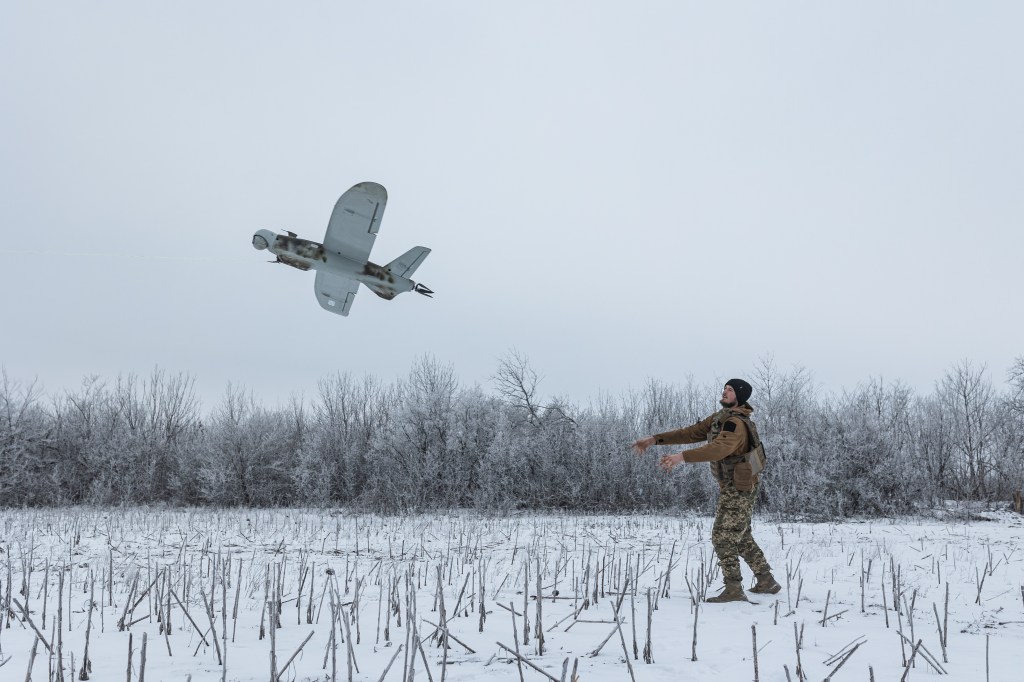
A Ukrainian soldier flies a reconnaissance drone at a combat position in the direction of Kostiantynivka, amid the ongoing Russia-Ukraine war in Donetsk Oblast, Ukraine, on Jan. 22, 2026. (Diego Herrera Carcedo/Anadolu via Getty Images)
KYIV, Ukraine — A new pocket-sized receiver can co-opt video from Russian unmanned systems, allowing Ukrainian drone operators to intercept enemy live feeds in real time, the device’s makers said this month, while adding only a little extra weight to operators’ kits.
Kyiv communications-equipment maker CODE380 developed the D·Vision SDR , which uses a software-defined radio (SDR) to sweep frequencies from 500 megahertz to 8.7 gigahertz for drone signals and convert them into video, reducing common visibility problems and allowing easy software updates for new drone specs.
The D-Vision SDR scans its frequency range without “blind spots” and offers greater sensitivity than competing detectors, the developers told the Ukrainian tech outlet DOU on Oct. 17.
The receiver joins a growing set of cheap, passive Ukrainian drone sensors that listen for threats without emitting a signal that could give away a unit’s position, working alongside radar, acoustic sensors and interceptors rather than replacing them.
CODE380’s device can display analog video from drones up to 6 miles (10 kilometers) away on frequencies between 540 megahertz and 6 gigahertz, and from 2 to 3 miles (3.5 to 5 kilometers) away on higher frequencies, according to manufacturer figures reported by Militarnyi .
Analog drones broadcast their camera feed unencrypted, so a receiver tuned to the right frequency can show a unit where an attack is heading and what the pilot is aiming at before impact.
The receiver’s sweep covers the 4.1 to 4.5 gigahertz band where Russia’s Molniya strike drones began sending video in June, according to Serhii “Flash” Beskrestnov, presidential adviser and radio specialist.
“Most detectors don’t see these frequencies, or see them poorly,” he wrote in June. “I’m warning you so that trust in a detector doesn’t cost you your life.”
The D-Vision SDR is not the first Ukrainian receiver to tap drone video, but its receiver weighs less than half as much as its main domestic rivals at roughly 10 ounces (290 grams).
Babai’s roughly 2-pound (0.9-kilogram) Vydun 7.5 intercepts analog video up to 7.5 gigahertz, while Contra-drone’s 21-ounce (600-gram) SENSE-4 reaches 8.2 gigahertz and BlueBird Tech’s Chuyka 3.0 , which weighs up to 23 ounces (650 grams), can now be upgraded to 8.8 gigahertz, according to manufacturers.
Many receivers struggle to decode digital video, detect Mavic-compatible signals beyond a few miles, and pick up fiber-optic drones guided by cables.
Drone variants are already being designed with harder-to-hack video feeds, Beskrestnov said, pointing out Russia’s Molniyas as an example.
“We need to be ready for digital video to one day fully replace analog,” he wrote, warning that portable detectors and fixed analog receiving stations would then become ineffective.
Katie Livingstone is the Ukraine correspondent for Defense News and Military Times. Based in Kyiv, she has covered Russia’s full-scale invasion since its first days. She is a former Fulbright fellow whose award-winning work has appeared in outlets across Europe and the U.S.
分享至 Facebook(在新窗口中打开) Facebook
分享至 X(在新窗口中打开)X
在 Bluesky 上分享(在新窗口中打开)Bluesky
分享到 Reddit(在新窗口中打开)
在领英上分享(在新窗口中打开)领英
使用原生工具分享 已复制到剪贴板
分享至邮件(在新窗口中打开)邮件
2026年1月22日,在乌克兰顿涅茨克州,一名乌克兰士兵在科斯蒂安蒂尼夫卡方向的作战阵地操控侦察无人机,当时俄乌战争仍在持续。(Diego Herrera Carcedo/Anadolu via Getty Images)
乌克兰基辅——该设备的制造商本月表示,一种新型袖珍接收器可以接收来自俄罗斯无人系统的视频,使乌克兰无人机操作员能够实时截获敌方的实时视频流,同时只会给操作员的装备增加一点额外的重量。
基辅通信设备制造商 CODE380 开发了 D·Vision SDR,它使用软件定义无线电 (SDR) 扫描 500 兆赫兹到 8.7 吉赫兹的频率,用于接收无人机信号并将其转换为视频,从而减少常见的可见性问题,并允许轻松进行软件更新以适应新的无人机规格。
开发人员于 10 月 17 日告诉乌克兰科技媒体 DOU,D-Vision SDR 扫描其频率范围时没有“盲点”,并且比竞争的探测器具有更高的灵敏度。
该接收器加入了日益增多的廉价被动式乌克兰无人机传感器行列,这些传感器可以监听威胁,而不会发出可能暴露单位位置的信号,它们与雷达、声学传感器和拦截器协同工作,而不是取代它们。
据 Militarnyi 报道,制造商数据显示,CODE380 的设备在 540 兆赫兹至 6 吉赫兹的频率范围内,可以显示最远 6 英里(10 公里)外无人机的模拟视频;在更高的频率范围内,可以显示 2 至 3 英里(3.5 至 5 公里)外的模拟视频。
模拟无人机以未加密的方式广播其摄像头画面,因此调谐到正确频率的接收器可以向无人机显示攻击方向以及飞行员在撞击前瞄准的目标。
据俄罗斯总统顾问兼无线电专家谢尔盖·“闪电”·别斯克列斯特诺夫称,接收器的扫描范围覆盖了 4.1 至 4.5 吉赫兹频段,俄罗斯的“闪电”攻击无人机从 6 月开始在该频段发送视频。
“大多数探测器要么探测不到这些频率,要么探测效果很差,”他在六月份写道。“我发出警告,是为了避免你们因为信任探测器而付出生命的代价。”
D-Vision SDR 不是第一款接收无人机视频的乌克兰接收器,但它的重量只有国内主要竞争对手的一半左右,约为 10 盎司(290 克)。
据制造商称,Babai 的 Vydun 7.5 重约 2 磅(0.9 公斤),可拦截高达 7.5 吉赫兹的模拟视频;Contra-drone 的 SENSE-4 重 21 盎司(600 克),可达到 8.2 吉赫兹;BlueBird Tech 的 Chuyka 3.0 重达 23 盎司(650 克),现在可以升级到 8.8 吉赫兹。
许多接收器难以解码数字视频,难以检测到几英里以外的 Mavic 兼容信号,也难以接收由电缆引导的光纤无人机。
别斯克列斯特诺夫表示,无人机的变种型号已经在设计中,配备了更难被黑客入侵的视频传输功能,他以俄罗斯的“闪电”无人机为例。
他写道:“我们需要做好准备,迎接数字视频有朝一日完全取代模拟视频的局面”,并警告说,届时便携式探测器和固定式模拟接收站将失效。
凯蒂·利文斯通是《防务新闻》和《军事时报》的乌克兰特派记者。她常驻基辅,自俄罗斯全面入侵乌克兰之初便开始报道此事。她曾是富布赖特学者,其获奖作品发表于欧洲和美国的多家媒体。