New CB90 CX Is Bigger, Optionally Crewed Evolution Of Saab’s Proven Combat Boat新型CB90 CX更大,可选配船员,是萨博久经考验的战斗艇的升级版。
The CX version brings expanded payload capacity and a new suite of combat capabilities to the familiar combat boat. The CX version brings expanded payload capacity and a new suite of combat capabilities to the familiar combat boat.
新闻视频
Published Nov 2, 2026 1:50 PM EST
Saab is taking its well-established CB90 combat boat in a notably more ambitious direction, introducing a larger, optionally crewed version that’s intended to do much more than ferry troops and conduct raids. The new Combat Boat 90 Capability X (CB90 CX) is being developed as a multi-mission combat platform capable of carrying sensors and weapons for intelligence, surveillance, and reconnaissance (ISR), anti-surface warfare, and short-range air defense (SHORAD).
The new boat represents a significant evolution of a design that has been adopted by naval forces around the world for littoral operations. Compared to the original design, however, the CX adds greater payload capacity, updated onboard systems, and the ability to operate with or without a crew.
A rendering showing the CB90 CX in its initial three mission versions, from left to right: anti-surface warfare, ISR, and SHORADS. Saab
Saab says the CB90 CX is currently in production for Sweden, which will be the launch customer, with 36 craft under contract for the Swedish Amphibious Battalion . With the Swedish Armed Forces, the new boat will operate alongside the existing, smaller CB90 NG rather than immediately replacing it.
Swedish attack divers of the Stockholm Amphibious Regiment perform an exercise with a CB90 at naval station Berga, Sweden, on May 7, 2024. Photo by Ida Marie Odgaard / Ritzau Scanpix / AFP / Denmark OUT
The development reflects several broader shifts in naval warfare, including the use of smaller combatants to contribute directly to the fight rather than simply transport personnel or support larger ships. At the same time, the ability of the CB90 CX to operate without personnel on board is indicative of the rapid advances being made in the uncrewed surface vessel (USV) space.
“The future of naval operations is not just about having more platforms; it is about distributing greater combat capability across the force,” Anders Hellman, head of Saab’s Docksta business unit, said in the announcement.
Hellman also pointed to recent operations in the Baltic Sea , the Black Sea, and the Red Sea to highlight the kinds of areas and missions the CB90 CX has been designed to face. In the Baltic, this includes protection of critical infrastructure as the threat from Russia continues to grow. In the Black Sea , Russia and Ukraine have been engaged in extensive naval warfare , increasingly using USVs to undertake missions including attacks on shipping and against ground targets, as well as SHORAD . Finally, the Red Sea has seen USVs, aerial drones, and cruise missiles attack commercial shipping , with the sheer volume of these strikes putting traditional naval air defenses under extreme pressure .
U.S. Navy sailors watch a CB90 from aboard the Wasp class amphibious assault ship USS Kearsarge on June 5, 2022, as the ship makes its way from Stockholm to the Baltic Sea to participate in the BALTOPS 22 exercise. Photo by JONATHAN NACKSTRAND/AFP via Getty Images
The baseline CB90 has already established its reputation through a combination of speed, maneuverability, and the ability to operate in confined coastal waters. While developed specifically with Swedish naval operations in mind, it has also been adopted by close to a dozen navies around the world.
The CB90 CX keeps those features but combines them with a larger hull and increased payload capacity, meaning it can accommodate a wider range of mission systems and weapons.
The ability for the CX to operate as an optionally crewed boat is derived from Saab’s proprietary Autonomous Ocean Core system. The company has not yet disclosed the full details of the autonomous operating modes but says that human supervision will be required as part of the decision-making process. Saab also says that every CB90 CX will come with the option of autonomous operations, with the decision falling upon the operator, based on the particular mission requirements.
A standard CB90 with Saab Barracuda marine camouflage netting. Saab
Clearly, the combination of a larger platform and autonomous operation opens up a range of possibilities for employing the boat in situations where putting a crew at risk may be undesirable. The CX is also designed to operate across a wider range of sea states.
In terms of specifications, the CB90 CX has an overall length of 59 feet, compared to 54.5 feet for the CB90 NG variant. It is powered by a pair of 1,100-horsepower engines driving waterjets, giving a maximum speed of over 40 knots, at which it can travel for more than 300 nautical miles. In crewed configuration, it can carry up to 10 personnel.
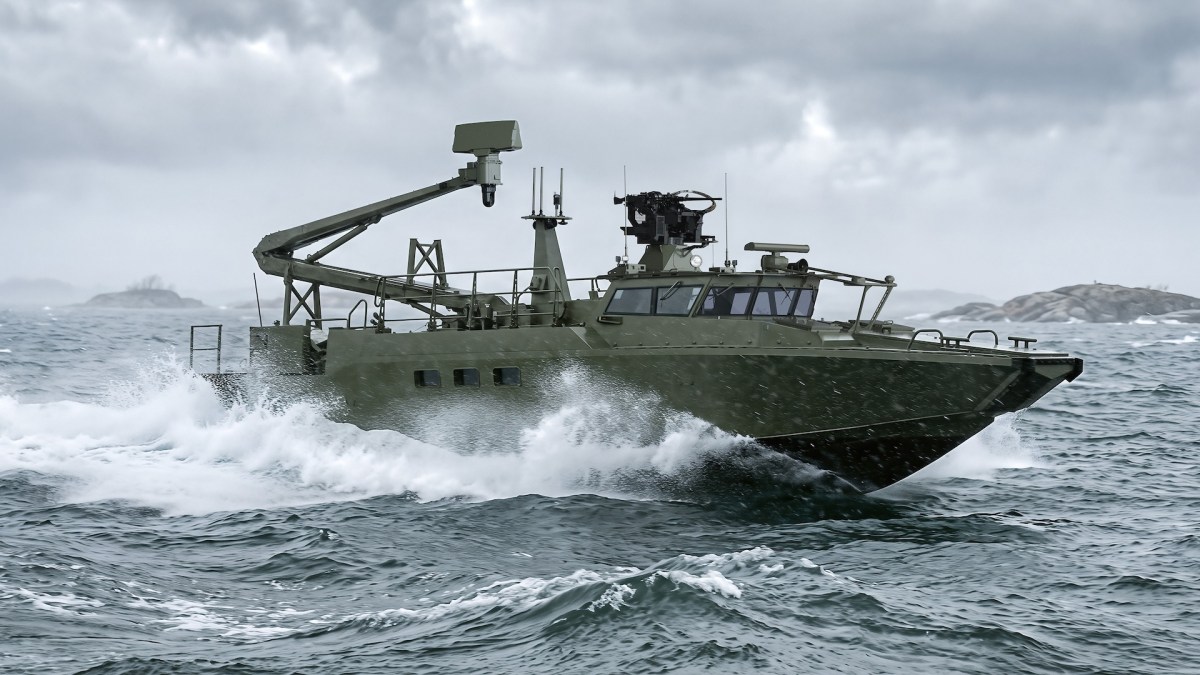
The ISR variant is designed to provide enhanced situational awareness across multiple domains. It incorporates Saab’s Giraffe 1X X-band 3D surveillance radar, which can detect and track threats in the air and on the surface, out to a range of over 62 miles against aerial targets. The radar is mounted on a 36-foot extending mast to increase its range over the horizon and in littoral zones.
CB90 CX ISR variant with radar mast folded down. Saab
The anti-ship warfare configuration is intended to provide over-the-horizon strike capability against surface vessels. Saab has shown a rendering of this version armed with a pair of MBDA’s Marte ER anti-ship missiles in angled canisters.
Marte ER is a lightweight, long-range missile designed to be deployed from a wide range of platforms, including aircraft, coastal batteries, and smaller naval vessels. It has a range of over 62 miles and operates on a sea-skimming ‘fire-and-forget’ principle, guided by an active radar seeker. The missile can also be employed against land targets, a capability that Saab doesn’t explicitly mention.
However, Marte ER is just one option for the CB90 CX, and Saab has confirmed that Sweden will arm the boats with a different, undisclosed missile.
Furthermore, both the ISR and anti-ship versions are armed with a 12.7mm or 30mm Trackfire Remote Weapon Station for self-defense.
Trackfire Remote Weapon Station on a standard CB90. Saab
The SHORAD configuration, meanwhile, is designed to address the growing threat posed by drones. It will employ Rheinmetall’s Seasnake 30mm autocannon, giving the boat a dedicated close-range air defense role. As well as drones, the gun, which has a nominal maximum rate of fire of 1,100 rounds per minute, can be used to engage helicopters, and it has a secondary role against surface targets, including USVs.
CB90 CX anti-surface warfare variant with Marte ER missiles. Saab
The latter capability is particularly notable as navies increasingly face the challenge of defending themselves against relatively inexpensive drones that can threaten even sophisticated warships.
Rheinmetall’s Seasnake 30mm autocannon. Rheinmetall
Beyond these three initial mission variants, Saab says it is developing an option to launch drones from the CB90 CX. Both tube-launched drones and quadcopters are being examined. Torpedo armament is also planned as an option.
The broader concept behind the CB90 CX involves the distribution of sensors and weapons across a larger number of smaller, more flexible platforms, which may or may not be crewed.
Operators could employ multiple CB90 CX boats in complementary roles. ISR-equipped boats could help detect and track threats, while anti-ship variants provide additional strike options, and SHORAD-equipped boats help protect the force against aerial threats.
Operating together, the different configurations could create a more distributed and more resilient combat fleet, particularly in coastal environments where geography, island chains, and confined waterways complicate operations.
Furthermore, the optionally crewed version would allow the boats to operate in higher-risk areas or undertake missions that would otherwise expose personnel to unacceptable danger.
The ISR variant, in particular, could be of use in a scenario like the current crisis with Iran, for instance. Vessels equipped with the Sea Giraffe radar could form a picket line across the Persian Gulf, Strait of Hormuz, and Gulf of Oman to detect incoming drones and cruise missiles, and also provide data on surface movements. A counter-drone variants could be used for force protection. The idea that these could even be uncrewed makes such an application even more attractive considering the threats posed to vessels in this region and especially in or near the strait.
For Sweden, the introduction of the CX alongside the CB90 NG means that a more capable combat boat can be introduced alongside the smaller platform, which remains useful for more traditional troop transport and raiding party missions.
Soldiers from the Swedish Amphibious Corps on a CB90 during the exercise Archipelago Endeavor 23 at Mallsten Island in the Stockholm archipelago on September 13, 2023. Photo by JONATHAN NACKSTRAND/AFP via Getty Images
The CB90 CX also represents an effort to expand the utility of the basic design out of its traditional littoral environment and into a more demanding and increasingly complex operational environment.
At the same time, broad commonality with the CB90 NG should make the new design more attractive to established customers.
The company has not yet disclosed a timeline for deliveries but says the first boat for Sweden is now undergoing final acceptance trials. Saab has also confirmed it aims to produce the CB90 CX alongside the previous CB90 NG, making use of a new production site to handle expected demand.
While the original CB90 made its name moving troops around the littorals, the CX is an altogether more ambitious development. At the same time, Saab will face competition from a growing number of USVs and optionally crewed boats, as these vessels continue to proliferate and be adapted for more roles.
Contact the author: thomas@thewarzone.com
Comments couldn’t be loaded. Please refresh the page.
发布于美国东部时间2026年11月2日下午1:50
萨博公司正将其成熟的CB90战斗艇推向一个更为雄心勃勃的方向,推出一款更大、可选载人的版本,其用途远不止运送部队和执行突袭任务。新型战斗艇90能力X型(CB90 CX)正在开发中,旨在成为一个多任务作战平台,能够搭载用于情报、监视和侦察(ISR)、反水面作战以及近程防空(SHORAD)的传感器和武器。
新型艇型代表了世界各国海军在近岸作战中采用的同类型艇型的重大改进。与原设计相比,CX型艇增加了更大的有效载荷能力、升级了艇载系统,并具备了有人或无人操作的能力。
这张渲染图展示了CB90 CX最初的三种任务版本,从左到右依次为:反水面作战、情报、监视与侦察(ISR)和近程防空导弹系统(SHORADS)。
萨博公司表示,CB90 CX目前正在为瑞典生产,瑞典将成为该型号的首发客户,已与瑞典两栖营签订了36艘艇的订单。在瑞典武装部队中,这款新型艇将与现有的、尺寸较小的CB90 NG并肩作战,而不是立即取代后者。
2024年5月7日,瑞典斯德哥尔摩两栖团的瑞典攻击潜水员在瑞典贝加海军基地使用CB90潜水艇进行演习。照片由Ida Marie Odgaard/Ritzau Scanpix/法新社/丹麦提供。
这一发展反映了海军作战的几项更广泛的转变,包括使用小型作战舰艇直接参与战斗,而不仅仅是运送人员或支援大型舰艇。同时,CB90 CX无人水面舰艇(USV)的无人作战能力也表明了无人水面舰艇领域正在取得的快速进展。
萨博公司Docksta业务部门负责人安德斯·赫尔曼在声明中表示:“海军作战的未来不仅仅是拥有更多平台;而是要在整个部队中分配更强大的作战能力。”
赫尔曼还提及了近期在波罗的海、黑海和红海的行动,以此强调CB90 CX的设计目标和任务类型。在波罗的海,随着来自俄罗斯的威胁不断加剧,CB90 CX的任务包括保护关键基础设施。在黑海,俄罗斯和乌克兰之间爆发了大规模海战,双方越来越多地使用无人水面艇(USV)执行包括攻击船只、地面目标以及近程防空(SHORAD)在内的任务。最后,在红海,无人水面艇、无人机和巡航导弹对商船发动了袭击,如此大量的攻击给传统的海军防空系统带来了巨大压力。
2022年6月5日,美国海军水兵在“黄蜂”级两栖攻击舰“基尔萨奇”号上观看一架CB90飞机。当时该舰正从斯德哥尔摩驶往波罗的海,准备参加“波罗的海行动22”(BALTOPS 22)演习。照片由JONATHAN NACKSTRAND/AFP via Getty Images提供。
CB90 基本型凭借其速度、机动性和在狭窄近岸水域的作战能力,已树立了良好的口碑。虽然它是专门为瑞典海军作战而开发的,但也已被全球近十几个国家的海军采用。
CB90 CX 保留了这些特点,但同时拥有更大的船体和更大的有效载荷能力,这意味着它可以容纳更广泛的任务系统和武器。
CB90 CX 可选载人作业模式源自 Saab 自主研发的海洋核心系统 (Autonomous Ocean Core)。该公司尚未公布自主作业模式的全部细节,但表示决策过程中仍需人工监督。Saab 还表示,每艘 CB90 CX 都将配备自主作业选项,是否启用自主作业将由操作员根据具体任务需求做出决定。
一辆标准的CB90,配有萨博梭鱼(Saab Barracuda)海洋迷彩网。
显然,更大的平台和自主操作能力的结合,为该艇在不宜让船员冒险的情况下执行任务开辟了多种可能性。CX型艇的设计也使其能够在更广泛的海况下运行。
CB90 CX 的总长度为 59 英尺,而 CB90 NG 型号的总长度为 54.5 英尺。它由两台 1100 马力的发动机驱动喷水推进器,最高航速超过 40 节,续航里程超过 300 海里。在配备船员的情况下,它最多可搭载 10 名船员。
ISR(情报、监视与侦察)型系统旨在增强跨多个领域的态势感知能力。它集成了萨博公司的Giraffe 1X X波段三维监视雷达,能够探测和跟踪空中和地面威胁,对空中目标的探测距离超过62英里。该雷达安装在36英尺长的可伸缩桅杆上,以扩大其在地平线以上和近岸区域的探测范围。
CB90 CX ISR 改型,雷达桅杆已折叠。
这种反舰作战配置旨在提供对水面舰艇的超视距打击能力。萨博公司展示了该版本的渲染图,图中显示其装备了两枚MBDA公司的Marte ER反舰导弹,导弹采用倾斜发射筒。
Marte ER 是一款轻型远程导弹,设计用于从包括飞机、岸基导弹阵地和小型舰艇在内的多种平台发射。其射程超过 62 英里,采用掠海飞行的“发射后不管”原理,并由主动雷达导引头制导。该导弹也可用于攻击陆地目标,但萨博公司并未明确提及这一能力。
然而,Marte ER 只是 CB90 CX 的其中一种选择,萨博公司已确认瑞典将为这些舰艇配备另一种未公开的导弹。
此外,ISR 和反舰版本均配备 12.7 毫米或 30 毫米 Trackfire 遥控武器站用于自卫。
标准CB90上的Trackfire遥控武器站。萨博
与此同时,近程防空系统(SHORAD)配置旨在应对无人机日益增长的威胁。它将采用莱茵金属公司的“海蛇”(Seasnake)30毫米自动炮,使该舰具备专门的近程防空能力。除了对付无人机外,这门炮的最大射速为每分钟1100发,还可用于攻击直升机,并可对包括无人水面艇(USV)在内的水面目标发挥辅助作用。
CB90 CX 反水面作战型,配备 Marte ER 导弹。萨博
后一种能力尤其值得关注,因为海军越来越面临着防御相对廉价的无人机的挑战,这些无人机甚至可以威胁到先进的军舰。
莱茵金属公司的“海蛇”30毫米自动炮。莱茵金属
除了这三种初始任务方案外,萨博公司表示正在开发从CB90 CX上发射无人机的选项。目前正在研究管式发射无人机和四旋翼无人机。鱼雷武器系统也被列为可选配置。
CB90 CX 背后的更广泛概念是将传感器和武器分布在更多更小、更灵活的平台上,这些平台可能有人驾驶,也可能无人驾驶。
作战人员可部署多艘CB90 CX艇,发挥互补作用。配备情报、监视与侦察(ISR)设备的艇可协助探测和追踪威胁,反舰型艇可提供额外的打击选项,而配备近程防空系统(SHORAD)设备的艇则有助于保护部队免受空中威胁。
不同的配置协同作战,可以打造一支更加分散、更具韧性的作战舰队,尤其是在地理环境、岛链和狭窄水道使作战变得复杂的沿海环境中。
此外,可选载人版本将使这些船只能够在风险更高的区域作业,或执行其他方式会使人员面临不可接受的危险的任务。
特别是ISR(情报、监视和侦察)版本,在类似当前伊朗危机的情境中可能发挥作用。配备“海长颈鹿”雷达的舰艇可以在波斯湾、霍尔木兹海峡和阿曼湾组成警戒线,探测来袭的无人机和巡航导弹,并提供水面活动数据。反无人机版本可用于部队防护。考虑到该地区,特别是霍尔木兹海峡及其附近海域的舰艇所面临的威胁,这些雷达甚至可以无人操作,这使得此类应用更具吸引力。
对于瑞典而言,CX 与 CB90 NG 的推出意味着可以在较小的平台之外,引入一艘功能更强大的战斗艇,而较小的平台仍然适用于更传统的部队运输和突袭队任务。
2023年9月13日,在斯德哥尔摩群岛的马尔斯滕岛举行的“群岛奋进23”演习期间,瑞典两栖部队的士兵们乘坐CB90登陆艇。图片由JONATHAN NACKSTRAND/AFP via Getty Images提供。
CB90 CX 也代表着一种努力,即把基本设计的用途从传统的近岸环境扩展到要求更高、日益复杂的作战环境。
同时,与 CB90 NG 的广泛共通性应该会让新设计对现有客户更具吸引力。
该公司尚未公布交付时间表,但表示首艘交付给瑞典的船只目前正在进行最终验收试验。萨博还确认,计划在生产CB90 NG的同时生产CB90 CX,并利用新的生产基地来满足预期需求。
最初的CB90因其在近岸海域运送部队而闻名,而CX则是一款目标更为远大的新型舰艇。与此同时,随着无人水面艇(USV)和可选载人艇数量的不断增长以及用途的日益多样化,萨博公司也将面临来自这些舰艇的日益激烈的竞争。
联系作者:thomas@thewarzone.com
评论加载失败,请刷新页面。