This Is Naval Group’s Concept For A Stealthy, Drone-Armed Future Destroyer这是法国海军集团提出的隐形、无人机武装的未来驱逐舰概念图。
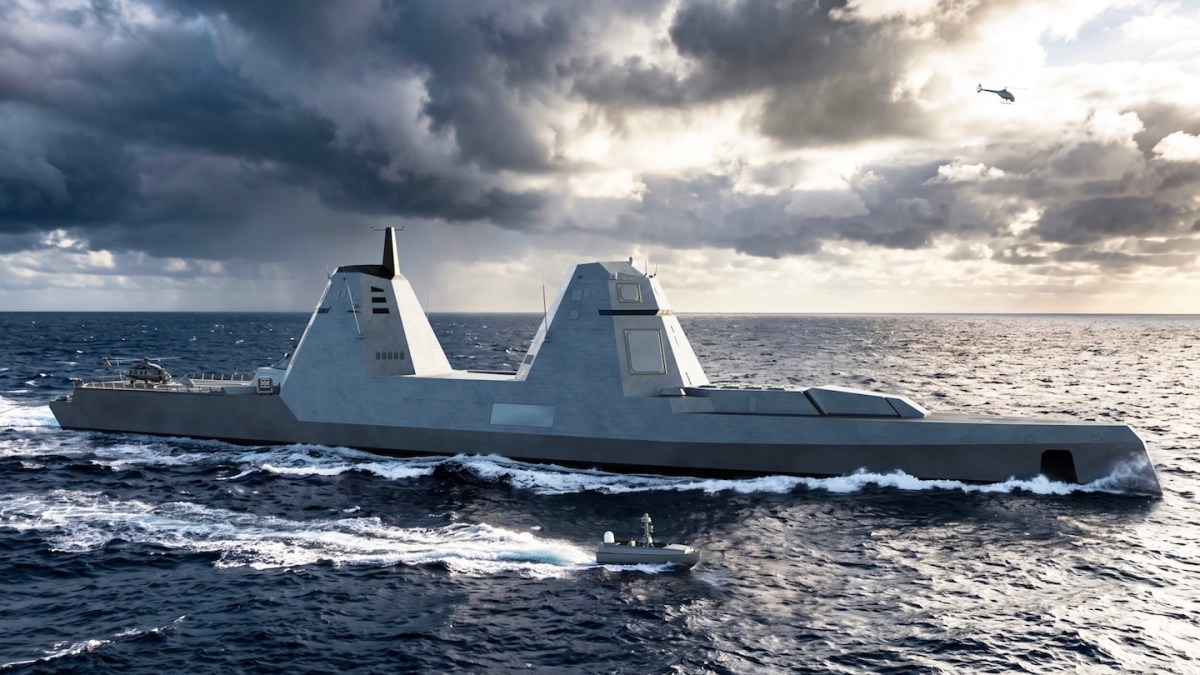
The SCX26 concept pairs a stealthy, split-superstructure design with advanced weapons and extensive facilities for uncrewed systems. The SCX26 concept pairs a stealthy, split-superstructure design with advanced weapons and extensive facilities for uncrewed systems.
新闻视频
Published Nov 3, 2026 2:01 PM EST
France’s Naval Group has unveiled the SCX26, a future warship concept exploring how large surface combatants could evolve to meet the demands of naval warfare in the coming decades. Heavily influenced by lessons from recent conflicts and emerging technologies, Naval Group describes it as a platform for testing ideas about future naval combat, rather than a design intended for immediate construction. However, it provides an interesting case study into what the next generation of destroyers could look like.
A digital rendering of the SCX26 future warship concept. Naval Group
In terms of the destroyer as a floating base for multiple types of drones, the potential of even smaller and cheaper drones to vastly increase the combat flexibility and overall capabilities of an advanced warship — especially when the drones can be employed in swarms — is something that TWZ has addressed in detail in the past .
Key features of the new design include a stealth-focused hull, distributed sensors, a substantial missile arsenal , and a large internal mission bay for uncrewed systems . Its most distinctive features are two widely separated superstructures that also act as sensor towers and extensive facilities for operating, maintaining, and potentially even manufacturing drones.
Vincent @VincentLamigeon sait prendre de belles photos 📸 du concept ship @navalgroup du SCX26 au @SalonEuronaval #Euronaval2026 pic.twitter.com/QXyr8FxIZ3 — Philippe Top-Action (@top_force) November 3, 2026
Vincent @VincentLamigeon sait prendre de belles photos 📸 du concept ship @navalgroup du SCX26 au @SalonEuronaval #Euronaval2026 pic.twitter.com/QXyr8FxIZ3
The SCX26 measures approximately 558 feet long and 79 feet wide, with a reported full-load displacement of around 8,000 metric tons. That makes it considerably larger than Naval Group’s FDI frigates . These innovative vessels, which you can read more about here , have a displacement of around 4,460 metric tons. These warships are 400 feet long and are 59 feet wide.
The Amiral Ronarc’h , the first of the French Navy’s new class of so-called defense and intervention frigates (FDI). Naval Group
Unveiled today at the Euronaval 2026 exhibition, taking place this week in Paris, the new ship is designed for a maximum speed of 30 knots and a range of up to 8,000 nautical miles. Its proposed propulsion system is CODLAG, or combined diesel-electric and gas turbine propulsion. In contrast, the French Navy’s FDIs are capable of speeds of 27 knots, driven by a combined diesel and diesel (CODAD) propulsion arrangement.
The concept artwork shows a long, low hull with smooth sides and minimal external clutter. Its angular superstructures reflect an emphasis on reducing radar signatures, while its wave-piercing, knife-like bow recalls that of the FDI design.
Extra! Extra! Inédito e exclusivo: a Naval Group revelou hoje na #Euronaval2026 o SCX26, navio conceito de 8.000 toneladas. Canhão eletromagnético, ao menos 64 células de mísseis e drones. Fotos em primeira mão: https://t.co/fgETVISAjN pic.twitter.com/yftbqq4bBV — Revista Conexão Naval (@conexaonaval) November 3, 2026
Extra! Extra! Inédito e exclusivo: a Naval Group revelou hoje na #Euronaval2026 o SCX26, navio conceito de 8.000 toneladas. Canhão eletromagnético, ao menos 64 células de mísseis e drones. Fotos em primeira mão: https://t.co/fgETVISAjN pic.twitter.com/yftbqq4bBV
Naval Group also says the design considers detection from above, including by radar satellites, with particular attention to the upper surfaces of its superstructures.
The SCX26’s most distinctive external feature is its split-superstructure arrangement.
Twin-island superstructures remain a highly unusual arrangement in which a ship’s functions are divided between two separate deckhouses rather than concentrated in one. On aviation-focused vessels such as the U.K. Royal Navy’s Queen Elizabeth class carriers, this allows navigation and flight operations to be managed separately. The same configuration was also studied for France’s future carrier, before it settled on a more conventional design .
HMS Prince of Wales at night alongside in Norway, displaying the twin-island superstructure. Crown Copyright
On the SCX26, the arrangement also distributes sensors and bridges between two structures.
The forward tower is broad, with large square radar panels integrated into its faceted sides. Mer et Marine reports that the largest panels are intended for a new-generation UHF radar, complemented by a multifunction active electronically scanned array (AESA) radar derived from the Sea Fire family used on the FDI frigate.
The aft tower is taller and narrower, topped by a pole mast.
Separating the sensor installations could provide wider coverage, reduce blind arcs, and improve resilience by distributing critical equipment across two structures. The arrangement also supports Naval Group’s emphasis on redundancy and survivability.
The choice of a UHF radar system reflects the requirement to improve long-range detection of demanding targets, including ballistic and hypersonic threats. Anti-ship ballistic missiles (ASBMs) and hypersonic weapons present some of the most demanding challenges for naval air defenses, and these types of threats are only set to proliferate. Their extreme speeds, combined in some cases with the ability to maneuver unpredictably during flight, compress the time available to detect, track, and intercept them.
An infographic showing ASBM types used by the Houthis. ©2023, The International Institute for Strategic Studies, originally published on https://iiss.org/online-analysis/military-balance/2024/01/houthi-anti-ship-missile-systems-getting-better-all-the-time/ (reproduced with permission)
A large open deck area separates the two towers. Naval Group describes this as a flexible central zone for additional mission equipment, including modular weapons and remotely operated systems. In a video also released today, the company presented mass-launcher boxes for drones. While these are shown in the video installed on an FDI frigate, they could equally occupy this central zone on the destroyer design.
#FDI Because high intensity demands high density and high flexibility. #Euronaval pic.twitter.com/FUTop05xgI — Naval Group (@navalgroup) November 3, 2026
#FDI Because high intensity demands high density and high flexibility. #Euronaval pic.twitter.com/FUTop05xgI
The proposed weapons fit includes 12 Sylver vertical-launch installations: eight forward and four aft. Depending on launcher configuration, these could accommodate up to 96 missiles, including Aster 30 surface-to-air missiles and MdCN land-attack cruise missiles.
Launch of an Aster 30 surface-to-air missile from an Italian warship:
Naval Group also identifies options for increasing the missile capacity beyond 100, including quad-packed CAMM missiles and future Sylver NG launchers.
Modern destroyers increasingly rely on large vertical launch system (VLS) arrays to carry a mixture of long- and short-range air-defense missiles, as well as other weapons. This capacity is particularly important in an era of massed missile and drone attacks , since ships have limited opportunities to replenish their missile stocks at sea and can quickly expend expensive interceptors defending against successive waves of threats.
In addition to the missiles loaded in the VLS cells, the ship would also carry two multifunctional Rampart launchers for short-range missiles, guided rockets, and decoys. On the model of the SCX26 shown at Euronaval, Rampart launchers are seen on either side of the rear of the ship, just forward of the flight deck.
The SCX26 concept includes several weapons that remain developmental or conceptual.
Its primary gun is described as a large-caliber electromagnetic weapon capable of firing rapid salvos. A conventional 57mm gun is also included. Both these guns are housed in shrouded cupolas, helping preserve the low-observable characteristics of the warship.
Electromagnetic railguns use powerful electrical currents and magnetic fields to accelerate projectiles to extremely high velocities , rather than relying on conventional gunpowder propellants. They promise long ranges, high rates of fire, and relatively inexpensive ammunition, potentially giving warships another way to engage air, surface, and land targets without consuming valuable missile stocks. So far, however, these systems have been dogged by significant technical challenges, especially when it comes to power generation and sustained operation, including barrel wear.
Testing of a prototype electromagnetic railgun aboard the Japanese warship Asuka last year. This was the first time anyone successfully fired a ship-mounted railgun at an actual target vessel. Japan’s Acquisition Technology & Logistics Agency
Another novel weapon system for the SCX26 is a proposed 100-kilowatt laser that would be mounted high on the forward superstructure, providing an elevated field of engagement against drones, missiles, and other threats.
High-energy lasers offer warships a potentially economical way to engage drones, small boats, and other relatively inexpensive threats without expending costly conventional missiles. They can engage targets at the speed of light and, provided sufficient electrical power and cooling are available, offer a virtually inexhaustible magazine compared with conventional weapons. On the other hand, their effectiveness is constrained by atmospheric conditions, range, and the need to maintain a sustained beam on the target. As a result, the SCX26 design considers the laser weapon as a supplement, rather than a replacement for traditional missiles.
With an output in the 100-kilowatt class, the laser would be comparable to the U.S. Navy Laser Weapon System Demonstrator (LWSD) Mk 2 Mod 0 that was installed in the San Antonio class amphibious warfare ship USS Portland in 2019, as seen in the video below:
The SCX26’s aviation facilities occupy a substantial portion of the stern. A large internal mission bay beneath the flight deck would accommodate helicopters and other uncrewed aerial, surface, and underwater vehicles.
A large elevator connects the mission bay to the flight deck, allowing systems to be moved between the two. As seen in the model displayed at Euronaval, the flight deck has spots for a single medium ( NH90 -sized) helicopter and two smaller spots for vertical takeoff and landing drones.
Naval Group describes the mission bay as a small onboard drone factory, with potential additive manufacturing capabilities alongside maintenance and repair facilities and spare-parts storage.
The arrangement would allow the SCX26 to carry and support a varied drone complement for intelligence gathering, surveillance, electronic warfare, strike, and other missions.
The drone-centric design of the SCX26 reflects the fact that warships are increasingly being conceived as motherships for uncrewed aerial, surface, and underwater vehicles, and not just simply platforms that can be adapted to support a handful of remotely operated systems. Drones can extend a vessel’s surveillance and targeting reach, conduct electronic warfare, support anti-submarine operations, and deliver weapons, while keeping crewed ships farther from danger. The kind of asymmetric advantage that drones can provide in a maritime context is something that Ukraine has employed with notable success against the Russian Navy in the Black Sea.
Naval Group ultimately envisions the SCX26 operating as a command and connectivity hub within a wider naval force, coordinating crewed vessels, aircraft, and autonomous platforms.
Its proposed combat system would use a data-centric architecture, advanced processing, and artificial intelligence to manage information and coordinate unmanned systems.
The ship would have a crew of approximately 150, with accommodation for another 100 personnel. The additional capacity could support an embarked command staff, drone operators, and special mission personnel.
Naval Group sees automation as a way to augment the crew while enabling the ship to manage a much larger network of systems.
At this point, the company considers the SCX26 as a research project rather than a production design. Already, however, its architecture has undergone substantial design work and reportedly includes model testing in a towing tank.
The concept provides an indication of the company’s thinking about future surface combatants: large, stealthy platforms with distributed sensors, layered defenses, flexible mission spaces, and extensive uncrewed systems. All of these factors will be addressed as France looks toward fielding a replacement for its current Horizon class air-defense destroyers.
The French Navy Horizon class destroyer Forbin transits through the Andaman Sea. U.S. Navy Photo by Mass Communication Specialist 2nd Class Kyle Carlstrom
Whether these ideas eventually inform a future French or export warship remains to be seen. However, the SCX26 underscores the pace of change that naval warfare is undergoing, with future destroyers expected to not just be heavily armed, but to have the facilities to operate and support a large family of uncrewed systems, too.
Contact the author: thomas@thewarzone.com
Comments couldn’t be loaded. Please refresh the page.
发布于美国东部时间2026年11月3日下午2:01
法国海军集团发布了SCX26概念舰艇,这是一款未来战舰概念设计,旨在探索大型水面作战舰艇如何发展以满足未来几十年海战的需求。该舰艇的设计深受近期冲突经验和新兴技术的影响,海军集团将其定位为未来海战理念的测试平台,而非旨在立即建造的成品。尽管如此,它仍然为我们了解下一代驱逐舰的可能形态提供了一个有趣的案例。
SCX26未来战舰概念的数字渲染图。法国海军集团
就驱逐舰作为多种类型无人机的浮动基地而言,即使是更小、更便宜的无人机也能极大地提高先进战舰的作战灵活性和整体能力——尤其是在无人机可以成群使用的情况下——TWZ 过去曾详细探讨过这个问题。
新设计的关键特征包括隐身船体、分布式传感器、强大的导弹库以及用于无人系统的大型内部任务舱。其最显著的特点是两个相距甚远的上层建筑,它们同时也是传感器塔和用于操作、维护甚至可能制造无人机的综合设施。
Vincent @VincentLamigeon sait prendre de belles 照片 📸 du 概念船 @navalgroup du SCX26 au @SalonEuronaval #Euronaval2026 pic.twitter.com/QXyr8FxIZ3 — Philippe Top-Action (@top_force) 2026 年 11 月 3 日
Vincent @VincentLamigeon sait prendre de belles 照片 📸 概念船 @navalgroup du SCX26 au @SalonEuronaval #Euronaval2026 pic.twitter.com/QXyr8FxIZ3
SCX26 型护卫舰长约 558 英尺,宽约 79 英尺,据报道满载排水量约为 8,000 公吨。这使其比法国海军集团的 FDI 型护卫舰大得多。这些创新型舰艇(您可以在这里了解更多信息)排水量约为 4,460 公吨。这些军舰长 400 英尺,宽 59 英尺。
“罗纳尔克海军上将”号是法国海军新型所谓防御与干预护卫舰(FDI)的首舰。法国海军集团
这艘新型舰艇今天在巴黎举行的2026年欧洲海军装备展(Euronaval 2026)上亮相,设计最高航速可达30节,续航里程可达8000海里。其拟采用柴电燃气轮机联合推进系统(CODLAG)。相比之下,法国海军的FDI级护卫舰航速为27节,采用的是柴电柴油联合推进系统(CODAD)。
概念图展示了一个修长低矮的船体,侧面光滑,外部杂波极少。其棱角分明的上层建筑体现了降低雷达反射截面的理念,而其破浪刀锋般的船首则令人联想起FDI的设计。
额外的!额外的! Inédito e exclusivo:海军集团revelou hoje na #Euronaval2026或SCX26,navio conceito de 8.000 toneladas。 Canhão eletromagnético,可提供 64 个无线和无人机。最初照片:https://t.co/fgETVISAjN pic.twitter.com/yftbqq4bBV — Revista Conexão Naval (@conexaonaval) 2026 年 11 月 3 日
额外的!额外的! Inédito e exclusivo:海军集团revelou hoje na #Euronaval2026或SCX26,navio conceito de 8.000 toneladas。 Canhão eletromagnético,可提供 64 个无线和无人机。最初的照片:https://t.co/fgETVISAjN pic.twitter.com/yftbqq4bBV
海军集团还表示,该设计考虑了来自上方的探测,包括雷达卫星的探测,尤其关注其上层建筑的上表面。
SCX26 最显著的外部特征是其分体式上层建筑布局。
双岛式上层建筑仍然是一种非常罕见的布局,它将舰船的功能划分到两个独立的甲板室中,而不是集中在一个甲板室中。在以航空为重点的舰艇上,例如英国皇家海军的伊丽莎白女王级航空母舰,这种布局使得导航和飞行作业可以分别进行管理。法国也曾研究过这种布局,但最终还是选择了更为传统的设计方案。
威尔士亲王号战列舰夜间停靠在挪威港,双岛式上层建筑清晰可见。英国皇家版权所有
在 SCX26 上,该布置还在两个结构之间分布传感器和桥梁。
前部塔架宽阔,多面侧面集成了大型方形雷达面板。《海事与海洋》杂志报道称,最大的面板用于安装新一代超高频雷达,并辅以源自FDI护卫舰所用“海火”系列的多功能有源相控阵雷达(AESA)。
后塔更高更窄,顶部装有一根桅杆。
将传感器装置分开部署,可以通过将关键设备分布在两个不同的结构上,提供更广阔的覆盖范围,减少盲区,并提高系统的韧性。这种安排也符合法国海军集团对冗余性和生存能力的重视。
选择超高频雷达系统是为了提高对包括弹道导弹和高超音速威胁在内的复杂目标的远程探测能力。反舰弹道导弹和高超音速武器对海军防空系统构成了极其严峻的挑战,而且这类威胁只会不断扩散。它们极高的速度,以及在某些情况下飞行过程中难以预测的机动能力,都极大地压缩了探测、跟踪和拦截的时间。
一张信息图,展示了胡塞武装使用的反舰弹道导弹类型。©2023,国际战略研究所,原载于https://iiss.org/online-analysis/military-balance/2024/01/houthi-anti-ship-missile-systems-getting-better-all-the-time/(经许可转载)
两座舰桥之间由一个宽敞的开放式甲板区域隔开。法国海军集团将其描述为一个灵活的中央区域,用于安装额外的任务设备,包括模块化武器和遥控系统。在今天发布的一段视频中,该公司展示了用于无人机的大规模发射箱。虽然视频中展示的是安装在FDI护卫舰上的发射箱,但它们同样可以安装在驱逐舰设计的这个中央区域。
#FDI 因为高强度需要高密度和高灵活性。#欧洲海军展 pic.twitter.com/FUTop05xgI — 法国海军集团 (@navalgroup) 2026年11月3日
#FDI 因为高强度需要高密度和高灵活性。#欧洲海军陆战队 pic.twitter.com/FUTop05xgI
拟议的武器配置包括12套“银箭”(Sylver)垂直发射装置:8套位于舰首,4套位于舰尾。根据发射装置的配置,这些装置最多可容纳96枚导弹,包括“紫菀30”(Aster 30)地对空导弹和“MdCN”陆攻巡航导弹。
从意大利军舰上发射一枚“紫菀30”型地对空导弹:
海军集团还确定了将导弹容量增加到 100 枚以上的方案,包括四联装 CAMM 导弹和未来的 Sylver NG 发射器。
现代驱逐舰越来越依赖大型垂直发射系统(VLS)阵列来携带远程和近程防空导弹以及其他武器。在导弹和无人机密集攻击的时代,这种能力尤为重要,因为舰艇在海上补充导弹库存的机会有限,而且在防御一波又一波的威胁时,昂贵的拦截导弹可能会迅速消耗殆尽。
除了垂直发射单元装载的导弹外,该舰还将配备两座多功能“堡垒”(Rampart)导弹发射装置,用于发射短程导弹、制导火箭和诱饵弹。在欧洲海军展上展出的SCX26模型中,“堡垒”导弹发射装置位于舰尾两侧,飞行甲板前方。
SCX26 概念包含几种仍处于研发或概念阶段的武器。
它的主炮被描述为一种大口径电磁武器,能够进行快速齐射。此外,它还配备了一门常规的57毫米炮。这两门炮都安装在封闭的炮塔内,有助于保持这艘战舰的低可探测性。
电磁轨道炮利用强大的电流和磁场将弹丸加速到极高的速度,而非依赖传统的火药推进剂。它们有望实现远射程、高射速和相对低廉的弹药成本,为军舰提供一种无需消耗宝贵导弹储备即可打击空中、水面和陆地目标的全新方式。然而,迄今为止,这些系统仍面临着诸多重大技术挑战,尤其是在发电和持续运行方面,例如炮管磨损。
去年,日本军舰“飞鸟”号上进行了电磁轨道炮原型机的测试。这是人类首次成功地用舰载电磁轨道炮击中实际目标舰艇。日本采办技术与后勤局
SCX26 的另一款新型武器系统是提议安装的 100 千瓦激光器,该激光器将安装在前部上层建筑的高处,从而提供高处的作战区域,以对抗无人机、导弹和其他威胁。
高能激光器为军舰提供了一种潜在的经济手段,无需消耗昂贵的常规导弹即可打击无人机、小型船只和其他相对廉价的威胁。它们能够以光速攻击目标,并且在电力和冷却条件充足的情况下,其弹药储备几乎是无限的,远超常规武器。另一方面,其效能受到大气条件、射程以及持续照射目标所需光束的限制。因此,SCX26的设计理念是将激光武器视为传统导弹的补充,而非替代品。
该激光器的输出功率为 100 千瓦级,与 2019 年安装在圣安东尼奥级两栖作战舰艇“波特兰”号上的美国海军激光武器系统演示器 (LWSD) Mk 2 Mod 0 相当,如下视频所示:
SCX26的航空设施占据了舰尾相当大的空间。飞行甲板下方的大型内部任务舱可容纳直升机和其他无人驾驶的空中、水面和水下航行器。
大型升降机连接任务舱和飞行甲板,方便在两者之间移动系统。正如在欧洲海军展上展出的模型所示,飞行甲板设有可容纳一架中型(NH90 大小)直升机的停机位,以及两个较小的垂直起降无人机停机位。
海军集团将任务舱描述为一个小型舰载无人机工厂,具备潜在的增材制造能力,以及维护和修理设施和备件存储。
这项安排将使 SCX26 能够携带和支持各种无人机,用于情报收集、监视、电子战、打击和其他任务。
SCX26 以无人机为中心的设计理念反映了这样一个事实:军舰正日益被视为无人驾驶空中、水面和水下航行器的母舰,而不仅仅是能够改装以支持少量遥控系统的平台。无人机可以扩展舰艇的监视和目标定位范围,执行电子战,支援反潜作战,并投放武器,同时使有人舰艇远离危险区域。乌克兰已在黑海对俄罗斯海军的战斗中,成功运用无人机在海上作战中提供的这种不对称优势。
海军集团最终设想 SCX26 能够作为更广泛的海军力量中的指挥和连接中心,协调有人驾驶舰艇、飞机和自主平台。
其提出的作战系统将采用以数据为中心的架构、先进的处理技术和人工智能来管理信息和协调无人系统。
该舰将配备约150名船员,并可容纳另外100名人员。额外的空间可用于搭载指挥人员、无人机操作员和特种任务人员。
法国海军集团认为自动化可以增强船员的能力,同时使船舶能够管理更大的系统网络。
目前,该公司将SCX26视为研发项目而非量产设计。不过,其架构已经过大量设计工作,据报道还包括在拖曳水池中进行的模型测试。
这一概念体现了该公司对未来水面作战舰艇的构想:大型隐身平台,配备分布式传感器、多层防御系统、灵活的任务空间以及广泛的无人系统。法国在寻求替换其现有的“地平线”级防空驱逐舰时,所有这些因素都将得到考虑。
法国海军“地平线”级驱逐舰“福尔班”号正在穿越安达曼海。美国海军二级大众传播专家凯尔·卡尔斯特罗姆摄
这些理念最终是否会应用于未来的法国或出口型军舰,还有待观察。然而,SCX26 的出现凸显了海战正在经历的快速变革,未来的驱逐舰不仅需要配备强大的武器装备,还需要具备操作和维护大量无人系统的能力。
联系作者:thomas@thewarzone.com
评论加载失败,请刷新页面。