Did The Blue Wave Just Sink Trump’s Battleship?蓝色浪潮是否已经击沉了特朗普的战舰?
Bipartisan pushback to President Trump's battleship program had been growing even before the Democrats' historic mid-term wins.
By Joseph Trevithick , Howard Altman
Published Nov 4, 2026 6:00 PM EST
The Democratic Party’s historic blowout of its Republican opponents in yesterday’s mid-term elections is extremely likely to result in a slew of high-profile Trump administration programs and initiatives getting put under the microscope and slashed. In the defense arena, the nuclear-powered Trump class battleship is likely the biggest target of opportunity for the new majority in the House and Senate.
The questionable utility and opportunity cost of the Trump class warships have made the program a hot topic of debate since it was first rolled out in December 2025 . The battleship effort has already faced growing bipartisan pushback over its price tag and practicality, as well as industrial base concerns .
A rendering of a Trump class battleship. White House/USN
To provide some quick additional context, Democrats are now set to take firm control of both chambers of Congress in January. This will give the party immense sway over how defense and other federal spending is authorized and appropriated, as well as how broader policy is set.
Control of key committees that oversee the U.S. military and its budgets will also change hands. Representative Adam Smith, a Washington state Democrat, could be in line now to become chairman of the House Armed Services Committee. Representative Joe Courtney, a Democrat from Connecticut, may be similarly poised to head up the Seapower and Projection Forces Subcommittee. Smith and Courtney have both been particularly outspoken critics of the Trump class battleship already.
President Donald Trump speaks at the rollout of the Trump class battleship program at his Mar-a-Lago estate in Florida in December 2025. Daniel Torok/White House
“We need an appropriate mix of high-end survivable systems and lower-cost attritable capabilities, not a fleet of nuclear-powered battleships as proposed by the President,” Representative Smith wrote in a letter to Democratic Party colleagues just today, which has now leaked online . The missive’s main thrust was to call for support for him returning to the role of Chairman of the House Armed Services Committee in January.
“I think the Democrats will make a broad effort to remove Trump branding from Washington,” Mark Cancian, a retired U.S. Marine Corps colonel who is now a senior adviser with the Defense and Security Department at the Center for Strategic & International Studies (CSIS) think tank, also told TWZ . “The Trump battleship is likely doomed both because of the branding and because the program is extremely expensive and weakly justified.”
“The battleship program was in stormy seas before the midterm elections, because it was premised on a strategy that ran counter to a decade long bipartisan effort to distribute maritime lethality,” Mark Montgomery, a retired U.S. Navy rear admiral who is now a senior fellow at the Foundation for Defense of Democracies (FDD) think tank, told us, as well. “Compounding this challenge was the fantastically high cost per battleship, equating to as many as 10 Arleigh Burke class Destroyers for one battleship – a terrible trade off.”
Montgomery is of the view that, “given the midterm election results, the battleship program is now aground and taking on water.”
The current state of the Trump class battleship plan
As it stands now, the Trump class battleship design is a 35,000-ton-displacement warship that is expected to boast a wide array of weapons, as well as advanced sensors and other systems. From what the Navy has said so far, the ship will be able to fire nuclear and conventional missiles, including hypersonic types, from several very large Vertical Launch System (VLS) arrays. Its armament package is also set to include an electromagnetic railgun and a pair of traditional 5-inch naval guns . Several classes of laser directed energy weapons, as well as other weapon systems for close-in defense, are to be fitted, as well.
An annotated graphic highlighting various capabilities set to be found on the Trump class design. Note that the mention here of “28 Mk 41 VLS” cells appears to be a typo, as other official information from the US Navy says the ships will have 128 such cells. USN via USNI News
In May, the Navy confirmed that the plan is also for the Trump class battleships to be nuclear-powered . The service retired its last nuclear-powered surface combatants – a category that does not include aircraft carriers and submarines – in the 1990s. It has been even longer since a ship of this type was built in the United States. Russia’s Kirov class battlecruiser Admiral Nakhimov is the only nuclear-powered surface combatant currently in service anywhere in the world.
The Navy has previously outlined plans to order at least 15 Trump class battleships between Fiscal Years 2029 and 2055. The first one, currently set to be named the USS Defiant , is not expected to enter service until 2036.
The USS Defiant could cost as much as $23 billion, and the average price of the next 14 battleships could be $18 billion, according to estimates the Congressional Budget Office (CBO) put out in August. To put this in perspective, even the $18 billion figure would make these warships significantly more expensive than each of the next three Ford class aircraft carriers .
A look at the future USS John F. Kennedy , the second Ford class carrier for the US Navy. HII
From the start, TWZ has raised detailed questions about the actual viability of the Trump class design, as it has been described to date. This includes the ability of these warships to conduct independent operations, as well as the value of employing them in this way. At least right now, the Navy only plans to acquire a very small number of these ships, each of which can only be in one place at one time, and that would be top targets for adversaries in future conflicts.
All of this comes at a time when the Navy has been struggling to meet operational demands for surface combatants with its existing fleets. This has been further exacerbated by shakeups in separate plans to acquire new frigates and larger uncrewed surface vessels (USV), as well as rising costs associated with its workhorse Arleigh Burke class destroyers .
The Arleigh Burke class destroyer USS Jack H. Lucas , which was the first example of the latest Flight III subclass to be commissioned into US Navy service. USN
Though top Navy officials have voiced significant support for the Trump class since December 2025, there had been no calls publicly for a ship of this type before Trump started his second term. For his part, Trump has been enamored with the idea of the Navy sailing new battleships for years now . He notably floated the idea while running for his first term in 2015.
TWZ has previously drawn further attention to industrial base concerns stemming from the battleship plans. Naval shipyard capacity in the United States has steadily dwindled since the end of the Cold War, and what remains is under immense strain from existing demands. Navy shipbuilding programs, even established ones, routinely run up against thing workforce shortages and growing costs. This is despite extensive efforts by the federal government , including under Trump , to reverse these trends.
Nuclear shipbuilding presents additional challenges. There are currently only two shipyards qualified to build nuclear-powered vessels of any kind in the United States, and only one supplier of naval reactors. This part of the naval industrial base is already heavily committed to building aircraft carriers and submarines . This includes new Columbia class nuclear ballistic missile submarines , the on-schedule delivery of which is critical to national security, but that also faces potential risks .
Naval nuclear reactor components for the future Ford class aircraft carrier USS Doris Miller . BWXT
Bipartisan pushback already to Trump’s battleships
For its part, the Republican-controlled House Armed Services Committee has already demanded that the Secretary of the Navy outline what the service is doing to ensure the battleship program will not disrupt carrier and submarine production. Democratic Representative Joe Courtney was the one to call for this report, which is due no later than March 1, 2027.
Earlier this year, the Republicans in the House also allowed the passage of a version of the annual defense policy bill, or National Defense Authorization Act (NDAA), for Fiscal Year 2027, with a key provision related to the Trump class battleship. Section 131 would block any work on the future USS Defiant until the Navy provides assurances that key weapon systems are “sufficiently mature.” Efforts to pass a final version of the Fiscal Year 2027 NDDA have since stalled in the Senate over non-battleship-related issues .
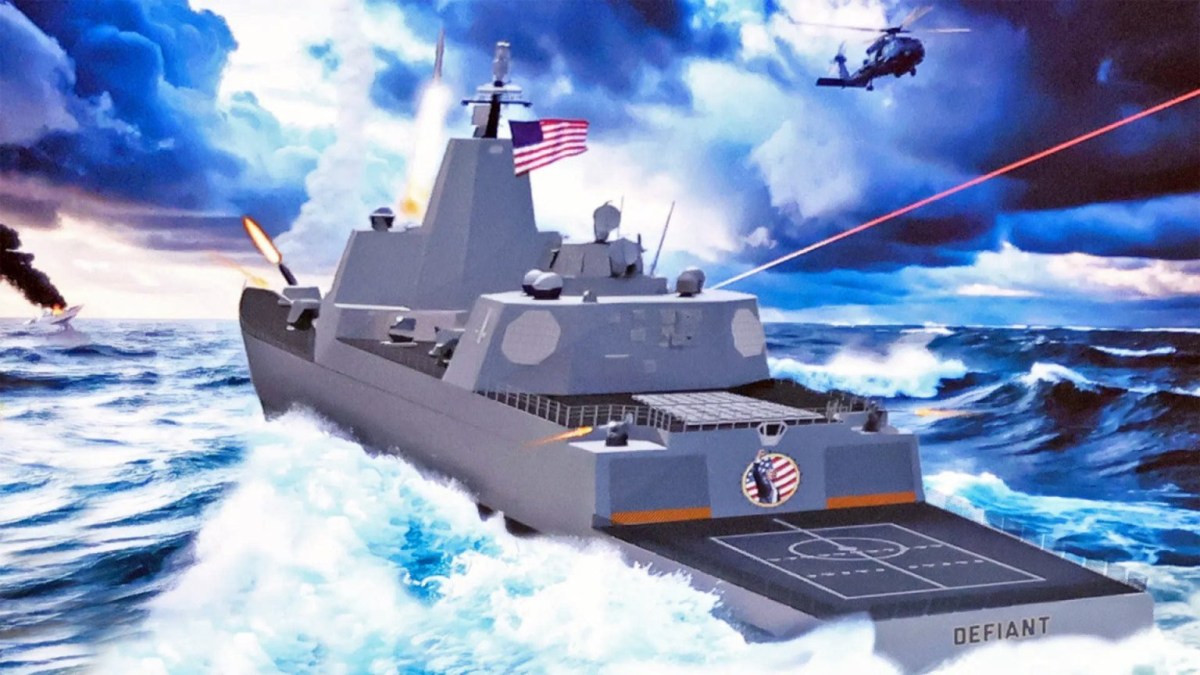
A rendering of the first planned Trump class battleship, the USS Defiant , firing a variety of different missiles, guns, and other weapons. USN
In July, the White House’s Office of Management and Budget issued a formal Statement of Administration Policy regarding the House’s version of the NDAA that included explicit opposition to Section 131 among other criticisms of the bill’s contents.
TWZ has pointed out on several occasions in the past that plans for the Trump class battleships could change dramatically given the lengthy schedule for the program. As mentioned, the USS Defiant is not expected to be delivered until 2036, well after the end of Trump’s second term, which will come to an end in January 2029.
There is still the possibility the battleship program could be reformulated in various ways rather than outright cancelled. Work on specific components, such as the railgun, might potentially be redirected to other programs.
A picture showing the prototype electromagnetic railgun at the White Sands Missile Range (WSMR) in New Mexico being fired during a test. USN
“Any money allocated to the program will be for research or long term parts ordering that could just as easily support a next generation destroyer effort rather than the battleship,” FDD’s Montgomery also told us. “The battleship program itself probably can’t be killed until Trump leaves office, but all involved need to ensure that it does minimal damage to other Navy program efforts as it sinks to the bottom.”
“The Navy still needs the capabilities resident in the proposed battleship,” Brent Sadler, Senior Research Fellow for Naval Warfare and Advanced Technology at the Allison Center for National Security within The Heritage Foundation think tank, also argued in response to queries from TWZ . “The name – Trump class – likely won’t survive but the ship will.”
Sadler added that, in his view, what is really “needed is a national shipbuilding industrial plan that includes upgrading shipyard capacity to build the needed large surface warship.”
New pressure from Congress likely to go beyond Battleships
The future prospects of other high-profile Trump administration defense initiatives are also very likely to at least see new scrutiny in the next year. Beyond battleships, the President has notably injected himself directly into other aspects of future naval shipbuilding plans as part of a larger effort dubbed the Golden Fleet .
In August, Trump notably put out a memo titled “Rebuilding the United States Navy and America’s Shipbuilding Industrial Base” that called for, in part, the drawing up of plans for installing steam-powered catapults and hydraulic elevators on the future Ford class aircraft carrier USS Doris Miller . The President has long been a critic of the Electromagnetic Aircraft Launch System (EMALS) catapults and Advanced Weapons Elevators (AWE) that are central Ford class design. EMALS and AWE have been a persistent source of reliability and maintenance issues over the years, but going back to steam and hydraulics would be a costly and risky undertaking, as TWZ has previously explored in detail .
President Donald Trump descends to the hangar deck of the US Navy’s Nimitz class aircraft carrier USS George Washington during a visit to the ship in October 2025. White House
Reports later in August also said Trump was pushing the Navy to physically reposition the island superstructure on the Ford class on aesthetic grounds. The President has been very vocal over the years about what he thinks warships should and should not look like .
The Golden Dome missile defense initiative is another potential area where the new Democrat-led Congress could clash with the administration. The full scale and scope of the Golden Dome plan, as well as its cost , remain very murky. In August, U.S. Space Force Gen. Michael Guetlein, the top officer in charge of the initiative, warned that work could come grinding to a halt if key budgetary hurdles were not overcome.
The leaked letter from Representative Smith makes clear that many more programs and policy issues, as well as defense spending writ large, are set to be put under the microscope when the Democrats take control of Congress in the new year. The Trump administration continues to pursue a roughly $1.5 trillion defense budget for Fiscal Year 2027, which includes some $350 billion that would come from outside normal defense spending streams via a process called reconciliation .
“We must thoroughly review our national defense strategy and develop a more realistic and sustainable approach that does not require a defense budget in excess of $1 trillion or paid for through draconian cuts to critical domestic programs,” Representative Smith wrote in his ‘dear colleagues’ letter today.
Many other defense programs could potentially be at risk of being truncated or even cancelled if defense spending plateaus in the near term. Spending priorities also now have to take into account the need to restock critical munitions expended in the course of the war with Iran , as well as other crises in the Middle East in recent years . There are also ongoing demands to support allies and partners, especially Ukraine .
“President Trump has outlined a bold vision to restore American maritime dominance and construct a Golden Dome to protect our homeland and our citizens,” Deputy White House Press Secretary Anna Kelly told TWZ when asked about concerns about the fate of certain defense programs following the mid-term election results. “President Trump will work with anyone to protect the United States from threats abroad – if Democrats oppose these critical projects, they are playing politics at the expense of our national security.”
Asked to confirm her comments included the Trump class ships, Kelly added that these remarks also extended to the realm of “maritime dominance.”
It is still far too early to know the full extent of the fallout from this year’s mid-term elections on the U.S. government’s defense and other priorities. When it comes to the Trump class battleship, the program’s course had already looked increasingly uncertain before this massive shift in the political winds, and it looks one heck of a lot more precarious now.
Contact the author: joe@twz.com
Comments couldn’t be loaded. Please refresh the page.
作者:约瑟夫·特雷维西克、霍华德·奥特曼
发布于2026年11月4日下午6:00(美国东部时间)
民主党在昨日的中期选举中以历史性优势击败共和党对手,极有可能导致特朗普政府一系列备受瞩目的项目和举措受到严格审查并大幅削减。在国防领域,核动力“特朗普”级战列舰很可能成为参众两院新多数党最大的目标。
自2025年12月首次公布以来,特朗普级战舰的实用性和机会成本一直备受质疑,并成为争论的焦点。这项战舰计划已经因其高昂的价格、实用性以及对工业基础的担忧而面临来自两党日益增长的反对。
特朗普级战列舰效果图。白宫/美国海军
为了提供一些补充背景信息,民主党人预计将在1月份牢牢掌控国会两院。这将使该党在国防和其他联邦支出的授权和拨款方式,以及更广泛的政策制定方面拥有巨大的影响力。
负责监督美国军方及其预算的关键委员会的控制权也将易手。华盛顿州民主党众议员亚当·史密斯(Adam Smith)很可能成为众议院军事委员会主席。康涅狄格州民主党众议员乔·考特尼(Joe Courtney)也可能出任海权和投射力量小组委员会主席。史密斯和考特尼此前都曾公开批评过“特朗普”级战列舰。
2025年12月,美国总统唐纳德·特朗普在其位于佛罗里达州的海湖庄园出席特朗普级战列舰项目启动仪式并发表讲话。(图片来源:丹尼尔·托罗克/白宫)
“我们需要的是高端生存系统和低成本消耗性作战能力的合理组合,而不是像总统提议的那样建造一支核动力战舰舰队,”众议员史密斯今天在一封写给民主党同僚的信中写道,这封信现在已经泄露到网上。这封信的主要目的是呼吁支持他于明年一月重返众议院军事委员会主席一职。
“我认为民主党人会竭尽全力将特朗普的品牌从华盛顿清除出去,”马克·坎西安(Mark Cancian)告诉TWZ。坎西安是一位退役的美国海军陆战队上校,现在是战略与国际研究中心(CSIS)国防与安全部门的高级顾问。“特朗普的战舰项目很可能注定失败,既是因为其品牌效应,也是因为该项目极其昂贵且缺乏充分的理由。”
“在中期选举前,战列舰项目就已陷入困境,因为它所依据的战略与两党十年来为分散海上杀伤力而做出的努力背道而驰,”退役美国海军少将、现任保卫民主基金会(FDD)智库高级研究员马克·蒙哥马利也告诉我们。“雪上加霜的是,每艘战列舰的造价高得惊人,相当于建造一艘阿利·伯克级驱逐舰的成本——这简直是得不偿失。”
蒙哥马利认为,“鉴于中期选举结果,战舰计划现在已经搁浅并开始进水。”
特朗普级战列舰计划的现状
目前来看,特朗普级战列舰的设计方案是一艘排水量35000吨的战舰,预计将配备种类繁多的武器、先进的传感器和其他系统。根据海军目前公布的信息,该舰将能够从多个大型垂直发射系统(VLS)阵列发射核导弹和常规导弹,包括高超音速导弹。其武器装备还包括一门电磁轨道炮和两门传统的5英寸舰炮。此外,该舰还将配备多种类型的激光定向能武器以及其他近程防御武器系统。
一张标注图,重点展示了“特朗普”级战舰设计中的各项功能。需要注意的是,图中提到的“28个Mk 41垂直发射单元”似乎有误,因为美国海军的其他官方信息显示,该级战舰将配备128个此类单元。(图片来自美国海军学会新闻网)
今年5月,美国海军确认,特朗普级战列舰也将采用核动力。海军上一次建造核动力水面作战舰艇(不包括航空母舰和潜艇)是在上世纪90年代。美国本土建造此类舰艇的时间则更长。目前,世界上唯一一艘仍在服役的核动力水面作战舰艇是俄罗斯的基洛夫级巡洋舰“纳希莫夫海军上将”号。
美国海军此前已制定计划,将在 2029 至 2055 财年间订购至少 15 艘特朗普级战列舰。首舰暂定命名为“无畏”号(USS Defiant),预计要到 2036 年才会服役。
根据国会预算办公室(CBO)8月份发布的估算,无畏号(USS Defiant)战列舰的造价可能高达230亿美元,而接下来14艘战列舰的平均造价可能为180亿美元。为了更直观地理解这个数字,即使是180亿美元的造价,也远高于接下来三艘福特级航空母舰的造价。
让我们一窥未来“约翰·F·肯尼迪”号航空母舰,它是美国海军第二艘福特级航母。
从一开始,TWZ就对目前所描述的“特朗普”级战舰设计的实际可行性提出了诸多质疑。这包括这些战舰独立作战的能力,以及以这种方式部署它们的价值。至少目前来看,海军只计划采购极少量此类战舰,而且每艘战舰一次只能部署在一个地点,这在未来的冲突中将成为对手的主要目标。
所有这一切都发生在海军现有舰队难以满足水面作战舰艇作战需求之际。此外,采购新型护卫舰和大型无人水面舰艇(USV)的计划也出现变动,加之其主力舰艇“阿利·伯克”级驱逐舰的成本不断攀升,这些都进一步加剧了海军的困境。
阿利·伯克级驱逐舰“杰克·H·卢卡斯”号,是最新型Flight III子级首艘交付美国海军服役的舰艇。
尽管海军高层官员自2025年12月以来就对“特朗普”级战列舰表示了强烈的支持,但在特朗普开始第二个任期之前,从未公开呼吁建造这种类型的战舰。而特朗普本人多年来一直对海军拥有新型战列舰的想法情有独钟。值得注意的是,他在2015年竞选第一个总统任期时就曾提出过这个想法。
TWZ此前曾进一步指出,战舰计划引发了人们对工业基础的担忧。自冷战结束以来,美国海军造船厂的产能持续萎缩,而剩余产能也面临着现有需求的巨大压力。海军造船项目,即使是已经成熟的项目,也经常遭遇劳动力短缺和成本上涨的困境。尽管联邦政府,包括特朗普政府在内,已做出诸多努力来扭转这些趋势,但情况依然如此。
核动力船舶建造面临着额外的挑战。目前,美国只有两家造船厂具备建造各类核动力船舶的资质,而且只有一家海军反应堆供应商。海军工业的这一部分已经投入大量资源用于建造航空母舰和潜艇。这其中包括新型哥伦比亚级核动力弹道导弹潜艇,其按时交付对国家安全至关重要,但也面临着潜在风险。
未来福特级航空母舰“多丽丝·米勒”号的海军核反应堆组件。BWXT
两党已对特朗普的战舰计划表示反对
共和党控制的众议院军事委员会已要求海军部长详细说明海军正在采取哪些措施,以确保战列舰项目不会影响航母和潜艇的生产。民主党众议员乔·考特尼呼吁提交这份报告,报告最迟应于2027年3月1日提交。
今年早些时候,众议院共和党人还通过了2027财年年度国防政策法案(即《国防授权法案》)的一个版本,其中包含一项与“特朗普”级战列舰相关的关键条款。该条款第131条规定,在海军保证关键武器系统“足够成熟”之前,任何关于未来“无畏”号战列舰的建造工作都将暂停。此后,由于与战列舰无关的问题,2027财年《国防授权法案》最终版本的通过工作在参议院陷入停滞。
这是首艘计划建造的特朗普级战列舰“无畏”号(USS Defiant)的效果图,图中展示了该舰发射各种导弹、舰炮和其他武器的场景。美国海军
7 月,白宫管理和预算办公室发布了一份正式的行政政策声明,批评众议院版本的《国防授权法案》,其中明确反对第 131 条,并对该法案的内容提出了其他批评。
TWZ过去曾多次指出,鉴于特朗普级战列舰项目工期漫长,其计划可能会发生重大变化。如前所述,预计“无畏”号战列舰要到2036年才能交付,届时特朗普的第二个任期已过,而他的第二个任期将于2029年1月结束。
战列舰项目仍有可能以各种方式进行调整,而不是彻底取消。某些特定部件(例如电磁炮)的研发工作可能会转移到其他项目中。
照片显示,位于新墨西哥州白沙导弹靶场(WSMR)的电磁轨道炮原型机正在进行测试并发射。美国海军
“拨给该项目的任何资金都将用于研究或长期零部件订购,这些资金完全可以用于下一代驱逐舰的研发,而不是战列舰,”FDD的蒙哥马利还告诉我们。“战列舰项目本身可能要等到特朗普卸任才能终止,但所有相关方都需要确保该项目在最终搁浅的过程中,对海军其他项目造成的损害降到最低。”
“海军仍然需要拟建战列舰所具备的能力,”传统基金会智库艾利森国家安全中心海军作战与先进技术高级研究员布伦特·萨德勒在回复TWZ的询问时也表示。“‘特朗普级’这个名字可能不会保留下来,但战舰本身会保留下来。”
萨德勒补充说,在他看来,真正“需要的是一个国家造船工业计划,其中包括升级造船厂产能,以建造所需的大型水面战舰”。
来自国会的新压力可能不仅仅局限于战列舰
特朗普政府其他备受瞩目的国防计划的未来前景,很可能在未来一年内至少会受到新的审视。除了战列舰之外,作为一项名为“黄金舰队”的更大规模计划的一部分,总统还亲自介入了未来海军造船计划的其他方面。
今年8月,特朗普发布了一份题为《重建美国海军和美国造船工业基础》的备忘录,其中一项内容是要求制定计划,在未来的福特级航空母舰“多丽丝·米勒”号上安装蒸汽弹射器和液压升降机。长期以来,特朗普总统一直批评福特级航母的核心设计——电磁弹射系统(EMALS)和先进武器升降机(AWE)。多年来,EMALS和AWE的可靠性和维护问题一直存在,但正如TWZ此前详细探讨的那样,重新采用蒸汽和液压系统将是一项成本高昂且风险巨大的举措。
2025年10月,美国总统唐纳德·特朗普访问美国海军尼米兹级航空母舰“乔治·华盛顿”号期间,走下舰艇机库甲板。白宫
8月下旬的报道还称,特朗普以美观为由,敦促海军对福特级战列舰的舰岛进行物理位置调整。多年来,总统一直就军舰的外观发表过许多看法。
“金穹顶”导弹防御计划是新一届民主党控制的国会可能与政府发生冲突的另一个潜在领域。该计划的规模、范围及其成本仍然非常不明朗。今年8月,负责该计划的美国太空军上将迈克尔·盖特莱因警告说,如果关键的预算障碍得不到克服,这项工作可能会陷入停滞。
泄露的史密斯众议员信件表明,民主党在新的一年掌控国会后,将对更多项目和政策问题,以及整体国防开支进行严格审查。特朗普政府仍在推进2027财年约1.5万亿美元的国防预算,其中包括约3500亿美元将通过一项名为“预算协调”的程序,从常规国防开支之外拨付。
“我们必须彻底审查我们的国防战略,并制定一个更现实、更可持续的方案,该方案不需要超过 1 万亿美元的国防预算,也不需要通过大幅削减关键国内项目来支付,”众议员史密斯今天在致“亲爱的同事们”的信中写道。
如果国防开支在短期内停滞不前,许多其他国防项目可能面临削减甚至取消的风险。此外,目前的支出优先事项还必须考虑到补充在与伊朗的战争以及近年来中东其他危机中消耗的关键弹药的需求。同时,也存在着持续支持盟友和伙伴(特别是乌克兰)的需求。
白宫副新闻秘书安娜·凯利在被问及中期选举结果后某些国防项目的命运时告诉TWZ:“特朗普总统描绘了一幅宏伟的蓝图,旨在恢复美国的海上霸权,并建造一座金色穹顶来保护我们的国土和公民。特朗普总统将与任何人合作,保护美国免受海外威胁——如果民主党人反对这些关键项目,他们就是在以国家安全为代价玩弄政治。”
当被问及她的评论是否包括特朗普级战舰时,凯利补充说,这些言论也延伸到了“海上优势”领域。
现在断言今年中期选举对美国政府国防和其他优先事项的影响程度还为时尚早。就“特朗普”级战列舰项目而言,在政治风向发生如此巨大转变之前,该项目的前景就已经越来越不明朗,而现在看来更是岌岌可危。
联系作者:joe@twz.com
评论加载失败,请刷新页面。