Navy unfairly evaluated Saildrone MUSV proposal, court finds法院裁定,海军对Saildrone MUSV方案的评估不公。
The court found that the Navy "engaged in disparate treatment" toward Saildrone's MUSV proposal, according to an opinion unsealed Wednesday.
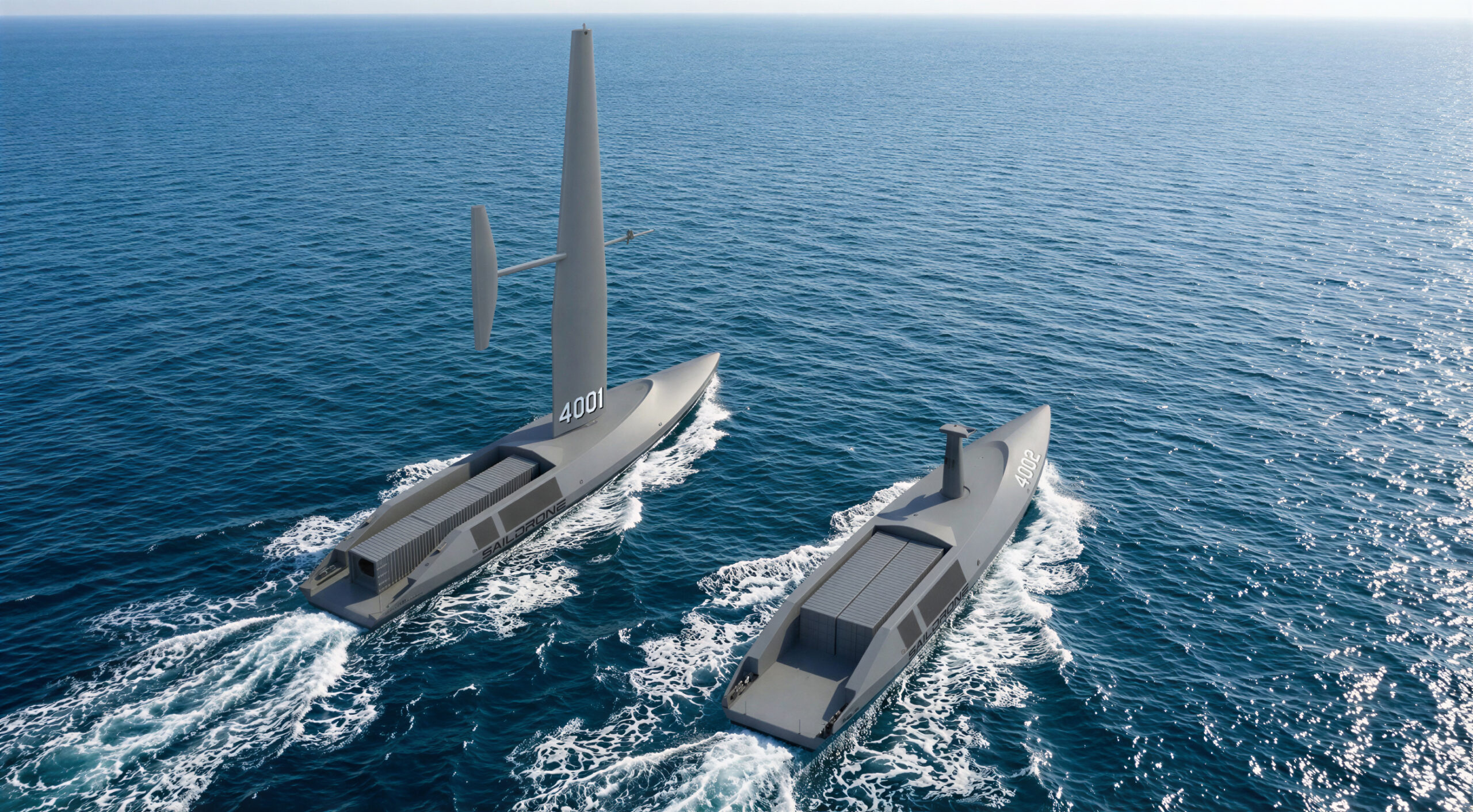
Saildrone's new Spectre MUSV comes in two variants: The Spectre Silent Endurance and the Spectre Stealth Strike. (Saildrone)
PARIS — The US Navy unfairly evaluated maritime drone manufacturer Saildrone’s proposal for the service’s medium unmanned surface vessel (MUSV) program, according to a ruling from the US Court of Federal Claims.
As a result, the Navy must reevaluate Saildrone’s proposal within the next two months, and is barred from spending a large chunk of its MUSV budget until that process is complete.
Saildrone and maritime tech startup Blue Water Autonomy filed lawsuits in June challenging the Navy’s decision to eliminate their respective proposals — Saildrone’s Spectre and Blue Water Autonomy’s Liberty — from the MUSV competition. The companies argued that their platforms met the Navy’s requirements for the MUSV marketplace, which launched in March, and that the service didn’t stick to its own evaluation guidance in the request for proposals (RFP).
“The Court finds that the Navy engaged in disparate treatment, and thus, acted in an arbitrary and capricious manner in its review of Saildrone’s proposal,” Judge Philip Hadji wrote in his opinion, which was originally issued Oct. 30 and publicly released on Wednesday.
The Navy originally disqualified Saildrone from advancing to on-water testing due to discrepancies between the company’s proposal and a summary document known as a J-8 Placemat, which is related to the maximum displacement of the design. The opinion said the Navy “eliminated Saildrone because its Placemat reported loaded displacements exceeded the stated maximum displacement.”
However, the court determined that Saildrone received disparate treatment compared to other firms because the Navy advanced a proposal from Sea Machines despite similar issues involving maximum displacement. It’s unclear which Sea Machines vessel — either the Steamracer of the Steamrunner — the Navy evaluated, the opinion said. However, the court noted that the distinction did not affect its finding.
“Because the Navy accepted from Sea Machines a Placemat that either reported both payload-condition displacements above the stated ‘Max Displacement,’ as Saildrone’s did (STEAMRUNNER), or left those fields blank (STEAMRACER), the Court finds the Navy’s subsequent treatment of the proposals disparately favored Sea Machines and arbitrarily held Saildrone to a higher standard,” the opinion said.
Drones and autonomous warfare: ‘One-way attack’ and reshaping ISR
Systems that can work independently while still being part of a unit are critical to carrying out multi-domain operations.
Under the ruling, the court ordered the Navy to reevaluate Saildrone’s proposal within 60 days, applying the same evaluation approach it used for companies that advanced in the competition. The ruling also prohibits the Navy from relying on its previously withdrawn findings under two other evaluation criteria to eliminate Saildrone.
The court also barred the Navy from spending more than $1.5 billion of the $2.1 billion allocated for the program on production until it completes that reevaluation.
A US Navy spokesperson told Breaking Defense that it will comply with the court’s order and reevaluate Saildrone’s proposal to determine if it will qualify for on-water testing.
“The future of naval warfare will be fought on the water, not in a courtroom,” Richard Jenkins, Saildrone’s founder and CEO, said in a statement on Monday. “We are eager to move beyond this litigation and return our entire focus to delivering world-leading maritime autonomy for the US Navy, to help secure America’s future maritime dominance. This ruling is a win for fair competition, for taxpayers, and for national security.”
However, Hadji reached a different conclusion regarding Blue Water Autonomy, determining that “the Navy reasonably rated Blue Water unacceptable.”
The service eliminated the company from the competition for several reasons, including because it claimed that Blue Water’s test vessel — a twin-hulled catamaran — was not “representative” of its production vessel, an axe-bow monohull.
However, Blue Water Autonomy argued that the Navy deviated from its own evaluation requirements because “[h]ull and machinery plants are not listed as assets to be evaluated in the testing.”
The court disagreed, and the opinion said that “the Court concludes that ‘representative’ unambiguously calls for comparing the test vessel with the production vessel, “ and noted that the solicitation did not exclude hull form or propulsion architecture from that comparison.
Even so, Austin Gray, co-founder and chief strategy officer at Blue Water Autonomy, said in a statement to Breaking Defense that “nothing about the test vessel was core to our technology, our ship, or our product.”
Gray also said the Navy has made positive changes in Phase II of its MUSV program the service unveiled in September.
For example, Phase I required proposals to travel 2,500 nautical miles at 25 knots in sea state 4 conditions with a payload capacity of two 40-foot containers. In contrast, Phase II requires that proposals include a payload capacity of at least two standard 20-foot shipping containers and eliminates the high-speed requirement.
“The Navy’s new leadership team has already leaned ahead and fixed problems highlighted by the protest,” Gray said. “The Medium USV Phase II program steers away from the prescriptive, compliance-centric testing rules of the previous competition, a change made by thoughtful Navy acquisition professionals months ago.”
Christopher Miller, Direct Reporting Portfolio Manager for robotic and autonomous systems (DRPM RAS) recently acknowledged some difficulties that Phase I requirements presented for industry. He said the Navy wants to “open the aperture” for new entrants and increase options for other services that may be interested in the capabilities.
“What I’m trying to do is also give more industry opportunities for companies that have something ready to go,” Miller told reporters in September. “Obviously with Phase I, there were some more challenging requirements that they had to meet, and so I’m trying to back off of those so that I can have a healthy, competitive industrial base and really use that to help us identify near-term opportunities to meet our operational demands.”
Breaking Defense Video
What now? Budget fight, Hegseth impeachment on deck for defense-focused lawmakers after midterms
The defense show circuit keeps rolling, plus Jimmy Stewart goes to war
Qatar’s domestic weapons, Turkey’s drone arsenal and the Mecca pact’s next test
3 congressional races that matter for defense
How General Atomics views Europe’s unmanned future
A more flexible way to defend maneuver forces from drones that doesn’t tie them down [Sponsored]
What’s haunting the Pentagon this Halloween?
The new must-have capabilities for drones [Sponsored]
Army’s tech chief talks autonomy, acquisition and the future of drones
Drones take over AUSA, plus the Army’s plan to bring in new vendors
Saildrone公司推出的新款Spectre MUSV无人机共有两个型号:Spectre Silent Endurance和Spectre Stealth Strike。(Saildrone)
巴黎——美国联邦索赔法院裁定,美国海军对海上无人机制造商 Saildrone 提交的中型无人水面舰艇 (MUSV) 项目方案进行了不公平的评估。
因此,海军必须在接下来的两个月内重新评估 Saildrone 的提案,并且在评估过程完成之前,海军不得动用其 MUSV 预算中的很大一部分资金。
今年6月,Saildrone和海事技术初创公司Blue Water Autonomy提起诉讼,质疑海军取消其各自方案——Saildrone的Spectre和Blue Water Autonomy的Liberty——参与MUSV竞标的决定。两家公司辩称,他们的平台符合海军3月份启动的MUSV市场的要求,并且海军在招标文件中没有遵守其自身的评估指南。
“法院认为海军在审查 Saildrone 的提案时采取了差别对待,因此其行为是任意且反复无常的,”法官菲利普·哈吉在他的意见书中写道。该意见书最初于 10 月 30 日发布,并于周三公开发布。
海军最初取消了Saildrone公司进入水上测试阶段的资格,原因是该公司提交的方案与一份名为J-8 Placemat的概要文件存在差异,该文件涉及设计的最大排水量。该意见指出,海军“取消Saildrone公司的资格,是因为其Placemat文件中报告的满载排水量超过了规定的最大排水量。”
然而,法院认定,Saildrone公司与其他公司相比受到了区别对待,因为尽管存在类似的排水量问题,海军还是选择了Sea Machines公司的方案。判决书指出,目前尚不清楚海军评估的是Sea Machines公司的哪艘船——是Steamracer还是Steamrunner。不过,法院也指出,这一区别并不影响其判决结果。
“由于海军接受了 Sea Machines 提供的方案,该方案要么像 Saildrone 的方案(STEAMRUNNER)那样,将有效载荷条件下的排水量都报告为高于规定的‘最大排水量’,要么将这些字段留空(STEAMRACER),因此法院认为海军随后对这些方案的处理方式明显偏袒 Sea Machines,并任意地对 Saildrone 提出了更高的要求,”该意见书写道。
无人机与自主作战:“单向攻击”与重塑情报、监视与侦察
能够独立运行但又能成为某个单位一部分的系统,对于执行多域作战至关重要。
根据裁决,法院责令海军在60天内重新评估Saildrone公司的方案,评估方法应与此前对其他入围公司的评估方法相同。裁决还禁止海军依据此前撤回的另外两项评估标准来淘汰Saildrone公司。
法院还禁止海军在完成重新评估之前,将分配给该项目的 21 亿美元中的 15 亿美元以上用于生产。
美国海军发言人告诉《防务新闻》,海军将遵守法院的命令,重新评估 Saildrone 的方案,以确定其是否符合水上测试的条件。
“未来海战的战场将是水域,而非法庭,”Saildrone创始人兼首席执行官理查德·詹金斯周一在一份声明中表示。“我们渴望尽快结束这场诉讼,并将全部精力重新投入到为美国海军提供世界领先的海上自主能力,以助力美国未来海上霸权的巩固。这项裁决对公平竞争、纳税人和国家安全而言都是一次胜利。”
然而,哈吉对“蓝水自主”计划得出了不同的结论,认为“海军有理由认为‘蓝水自主’计划是不可接受的”。
该服务将该公司从竞争中剔除,原因有很多,其中包括声称 Blue Water 的测试船——一艘双体船——不能“代表”其生产船——一艘斧头形单体船。
然而,Blue Water Autonomy 认为海军偏离了其自身的评估要求,因为“船体和机械装置并未被列为测试中需要评估的资产”。
法院不同意这一观点,并表示“法院认为‘代表性’一词明确要求将试验船与生产船进行比较”,并指出招标书并未将船体形状或推进结构排除在比较范围之外。
即便如此,Blue Water Autonomy 的联合创始人兼首席战略官 Austin Gray 在给 Breaking Defense 的一份声明中表示,“测试船的任何方面都不是我们的技术、我们的船只或我们的产品的核心。”
格雷还表示,海军在其9月份公布的MUSV计划第二阶段中做出了积极的改变。
例如,第一阶段要求方案能在4级海况下以25节的航速航行2500海里,有效载荷为两个40英尺集装箱。相比之下,第二阶段仅要求方案的有效载荷至少为两个标准20英尺集装箱,并取消了高速航行的要求。
格雷说:“海军新领导团队已经积极主动地解决了抗议中暴露出的问题。中型无人水面艇二期项目摒弃了之前竞标中以合规性为中心的强制性测试规则,这是海军采购专业人员几个月前就做出的深思熟虑的改变。”
海军机器人与自主系统项目组合直接汇报经理克里斯托弗·米勒(Christopher Miller)近日承认,第一阶段的要求给业界带来了一些困难。他表示,海军希望为新进入者“敞开大门”,并为其他可能对相关能力感兴趣的军种提供更多选择。
“我正在努力为那些已经做好充分准备的公司提供更多行业机会,”米勒在9月份告诉记者。“显然,第一阶段有一些更具挑战性的要求需要他们满足,所以我正在尝试放宽这些要求,以便建立一个健康、具有竞争力的产业基础,并真正利用这一点来帮助我们找到满足近期运营需求的机会。”
突破性防御视频
接下来会发生什么?中期选举后,以国防为中心的议员们将面临预算之争和对赫格塞斯的弹劾。
国防题材的巡回演出仍在继续,此外,吉米·斯图尔特也参战了。
卡塔尔的国产武器、土耳其的无人机武库以及麦加条约的下一次测试
3场对国防至关重要的国会选举
通用原子公司如何看待欧洲的无人化未来
一种更灵活的防御机动部队免受无人机攻击的方式,不会限制其行动[赞助]
今年万圣节,五角大楼究竟闹鬼?
无人机必备的新功能 [赞助内容]
陆军技术主管谈无人机的自主性、采购和未来
无人机主导了美国陆军协会(AUSA)的会议,此外,陆军还计划引入新的供应商。