MBDA plans to fly ‘fat’ hypersonic interceptor demonstrator before end-2029MBDA计划在2029年底前试飞“胖”型高超音速拦截机验证机。
“So it’s a bit fat, but it’s a Formula 1. It’s hypersonic, truly hypersonic, not just Mach 5," MBDA executive Lionel Mazenq said of the envisioned Hydis interceptor missile for Europe.
Share on Facebook (Opens in new window) Facebook
Share on X (Opens in new window) X
Share on Bluesky (Opens in new window) Bluesky
Share on Reddit (Opens in new window) Reddit
Share on LinkedIn (Opens in new window) LinkedIn
Share using Native tools Share Copied to clipboard
Share on Mail (Opens in new window) Mail
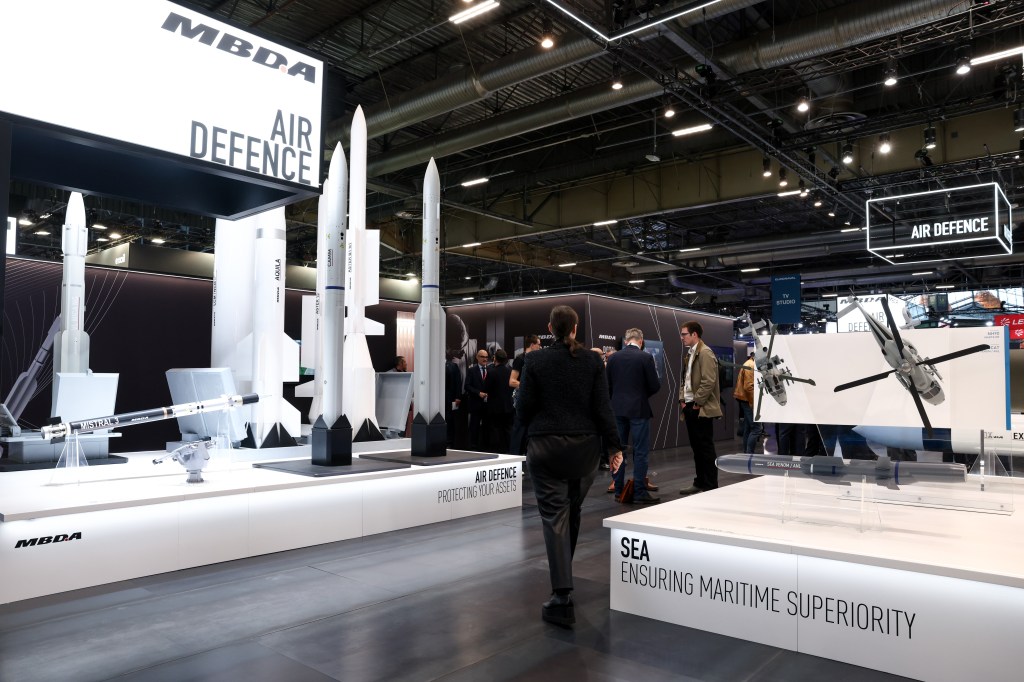
A selection of air defense missile systems made by MBDA is displayed at the Euronaval trade show near Paris on Nov. 3, 2026. (Tom Nicholson/Getty Images)
PARIS — An industry consortium developing a European hypersonic interceptor plans to fly a full-systems demonstrator by the end of 2029, project leader MBDA said in a briefing at the Euronaval maritime-defense exhibition.
The program, named Hydis , is competing with the Hydef program coordinated by Spain’s Sistemas de Misiles to secure €100 million (US$112 million) in European funding for the second development phase of the interceptor. A decision about who will get the financing is due at the end of the month, Lionel Mazenq, MBDA’s vice president for program incubators, said Nov. 4.
While China and Russia have been developing hypersonic glide vehicles for attack, Europe lacks capabilities to intercept them, something Hydis and Hydef seek to address. Both projects received European funding for their initial development, but the European Defence Funds plans to fund only one of the two proposals as part of its 2026 work program.
The Hydis interceptor is designed to address a large number of threats that are “very diverse in terms of behavior,” Mazenq said. “Today nothing is able to intercept this portfolio of threats, absolutely nothing.”
With the final concept selected , the consortium is now undertaking a number of on-the-ground demonstrations to bring technology readiness to level 3 or 4 as part of the first phase of the project, the executive said. The commonly used technology readiness scale spans nine tiers, with the highest level representing a system completely developed and proven to work.
For the second phase, Hydis will expand to 36 industrial and research partners as well as 14 subcontractors, from the current 19 companies involved in the project, according to Mazenq. Companies joining the consortium include Safran, which will provide terminal-guidance sensors, as well as Thales, Saab and Leonardo for capabilities such as communication and data links.
The current three-year phase of Hydis, which runs until May 2027, has received €80 million in European funding, with additional funding of €57 million from the four supporting countries France, Italy, Germany and the Netherlands.
The project will expand to 17 countries for the second phase, with 11 member states contributing a combined €133 million of funding in addition to the European money, MBDA said. Germany is dropping out as a partner country for the second phase of the project, according to the briefing documents.
The companies involved in the project will also provide more than €10 million in combined funding, Mazenq said. The consortium is “working on fallback options” should the European Commission choose Hydef instead, though Mazenq said “we are thinking that we will win.”
The second phase is set to run from mid-2027 to mid-2029, and will include full-scale flight trials, according to Mazenq. At the end of the second phase, Hydis aims for a level of technology readiness between 3 and 6 for all functions, with a full-systems demonstrator “by the end of the decade, so very soon after.”
Production of the interceptor is scheduled to start in the first half of the 2030s, the executive said.
France, Italy, Belgium, the Netherlands, Sweden and Poland will provide “massive contributions” to the project, with smaller contributions from other countries, he said.
The MBDA executive presented a design for a four-stage missile, a “multi-stage stratospheric hypersonic interceptor” capable of dealing both with hypersonic threats arriving horizontally at medium altitudes, as well as ballistic missiles that approach with a relatively steep dive, and which must be intercepted “relatively early” in the upper layers of the atmosphere.
The Hydis partner countries as well as the European Commission requested an interceptor that covers both ballistic and hypersonic defense, “which requires, effectively, an additional effort in terms of design,” but brings advantages in terms of being able to stockpile a single missile against multiple threats, Mazenq said.
China is probably the country that is ahead in developing hypersonic weapons, more than Russia, with its DF-17 hypersonic glide vehicle the most advanced in service today, according to Mazenq.
“So being obsessed just by Russia is not the solution to prepare a robust system for defending Europe, not only the European continent, but also our forces deployed around the world,” the executive said.
The big challenge of intercepting hypersonic glide vehicles is their maneuverability at altitudes between 30 and 45 kilometers, which means that a slight turn can change the projected interception point by tens or hundreds of kilometers, according to the MBDA executive.
Predicting the trajectory of hypersonic threats will be key to intercepting them, with artificial intelligence running real-time models as soon as a target is detected to identify the right time and place to intercept, updated throughout the flight of the interceptor as it climbs towards its target, Mazenq said.
“This capability is absolutely essential because if you don’t have it, the pressure on the design of the interceptor is such that it’s impossible to do.”
Target and interceptor encounter velocity can reach 5 kilometers per second, according to Mazenq.
The only equivalent to the European program is the U.S. Glide Phase Interceptor project, which was awarded to Northrop Grumman, Mazenq said. The difference with the European project is that GPI only addresses the hypersonic glider threat, with intermediate-range ballistic missiles handled by exoatmospheric interceptors such as SM-3, according to the MBDA executive.
Hydis is aiming for a “robust design” that can be effective with a limited number of sensors. While the system is designed to be integrated with European space-based missile early-warning capabilities JEWEL and Odin’s Eye, it must also be capable of delivering “a good performance” with only a long-range radar, Mazenq said.
“That’s an additional challenge, but this is absolutely necessary to strengthen the future capability and to make it robust to all the conditions that can be encountered during a conflict.”
Hydis aims for its interceptor to cost less than a third of the unit price of an SM-3 missile, according to Mazenq, who didn’t clarify which version of the U.S. missile when asked. The SM-3 Block 1B missile costs $9.7 million to $12.5 million per intercept, while the price tag for the Block IIA missile is $27.9 million, according to the non-profit Missile Defense Advocacy Alliance.
The Hydis concept is hit-to-kill, and the interceptor builds on technology from existing programs, particularly MBDA’s Aster air-defense missile for flight control, while Italy’s Avio provides high-performance solid rocket motors. The system is designed to defeat a hypersonic threat with a maximum of two interceptors fired, according to Mazenq.
A visual comparison with the Aster B1 NT air-defense missile in the presentation indicated an interceptor that stands around 30% taller, with a length of about 7 meters (23 ft). Mazenq said the missile will be compatible with vertical-launch systems onboard ships, including the Mark 41 vertical-launch cell as well as a future version of Naval Group’s Sylver VLS.
“It’s effectively four-stage with a very high capability of acceleration, because we want to fire it as late as possible, due to the indetermination of the hypersonic threat trajectory,” Mazenq said. “So it’s a bit fat, but it’s a Formula 1. It’s hypersonic, truly hypersonic, not just Mach 5.”
Rudy Ruitenberg is a Europe correspondent for Defense News. He started his career at Bloomberg News and has experience reporting on technology, commodity markets and politics.
分享至 Facebook(在新窗口中打开) Facebook
分享至 X(在新窗口中打开)X
在 Bluesky 上分享(在新窗口中打开)Bluesky
分享到 Reddit(在新窗口中打开)
在领英上分享(在新窗口中打开)领英
使用原生工具分享 已复制到剪贴板
分享至邮件(在新窗口中打开)邮件
2026年11月3日,在巴黎附近的欧洲海军装备展上,MBDA公司展出了一系列防空导弹系统。(图片来源:Tom Nicholson/Getty Images)
巴黎——欧洲高超音速拦截机研发联盟的项目负责人MBDA在欧洲海军防务展上举行的新闻发布会上表示,该联盟计划在2029年底前试飞一架全系统验证机。
这项名为Hydis的项目正在与西班牙导弹系统公司(Sistemas de Misiles)协调的Hydef项目竞争,以争取1亿欧元(1.12亿美元)的欧洲资金,用于拦截器的第二阶段研发。MBDA公司负责项目孵化器的副总裁莱昂内尔·马岑克(Lionel Mazenq)于11月4日表示,最终的资金分配决定将于本月底公布。
尽管中国和俄罗斯一直在研发用于攻击的高超音速滑翔飞行器,但欧洲缺乏拦截此类飞行器的能力,而Hydis和Hydef项目正是为了解决这一问题。这两个项目在初期研发阶段都获得了欧洲的资金支持,但欧洲防务基金计划在其2026年工作计划中仅资助其中一个项目。
马赞克表示,Hydis拦截器旨在应对大量“行为方式千差万别”的威胁。“目前没有任何技术能够拦截所有这些威胁,绝对没有。”
该高管表示,随着最终方案的选定,该联盟目前正在开展一系列实地演示,以将技术成熟度提升至3级或4级,这是项目第一阶段的工作。常用的技术成熟度等级分为九个级别,最高级别代表系统已完全开发并经过验证可行。
据马赞克透露,在第二阶段,Hydis项目将从目前的19家公司扩展到36家工业和研究合作伙伴以及14家分包商。加入该联盟的公司包括赛峰集团(Safran),该公司将提供终端制导传感器;以及泰雷兹集团(Thales)、萨博集团(Saab)和莱昂纳多集团(Leonardo),它们将提供通信和数据链路等功能。
Hydis 目前的三年阶段(到 2027 年 5 月结束)已获得 8000 万欧元的欧洲资金,此外,法国、意大利、德国和荷兰这四个支持国还提供了 5700 万欧元的额外资金。
MBDA表示,该项目第二阶段将扩展至17个国家,其中11个成员国将除欧盟资金外,共同出资1.33亿欧元。根据简报文件,德国将退出该项目第二阶段的合作国行列。
Mazenq表示,参与该项目的公司还将提供超过1000万欧元的联合资金。该财团正在“制定备选方案”,以防欧盟委员会最终选择Hydef,不过Mazenq也表示“我们认为我们会胜出”。
据马赞克称,第二阶段计划从2027年中期持续到2029年中期,并将包括全尺寸飞行试验。在第二阶段结束时,海迪斯的目标是所有功能的技术成熟度达到3到6级,并在“本十年末,也就是之后不久”完成全系统验证。
该高管表示,拦截器的生产计划于2030年代上半叶开始。
他表示,法国、意大利、比利时、荷兰、瑞典和波兰将为该项目提供“巨额贡献”,其他国家也将做出较小贡献。
MBDA 的一位高管展示了一种四级导弹的设计方案,这是一种“多级平流层高超音速拦截器”,能够应对水平方向到达中空的高超音速威胁,以及以相对陡峭的俯冲角度接近的弹道导弹,这些导弹必须在大气层上层“相对较早”地被拦截。
马赞克表示,Hydis 项目的伙伴国以及欧盟委员会要求研发一种能够同时防御弹道导弹和高超音速导弹的拦截器,“这实际上需要在设计方面付出额外的努力”,但其优势在于能够储备一枚导弹来应对多种威胁。
据马赞克称,中国在研发高超音速武器方面可能领先于俄罗斯,其DF-17高超音速滑翔飞行器是目前服役中最先进的飞行器。
“因此,仅仅关注俄罗斯并不能解决建立一个强大的欧洲防御体系的问题,这不仅关乎欧洲大陆,也关乎我们在世界各地部署的部队,”这位高管说道。
MBDA 的一位高管表示,拦截高超音速滑翔飞行器的最大挑战在于其在 30 至 45 公里高度的机动性,这意味着轻微的转弯就可能使预计的拦截点改变数十或数百公里。
马赞克表示,预测高超音速威胁的轨迹是拦截它们的关键,人工智能会在检测到目标后立即运行实时模型,以确定合适的拦截时间和地点,并在拦截器爬升到目标的过程中不断更新模型。
“这种能力至关重要,因为如果没有这种能力,拦截器的设计压力将非常大,根本无法完成。”
据 Mazenq 称,目标与拦截器相遇时的速度可达每秒 5 公里。
马赞克表示,唯一能与欧洲项目相媲美的是美国的滑翔相拦截器(GPI)项目,该项目已授予诺斯罗普·格鲁曼公司。MBDA公司的一位高管指出,GPI与欧洲项目的区别在于,GPI仅针对高超音速滑翔导弹的威胁,而中程弹道导弹则由SM-3等大气层外拦截器来应对。
Hydis的目标是打造一种“稳健的设计”,使其能够在传感器数量有限的情况下也能有效运行。Mazenq表示,虽然该系统旨在与欧洲的天基导弹预警系统JEWEL和Odin's Eye集成,但它也必须能够在仅使用远程雷达的情况下提供“良好的性能”。
“这又是一个额外的挑战,但这对于加强未来的作战能力,使其能够应对冲突中可能遇到的所有情况,是绝对必要的。”
据马赞克称,海迪斯公司的目标是使其拦截器的成本低于SM-3导弹单价的三分之一。当被问及具体是哪种型号的美国SM-3导弹时,马赞克并未说明。非营利组织导弹防御倡导联盟的数据显示,SM-3 Block 1B导弹的单次拦截成本为970万美元至1250万美元,而Block IIA导弹的单次拦截成本则高达2790万美元。
Hydis系统采用直接命中摧毁的策略,其拦截弹基于现有项目的技术,特别是MBDA公司的Aster防空导弹的飞行控制系统,而意大利Avio公司则提供高性能固体火箭发动机。据Mazenq公司称,该系统旨在最多发射两枚拦截弹来击退高超音速威胁。
演示中,该拦截导弹与Aster B1 NT防空导弹进行了视觉对比,结果显示其高度大约高出30%,长度约为7米(23英尺)。马赞克表示,该导弹将兼容舰载垂直发射系统,包括Mark 41垂直发射单元以及法国海军集团Sylver垂直发射系统的未来版本。
“它实际上是四级火箭,加速能力非常强,因为我们希望尽可能晚地发射它,考虑到高超音速威胁的飞行轨迹难以确定,”马赞克说。“所以它有点笨重,但它就像一级方程式赛车一样。它是真正的高超音速火箭,而不仅仅是5马赫。”
鲁迪·鲁伊滕贝格是《防务新闻》的欧洲记者。他的职业生涯始于彭博新闻社,拥有报道科技、大宗商品市场和政治方面的经验。