Can China’s latest air-to-air missile take on its US equivalent? Definitely maybe, experts say.中国最新型的空空导弹能与美国的同类产品匹敌吗?专家表示,很有可能。
The PL-16’s specs would let it chase large, slower-moving aircraft, one analyst said, though its effectiveness against smaller, faster planes is unclear.
NEW TAIPEI CITY, Taiwan — China’s newest air-to-air missile, the PL-16, could vie with an equivalent advance by the U.S. military and give the People’s Liberation Army an edge in any Asia-Pacific conflicts because of its increased travel distance and a second-wind feature, experts say.
The PL-16 beyond-visual-range missile as described in social and trade media would answer Lockheed Martin’s AIM-260 Joint Advanced Tactical Missile (JATM) for the U.S. armed forces, analysts believe, and improve on previous generations developed in China.
They say China’s missile boasts a long total flight distance estimated at 200 to 300 kilometers (124 to 186 miles) and dual-pulse or variable-thrust rocket motor technology that allow for a second burst of propulsion late in flight, the Indian defense news portal Indian Defence Research Wing said in a June 3 analysis.
Lockheed Martin’s system is also expected to feature extra propulsion for flights beyond visual range and travel at least 200 kilometers.
The PL-16’s specs would let it chase large, slower-moving aircraft, said Malcolm Davis, a senior analyst for defense strategy and national security with the Australian Strategic Policy Institute. That chase could be a battle changer.
“What matters at those long ranges is maneuverability in the terminal phase and guidance,” Davis said. The PL-16 is designed, he said, to hit airborne early warning and control platforms, refueling tankers and reconnaissance aircraft, so “the likelihood of a kill, even at very long range is very high.
“The People’s Liberation Army Air Force’s strategy here is clear – take out the key combat enablers for the U.S. Air Force and the U.S. Navy, as well as allied forces, and the U.S. and its allies can no longer project naval air power,” Davis said.
“The JTAM was a response to the PL-15, so there is an interesting race between China and the U.S. on beyond-visual-range air-to-air missiles underway,” he added. “The key challenge is how quickly the U.S. can get JATM into production, because the Chinese will be moving very fast with PL-16 production.”
It’s unclear whether Washington would jump into any war with Beijing over Taiwan, a decades-old flashpoint, or in the South China Sea where American treaty ally the Philippines is wrangling for control of tiny islets with the Chinese. The U.S. military maintains bases in nearby Guam, Hawaii and Japan in case of an Indo-Pacific conflict.
“I’m pretty sure (PL-16) is going to be a headache for bigger bombers, B52 and the likes, if in range, but I am not quite sure about other smaller, nimbler, faster platforms,” said Enrico Cau, an associate researcher at the Taiwan Strategy Research Association think tank.
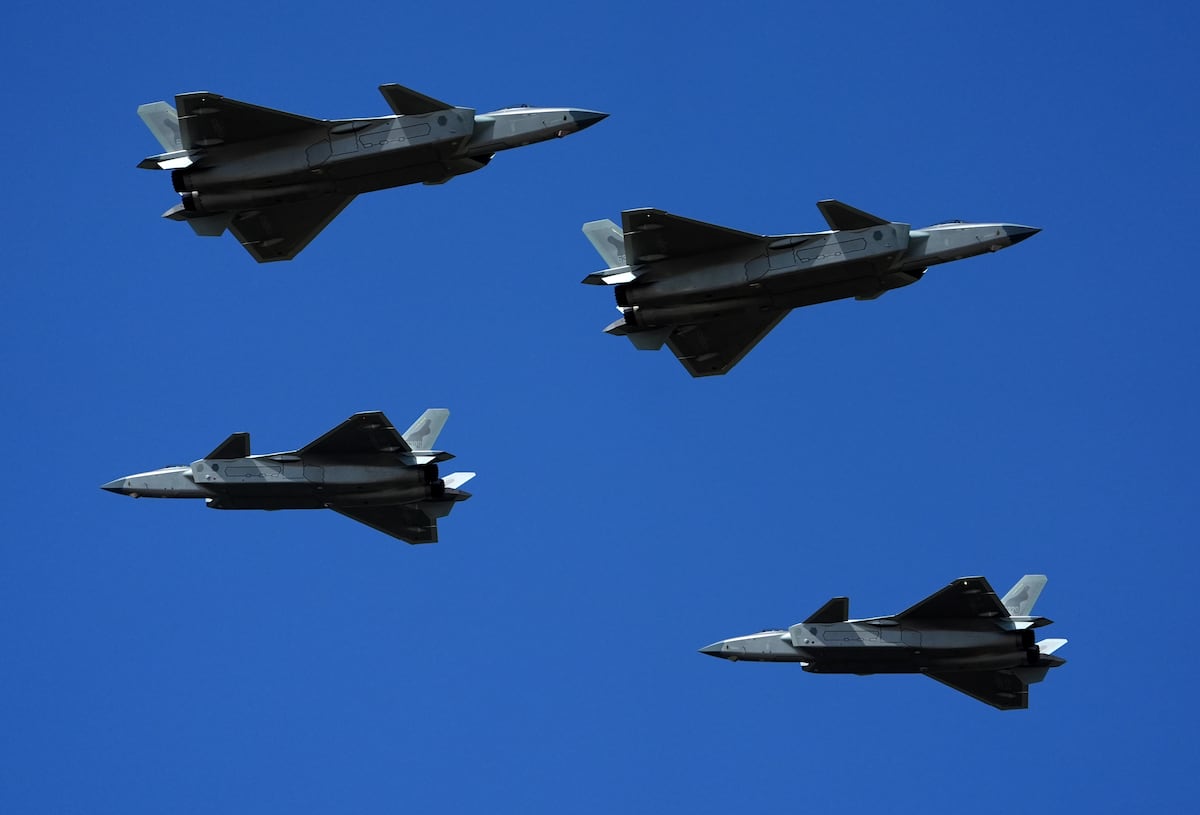
The missiles may fit adeptly into the bays of Chinese stealth fighters such as the J-20 and upcoming J-35, the Indian Defence Research Wing said.
A J-20 aircraft that can carry four earlier-generation PL-15 missiles in its internal weapons bay would be able to take as many as six PL-16s, said Huang Chung-ting, associate research fellow with the Institute for National Defense and Security Research in Taipei.
“This means a J-20 can engage not only one or two more targets but also has a greater capacity to remain in the combat zone after the initial attack, rather than having to retreat after running out of missiles,” Huang said.
With no confirmation from Beijing about the PL-16’s development, analysts and media outlets are relying largely on leaked, sometimes second-hand information including presentation slides shown at a Chinese military aviation seminar.
A post to the image-sharing platform Imgur.com says the Chinese missiles would be four meters long, 203 millimeters in diameter and 200 kilograms.
The PL prefix stands for “Pi Li”, which is Chinese for “thunderbolt.”
The PL-16’s more than 10-year-old predecessor, the PL-15, can fly 200 kilometers, twice as far as the earlier PL-12 and more than three times the maximum distance of the oldest model, PL-11, according to the leaked presentation slides.
“China may indeed be developing a new air-to-air weapon that saves more (aircraft) bay space and allows the J-20 to carry more missiles — this general direction has a certain degree of credibility,” Huang said.
But he cautioned that information online today doesn’t confirm the PL-16’s specs, including its range and type of propulsion technology. Huang said the online material also cannot determine whether the PL-16 has been put into mass use.
台湾新台北市——专家表示,中国最新型的空空导弹PL-16,凭借其更远的射程和二次飞行能力,可以与美国军方的同类先进导弹相媲美,并使中国人民解放军在任何亚太冲突中都占据优势。
分析人士认为,社交媒体和贸易媒体所描述的PL-16超视距导弹将与美国武装部队的洛克希德·马丁AIM-260联合先进战术导弹(JATM)展开竞争,并且在中国研制的前几代导弹的基础上有所改进。
据印度国防新闻门户网站印度国防研究局 (Indian Defence Research Wing) 6 月 3 日的分析报道,中国导弹的总飞行距离估计为 200 至 300 公里(124 至 186 英里),并采用双脉冲或可变推力火箭发动机技术,可在飞行后期进行第二次推进。
洛克希德·马丁公司的系统预计还将配备额外的推进装置,用于超视距飞行,航程至少可达 200 公里。
澳大利亚战略政策研究所国防战略与国家安全高级分析师马尔科姆·戴维斯表示,PL-16的性能参数使其能够追击大型、速度较慢的飞机。这种追击可能会改变战局。
戴维斯说:“在远距离作战中,末段机动性和制导能力至关重要。” 他说,PL-16的设计目标是打击空中预警和控制平台、加油机和侦察机,因此“即使在非常远的距离上,击落目标的可能性也非常高。”
戴维斯说:“中国人民解放军空军的战略很明确——摧毁美国空军、美国海军以及盟军的关键作战保障力量,这样美国及其盟友就无法再投射海空力量。”
他补充说:“联合超视距空空导弹(JTAM)是对PL-15的回应,因此中美之间正在进行一场有趣的超视距空空导弹竞赛。关键挑战在于美国能否尽快将JTAM投入生产,因为中国在PL-16的生产方面也会迅速推进。”
目前尚不清楚华盛顿是否会因台湾问题(一个持续数十年的敏感问题)或南海问题(美国条约盟友菲律宾正与中国争夺南海一些小岛的控制权)而与北京开战。为应对印太地区可能发生的冲突,美军在附近的关岛、夏威夷和日本都设有军事基地。
“我很确定(PL-16)如果射程足够,将会给B52之类的大型轰炸机带来麻烦,但我不太确定它对其他更小、更灵活、更快的平台会有什么影响,”台湾战略研究协会智库的副研究员Enrico Cau说道。
印度国防研究机构表示,这些导弹可以巧妙地装入中国隐形战斗机(如歼-20和即将推出的歼-35)的弹舱中。
台北国防安全研究院副研究员黄仲廷表示,一架内部武器舱可携带四枚上一代PL-15导弹的歼-20飞机,最多可携带六枚PL-16导弹。
黄说:“这意味着歼-20不仅可以攻击一到两个额外的目标,而且在最初攻击之后,它还有更大的能力留在作战区域,而不是在导弹耗尽后被迫撤退。”
由于北京方面没有对PL-16的研发做出任何确认,分析人士和媒体主要依靠泄露的、有时甚至是二手的信息,包括在中国军事航空研讨会上展示的幻灯片。
图片分享平台 Imgur.com 上的一则帖子称,中国导弹长 4 米,直径 203 毫米,重 200 公斤。
PL前缀代表“Pi Li”,在中文里是“雷电”的意思。
根据泄露的演示幻灯片显示,PL-16 的 10 多年前的前身 PL-15 可以飞行 200 公里,是早期 PL-12 的两倍,是老款 PL-11 最大航程的三倍多。
黄说:“中国可能确实正在研发一种新型空空武器,这种武器可以节省更多(飞机)弹舱空间,使歼-20能够携带更多导弹——这一方向具有一定的可信度。”
但他提醒说,目前网上的信息并不能证实PL-16的具体规格,包括其航程和推进技术类型。黄表示,网上资料也无法确定PL-16是否已经投入大规模使用。