This Obscure DC-Area Office Helps US Special Operators Hunt Down And Secure Loose WMDs这个位于华盛顿特区附近的隐秘办事处帮助美国特种作战人员追踪并控制散落的大规模杀伤性武器
The fusion center coordinates US military efforts to make sure the deadly weapons don't end up in the wrong hands.
By Joseph Trevithick
Updated Jun 29, 2019 11:37 PM EDT
As part of its new job as the lead U.S. military organization managing responses to possible crises involving weapons of mass destruction, the Pentagon’s top special operations headquarters is running a dedicated office to gather intelligence and information about these potential threats. Since President George W. Bush’s administration made the case for its invasion of Iraq, “WMDs” has become something of a dirty word, but that doesn’t mean there aren’t real concerns about hostile foreign powers and other groups getting hold such arms, including nuclear , radiological, chemical , and biological weapons .
There’s a certain alphabet soup to the arrangement, with U.S. Special Operations Command’s (SOCOM) Counter-Weapons of Mass Destruction-Fusion Center (CWMD-FC) being situated somewhere in the greater Washington, D.C. area, known to the U.S. military as the National Capital Region (NCR), which is already home to another secretive special operations counter-terrorism element, sometimes referred to as SOCOM-NCR . The mission of “countering” these deadly weapons can be somewhat confusing, as well.
The fusion center’s job is to provide “a persistent focus on the weapons of mass destruction problem set,” Ken McGraw, a spokesman for SOCOM, explained in an Email. An extension of the work the command does at its headquarters in Tampa, Florida, the personnel actively work with their counterparts across the rest of the U.S. military, the Intelligence Community, and law enforcement agencies, among others, as well as foreign governments, he added.
From this description, the fusion center’s role sounds utterly banal. But coordinating the Pentagon’s strategy to combat the spread of weapons of mass destruction, which is essentially equal arms control and direct action, is a complicated and multi-faceted mission.
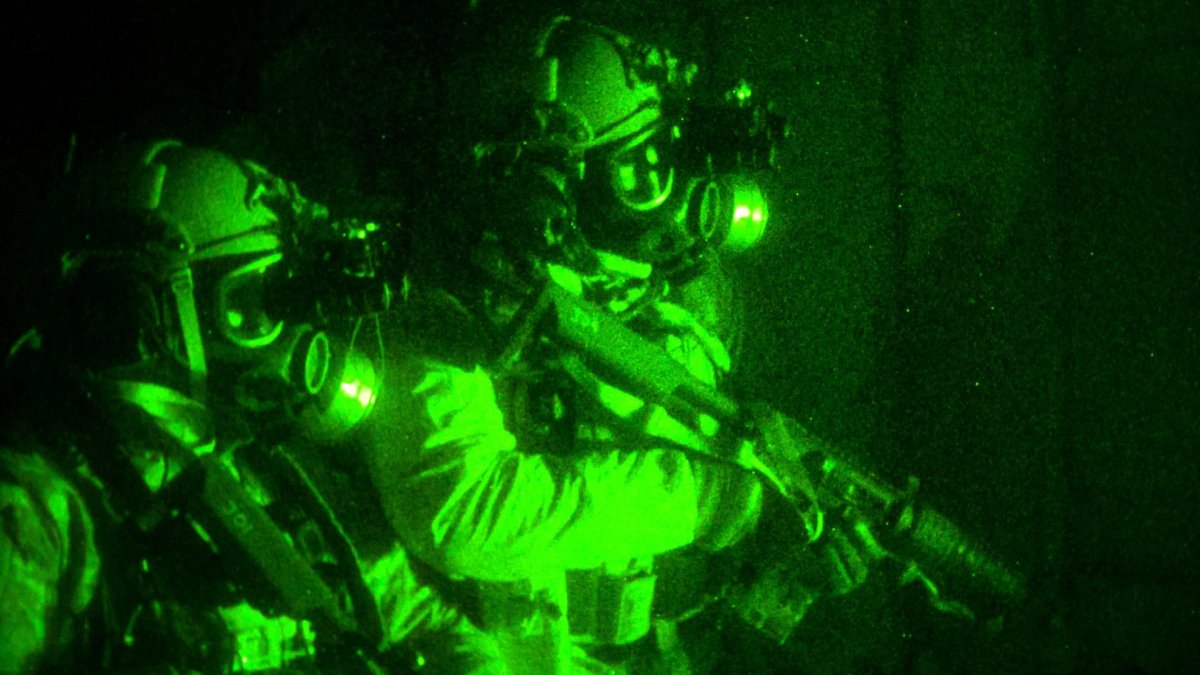
A US special operator in protective gear maneuvers during a training exercise involving a chemical or biological threat., SOCEUR
Preventing countries or other hostile actors from acquiring or transferring WMDs involves monitoring the movement and flow of weapons, precursor materials, and funding, helping to secure and destroy these items when necessary, and making sure foreign governments abide by various international agreements, such as the Non-Proliferation Treaty. At the same time, SOCOM has to take the lead if the U.S. military ends up responding to related crises as diverse as a weapon accidently going off at home or abroad or there is a need to neutralize a hostile WMD capability.
It’s an amazingly complex set of problems and that’s part of the reason why President Barack Obama’s administration, as one of its final official acts, shifted the job from U.S. Strategic Command (STRATCOM) to SOCOM in December 2016. Critics were concerned that STRATCOM, which manages America’s nuclear deterrent, strategic intelligence, and military space activities, was either unwilling or unable to give countering WMDs the attention it deserved.
STRATCOM “rarely invested the necessary political and intellectual capital,” one anonymous U.S. defense official told The Washington Post when it first reported on the shift in December 2016. As a whole, they said the U.S. military gave WMD threats an “overall low sense of priority as compared to its other missions.”
A US Army special forces soldier cuts their way through a metal barrier with a rotary saw during a training exercise., US Army
An additional factor was the difficulty in coordinating the activities of a myriad number of U.S. military elements charged with the mission, but not necessarily working directly together. These include the U.S. Army’s 20th Support Command and 21st Ordnance Company, the latter dedicated specifically to defusing WMDs, and the U.S. Marine Corps Chemical Biological Incident Response Force , among others.
There is also the Defense Threat Reduction Agency (DTRA), a separate agency with the Department of Defense focused on responding to WMD threats. Many of these units and offices have individual agreements with other U.S. government agencies to better mesh their respective activities, too. According to a Memorandum of Understanding The War Zone obtained via the Freedom of Information Act, U.S. Special Operations Command North, which oversees special operations missions in North America, has had a contract expert working within the Federal Bureau of Investigation’s Weapons of Mass Destruction Directorate since 2015.
In part, SOCOM’s fusion center has the job of making sure these various parties are working together smoothly. With U.S. special operations forces themselves heavily committed, with some suggesting they are close to their breaking point organizationally under the strain of near constant operations, it’s possible that SOCOM could find struggling with many of the same problems.
The command does have a long-standing relationship with the counter-WMD mission itself, though. One of the “ core activities ” of U.S. special operations forces is supporting U.S. government efforts to stem the proliferation of WMDs, according to SOCOM’s website.
US special operators wearing protective gear with a self-contained breathing system carry a simulated casualty during a training exercise., SOCEUR
According to Sean Naylor’s Relentless Strike , the secretive Joint Special Operations Command (JSOC) spent much the 1990s preparing to respond to a “loose nuke” or similar scenario. This is not particularly surprising, given the increased fear after the fall o the Soviet Union in 1991 that Russia or other former Soviet republics had limited control of their stockpiles of nuclear weapons and material.
While we don’t know how much time JSOC continues to devote to this mission, we do know the U.S. military still practices for these types of contingencies. In 2015, American personnel reportedly stopped a mock nuclear or radiological attack in Canada as part of an annual counter-terrorism exercise called Vital Archer.
And while the idea that Saddam Hussein had an active set of WMD development programs in 2003 turned out to be bogus, there have been a host of very real world examples of these potential dangers since then. Most notably, in 2013, the U.S. military participated in a failed international effort to destroy the Syrian government’s chemical weapon stockpiles and production capability. DTRA worked with the U.S. Army to develop and provide a mobile system to destroy the dangerous arms on board the M/V Cape Ray , a ship from the U.S. government’s Ready Reserve Force, which keeps various ships storage until just such a need arises.
In addition to the Syrian regime of dictator Bashar Al Assad, ISIS has employed chemical weapons in Iraq and Syria. It is very possible that American special operators have already worked with local forces in both countries to identify and manage chemical weapons and hazardous materials as they’ve pushed back the terrorist organization.
In 2011, American troops had also deployed to Libya to guard that country’s chemical arsenal after the dramatic fall of long-time dictator Muammar Gaddafi, a mission known as Operation Odyssey Guard. In February 2014, the U.S. government announced it had finished safely destroying the remaining weapons and associated materials, preventing them from falling into the hands of terrorists or other militants.
There is evidence that these organizations continue to be interested in radiological weapons, more commonly known as “ dirty bombs ,” as well, even though many experts suggest the biggest danger they pose is from panic . Just in August 2017, Indonesia authorities told Reuters that the country’s security forces had broken up a terror cell that was trying to make one of these devices. ISIS terrorists almost stumbled upon a potential source of radioactive material during their occupation of the city of Mosul in Iraq.
Regardless of whether or not these plans would work, it still makes sense to tightly control radioactive material as part of the counter-WMD mission. In August 2015, a U.S. Air Force C-17 cargo plane quietly arrived at an undisclosed airport in Mexico to load up three irradiators, which the country had previously used to eliminate agricultural pests, full of cesium-137 and spirited them away to a secure disposal site in the United States.
Radioisotope thermoelectric generators on board a US Air Force C-17, destined for disposal at the Nevada National Security Site, in 2015., USAF
There are an increasing number of much larger potential threats, as well. Any talk of military action against North Korea, no matter how remote , has to include a discussion of what to do about that country’s growing nuclear arsenal, as well as its existing stockpile of chemical weapons. So, it’s very likely that SOCOM’s D.C.-area fusion center has been part of the inter-agency work in response to the ever growing tensions with North Korea, especially after its sixth nuclear weapons test .
In addition, the office no doubt at least followed the reported Israeli air strike on Syria’s Scientific Studies and Researchers Center, which leads that country’s chemical weapon development work and has probably talked with DTRA about its operation to make sure WMD materials don’t slip across the border from Syria into Jordan , the same country where JSOC has reportedly situated some portion of its effort to target and eliminate ISIS leaders, known as Operation Gallant Phoenix.
The center could be contributing information about Iran’s compliance with the international agreement about its controversial nuclear program, formally known as the Joint Comprehensive Plan of Action (JCPOA). On Sept. 19, 2017, President Donald Trump called the Iran Deal “an embarrassment to the United States.”
However, “the facts are that Iran is operating under the agreements the we signed up for under the JCPOA,” U.S. Air Force General John Hyten, head of STRATCOM, told a gathering at the Hudson Institute event on Sept. 20, 2017. “But at the same time they are rapidly, rapidly deploying and developing a whole series of ballistic missiles and testing ballistic missiles at all ranges that provide significant concerns to not just the United States, but our allies.”
And there’s always the possibility of a completely naturally occurring WMD emergency, whether it be serious damage to a nuclear power plant from a natural disaster, as happened to the Fukushima Daiichi plant in Japan after an earthquake and subsequent tsunami in 2011, or an outbreak of deadly disease such as the Ebola outbreak that turned into a regional pandemic in West Africa in 2014. Both incidents resulted in massive U.S. government responses that involved American military personnel.
All in all, WMD-related security concerns seem to have been expanding rather than receding in the past few years. It’s now SOCOM’s job to lead the U.S. military’s numerous efforts to counter that trend and Counter-Weapons of Mass Destruction-Fusion Center looks set to be an important part of staying on top of the issues.
Contact the author: joe@thedrive.com
Comments couldn’t be loaded. Please refresh the page.
作者:约瑟夫·特雷维西克
更新于美国东部时间2019年6月29日晚上11:37
作为美国应对大规模杀伤性武器潜在危机的主要军事机构,五角大楼最高特种作战司令部设立了一个专门办公室,负责收集有关这些潜在威胁的情报和信息。自从乔治·W·布什政府提出入侵伊拉克的理由以来,“大规模杀伤性武器”一词已变得颇具贬义,但这并不意味着人们不真正担忧敌对外国势力和其他组织会获得此类武器,包括核武器、放射性武器、化学武器和生物武器。
这套体系可谓错综复杂,美国特种作战司令部(SOCOM)的大规模杀伤性武器反制融合中心(CWMD-FC)位于大华盛顿特区地区,美军称之为国家首都地区(NCR)。而NCR本身也是另一个秘密特种作战反恐机构的所在地,有时也被称为SOCOM-NCR。此外,其“反制”这些致命武器的任务本身也颇为复杂。
特种作战司令部发言人肯·麦格劳在一封电子邮件中解释说,情报融合中心的工作是“持续关注大规模杀伤性武器问题”。他补充说,作为该司令部位于佛罗里达州坦帕总部工作的延伸,中心人员积极与美国其他军方部门、情报界、执法机构以及外国政府的同行开展合作。
从这段描述来看,情报融合中心的作用似乎微不足道。但协调五角大楼应对大规模杀伤性武器扩散的战略——这本质上既包括军备控制也包括直接行动——是一项复杂且多方面的任务。
一名身穿防护装备的美国特种作战人员在一次涉及化学或生物威胁的训练演习中进行机动。
防止国家或其他敌对行为体获取或转移大规模杀伤性武器,需要监控武器、前体材料和资金的流动,必要时协助确保并销毁这些物品,并确保外国政府遵守各项国际协议,例如《不扩散核武器条约》。同时,如果美军最终需要应对各种相关危机,例如武器在国内或国外意外引爆,或者需要消除敌方大规模杀伤性武器能力,特种作战司令部(SOCOM)必须发挥主导作用。
这是一系列极其复杂的问题,这也是巴拉克·奥巴马总统的政府在其任期即将结束之际,于2016年12月将应对大规模杀伤性武器的任务从美国战略司令部(STRATCOM)移交给特种作战司令部(SOCOM)的部分原因。批评人士担心,负责管理美国核威慑、战略情报和军事太空活动的战略司令部要么不愿要么无力给予应对大规模杀伤性武器应有的重视。
一位不愿透露姓名的美国国防官员在2016年12月《华盛顿邮报》首次报道这一转变时告诉该报,战略司令部“很少投入必要的政治和智力资源”。他们表示,总体而言,与美军的其他任务相比,美军对大规模杀伤性武器威胁的重视程度“总体较低”。
一名美国陆军特种部队士兵在训练演习中用旋转锯切割金属障碍物。
另一个因素是难以协调众多负责执行该任务的美国军事单位的活动,这些单位未必直接合作。其中包括美国陆军第20支援司令部和第21军械连(后者专门负责拆除大规模杀伤性武器),以及美国海军陆战队化学生物事件应急部队等。
此外,国防部下属的独立机构——国防威胁降低局(DTRA)也负责应对大规模杀伤性武器威胁。许多此类单位和办公室还与其他美国政府机构签订了单独的协议,以更好地协调各自的行动。根据《战区》通过《信息自由法》获得的一份谅解备忘录显示,负责北美特种作战任务的美国北方特种作战司令部自2015年以来就一直在联邦调查局大规模杀伤性武器局聘用一名合同专家。
特种作战司令部情报融合中心的部分职责是确保各方顺利协作。由于美国特种作战部队自身也身负重任,有人认为他们在近乎持续不断的行动压力下,组织结构已接近崩溃边缘,因此特种作战司令部也可能面临许多类似的难题。
不过,该司令部与反大规模杀伤性武器任务本身确实有着长期的联系。根据美国特种作战司令部的网站,美国特种作战部队的“核心活动”之一就是支持美国政府遏制大规模杀伤性武器扩散的努力。
美国特种作战人员身穿防护装备,配备自给式呼吸系统,在训练演习中抬着一名模拟伤员。
根据肖恩·内勒的《无情打击》一书,神秘的联合特种作战司令部(JSOC)在20世纪90年代的大部分时间里都在为应对“失控核弹”或类似情况做准备。考虑到1991年苏联解体后,人们越来越担心俄罗斯或其他前苏联加盟共和国对其核武器和核材料库存的控制有限,这一点并不令人意外。
虽然我们不清楚联合特种作战司令部(JSOC)目前仍投入多少时间执行这项任务,但我们知道美军仍在进行应对此类突发事件的演练。据报道,2015年,作为名为“关键弓箭手”(Vital Archer)的年度反恐演习的一部分,美军人员在加拿大成功阻止了一起模拟核或放射性袭击。
尽管萨达姆·侯赛因在2003年拥有大规模杀伤性武器研发计划的说法最终被证实是错误的,但此后现实世界中却出现了大量此类潜在危险的案例。最引人注目的是,2013年,美国军方参与了一项旨在摧毁叙利亚政府化学武器库存和生产能力的国际行动,但最终以失败告终。美国国防威胁降低局(DTRA)与美国陆军合作,开发并提供了一套移动系统,用于销毁“卡佩雷”号(M/V Cape Ray)上的危险武器。“卡佩雷”号是美国政府预备役部队的一艘舰船,该部队负责为各种舰船提供储存空间,以备不时之需。
除了叙利亚独裁者巴沙尔·阿萨德政权外,ISIS也在伊拉克和叙利亚使用了化学武器。美国特种部队很可能已经与两国当地部队合作,在打击该恐怖组织的过程中识别和管理化学武器及危险材料。
2011年,在长期独裁者穆阿迈尔·卡扎菲戏剧性倒台后,美军也曾部署到利比亚,负责守卫该国的化学武器库,这项行动被称为“奥德赛卫士行动”。2014年2月,美国政府宣布已安全销毁剩余的武器及相关材料,防止其落入恐怖分子或其他武装分子手中。
有证据表明,这些组织仍然对放射性武器(俗称“脏弹”)感兴趣,尽管许多专家认为它们最大的危险在于引发恐慌。就在2017年8月,印尼当局告诉路透社,该国安全部队捣毁了一个试图制造此类装置的恐怖小组。在占领伊拉克摩苏尔期间,ISIS恐怖分子几乎意外发现了一处潜在的放射性物质来源。
无论这些计划是否奏效,严格控制放射性物质作为反大规模杀伤性武器行动的一部分仍然意义重大。2015年8月,一架美国空军C-17运输机悄悄抵达墨西哥一处未公开的机场,装载了三台此前用于消灭农业害虫的辐照器,这些辐照器装满了铯-137,随后被秘密运往美国一处安全处置场。
2015年,美国空军一架C-17运输机上装载的放射性同位素热电发电机被运往内华达国家安全基地进行处置。
此外,还有越来越多规模更大的潜在威胁。任何关于对朝鲜采取军事行动的讨论,无论可能性多么渺茫,都必须包含如何应对该国不断增长的核武库及其现有化学武器储备的议题。因此,美国特种作战司令部位于华盛顿特区的情报融合中心很可能参与了应对与朝鲜日益紧张关系的跨部门合作,尤其是在朝鲜进行第六次核武器试验之后。
此外,该办公室无疑至少关注了以色列对叙利亚科学研究中心(该中心领导着叙利亚的化学武器研发工作)的空袭报道,并且可能已经与国防威胁降低局 (DTRA) 讨论过其确保大规模杀伤性武器材料不会从叙利亚流入约旦的行动。据报道,联合特种作战司令部 (JSOC) 已将部分旨在打击和消灭 ISIS 领导人的行动(即“英勇凤凰行动”)部署在约旦。
该中心可能正在提供有关伊朗遵守其备受争议的核计划国际协议(正式名称为《联合全面行动计划》)的信息。2017年9月19日,唐纳德·特朗普总统称伊朗核协议“令美国蒙羞”。
然而,美国战略司令部司令、空军上将约翰·海顿在2017年9月20日于哈德逊研究所举办的活动上表示:“事实是,伊朗正在按照我们根据伊核协议签署的协议行事。但与此同时,他们正在迅速部署和研发一系列弹道导弹,并在各个射程进行弹道导弹测试,这不仅对美国,也对我们的盟友构成了重大威胁。”
而且,还存在完全自然发生的大规模杀伤性武器紧急情况的可能性,无论是自然灾害对核电站造成的严重破坏,例如2011年日本福岛第一核电站在地震和随后的海啸后发生的事故,还是致命疾病的爆发,例如2014年西非爆发的埃博拉疫情,该疫情演变为区域性大流行。这两起事件都导致美国政府采取了大规模应对措施,并动用了美国军方人员。
总而言之,过去几年里,与大规模杀伤性武器相关的安全隐患似乎有增无减。如今,领导美军应对这一趋势的各项举措已成为特种作战司令部的职责,而反大规模杀伤性武器融合中心将在密切关注这些问题方面发挥重要作用。
联系作者:joe@thedrive.com
评论加载失败,请刷新页面。