How A Canadian Pilot Became The First Westerner To Fly The Feared MiG-29 Fulcrum一位加拿大飞行员如何成为首位驾驶令人闻风丧胆的米格-29“支点”战斗机的西方人
With only minutes to prepare, CF-18 Hornet pilot Bob Wade was let loose in the cockpit of one of the Soviet Union’s latest fighter jets.
新闻视频
Updated Nov 27, 2020 6:35 PM EST
Readers might be forgiven for not knowing that the first Western pilot to get a chance to fly the then-Soviet Union’s much-vaunted MiG-29 Fulcrum fighter jet was a Canadian. But the story of how now-retired Royal Canadian Air Force Major Bob Wade got his hands on the warplane only months before the fall of the Iron Curtain is an extraordinary one. It’s relayed by Wade himself in a fascinating podcast hosted by the Cold War Conversations website, and some of the details are well worth examining. The entire interview, which you can find here , is also worth listening to in full.
Having a chance to take the controls of one of your principal enemy’s top-end fighters is a pretty unusual event in itself. Wade had no idea what awaited him at the 1989 Abbotsford International Airshow, where he would find himself in the front seat of a MiG-29UB combat trainer with only a rudimentary 10-minute briefing, no understanding of Russian, and a back-seater with only the most basic grasp of English.
Today, the Mikoyan MiG-29 is a familiar sight in air forces around the world , and it’s perhaps hard to recall just how alarmed Western observers were when this potent fighter entered service with the Soviet Air Force in the early 1980s. At this time, the United States was so eager to evaluate Soviet-built warplanes that it went to extreme lengths to obtain them, flying them in secrecy to better understand their capabilities and giving its pilots a chance to fly against them. The most dramatic example of this was the Cold War-era Red Eagles MiG aggressor squadron, which you can learn more about here .
It wasn’t until the era of “ glasnost ” that the general public — and foreign military top brass alike — got to see the jet at closer quarters. There was a spectacular appearance at the Farnborough International Airshow in the United Kingdom in 1988, which kicked off a series of presentations by Soviet (and soon-to-be Russian) military aircraft around the globe. You can watch that display here:
The 1988 Farnborough appearance introduced the world to Anatoly Kvochur , who would go on to be one of the best-known test and demonstration pilots of his era, later working for the Sukhoi design bureau. By the time of the Abbotsford Airshow in August 1989, Kvochur had made headlines for all the wrong reasons, with a dramatic low-level ejection from his MiG-29 at the Paris Air Show in France in June of the same year.
By the late summer of 1989, the Soviets’ latest-generation warplanes had made a serious impression on Western observers and it seems someone in Moscow thought it was time for them to get some exclusive access to rival hardware. Before coming to North America for the Abbotsford Airshow, Wade recalls, Soviet officials had made efforts to secure their own familiarization flights in an F-15 Eagle or F/A-18 Hornet jet fighter. Should one of the North American air arms accept, there would be a seat waiting for one of their fighter pilots in a Soviet MiG-29. The American military point-blank refused this offer.
The two Soviet MiG-29s en route to Canada are intercepted by F-15s from the 21st Tactical Fighter Wing at Elmendorf., U.S. AIR FORCE
When the two Fulcrums came to visit, arriving in North American airspace over the Bering Strait, they were intercepted by USAF F-15 fighter jets on alert at Elmendorf Air Force Base . The Soviet fighters touched down at the Alaskan base for a night stop, still with no agreement in place for any reciprocal flights.
Wade was alert force commander at Canadian Forces Base Comox, British Columbia, home of the closest fighter alert facility, when the MiGs were due to arrive at the commercial airport of Abbotsford. He describes how he was alerted by North American Aerospace Defense Command ( NORAD ) that the Soviet jets were expected to arrive via the Alaska panhandle, before touching down at Abbotsford in southern British Columbia. However, the Royal Canadian Air Force (RCAF) was expected only to shepherd them through the country’s airspace, since the Soviet pilots would be under civilian air traffic control from Vancouver.
At this time, there were normally four RCAF CF-18 Hornets on alert at Comox, two of them active, and two on standby. Wade recalls that with three of his Hornets available, it was decided to send all of them up for this most unusual of intercepts. NORAD told him and his crews to “proceed no closer than 1,000 feet and make no attempt to communicate with the MiG-29 pilots.”
Wade and his wingmen picked up the MiGs as planned at the bottom of the Alaskan panhandle, where they also met the Elmendorf F-15s that had escorted the Soviet jets through U.S. airspace. On the NORAD side, this whole process was controlled by an E-3 AWACS radar plane, Wade remembers.
“We had never seen a MiG-29 before,” he said. “Of course, we’d had lots of intelligence briefings on it, but everyone was pretty excited to see one in person.”
View from a CF-18 cockpit of a mixed formation of Hornets and MiG-29s., VIC JOHNSON VIA HAROLD SKAARUP
Approaching the Soviet jets — one single-seat Fulcrum-A and one two-seat Fulcrum-B — from the stern, Wade and the other RCAF pilots trailed them at a height of approximately 37,000 feet and a speed of around Mach 0.9. After the NORAD Eagles and Hornets had made use of the unique formation to take some photos of all the jets, the CF-18s and MiGs continued south, while the Eagles waved off.
Twenty minutes later, the RCAF fighter pilots’ excitement had probably only diminished slightly when Wade noticed that the MiG duo was now headed approximately 40 degrees off their intended track. Since the Soviets were under civilian control, Wade recalls that he was unsure where they were being vectored to, so made an appropriate call to AWACS.
“Hey, we have no idea where they’re heading,” came the response from the surveillance plane. Wade then called Vancouver on his second radio, only to find that they hadn’t had contact with the Soviet aviators, either.
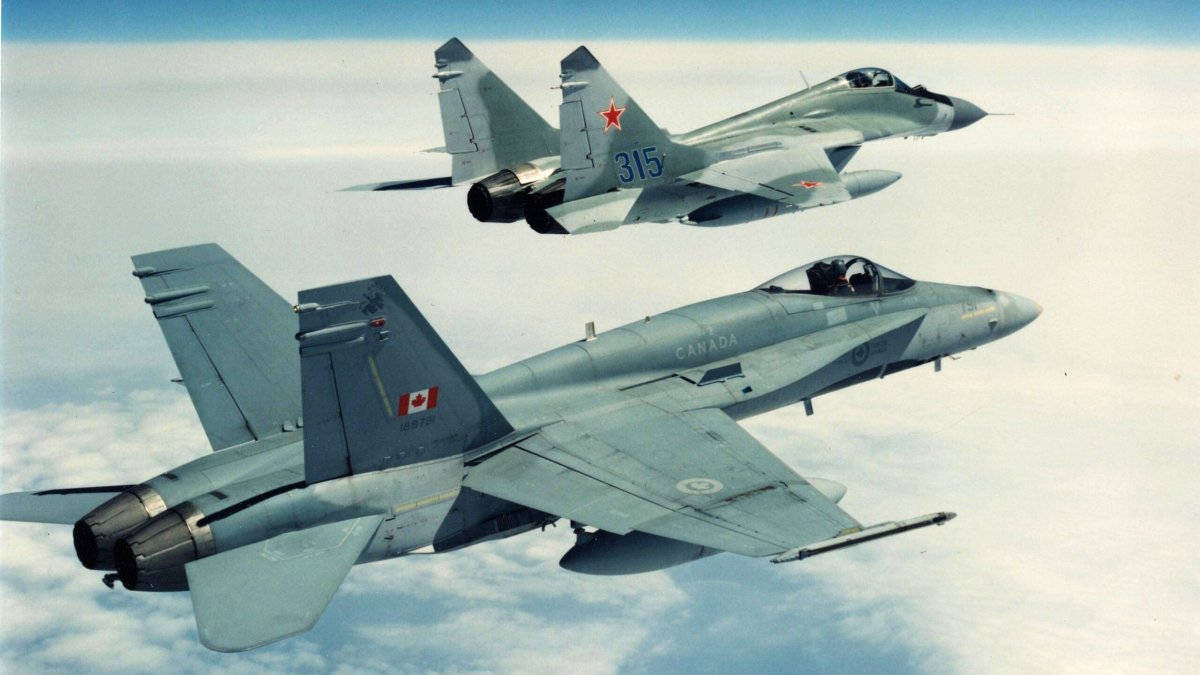
A useful comparison of the CF-18 Hornet (foreground) and single-seat MiG-29., VIC JOHNSON VIA HAROLD SKAARUP
At this point, Wade made the decision to approach the Soviet lead (the MiG-29UB), who used hand signals to indicate his radio had failed. With strict instructions not to fly near the alert base at Comox, Wade pointed at the lead pilot then took up a position 40 degrees to the left of their previous course and the Soviet pilot turned immediately in response, before signaling that they had only had 30 minutes’ of fuel remaining. A safe arrival at Abbotsford now looked touch-and-go, so Wade decided to put the Eastern bloc visitors on his wing, two MiGs on the right, two CF-18s on the left, tucked in tight to begin the descent into Abbotsford through 30,000 feet of cloud. After waving the MiGs off to land, Wade was “pretty impressed by what the boys did,” he reflected.
Wade then describes his return to base at Comox, where the crew chief told him that the phone had barely stopped ringing — it was the Soviet Embassy (“How they got the phone number of the QRA, I’ve got no idea”). They wanted to thank Wade for his assistance and invite him as a guest at the upcoming airshow. Wade didn’t have to think about the decision long — he was already headed to the base to take part in a static display of aircraft.
The two-seat MiG-29UB parked on the ramp at Abbotsford in front of a giant An-225 transporter., U.S. DEPARTMENT OF DEFENSE
But the welcome awaiting Wade at the Soviets’ pavilion on the first day of the show was Cold War-frosty. After introducing himself, he was told “Nyet, go away.” The following day, the same thing happened, with the Soviet guard again telling Wade’s RCAF contingent to leave.
Finally, on Sunday, the last day of the show, the Soviets seemed to have had an abrupt change of tack. “They really wanted to fly the F-15 or F-18 and get a Western pilot to make an assessment of MiG-29 to help them market it,” Wade speculated. With any chance of one of their test pilots flying in a Western “teen-series” jet having evaporated, it seems Moscow decided instead to go on the public relations offensive, showing a Western pilot exactly what their jet was capable of.
Bob Wade, in the dark flying suit, strapping into the MiG-29UB with test pilots Roman Taskaev and Valery Menitsky (left)., VIA COLD WAR CONVERSATIONS
The offer was initially turned down by the Canadian top brass but, luckily for Wade, Deputy Defense Minister Mary Collins was at the event and helped get it signed off. In Wade’s view, the minister put her career on the line to secure his place in the Soviet cockpit. With Anatoly Kvochur still recovering from his bailout in Paris, his colleague Valery Menitsky would fly in the back seat, but he spoke very little English. Wade borrowed an ill-fitting g-suit and helmet and was quickly shown how to start the jet’s twin Klimov RD-33 turbofans. With all instruments in Cyrillic, and measurements in kilometers per hour and meters, Wade would have to rely on the instincts he’d developed as a military aviator.
The preflight brief was limited — no details were given about take-off, landing, or flap speeds. Wade assumed Menitsky would handle that. With 10 minutes to prepare, there was now some concern on the Canadian side that the flight might not be such a good idea after all.
“Don’t screw this up or we’ll both be looking for work,” Collins told Wade. “She might be looking for work but I’d be dead!”, he reflected.
A CF-18 flown by Lieutenant Colonel Ray Levasseur, commander of 433 TFS, escorting the single-seat MiG-29 flown by Roman Taskaev, during a second visit to Canada in June 1990., VIC JOHNSON VIA HAROLD SKAARUP
Once in the jet, Wade was determined to use his experience as a CF-18 demonstration pilot to evaluate the MiG and aimed to replicate parts of his own 12-minute low-level aerobatic routine for comparison. This video shows Wade at work in his CF-18 during an air display:
Wade was told by Menitsky that he was happy for him to take-off. Wade still had no idea of take-off speed, let alone the fuel load of the jet he was sat in.
Once airborne, Wade decided he wanted to perform a roll at the top of the climb-out. “Pulling through the vertical after take-off, on the F-18 airspeed would stagnate or maybe roll back a few knots; on the MiG-29 when I pulled through the vertical that airplane was still accelerating, so I knew it had better thrust-to-weight at whatever fuel weight it was carrying. I was pretty happy with that”, he recalls.
After another vertical climb, it was time to attempt some hard maneuvering, including maximum stick deflection, rolling in both directions. Wade judged the results “equivalent to the F-18. The F-18 would roll at 720 degrees per second; the MiG-29 was quite comparable.”
Roman Taskaev leaves his MiG-29 parked on the ramp after a demonstration flight at Abbotsford., U.S. AIR FORCE
Exactly how hard he was maneuvering was hard to judge, though. Wade couldn’t find the G-meter, let alone read it. He reckons he was pulling around 7g and found he had enough power, in afterburner, to sustain the turn. Then “Valeri pilot,” came the command from the back seat, and the Soviet aviator slammed the jet back into the vertical, and at around 3,000 feet idled both throttles for a tailslide .
The CF-18 would need 5,000 feet to recover from such a maneuver, Wade reflected. He was also surprised to note both the MiG’s afterburners kicking in instantaneously when lit — unlike in the Hornet. Menitsky pushed the stick forward and the nose fell — another surprise — and they flew out without a problem.
“Bob pilot,” was the next command from the back seat, and now it was Wade’s chance to perform a tailslide. He was “surprised how easy it was.”
VIC JOHNSON VIA HAROLD SKAARUP
Eager to know what the Fulcrum could do in low-speed dogfighting, on the next recovery from the tailslide, Wade held the nose, selected afterburner and kept the jet steady at around 70 degrees nose-up, checking rudder responsiveness in both directions. “I was amazed, I learned a lot in that particular maneuver”, Wade notes. He judged the MiG equal to the F/A-18 in the low-speed, high-angle-of-attack domain.
Menitsky then pulled a 360-degree turn that Wade estimates was around 8g, leaving the Canadian “buried into the cockpit, working hard just trying to stay conscious.” Watching the airspeed indicator through the maneuver, the speed never increased or decreased by more than around 20 knots — “Pretty credible turn capability,” in Wade’s assessment.
After 15 minutes, the next command came: “Bob pilot landing.” Wade took the jet around, dropped flaps and gear when it felt right, touched down and rolled out. His conclusion: “I was pretty impressed with it.”
The MiG flight had won over Wade, but he was still of the basic opinion that Soviet fighters were built for a war of attrition — “rivets sticking out, tires threadbare, pretty crude,” but that they overcame these shortcomings with their sheer power.
Notably, the Soviets wouldn’t turn on the head-up display , and the MiG-29UB was not fitted with radar. Nonetheless, Wade felt he had a good understanding of the jet’s capabilities in a dogfight. Here, he reckoned, it would be equivalent to a Hornet, although the MiG’s 30mm gun had better range than the Hornet’s 20mm M61A1 Vulcan cannon .
After touchdown, the Soviets made efforts to ensure Wade didn’t speak immediately to the media. Instead, he was ushered back to the pavilion where he was plied with no fewer than three tumblers of vodka, as he and his hosts toasted the jet, Wade, and then the Soviet Union. “Those boys drank it straight down,” remembers Wade — who did the same. “I don’t really know a lot that went on after that in the pavilion… I was pretty drunk,” he remembers.
With the benefit of hindsight, Wade admits he probably talked up the MiG: “I really gave them good press” and he had “no qualms about painting them 10 feet tall” — this, after all, would also be for the benefit of North America’s defense industry, he explains.
In the wake of the events at Abbotsford, Canada’s Chief of Defense Staff called Wade to Ottawa for an urgent debrief, immediately after which a pair of CIA agents wanted to hear his account, too. Wade’s intelligence windfall would see him spending the next 12 months or so delivering 20-minute briefings on the Fulcrum around NATO.
Three months after the Abbotsford show, the Berlin Wall came down and the Cold War standoff evaporated overnight. As happened in many countries, Canada saw a major subsequent defense spending drawdown. The RCAF was slashed from six operational CF-18 units to just three, and Wade left the service, finding work as a commercial pilot.
Once the Warsaw Pact collapsed, the NATO powers would have plenty more opportunities to fully evaluate the Soviet jet, including the former East German fleet that was inherited by the air arm of the newly reunified Germany . The United States also began to assemble a collection of its own MiG-29s, for detailed analysis, as part of its foreign materiel exploitation ( FME ) effort — no fewer than 21 MiG-29s were snapped up from the former Soviet republic of Moldova in 1997, one of which is now on display at the Threat Training Facility at Nellis Air Force Base in Nevada. In the meantime, Western pilots flying MiG-29s would become more commonplace, and the Fulcrum itself remains a key element of NATO air arms in Bulgaria, Hungary, Poland, and Slovakia.
As for Wade, his relationship with Russian fighters almost had a surprising revival. He remembers getting a call from Langley at some point in the mid-1990s, telling him the Russians had chosen him to fly in a Su-30 (with thrust-vectoring engines), at Farnborough — what’s more, he would be paid to do it. A day before he was due to fly to the United Kingdom, another call from Langley informed him the trip had been canceled by the Russians. It was, Wade admits, “one of my big regrets.”
The author would like to thank Harold Skaarup for sharing photos of the MiGs’ visit to Canada.
Contact the author: thomas@thedrive.com
Comments couldn’t be loaded. Please refresh the page.
更新于美国东部时间2020年11月27日下午6:35
读者或许不知道,首位有机会驾驶当时苏联引以为傲的米格-29“支点”战斗机的西方飞行员竟然是一位加拿大人。但这位现已退役的加拿大皇家空军少校鲍勃·韦德在铁幕落下前几个月就获得了这架战机,他的故事堪称传奇。韦德本人在“冷战对话”网站主持的一期精彩播客节目中讲述了这段经历,其中一些细节值得深入探究。完整的访谈内容(点击此处收听)也值得一听。
有机会驾驶主要敌人的顶级战斗机本身就是一件非常罕见的事情。韦德完全不知道在1989年的阿伯茨福德国际航展上等待着他的是什么:他发现自己坐在米格-29UB战斗教练机的前座上,只有短短10分钟的简报,不懂俄语,后座上的飞行员也只会说最基本的英语。
如今,米格-29战斗机在世界各国的空军中已是司空见惯的景象。或许很难想象,当这款强大的战斗机在20世纪80年代初加入苏联空军服役时,西方观察家们是多么震惊。当时,美国急于评估苏联制造的战机,甚至不惜一切代价获取它们,秘密试飞以更好地了解其性能,并让本国飞行员有机会与苏联战机进行对抗。其中最引人注目的例子便是冷战时期的“红鹰”米格假想敌中队,您可以在这里了解更多信息。
直到“公开性”政策实施后,普通民众以及外国军方高层才有机会近距离观察这种喷气式飞机。1988年,它在英国范堡罗国际航展上惊艳亮相,由此拉开了苏联(以及即将成为俄罗斯的)军用飞机在全球各地进行一系列展示的序幕。您可以在这里观看那次展示:
1988 年范堡罗航展上,阿纳托利·克沃丘尔的亮相让世界认识了他。他后来成为那个时代最著名的试飞员和表演飞行员之一,之后曾就职于苏霍伊设计局。然而,到了 1989 年 8 月阿伯茨福德航展时,克沃丘尔却因同年 6 月在法国巴黎航展上驾驶米格-29 战斗机时发生的低空弹射事故而登上新闻头条,但这次事故却让他颜面尽失。
到了1989年夏末,苏联最新一代战机给西方观察家留下了深刻印象,莫斯科方面似乎有人认为,是时候让他们有机会独家体验一下竞争对手的装备了。韦德回忆说,在来北美参加阿伯茨福德航展之前,苏联官员曾努力争取乘坐F-15“鹰”式或F/A-18“大黄蜂”战斗机进行熟悉飞行。如果北美空军接受邀请,苏联米格-29战斗机上就会有一个座位等着他们的飞行员。但美国军方断然拒绝了这一提议。
两架飞往加拿大的苏联米格-29战斗机在埃尔门多夫空军基地被美国空军第21战术战斗机联队的F-15战斗机拦截。
两架“支点”战斗机前来访问,飞抵白令海峡上空的北美空域时,遭到驻扎在埃尔门多夫空军基地的美国空军F-15战斗机的拦截。苏联战斗机在阿拉斯加的这个基地降落过夜,但双方仍未就互访飞行达成任何协议。
韦德当时是加拿大不列颠哥伦比亚省科莫克斯空军基地的警戒部队指挥官,该基地是距离阿伯茨福德最近的战斗机警戒设施所在地。米格战机预计抵达阿伯茨福德商业机场时,韦德回忆说,北美防空司令部(NORAD)通知他,苏联战机预计将经由阿拉斯加狭长地带抵达,最终降落在不列颠哥伦比亚省南部的阿伯茨福德。然而,由于苏联飞行员将接受温哥华的民用空中交通管制,加拿大皇家空军(RCAF)的任务仅仅是引导他们飞越加拿大领空。
当时,科莫克斯空军基地通常有四架加拿大皇家空军的CF-18“大黄蜂”战斗机处于警戒状态,其中两架正在执行任务,两架待命。韦德回忆说,由于他手下有三架“大黄蜂”战斗机可用,于是决定派出全部三架执行这次极其特殊的拦截任务。北美防空司令部指示他和他的机组人员“与敌机保持至少1000英尺的距离,并且不要试图与米格-29战斗机的飞行员进行任何通信”。
韦德和他的僚机按计划在阿拉斯加狭长地带的南端接上了米格战机,在那里他们也遇到了护送苏联战机穿越美国领空的埃尔门多夫F-15战斗机。韦德回忆说,在北美防空司令部(NORAD)方面,整个过程都由一架E-3预警机控制。
“我们之前从未见过米格-29战斗机,”他说。“当然,我们听取过很多关于它的情报简报,但每个人都对亲眼见到它感到非常兴奋。”
从CF-18战斗机的座舱内拍摄的由“大黄蜂”和米格-29战斗机组成的混合编队。(图片来源:VIC JOHNSON,经HAROLD SKAARUP授权使用)
韦德和其他加拿大皇家空军飞行员从苏联喷气式飞机——一架单座的“支点-A”和一架双座的“支点-B”——的尾部接近它们,飞行高度约为37000英尺,速度约为0.9马赫。北美防空司令部的“鹰”式和“大黄蜂”式战斗机利用这种独特的编队为所有喷气式飞机拍摄了一些照片后,CF-18和米格战斗机继续向南飞行,而“鹰”式战斗机则挥手告别。
二十分钟后,当韦德注意到那两架米格战机偏离预定航线约40度时,加拿大皇家空军战斗机飞行员们的兴奋之情或许才略微消退。由于苏联战机当时由民用飞机控制,韦德回忆说,他并不确定它们的飞行方向,于是立即呼叫了预警机。
“嘿,我们不知道他们往哪儿飞,”侦察机那边传来回复。韦德随后用他的第二部无线电联系温哥华,却发现他们也没能联系上苏联飞行员。
CF-18“大黄蜂”(前景)与单座米格-29的对比图,维克·约翰逊(VIC JOHNSON)供稿,哈罗德·斯卡鲁普(HAROLD SKAARUP)发布
此时,韦德决定接近苏联领航机(米格-29UB),领航机用手势示意无线电失灵。韦德接到严令不得飞越科莫克斯警戒基地,他指向领航机飞行员,然后向左侧偏转40度,偏离了之前的航线。苏联飞行员立即转向,并示意他们只剩下30分钟的燃料。安全抵达阿伯茨福德机场现在看来几乎是碰运气了,于是韦德决定让这些来自东欧的飞机跟在他的机翼上,两架米格战机在右侧,两架CF-18在左侧,紧密编队,开始穿过3万英尺的云层下降到阿伯茨福德。挥手示意米格战机降落后,韦德回忆说:“我对这些小伙子们的表现印象深刻。”
韦德随后描述了他返回科莫克斯基地的情景。机组长告诉他,电话铃声几乎响个不停——是苏联大使馆打来的(“他们怎么弄到快速反应部队的电话号码,我完全摸不着头脑”)。他们想感谢韦德的协助,并邀请他作为嘉宾参加即将举行的航展。韦德几乎没怎么犹豫就答应了——他当时正赶往基地参加飞机静态展示。
一架双座米格-29UB战斗机停在阿伯茨福德机场的停机坪上,前方是一架巨大的安-225运输机。(美国国防部)
但韦德在展会首日抵达苏联展馆时,却受到了冷战时期特有的冷遇。他自我介绍后,对方却说“不,走开”。第二天,同样的事情再次发生,苏联警卫再次要求韦德所在的加拿大皇家空军分遣队离开。
最后,在航展的最后一天,也就是周日,苏联方面似乎突然改变了策略。“他们原本想试飞F-15或F-18,并让一位西方飞行员对米格-29进行评估,以帮助他们进行市场推广,”韦德推测道。既然他们的试飞员驾驶西方“青少年系列”战机的机会已经破灭,莫斯科似乎决定转而发起公关攻势,向西方飞行员展示他们的战机究竟具备怎样的性能。
鲍勃·韦德身穿深色飞行服,与试飞员罗曼·塔斯卡耶夫和瓦列里·梅尼茨基(左)一起系好安全带,进入米格-29UB战斗机。(图片来自冷战对话)
加拿大高层最初拒绝了这项提议,但幸运的是,国防部副部长玛丽·柯林斯当时也在场,并帮助促成了最终的批准。在韦德看来,这位部长为了确保他能坐上苏联的驾驶舱,不惜赌上自己的职业生涯。由于阿纳托利·克沃丘尔仍在巴黎接受紧急救助,他的同事瓦列里·梅尼茨基将坐在后座,但他几乎不会说英语。韦德借了一套不太合身的抗荷服和头盔,并很快学会了如何启动喷气式飞机的两台克里莫夫RD-33涡扇发动机。由于所有仪表都使用西里尔字母,计量单位为公里/小时和米,韦德只能依靠他作为一名军用飞行员所培养的本能。
飞行前简报内容有限——没有提供起飞、着陆或襟翼速度等细节。韦德认为梅尼茨基会处理这些问题。距离起飞只剩10分钟准备时间,加拿大方面开始担心这次飞行或许并非明智之举。
“别搞砸了,不然我们俩都得找工作,”柯林斯对韦德说。“她或许能找到工作,但我恐怕就没命了!”他心想。
1990年6月,第433战术战斗机中队指挥官雷·勒瓦瑟尔中校驾驶的CF-18战斗机,在第二次访问加拿大期间,为罗曼·塔斯卡耶夫驾驶的单座米格-29战斗机护航。(图片来源:维克·约翰逊,经哈罗德·斯卡鲁普提供)
进入战机后,韦德决心利用他作为CF-18特技飞行员的经验来评估米格战机,并计划重现他自己12分钟低空特技飞行表演的部分内容以作比较。这段视频展示了韦德在飞行表演中驾驶CF-18战机的场景:
梅尼茨基告诉韦德,他很乐意让他起飞。韦德仍然不知道起飞速度是多少,更不用说他所乘坐的喷气式飞机的燃油量了。
韦德起飞后,决定在爬升顶点做一个滚转动作。“F-18起飞后做垂直滚转时,空速会停滞不前,甚至可能下降几节;而米格-29做垂直滚转时,飞机仍在加速,所以我知道无论携带多少燃油,它的推重比都更好。我对这个结果非常满意。”他回忆道。
又一次垂直爬升后,是时候尝试一些高难度机动动作了,包括最大杆偏转和双向滚转。韦德评价结果“与F-18相当。F-18的滚转速度为每秒720度;米格-29与之相当。”
罗曼·塔斯卡耶夫驾驶的米格-29战斗机在阿伯茨福德完成演示飞行后停放在停机坪上。(美国空军)
不过,他当时究竟做了多大的机动动作,很难判断。韦德找不到过载表,更别说读取数值了。他估计自己承受了大约7g的过载,并且发现开启加力燃烧室后,动力足够维持转弯。这时,后座传来“瓦列里,飞行员!”的指令,苏联飞行员猛地将飞机拉回垂直高度,并在大约3000英尺的高度将油门杆完全关闭,准备进行尾滑。
韦德回忆说,CF-18需要5000英尺的高度才能从这样的机动中改出。他还惊讶地发现,米格战机的加力燃烧室一点燃就瞬间启动——这与大黄蜂战机不同。梅尼茨基向前推杆,机头下沉——这又是一个意外——他们顺利地飞了出来。
“鲍勃,驾驶!”后座传来下一个指令,现在轮到韦德表演尾滑了。他“惊讶地发现这竟然如此容易”。
维克·约翰逊通过哈罗德·斯卡鲁普
为了了解“支点”战斗机在低速近距离空战中的表现,韦德在下一次尾滑改出后,保持机头稳定,开启加力燃烧室,并将飞机保持在约70度的机头上仰角,同时测试方向舵在两个方向上的响应。“我感到非常惊讶,在那次机动中我学到了很多东西,”韦德说道。他认为,在低速、大攻角空战领域,米格战机的性能与F/A-18不相上下。
随后,梅尼茨基完成了一个360度转弯,韦德估计其承受的过载约为8g,导致加拿大飞行员“被压在驾驶舱内,竭力保持清醒”。韦德观察空速指示器,发现整个转弯过程中速度的增减幅度从未超过20节——韦德认为这是“相当可靠的转弯能力”。
15分钟后,下一个指令传来:“鲍勃,飞行员着陆。”韦德驾驶飞机绕了一圈,感觉合适后放下襟翼和起落架,着陆并滑行。他的结论是:“我对它的表现相当满意。”
米格战斗机的飞行表演赢得了韦德的认可,但他仍然坚持认为苏联战斗机是为消耗战而设计的——“铆钉外露,轮胎磨损严重,相当粗糙”,但它们凭借强大的力量克服了这些缺点。
值得注意的是,苏联人没有启用抬头显示器,而且米格-29UB也没有配备雷达。尽管如此,韦德仍然认为自己对这架喷气式飞机的空战能力有相当的了解。他认为,米格-29UB的性能与大黄蜂相当,尽管它的30毫米机炮射程比大黄蜂的20毫米M61A1“火神”机炮更远。
飞机着陆后,苏联方面设法阻止韦德立即接受媒体采访。他们把他带回休息室,在那里,他和东道主们一起举杯,为飞机、韦德以及苏联干杯,至少喝了三杯伏特加。“那些家伙一口气喝光了,”韦德回忆道——他也喝了。“之后在休息室里发生了什么,我不太清楚……我当时喝得有点醉了,”他回忆说。
事后看来,韦德承认他可能夸大了米格战机的战绩:“我确实给了它们很好的宣传”,而且他“毫不犹豫地把它们画得像10英尺高”——毕竟,这也有利于北美的国防工业,他解释说。
阿伯茨福德事件发生后,加拿大国防参谋长立即召韦德前往渥太华进行紧急汇报,随后两名中央情报局特工也想听听他的说法。韦德因此获得了宝贵的情报,在接下来的大约12个月里,他需要就北约“支点”行动向各方进行20分钟的简报。
阿伯茨福德航展三个月后,柏林墙倒塌,冷战僵局一夜之间瓦解。与许多国家一样,加拿大随后大幅削减了国防开支。加拿大皇家空军的CF-18作战部队从六个锐减至三个,韦德也离开了军队,成为了一名商业飞行员。
华沙条约组织解体后,北约各国将有更多机会全面评估苏联的米格-29战机,包括新统一的德国空军继承的前东德米格-29机队。美国也开始收集一批米格-29战机进行详细分析,作为其外国物资利用(FME)计划的一部分——1997年,美国从前苏联加盟共和国摩尔多瓦购入了不少于21架米格-29战机,其中一架现陈列于内华达州内利斯空军基地的威胁训练设施。与此同时,西方飞行员驾驶米格-29战机的情况也日益普遍,“支点”战机本身至今仍是北约驻保加利亚、匈牙利、波兰和斯洛伐克空军的重要组成部分。
至于韦德,他与俄罗斯战斗机的关系几乎有过一次出人意料的复苏。他记得在20世纪90年代中期的某个时候接到兰利的电话,对方告诉他,俄罗斯方面选中他驾驶苏-30(配备推力矢量发动机)参加范堡罗航展——而且,他还会获得报酬。然而,就在他即将飞往英国的前一天,兰利方面又打来电话,告知他俄罗斯方面取消了这次行程。韦德承认,这是“我最大的遗憾之一”。
作者感谢 Harold Skaarup 分享米格战机访问加拿大的照片。
联系作者:thomas@thedrive.com
评论加载失败,请刷新页面。