Veteran Flight Tester On How The YA-7F Strikefighter Was Really A Jet Recycling Program资深试飞员讲述YA-7F攻击战斗机实际上是喷气式飞机回收计划
The YA-7F program aimed to field a new battlefield interdiction jet for pennies on the dollar by using spare engines and airframes. And it worked.
Updated Jul 10, 2020 11:05 PM EDT
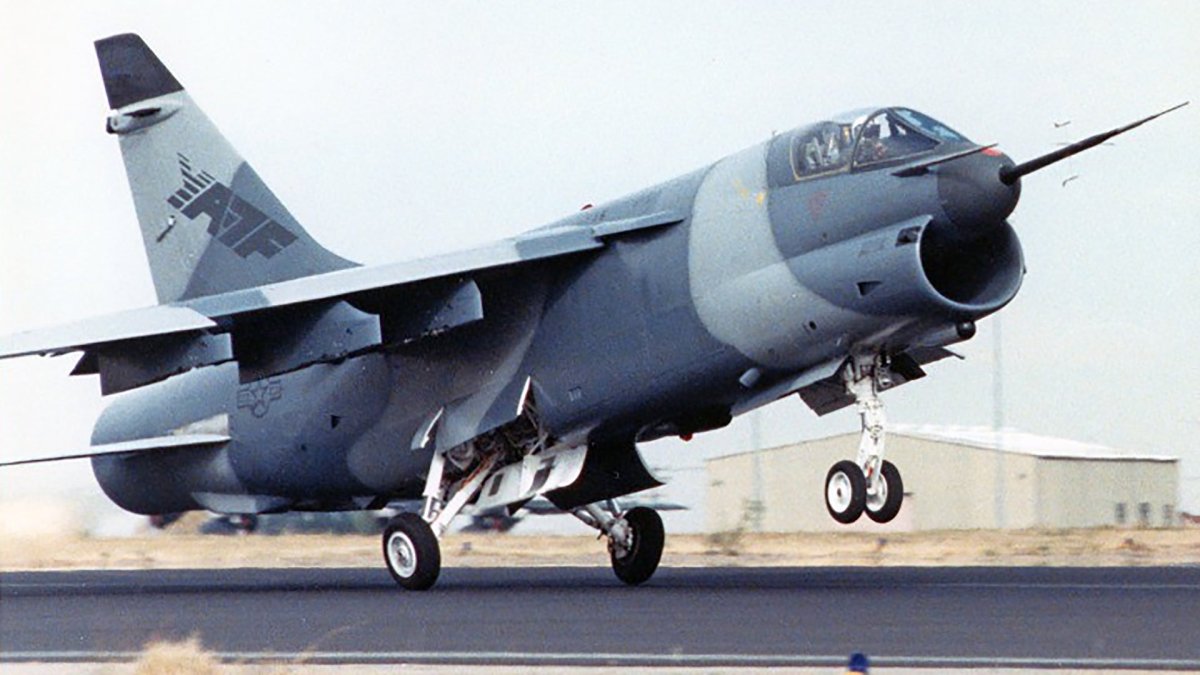
The YA-7F Strikefighter program looked to do something breathtakingly logical: take existing largely surplus A-7 Corsair II attack jets that lacked speed, maneuverability, and more advanced capabilities and turn them into a more agile supersonic night-fighting battlefield interdiction jets for pennies on the dollar compared to what a new airframe would cost. By all accounts, the YA-7F team was successful at doing just that, but they were fighting a losing battle due to a number of factors, the biggest of which was the latest rendition of the F-16, the Block 40/42 F-16CG/DG, and the love of pointy-nosed fighter jets among the Air Force brass. The fact that big defense contractors wouldn’t make a windfall revamping surplus A-7s probably also had something to do with it.
In the end, the far more expensive and sexy F-16, which was born a fighter, would be chosen over the utilitarian YA-7F for the nighttime battlefield interdiction mission, but in retrospect, that may not have been the best choice, at least entirely. You can read all about the YA-7F program and its potential in this past piece of mine , but now, thanks to retired Air Force Lieutenant Colonel Mitchell Burnside Clapp, we have an entirely new perspective on this enigmatic initiative from someone who was right there during the test program.
According to Clapp, the YA-7F was really an incredibly logical recycling program more than anything else. If it would have been greenlit into production, it probably would have been the most bang for the buck the Air Force had realized in an airframe in decades. It also would have been remarkably suited for the period of turmoil that would come a decade later in the air campaigns that followed the attacks on 9/11.
Lt Col Michell Burnside Clapo recounted the following about his time with the YA-7F program and its demise to The War Zone:
My first job out of Test Pilot School in 1988 was the YA-7F. The jet was great. The subtle changes in the aerodynamics really improved a lot of things, particularly handling at high angles of attack (AOA). We couldn’t even spin the jet even with adverse control inputs into the heavy wing with an asymmetric load. The avionics were the basic LANA suite (a “Low Altitude Night Attack” package that did pretty much what LANTIRN did later in the rest of the fleet). Some of the things we did during the test program less useful than hoped – loading the GPU-5/A gun pod was a good way to test vibration, but not a good way to actually hit anything on the ground with any accuracy. It was a great year of flying, and the test team hit all the points and demonstrated everything that the jet was supposed to do.
Both YA-7F prototypes along with an A-7D chase jet. , Vought.org
In the mid-1980s, it became clear that IPEs (Improved Performance Engines) would soon be available for the tactical air forces. These were the -129 and -229 variants of the General Electric and Pratt & Whitney fighter engines, respectively. I’ll talk about the Pratt engines from here onwards since that’s what we flew in the YA-7F, but feel free to assume that it’d apply to the GE engines, as well.
The then-current (i.e. -220) versions of the engine produced around 14,000 pounds of thrust in full military power (MIL) and 23,000 in max afterburner. The soon-to-be-available -229s, though, could produce 17,800 pounds in MIL and 29,000 pounds in max afterburner. The tactical fighter fleet was then full of hundreds of F-16 Vipers and F-15 Eagles with perfectly serviceable -220 engines. The -220 was the variant that had the digital engine controller and substantially improved maintenance and uptime over its predecessors, but the -229 would have been a serious improvement in performance.
It would have been great to re-engine all the tactical fighters in the ‘90s inventory, but that poses the question, what do you do with all the perfectly serviceable and relatively low-time -220s? A potential answer was the YA-7F Strikefighter.
The YA-7F with its F100-220E in full afterburner. , USAF
At this point, in the mid-1980s, the only active-duty places still flying the A-7 were Edwards, for test support, chase, education at Test Pilot School, and so on, and at dark grey places in southern Nevada , where it was used to get enough flight time to maintain proficiency for the pilots of airplanes up that way that didn’t generate a lot of sorties. All the other remaining A-7s, D models, were in the Air National Guard. The Navy, the Portuguese, and the Greeks still had theirs, of course, but the Air Force’s A-7 fleet was a guard-only operation, and the guard was the customer, ultimately. The guard wanted F-16s, which, eventually, they got.
Edwards AFB A-7 high over Rogers Dry Lake. , USAF
Consequently, the YA-7F never lost its “Y” (prototype) prefix and the 200-ish flight tests that took place, mostly in 1990, submitted a stack of technical reports and everybody dispersed. Conversion costs of the jet from D-model to F-model would have been, if memory serves me right, around just $7M per jet in 1990 dollars.
The aircraft only went supersonic to calibrate the air data system. There was no point in going that fast tactically. The extra thrust was more useful for shortening takeoff, maintaining speed during maneuvering, particularly during automatic terrain following, and accelerating from around 300 to 500 knots, in the tactical speed range. Mostly the jet was about delivering bombs on target. While the top speed may have theoretically been around 1.6 Mach, it would have taken you all afternoon to get that fast and you were likely to run out of gas on the way.
YA-7F in burner. , Vought.org
The fuselage was stretched four feet in total. Two and a half feet were in front of the wing and one and a half feet were behind it. Because of the stretch, the aft fuselage had to be canted upwards a little bit to maintain ground clearance. That caused the horizontal tail to get hammered in the wake of the main wing. That problem turned out to be fixable with a change in the dihedral angle to a slightly negative value of about five degrees. It turned out that putting the left horizontal tail on the right side and vice versa managed to solve the problem completely and was only a half-degree off optimum.
A-7F alternations to the standard A-7 airframe. , Public Domain
The stretch included room for extra gas, which, if you didn’t use the burner, could have improved the endurance of the already-long-legged basic jet. After all, the ‘unaugmented’ thrust was the same for both D and F, around 14,000 pounds of thrust. There was a minor concern at one point that the jet in afterburner could accelerate fast enough on takeoff to overspeed the gear during transition, but I don’t think that particular problem actually manifested in flight.
The vertical tail basically had its tip cleaned up and extended a bit, which wasn’t a big change. It probably helped a little at high AoA, though. The big help was from the leading edge extensions. There was a syllabus ride at Test Pilot School to do A-7 departures with a variety of entries and all the F-model pilots repeated it in the A-7K (two-seater standard model) that the program used for chase duties during test flights.
You could get the basic A-7 to do some pretty violent things with adverse control inputs, but the F model was very resistant to that. You could keep it heading not-very-pointy end forward with a little attention to the rudder pedals at angles of attack at which you already would have been out of control in the D model. D model recoveries were nearly always “ailerons into the spin,” the F model was the same, but frankly “just grab the mirrors” would have worked just as well.
YA-7F with one of Edwards AFB’s A-7 test and chase jets. , Vought.org
The engine was great and that was particularly true in formation flight and rejoins. The original turbofan in the D model had a lot of lag and sometimes it felt like you were communicating with the engine by mail. You had to be ahead of the jet to fly in company, which is never a bad thing airmanship-wise, but the new engine was much more responsive.
Other mods on the jet were an OBOGS – an onboard oxygen generation system – which filtered compressor bleed air to remove most of the nitrogen. Not all, though – it was still about seven percent N2. That made some of the air start testing a bit challenging because the pilot was still going to have some N2 in his blood, which raised the risk of decompression sickness if there was a loss of cabin pressure, which should be expected if you shut the engine off.
YA-7F tail number 344 had a metal piece covering its turkey feathers – the moveable nozzle parts at the exhaust end of the engine. About halfway through the test program that part was removed. It turned out that the turkey feathers were being drawn outwards slightly by suction between the nozzle flaps and the tail cone extension and the engine controller wasn’t reading the position of the flaps accurately. When the part was off, the performance of the jet improved a little and that was the configuration we completed the test program in. The other jet, 039, kept its extension because that was where the spin chute was mounted and that was the jet we used for all the high AoA testing.
344 with its turkey feathers exposed., USAF
The basic requirement for the flight tests was “fly no worse than the A-7D” and it was achieved. For test planning purposes, we were in the odd position of having to test with respect to an outdated specification – MIL-F-8785B – Charlie was the current version at the time. The original test report’s lead engineer was… Burt Rutan! He wrote it during his active duty tour in the mid-1960s.
All in all, the YA-7F did what it was supposed to do and did it well. The modification team and test team ran a fairly fast, efficient, and comprehensive program, and the transition to production would have resulted in a solid Close Air Support/Battlefield Area Interdiction capability. It was originally called the “A-7 Plus” by LTV, its manufacturer (occasionally some wit would call it the “F-8 Minus”) before it received its official designation. But a fleet of A-7Fs was not to be, because the Guard was holding out for moving up to the F-16, which is inherently far more multi-role capable than the unlovely YA-7F variant of the SLUF (slightly longer ugly fellow).
Editor’s note: A big thank you to Lt Col Mitchell Burnside Clapp USAF (ret), who currently works at Embassy Aerospace LLC, for sharing his YA-7F memories with us.
Contact the editor: Tyler@thedrive.com
Comments couldn’t be loaded. Please refresh the page.
更新于美国东部时间2020年7月10日晚上11:05
YA-7F攻击战斗机项目旨在完成一项看似合乎逻辑的任务:将现有的、速度慢、机动性差、性能欠佳的A-7“海盗II”攻击机(这些飞机大多是剩余的)改造为更灵活的超音速夜间战场拦截机,而成本仅为制造一架新飞机的几分之一。从各方面来看,YA-7F团队确实成功地完成了这项任务,但由于诸多因素,他们最终还是败下阵来。其中最主要的因素是最新型的F-16战斗机——Block 40/42 F-16CG/DG,以及空军高层对尖头战斗机的偏爱。此外,大型国防承包商无法通过改造剩余的A-7飞机获得巨额利润,这可能也是导致该项目失败的原因之一。
最终,价格昂贵且外形炫酷的F-16战斗机(它天生就是战斗机)取代了实用性较强的YA-7F,被选中执行夜间战场拦截任务。但事后看来,这或许并非最佳选择,至少并非完全如此。你可以在我之前的文章中了解YA-7F项目及其潜力。如今,多亏了退役空军中校米切尔·伯恩赛德·克拉普,我们得以从一位亲历过该测试项目的人士的角度,对这项神秘的计划有了全新的认识。
克拉普认为,YA-7F与其说是一个项目,不如说是一个极其合理的回收利用计划。如果它当初获准投产,很可能成为空军几十年来在机型研发上取得的最大收益。此外,它也非常适合应对9·11事件后十年间空战的动荡时期。
米歇尔·伯恩赛德·克拉波中校向《战区》杂志讲述了他在YA-7F项目期间的经历以及该项目最终失败的经过:
1988年我从试飞员学校毕业后的第一份工作就是驾驶YA-7F。这架喷气式飞机非常棒。气动外形上的细微改进确实提升了很多性能,尤其是在高攻角(AOA)下的操控性。即使对负载不对称的重型机翼施加不利的控制输入,我们也无法让飞机进入螺旋状态。航电系统是基本的LANA套件(一种“低空夜间攻击”套件,其功能与后来其他机型使用的LANTIRN基本相同)。我们在测试项目中做的一些事情并没有预期的效果——比如,装载GPU-5/A机炮吊舱是测试振动的好方法,但却无法精确击中地面目标。那一年飞行体验非常棒,测试团队完成了所有测试项目,并展示了这架飞机应有的所有性能。
两架YA-7F原型机以及一架A-7D伴飞机。,Vought.org
20世纪80年代中期,很明显,改进型发动机(IPE)很快就能供战术空军使用。这些发动机分别是通用电气(GE)的-129型和普惠(Pratt & Whitney)的-229型战斗机发动机。接下来我将主要讨论普惠发动机,因为我们驾驶的YA-7F就是这种发动机,但您可以认为这些内容同样适用于通用电气发动机。
当时的F-220型发动机在全军用功率(MIL)下可产生约14,000磅的推力,在最大加力燃烧室模式下可产生23,000磅的推力。而即将服役的F-229型发动机,在全军用功率下可产生17,800磅的推力,在最大加力燃烧室模式下可产生29,000磅的推力。当时的战术战斗机部队中,数百架F-16“蝰蛇”和F-15“鹰”式战斗机都配备了性能良好的F-220型发动机。F-220型发动机配备了数字发动机控制器,相比其前代产品,维护性和正常运行时间都得到了显著提升,但F-229型发动机在性能方面无疑会有更大的进步。
如果能为90年代库存的所有战术战斗机更换发动机,那当然很好,但这引出了一个问题:如何处理所有性能完好且飞行时间相对较低的-220型战斗机?YA-7F攻击战斗机或许是一个解决方案。
YA-7F 搭载 F100-220E 发动机,开启加力燃烧室。(美国空军)
到了20世纪80年代中期,当时仍在服役的A-7攻击机只有爱德华兹空军基地还在使用,用于测试支援、护航、试飞员学校的训练等等;内华达州南部一些偏远地区也还在使用,用于为那些出动架次不多的飞行员提供足够的飞行时间,以保持他们的飞行技能。其他所有剩余的A-7(D型)都在国民警卫队服役。当然,海军、葡萄牙和希腊仍然保留着他们的A-7,但空军的A-7机队完全由国民警卫队使用,最终客户也是国民警卫队。国民警卫队想要的是F-16战斗机,最终他们如愿以偿。
美国空军爱德华兹空军基地A-7攻击机高空飞越罗杰斯干湖。
因此,YA-7F 始终保留着“Y”(原型机)前缀,大约 200 次的飞行测试(主要集中在 1990 年)提交了一堆技术报告,之后各方便各自散去。如果我没记错的话,1990 年时,将 D 型飞机改装成 F 型飞机的成本大约为每架 700 万美元。
这架飞机超音速飞行只是为了校准空速数据系统。战术上没有必要飞得那么快。额外的推力更适用于缩短起飞距离、在机动飞行中保持速度(尤其是在自动地形跟踪飞行中),以及在战术速度范围内从大约300节加速到500节。这架喷气式飞机的主要用途是向目标投掷炸弹。虽然理论上最高速度可能在1.6马赫左右,但要达到这个速度需要花费整个下午的时间,而且很可能在途中耗尽燃料。
YA-7F 正在燃烧室中。,Vought.org
机身总共加长了四英尺。其中两英尺半位于机翼前方,一英尺半位于机翼后方。由于机身加长,为了保持离地间隙,后机身必须略微向上倾斜。这导致水平尾翼在主翼尾流中受到冲击。后来发现,将上反角调整为略微负五度即可解决这个问题。最终,将左侧水平尾翼移至右侧,反之亦然,彻底解决了这个问题,而且角度仅比最佳值略微偏离了半度。
A-7F 对标准 A-7 机身的改进。,公共领域
加长部分预留了额外的燃料空间,如果不使用加力燃烧室,这可以进一步提升这款原本航程就很远的喷气式飞机的续航能力。毕竟,D型和F型飞机在未加力燃烧室的情况下推力相同,约为14000磅。曾有人担心,加力燃烧室起飞时喷气式飞机的加速可能过快,导致起落架在过渡阶段转速过高,但我认为这个问题在实际飞行中并未出现。
垂直尾翼的翼尖基本上只是做了些许修饰和延长,这算不上什么大的改动。不过,在大迎角下,这可能确实有所帮助。真正起到关键作用的是前缘延伸部分。试飞员学校的课程安排中有一节课,要求飞行员练习A-7的各种起飞方式,所有F型飞行员都驾驶A-7K(双座标准型)重复了这节课,该机型是试飞期间用于伴飞任务的飞机。
你可以让基本的A-7在受到反控制输入时做出一些非常剧烈的动作,但F型对此却非常抗拒。在D型已经失控的迎角下,你只需稍加注意方向舵踏板,就能让它保持略微偏前的方向。D型的改出几乎总是“用副翼进入螺旋”,F型也是如此,但说实话,“直接拉后视镜”的效果也一样好。
YA-7F 与爱德华兹空军基地的一架 A-7 测试和伴飞飞机合影。(Vought.org)
这台发动机性能卓越,尤其是在编队飞行和重新编队时。D 型飞机原装的涡扇发动机反应迟滞严重,有时感觉就像在用邮件与发动机沟通。你必须领先于其他飞机才能与之编队飞行,从飞行技术角度来看,这当然是好事,但新发动机的响应速度要快得多。
飞机上的其他改装包括机载氧气发生系统(OBOGS),它可以过滤压缩机引气,去除大部分氮气。但并非完全去除——仍然含有约7%的氮气。这使得一些启动测试颇具挑战性,因为飞行员血液中仍然会含有少量氮气,如果发生座舱失压(发动机关闭时必然会发生这种情况),就会增加减压病的风险。
YA-7F 344号机尾部覆盖着一块金属片,这块金属片遮盖了发动机排气端的可移动喷嘴部件——“火鸡羽毛”。测试计划进行到一半时,这块金属片被移除。结果发现,由于喷嘴襟翼和尾锥延伸部分之间的吸力,“火鸡羽毛”被略微向外拉扯,导致发动机控制器无法准确读取襟翼的位置。移除这块金属片后,飞机的性能略有提升,我们最终以这种配置完成了测试计划。另一架飞机,039号机,保留了尾锥延伸部分,因为那里安装有减速伞,而且我们用这架飞机进行了所有的高攻角测试。
344号,羽毛裸露,像火鸡一样。,美国空军
飞行测试的基本要求是“飞行性能不逊于A-7D”,而这一要求也确实达到了。出于测试计划的考虑,我们面临着一个棘手的困境:我们必须依据一份过时的规范——MIL-F-8785B——进行测试——而当时的最新版本正是Charlie。这份原始测试报告的主编工程师竟然是……伯特·鲁坦!他在20世纪60年代中期服役期间撰写了这份报告。
总而言之,YA-7F 完成了它应该完成的任务,而且完成得很好。改进团队和测试团队开展了一个相当迅速、高效且全面的项目,如果顺利投入生产,它将具备可靠的近距离空中支援/战场区域遮断能力。在正式命名之前,其制造商 LTV 最初称其为“A-7 Plus”(偶尔有人会戏称其为“F-8 Minus”)。但最终未能实现 A-7F 机队的部署,因为国民警卫队当时正等待升级到 F-16,而 F-16 的多用途能力远胜于外形丑陋的 YA-7F SLUF 改进型(这家伙稍微长一点,也挺丑)。
编者按:非常感谢美国空军中校(退役)Mitchell Burnside Clapp,他目前在 Embassy Aerospace LLC 工作,与我们分享了他关于 YA-7F 的回忆。
联系编辑:Tyler@thedrive.com
评论加载失败,请刷新页面。