This Is What A Boeing F-32 Would’ve Looked Like If Lockheed Lost The JSF Competition如果洛克希德·马丁公司输掉了联合攻击战斗机(JSF)竞标,波音F-32战斗机大概会是这个样子。
To this day the X-32 is lambasted for its atrocious looks, but Boeing's final vision for its F-32 fighter was markedly different in appearance.
新闻视频
Updated May 19, 2018 9:10 PM EDT
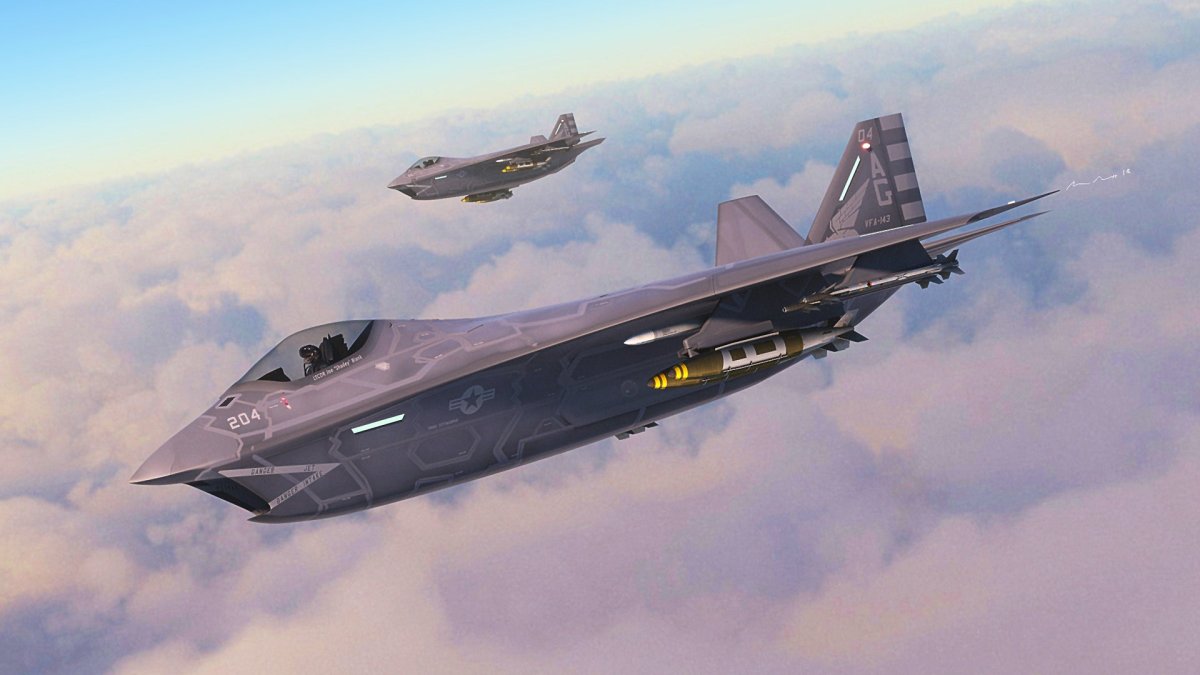
In 2001, Boeing’s X-32 stood off against Lockheed’s X-35 in a fly-off for the massively lucrative Joint Strike Fighter contract. Making a stealth fighter capable of carrying a significant payload while also having a version that can take off in short distances and land vertically was quite the task, and both companies went about solving the problem very differently. In the end, the X-32 lost to the X-35 for a number of reasons that we will get into in a future post, but many who were taken aback by the X-32’s ‘unique’ looks didn’t realize that Boeing had already planned a number of very significant design changes for their production F-32. Now, thanks to our friend Adam Burch over at Hangar-b.com we can take another look at what this aircraft would have become.
Adam Burch/ hangar-b.com
Adam Burch/hangar-b.com
Partially as a result of the Navy pushing for performance changes late in the game—too late to integrate those changes on their X-plane demonstrators—Boeing’s design refinements included an entirely new wing concept. Gone was the big modified delta wing and in its place was a more traditional fighter wing configuration that also included separate, fully articulated ‘tailerons.’
The X-32 demonstrator with its massive delta planform. , Boeing/JSF program
X-32 production configuration mockup., Boeing
The aircraft’s nose was also remolded as well to accommodate a radar and its notorious inlet design would become a bit less ‘gaping’ and included a more refined forward-swept ‘underbite.’ The cockpit canopy also changed, losing the bow and going to an unobstructed bubble configuration. There were many other smaller changes made to the jet’s original mold-line as well.
Overall the F-32A was a less exotic and more attractive design that retained a lot of internal volume for fuel and weapons. Its remodeled wing retained much of the wide chord and camber of its delta-wing predecessor. The aircraft’s inlet design was still an issue but with the alterations, less of the engine face would have been visible to radar from front hemisphere aspects and the design always intended to incorporate a variable geometry baffle on the engine face to greatly reduce the aircraft’s critical head-on radar cross-section.
So even though it still might have deserved to lose to the X-35, the F-32 concept is largely misunderstood because the X-32 demonstrators really didn’t represent the baseline design configuration. At least aesthetically, the F-32 was miles ahead of its proof of concept progenitors, and that probably would have helped its bid to become the largest military aircraft program ever.
A huge thanks again to Adam Burch for these awesome renderings. Make sure to check out his other killer art at Hangar-B.com . The man literally paints space stations and rockets for a living, how cool is that!?
Contact the author: Tyler@thedrive.com
Comments couldn’t be loaded. Please refresh the page.
更新于美国东部时间2018年5月19日晚上9:10
2001年,波音公司的X-32与洛克希德公司的X-35在竞争利润丰厚的联合攻击战斗机(JSF)合同的试飞中展开角逐。制造一款既能携带大量有效载荷,又能短距起降的隐形战斗机绝非易事,两家公司为此采取了截然不同的解决方案。最终,X-32败给了X-35,原因有很多,我们将在以后的文章中详细探讨。但许多人被X-32“独特”的外观所震撼,却并未意识到波音公司当时已经为其量产型F-32制定了一系列意义重大的设计变更计划。现在,感谢Hangar-b.com网站的亚当·伯奇(Adam Burch)的分享,我们可以再次一窥这款飞机原本的模样。
Adam Burch/ hangar-b.com
Adam Burch/hangar-b.com
部分原因是由于海军在项目后期才提出性能改进要求——为时已晚,无法将这些改进整合到他们的X型飞机验证机上——波音公司的改进方案中包含了一种全新的机翼概念。大型改进型三角翼被弃用,取而代之的是更传统的战斗机机翼布局,其中还包括独立的、完全铰接的尾翼。
X-32验证机采用巨大的三角翼布局。波音/JSF项目
X-32 生产配置模型,波音公司
为了安装雷达,飞机的机头也进行了重新设计,其臭名昭著的进气口设计也变得不那么“张开”,并采用了更精致的前掠式“下颚”造型。座舱盖也进行了改动,取消了前部设计,改为无遮挡的气泡式结构。此外,飞机的原始模具线也进行了许多其他细微的改动。
总体而言,F-32A 的设计虽然不那么奇特,但更具吸引力,同时保留了大量的内部空间用于存放燃料和武器。其改进后的机翼保留了其三角翼前身的大部分宽弦长和弯度。飞机的进气道设计仍然存在问题,但经过改进后,从正面半球方向雷达可探测到的发动机表面面积有所减少,而且该设计始终计划在发动机表面安装可变几何挡板,以大幅降低飞机正对正面的雷达反射截面积。
因此,尽管F-32最终败给X-35或许情有可原,但人们对F-32概念的理解存在很大偏差,因为X-32的验证机实际上并未代表其基本设计配置。至少在外观上,F-32远胜于其概念验证原型机,这或许有助于它最终成为史上规模最大的军用飞机项目。
再次衷心感谢 Adam Burch 绘制的这些精彩渲染图。一定要去 Hangar-B.com 看看他的其他杰作。他可是靠绘制空间站和火箭为生的,是不是很酷?!
联系作者:Tyler@thedrive.com
评论加载失败,请刷新页面。