WWII Vintage USS Oak Ridge Is Being Auctioned Off, Maybe The Navy Should Buy It Back二战时期的“橡树岭”号航空母舰正在拍卖,或许海军应该把它买回来。
The unique 75-year-old vessel could provide much needed dry dock capacity for the Navy's submarine fleet or it could be scrapped for its recycling value.
新闻视频
Updated Sep 6, 2018 5:22 PM EDT
The functional USS Oak Ridge , a forward-deployable floating dry dock that participated in World War II, is being auctioned off by the U.S. government. The offering was set to close at 12pm PDT today, but a flurry of late bids has extended the bidding. The odd thing about the sale is that Oak Ridge’s utility may be greater now to the U.S. Navy than it had been in decades. So selling it off for pennies on the dollar seems like a questionable move.
The auction listing, which is posted over at GSAauctions.gov, reads:
The 1944 OAKRIDGE is a 540-ft long and 81-ft wide closed-basin towable floating dry-dock with an enclosed bow, constructed entirely of welded steel. The dock is specifically designed to withstand the stresses imposed by the sea while under tow. The wing walls, pontoon deck, and stern gate form the dock chamber. OAKRIDGE is able to lift vessels up to 6,096 MT and is suitable to lift any ship that fits within the physical limits of the dock, including Naval submarines and Coast Guard surface vessels. The dock has a light draft of 8-ft and a 8,995 MT displacement. Latest docking operation was conducted in February 2018. There are two 23 MT capacity portal wing wall cranes and four 3512 Caterpillar generator sets currently not operative, but can be returned to service with overhaul and repairs. Hazardous materials such as asbestos containing material and lead paint have been either encapsulated or stabilized. All known PCB containing materials have been entirely removed. Next owner/operator will need to have the capacity to tow away the Oakridge via tug boats from its current location at Coast Guard Yard in Curtis Bay, MD. Please contact Property Custodian LT Thomas Kai with any questions.” It is the purchaser s responsibility to comply with all applicable Federal, state, local, and export laws and regulations to ensure the proper registration, licensing, possession, transportation, and subsequent use, resale or disposal of the property. Failure to sign the certification may result in the bid being rejected as nonresponsive: The successful bidder hereby certifies that he/she will comply with all applicable Federal, state, and local laws, ordinances, and regulations with respect to the care, handling, storage, shipment, resale, export, or other use of the material hereby purchased. The bidder will hold the United States harmless from and indemnify the United States against any or all debts, liabilities, judgments, costs, demands, suits, actions, or other claims of any nature arising from or incident to the handling, use, storage, shipment, resale, export, or other disposition of the items purchased*****The dry dock is affixed to the dock and the successful bidder is responsible for taking actions for its detachment from the dock*****The Government recommends that potential purchaser~s inspect the dry dock prior to bidding*****The Successful Bidder will be required to complete the attached End Use Certificate. This document must be completed in its entirety prior to submitting full payment. The completed document must be submitted via email to tonyar.dillard@gsa.gov*****PLEASE REVIEW THE ATTACHED END USE DOCUMENT PRIOR TO SUBMITTING BID**** Z700988058H001 THE CONDITION OF THE PROPERTY IS NOT WARRANTED.
The 1944 OAKRIDGE is a 540-ft long and 81-ft wide closed-basin towable floating dry-dock with an enclosed bow, constructed entirely of welded steel. The dock is specifically designed to withstand the stresses imposed by the sea while under tow. The wing walls, pontoon deck, and stern gate form the dock chamber. OAKRIDGE is able to lift vessels up to 6,096 MT and is suitable to lift any ship that fits within the physical limits of the dock, including Naval submarines and Coast Guard surface vessels. The dock has a light draft of 8-ft and a 8,995 MT displacement. Latest docking operation was conducted in February 2018. There are two 23 MT capacity portal wing wall cranes and four 3512 Caterpillar generator sets currently not operative, but can be returned to service with overhaul and repairs. Hazardous materials such as asbestos containing material and lead paint have been either encapsulated or stabilized. All known PCB containing materials have been entirely removed. Next owner/operator will need to have the capacity to tow away the Oakridge via tug boats from its current location at Coast Guard Yard in Curtis Bay, MD. Please contact Property Custodian LT Thomas Kai with any questions.” It is the purchaser s responsibility to comply with all applicable Federal, state, local, and export laws and regulations to ensure the proper registration, licensing, possession, transportation, and subsequent use, resale or disposal of the property. Failure to sign the certification may result in the bid being rejected as nonresponsive: The successful bidder hereby certifies that he/she will comply with all applicable Federal, state, and local laws, ordinances, and regulations with respect to the care, handling, storage, shipment, resale, export, or other use of the material hereby purchased. The bidder will hold the United States harmless from and indemnify the United States against any or all debts, liabilities, judgments, costs, demands, suits, actions, or other claims of any nature arising from or incident to the handling, use, storage, shipment, resale, export, or other disposition of the items purchased*****The dry dock is affixed to the dock and the successful bidder is responsible for taking actions for its detachment from the dock*****The Government recommends that potential purchaser~s inspect the dry dock prior to bidding*****The Successful Bidder will be required to complete the attached End Use Certificate. This document must be completed in its entirety prior to submitting full payment. The completed document must be submitted via email to tonyar.dillard@gsa.gov*****PLEASE REVIEW THE ATTACHED END USE DOCUMENT PRIOR TO SUBMITTING BID**** Z700988058H001
THE CONDITION OF THE PROPERTY IS NOT WARRANTED.
There are also a number of interesting files attached to the auction post which you can check out here , here , and here .
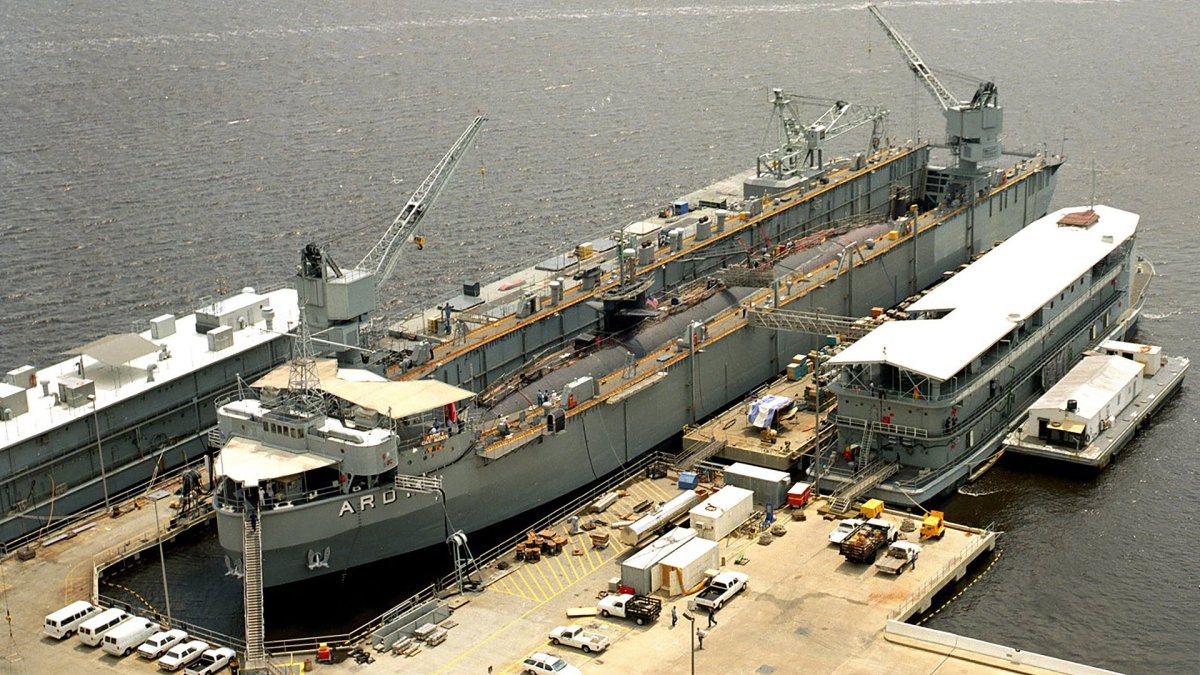
The 536-foot long, 81-foot wide, unpowered vessel can handle vessels the size of nuclear fast attack submarines and smaller. It is a closed bow, open stern design that allows it to be moved across the oceans to different locales. The addition of rudders and onboard generators means the vessel operates similarly to a standard ship during transits, but it has to rely on some form of tow vessel for propulsion. It was built with all the amenities of a normal Navy ship and to support a crew of nearly 200.
Oak Ridge was originally commissioned as auxiliary repair dock USS ARD-19 during World War II. It supported the Palau offensive and took damage during an attack on San Pedro Bay, where ARD-19 was servicing the destroyer USS Ross at the time . A Japanese Tojo fighter careened into it and a large fire broke out in the dry dock area after the aircraft ripped through the vessel’s outer wall. The fire was in the process of being extinguished when another Japanese fighter made a strafing run on the ship, but before it could do much damage, ARD-19’s gunners shot down the assaulting aircraft.
Not bad for a lowly dry dock!
In a relatively short period of time, the ship was back operational again and not long after the incident, ARD-19 was towed to Subic Bay where it spent the rest of the war tending to very needy U.S. Navy ships.
The dry dock spent time in the reserve fleet and executed miscellaneous roles after the war. She was then recommissioned as USS Oak Ridge (ARDM-1) in 1963 after extensive modifications and upgrades. Her new role was to support America’s burgeoning Polaris ballistic missile submarine force. She was the only ship that could put these submarines into dry dock and transport them over long distances if need be.
Oak Ridge with a submarine in its dry dock area. , Oak Ridge Facebook Page
The newly minted Oak Ridge stood up service at Naval Base Rota in Spain in late 1964. Over the decades she continued to support the Navy’s submarine force, and later in life, this included exclusively servicing nuclear fast-attack submarines due to the increased size of the Navy’s ballistic missile carrying subs. This was her role up until her retirement in 2001, with Oak Ridge’s last station being Naval Submarine Base New London in Connecticut.
Oak Ridge was transferred to the Coast Guard after being struck from the Navy register and has served as a dry dock facility at the Coast Guard’s shipyard in Curtis Bay, Maryland ever since. In fact, Oak Ridge received a basic service life extension in 2013. This included structural and systems rehabilitation, as well as the installation of new communications systems and other technological enhancements.
Oak Ridge at the Coast Guard’s shipyard in Maryland. , USG
Originally the Coast Guard saw the ship as only being usable for five years, but it has remained in an operational state despite being nearly 75 years old and receiving relatively minimal investment. And although 75 years may seem ancient, that is comparatively young compared to a number of the Navy’s fixed dry dock installations.
USS Oak Ridge pictured with USCGC Eagle in its dry dock in late December 2017., Kenau22 /Wikicommons
And that’s why getting rid of Oak Ridge seems a bit puzzling. The Navy has a major dry dock capacity deficit , and many of the ones it does have are decaying rapidly, an issue that the Navy, now flush with cash, is trying to remedy but it will be a long and arduous process doing so.
Considering Oak Ridge can accommodate nuclear fast attack submarines, and anything smaller, not to mention it is portable and can be moved if need be, it seems like a good candidate for reenlistment to meet the Navy’s growing needs, especially in terms of submarine maintenance and service. The Navy is experiencing a damning backlog of dry dock time for these essential and hugely expensive national security assets. This has resulted in some subs being sidelined for years just as the Navy says it is sorely lacking in submarine capacity to meet tasking demands.
Oak Ridge Facebook Page
The Coast Guard’s reasoning for getting rid of the unique ship is stated in this official 2015 Coast Guard document on its dry dock facilities, in which it notes the vessel’s age, disrepair, and lack of investment, and states:
The annual maintenance and depreciation cost for OAKRIDGE is $957,000 per year. At present, the operating and maintenance costs of OAKRIDGE are 11 times greater than the ship lift system (per linear foot of useable dock space). Floating dry-docks are required to be dry-docked themselves once every 10 years, to perform hull inspections and maintenance, consistent with both Navy and Coast Guard requirements. The Yard performed dive inspections on OAKRIDGE instead of dry docking; OAKRIDGE has not been docked since the mid-1990s. At present, there are no active shipyards in a safe transit distance from the Yard that have the capacity to dry dock OAKRIDGE to perform this maintenance, and even if dry-dock facilities were available, the costs would be prohibitive, so this work has been permanently deferred until OAKRIDGE is removed from service.
This all sounds logical for the Coast Guard, but maybe not so much for the Pentagon’s increasingly needy naval portfolio. Additionally, the dry dock is going to have to be transported by its new owner, so clearly it can be moved. Putting it through a much-needed dry dock period itself and giving it a deep overhaul may be a far quicker way to gain additional Navy dry dock capacity than building an entirely new dry dock facility.
USS Baltimore SSN-704 aboard Oak Ridge in 1997., USN
Even porting Oak Ridge over to a contractor to operate it and make it available for the federal government’s needs may make more sense than selling it to a customer that potentially has other uses in mind, which could include ripping it apart for scrap. One can hope this won’t be the case.
In the past, vessels with similarly unique capabilities have been saved from the scrapper’s torch, such as the Hughes Mining Barge and Sea Slice , and put back to work after an overhaul. But there is no language in the auction contract that will require this to occur. And even if it is put back into service, it may do so servicing yachts and commercial vessels, not the Navy’s inventory.
Currently, the bidding is in its final stages and is up to $1,322,099. Hopefully, with the buyer making that level of investment, the historic Oak Ridge will still have a bright future ahead of it.
Contact the author: Tyler@thedrive.com
Bidding has ended with the final strike price being $1,396,099. 18 parties put in bids. Not bad for this old ship that is supposedly not worth keeping!
Comments couldn’t be loaded. Please refresh the page.
更新于美国东部时间2018年9月6日下午5:22
二战时期曾参与前沿部署的浮动干船坞“橡树岭”号(USS Oak Ridge)目前仍处于功能状态,正由美国政府拍卖。拍卖原定于今天太平洋时间中午12点结束,但由于大量竞标者的加入,拍卖时间已延长。此次拍卖的奇特之处在于,“橡树岭”号对美国海军的价值或许比过去几十年都要高。因此,以极低的价格出售它似乎是一个值得商榷的举动。
拍卖清单已发布在GSAauctions.gov网站上,内容如下:
1944年建造的“橡树岭”(OAKRIDGE)号是一座长540英尺、宽81英尺的封闭式拖曳式浮式干船坞,船首封闭,完全由焊接钢结构建造。该船坞经过特殊设计,能够承受拖曳过程中海浪带来的各种应力。翼墙、浮筒甲板和尾门共同构成船坞舱室。“橡树岭”号能够吊装重达6096吨的船舶,适用于吊装任何符合船坞物理尺寸限制的船舶,包括海军潜艇和海岸警卫队水面舰艇。该船坞吃水浅,吃水8英尺,排水量8995吨。最近一次入坞作业是在2018年2月。目前,船坞内有两台23吨级的门式翼墙起重机和四台3512型卡特彼勒发电机组,但这些设备目前无法运行,不过经过大修和维修后即可恢复使用。含石棉材料和含铅油漆等有害物质已被封装或稳定化处理。所有已知的含多氯联苯(PCB)材料均已彻底清除。下一位业主/经营者需要具备使用拖船将“橡树岭”号从其目前位于马里兰州柯蒂斯湾海岸警卫队船坞的位置拖走的能力。如有任何疑问,请联系物业管理员托马斯·凯中尉。买方有责任遵守所有适用的联邦、州、地方和出口法律法规,以确保对该财产进行正确的登记、许可、持有、运输以及后续的使用、转售或处置。未签署此证明可能导致投标因不符合要求而被拒绝:中标者特此证明,其将遵守所有适用的联邦、州和地方法律、法令及法规,以妥善保管、处理、储存、运输、转售、出口或以其他方式使用此次购买的物品。中标者将使美国免受损害,并赔偿美国因处理、使用、储存、运输、转售、出口或其他处置所引起的或与之相关的任何性质的债务、责任、判决、费用、索赔、诉讼、诉讼请求或其他索赔。*****干船坞已固定在码头上,中标者负责采取措施将其从码头上拆卸下来。*****政府建议潜在买方检查干船坞。投标前请仔细阅读*****中标者需填写随附的最终用途证明。此文件必须在全额付款前完整填写。填写完毕的文件必须通过电子邮件发送至tonyar.dillard@gsa.gov*****请在提交投标前仔细阅读随附的最终用途文件**** Z700988058H001 不保证房产状况。
1944年建造的“橡树岭”(OAKRIDGE)号是一座长540英尺、宽81英尺的封闭式拖曳式浮式干船坞,船首封闭,完全由焊接钢结构建造。该船坞经过特殊设计,能够承受拖曳过程中海浪带来的各种应力。翼墙、浮筒甲板和尾门共同构成船坞舱室。“橡树岭”号能够吊装重达6096吨的船舶,适用于吊装任何符合船坞物理尺寸限制的船舶,包括海军潜艇和海岸警卫队水面舰艇。该船坞吃水浅,吃水8英尺,排水量8995吨。最近一次入坞作业是在2018年2月。目前,船坞内有两台23吨级的门式翼墙起重机和四台3512型卡特彼勒发电机组,但这些设备目前无法运行,不过经过大修和维修后即可恢复使用。含石棉材料和含铅油漆等有害物质已被封装或稳定化处理。所有已知的含多氯联苯(PCB)材料均已彻底清除。下一位业主/经营者需要具备使用拖船将“橡树岭”号从其目前位于马里兰州柯蒂斯湾海岸警卫队船坞的位置拖走的能力。如有任何疑问,请联系物业管理员托马斯·凯中尉。买方有责任遵守所有适用的联邦、州、地方和出口法律法规,以确保对该财产进行正确的登记、许可、持有、运输以及后续的使用、转售或处置。未签署此证明可能导致投标因不符合要求而被拒绝:中标者特此证明,其将遵守所有适用的联邦、州和地方法律、法令及法规,以妥善保管、处理、储存、运输、转售、出口或以其他方式使用此次购买的物品。中标者将使美国免受损害,并赔偿美国因处理、使用、储存、运输、转售、出口或其他处置所引起的或与之相关的任何性质的债务、责任、判决、费用、索赔、诉讼、诉讼请求或其他索赔。*****干船坞已固定在码头上,中标者负责采取措施将其从码头上拆卸下来。*****政府建议潜在买方检查干船坞。投标前请仔细阅读*****中标者需填写随附的最终用途证明。此文件必须在全额付款前完整填写。填写完毕的文件必须通过电子邮件发送至tonyar.dillard@gsa.gov*****请在提交投标前仔细阅读随附的最终用途文件**** Z700988058H001
房屋状况不作任何保证。
拍卖帖子还附带了一些有趣的文件,您可以在这里、这里和这里查看。
这艘长536英尺、宽81英尺的无动力舰艇可以拖曳核动力快速攻击潜艇及更小的舰艇。它采用封闭式船首、开放式船尾设计,使其能够跨越海洋到达不同地点。由于加装了舵和船载发电机,该舰艇在航行过程中与标准船舶的运行方式类似,但需要依靠某种拖船提供动力。该舰艇配备了普通海军舰艇的所有设施,并可容纳近200名船员。
“橡树岭”号最初是二战期间作为辅助修理船坞船“ARD-19”号服役的。它曾参与帕劳战役,并在圣佩德罗湾遭到袭击时受损。当时,“ARD-19”号正在那里为驱逐舰“罗斯”号提供维修服务。一架日本东条英机撞上了“橡树岭”号,飞机撕裂了船体外墙后,干船坞区域燃起了熊熊大火。正当火势被扑灭之际,另一架日本战斗机对“橡树岭”号进行了扫射,但“ARD-19”号的炮手在它造成更大损失之前将其击落。
对于一个不起眼的干船坞来说,这成绩相当不错了!
在相对较短的时间内,这艘船就恢复了运行,事件发生后不久,ARD-19 就被拖到苏比克湾,并在那里度过了战争的剩余时间,为急需维修的美国海军舰艇提供维修服务。
战后,这艘干船坞舰曾短暂服役于后备舰队,并执行过各种杂务。经过大规模改装和升级后,于1963年重新服役,命名为“橡树岭”号(ARDM-1)。她的新任务是为美国日益壮大的北极星弹道导弹潜艇部队提供支持。她是唯一一艘能够将这些潜艇送入干船坞并在必要时进行长途运输的舰艇。
橡树岭海军基地,干船坞区停泊着一艘潜艇。(橡树岭海军基地 Facebook 主页)
新近服役的“橡树岭”号于1964年底在西班牙罗塔海军基地正式投入使用。几十年来,她持续为海军潜艇部队提供支持,后期由于海军弹道导弹潜艇体积的增大,她的任务也扩展到专门为核动力快速攻击潜艇提供维护保养。直至2001年退役,“橡树岭”号的最后一个驻地是位于康涅狄格州新伦敦的海军潜艇基地。
“橡树岭”号从海军舰艇名录中除名后移交给海岸警卫队,此后一直作为干船坞设施停泊在马里兰州柯蒂斯湾的海岸警卫队造船厂。事实上,“橡树岭”号在2013年进行了基础延寿改造,包括结构和系统修复,以及安装新的通信系统和其他技术升级。
橡树岭位于马里兰州海岸警卫队造船厂。
最初,海岸警卫队认为这艘船只能使用五年,但尽管它已有近75年的历史,且投资相对较少,却一直保持着服役状态。虽然75年听起来很古老,但与海军的许多固定干船坞设施相比,这还算是比较年轻的。
2017年12月下旬,橡树岭号航空母舰与海岸警卫队鹰号巡逻舰在干船坞内合影。(图片来源:Kenau22 /Wikicommons)
因此,放弃橡树岭海军基地似乎有点令人费解。海军的干船坞容量严重不足,而且现有的许多船坞都在迅速老化。海军现在资金充裕,正试图解决这个问题,但这将是一个漫长而艰巨的过程。
考虑到橡树岭海军基地能够容纳核动力快速攻击潜艇以及任何更小的舰艇,而且它还具有可移动性,必要时可以调动,因此它似乎是满足海军日益增长的需求(尤其是在潜艇维护和保养方面)的理想选择。海军目前面临着这些至关重要且造价极其昂贵的国家安全资产的干船坞维修时间严重积压的问题。这导致一些潜艇被闲置多年,而海军却声称其潜艇能力严重不足,无法满足任务需求。
橡树岭脸书页面
海岸警卫队在其2015年关于干船坞设施的官方文件中阐述了处置这艘特殊舰艇的理由,其中指出该舰艇船龄老旧、年久失修且缺乏投资,并指出:
“奥克里奇”号的年度维护和折旧费用为95.7万美元。目前,“奥克里奇”号的运营和维护成本是船舶升降系统成本的11倍(按可用船坞空间每英尺计算)。根据海军和海岸警卫队的要求,浮动干船坞需要每10年进坞一次,以进行船体检查和维护。船厂对“奥克里奇”号进行了潜水检查,而非干船坞维修;自20世纪90年代中期以来,“奥克里奇”号就未曾进坞。目前,在距离船厂安全航程范围内没有其他正在运营的船厂具备干船坞维修能力,即使有干船坞设施,成本也过于高昂,因此这项工作已被永久推迟,直至“奥克里奇”号退役。
这一切对海岸警卫队来说似乎合情合理,但对五角大楼日益紧缺的海军部门来说可能就未必如此了。此外,干船坞需要由新业主负责运输,显然它是可以搬迁的。与其建造全新的干船坞设施,不如让现有干船坞进行一次急需的维护和彻底翻新,这或许是更快地增加海军干船坞容量的途径。
1997年,美国海军巴尔的摩号核潜艇(SSN-704)停泊在橡树岭海军航空站。
即使是将橡树岭国家实验室移交给承包商运营,并使其满足联邦政府的需求,也可能比将其出售给可能另有用途的客户(例如将其拆解成废料)更明智。但愿这种情况不会发生。
过去,一些拥有类似独特能力的舰艇曾被从拆解的命运中拯救出来,例如休斯采矿驳船和海切号,并在大修后重新投入使用。但拍卖合同中并没有相关条款要求这样做。即使这艘船重新服役,也可能是为游艇和商船提供服务,而不是作为海军舰艇。
目前,竞标已进入最后阶段,出价达到 1,322,099 美元。希望买家能够进行如此大笔的投资,使历史悠久的橡树岭庄园拥有光明的未来。
联系作者:Tyler@thedrive.com
竞标结束,最终成交价为1,396,099美元。共有18家竞标方参与竞标。对于这艘据说不值得保留的老船来说,这个价格还算不错!
评论加载失败,请刷新页面。