John Glenn’s Combat Nickname Was “Old Magnet Ass” For All The Right Reasons约翰·格伦的战斗绰号是“老磁铁屁股”,这完全是名副其实的。
He was a daring flying leatherneck before he donned a spacesuit for NASA.
新闻视频
Updated Jul 3, 2020 3:38 AM EDT
Sure, he was the first American to orbit the earth, and he went on to win a Senate seat, but John Glenn was also a down and dirty fighter pilot. He flew F4U Corsairs in the Pacific Theatre during World War II, then went back to war over the skies of Korea in Grumman F9F Panthers. It was during his 63 missions with VMF-311 “Tomcats” over Korea that he gained an off-color but awesomely fitting nickname: “Old Magnet Ass.”
The nickname may sound like a ribbing—it’s anything but. “Old Magnet Ass” came into being as a result of the way Glenn would aggressively pursue ground targets in his Panther. At times he would bravely dive in for attack runs long after the element of surprise had been lost. In the process he would attract so much anti-aircraft artillery fire that his jet would come back riddled with holes.
On one flight near Sinanju, he spotted a North Korean AAA pillbox, though by the time he positively identified the position he would have to circle back to make an attack run. He swooped down and opened up at close range with the Panther’s 20mm cannons, and the North Korean gunners returned the favor with prejudice. Although he nailed the AAA emplacement, his jet was a wreck and nearly uncontrollable, flying far out of trim in the vertical axis.
VMF-311 F9Fs in Korea., DoD
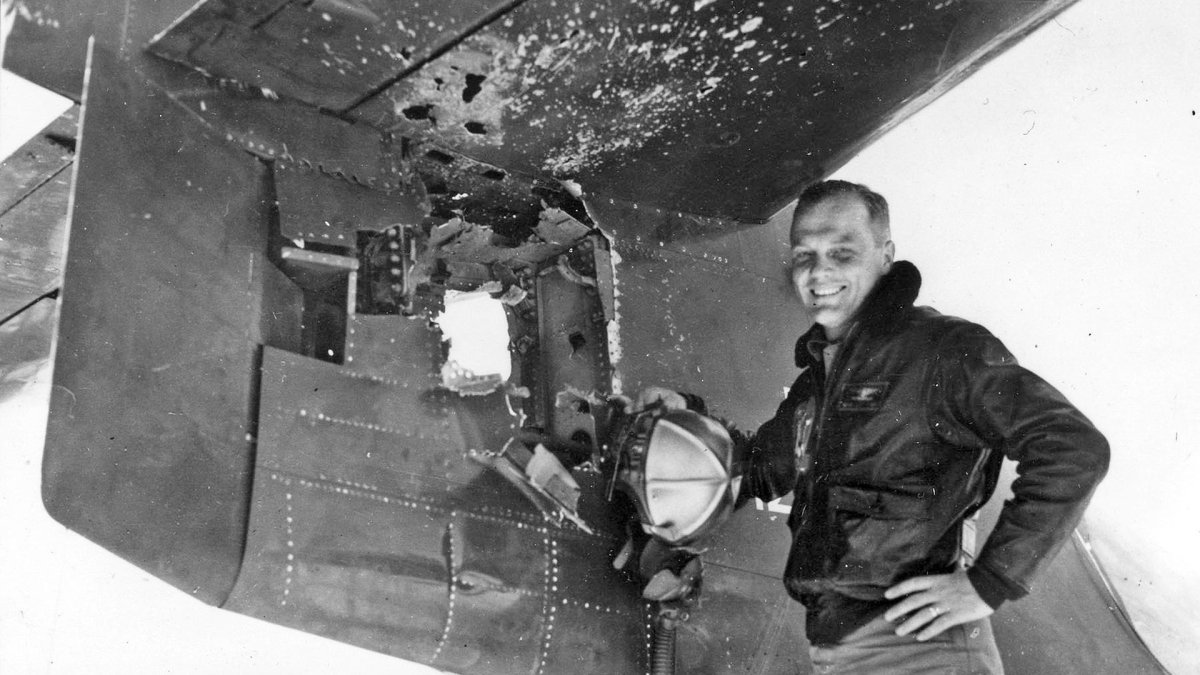
Amazingly he made it back to K-3 airfield, his home base at the time, and was able to set the plane down in one piece. Upon landing, ground crews were stunned by what they saw. The Panther’s tail had a massive hole blasted in it, nearly large enough to crawl through. Another 250 or so perforations were found on the aircraft. It was amazing that the jet made it back, and Glenn along with it.
In the end, once the Panther had a completely new tail grafted on and the holes were patched the jet returned to action. Glenn swore that it would be the last time he would make a second pass on a target, especially on one whose only mission was to shoot back.
A week later Glenn’s Panther was hit once again, but this time a AAA shell detonated a napalm canister on its wing. Once again, the astronaut-to-be limped the charred and badly damaged airplane back to base and lived to tell about it—though this time there was no saving the aircraft—it was literally burnt to a crisp.
The straight-winged and portly Panther was fairly antiquated from its birth in the ultra-fast evolving jet tech jumble of the 1950s. While it had a reputation as stout ground attack jet that could take a hit, as an air-to-air fighter it was less than sprightly. Glenn missed dogfighting, and after he completed 63 missions with VMF-311 he put in for an exchange slot with the USAF where he would fly America’s new hotrod of the skies—the swept-wing F-86 Sabre—an aircraft that could directly tangle with MiG-15s being flown by the North and its communist allies.
John Glenn standing proudly in front of his USAF F-86F Sabre. , USAF
Glenn patrolled the MiG Alley constantly, in the hope of taking on the Soviet-designed jets. Eventually this thirst for air-to-air action got him his second nickname: “The MiG Mad Marine.” Eventually his dogfighting wishes would come true, and he would down three MiGs during his 27 F-86 missions of the Korean War.
For his incredible combat actions in both wars, as well as his more publicized flying feats that came after, Glenn received six Distinguished Flying Crosses—among an avalanche of other medals and awards.
John Glenn’s “MiG Mad Marine” F-86 Sabre during the Korean War., USAF
Later the man would go on to become an elite Navy Test Pilot, set a cross-country speed record in a an F-8 Crusader , then become the first American to orbit the earth. His accomplishments would continue to stack up long after his historic space mission, becoming a US Senator, then going back into space at the age of 77 aboard the Space Shuttle Discovery as a mission payload specialist. He remains the oldest human to ever fly in space.
John Glenn seen before his 1957 transcontinental record breaking trip in an F-8 Crusader. , AP
Although his death is clearly sad, it’s impossible not to celebrate John Glenn’s amazing life. He is the definition of an American hero, and an inspiration to so many people on so many different levels. When reflecting on the loss of such an amazing American, it brings into focus the stark reality that these heroes from our glorious and gutsy space faring past will one day, in the not too distant future sadly, be gone.
Why don’t we have heroes like this anymore? Or maybe a better question, how can we have heroes like this once again?
John Glenn going literally where no man has gone before during his historic flight into space. , AP
They say timing in life is everything, and the heroes of the “Right Stuff” era certainly were in the right place at the right time. They worked excruciatingly hard and took massive risks that few can comprehend. It is hard to argue that America neglected its ability to create environments in which risk takers—explorers and the best among us—can turn become a hero of John Glenn’s level. The sad state of our space program , and a huge aversion to risk in just the places where we need to risk the most can be at least be partially blamed.
In the end maybe John Glenn’s passing will be a stark reminder of what the greatest among us are capable of, when the right medium for fostering massive success is put into place. In the meantime, we can also all admire a special man that became a hero so many times over, and that accomplishing amazing things became the norm not the exception.
I mean you don’t get the name “Old Magnet Ass” for playing it safe right?
NASA via Getty Images
Contact the author Tyler@thedrive.com
Comments couldn’t be loaded. Please refresh the page.
更新于美国东部时间2020年7月3日凌晨3:38
没错,他是第一个绕地球轨道飞行的美国人,后来还当选了参议员,但约翰·格伦也是一位身经百战的战斗机飞行员。二战期间,他驾驶F4U海盗式战斗机在太平洋战场作战,之后又驾驶格鲁曼F9F黑豹式战斗机重返朝鲜战场。正是在朝鲜战争期间,他驾驶VMF-311“雄猫”战斗机执行了63次任务,并因此获得了一个略带粗俗但却十分贴切的绰号:“老磁铁屁股”。
这个绰号听起来像是在嘲讽——其实不然。“老磁铁屁股”这个绰号源于格伦驾驶他的“黑豹”战斗机积极追击地面目标的风格。有时,即使奇袭优势早已消失,他仍然会勇敢地俯冲攻击。在这个过程中,他吸引了大量的防空炮火,以至于他的战机返航时总是布满弹孔。
在一次飞越新安州附近的飞行中,他发现了一个朝鲜高射炮碉堡,但当他最终确定碉堡位置时,他不得不绕道返回才能发起攻击。他俯冲而下,用“黑豹”战斗机的20毫米机炮近距离开火,朝鲜炮手毫不示弱地还击。尽管他击中了高射炮阵地,但他的战机也损毁严重,几乎无法控制,垂直方向严重失控。
VMF-311中队的F9F战斗机在韩国服役。美国国防部
令人惊奇的是,他竟然成功返回了当时的基地——K-3机场,并且完好无损地降落了飞机。着陆后,地勤人员被眼前的景象惊呆了。“黑豹”战斗机的尾翼被炸出了一个巨大的洞,几乎大到可以让人爬过去。飞机上还发现了大约250个穿孔。这架喷气式飞机能够安全返回,格伦也平安归来,简直是个奇迹。
最后,在“黑豹”战斗机换上了全新的尾翼并修补了所有破洞之后,它重新投入了战斗。格伦发誓,这将是他最后一次对同一个目标进行第二次攻击,尤其是一个唯一任务就是还击的目标。
一周后,格伦的“黑豹”战斗机再次遭到袭击,但这次一枚高射炮弹引爆了机翼上的凝固汽油弹罐。这位未来的宇航员再次艰难地驾驶着这架烧焦且严重受损的飞机返回基地,并最终活了下来——尽管这一次飞机已经无法挽救,它被彻底烧成了灰烬。
在20世纪50年代喷气式技术飞速发展的时代,身形臃肿、采用直翼设计的“黑豹”战斗机显得相当老旧。虽然它以坚固耐用、能承受打击而闻名,但作为空战战斗机,它的性能却差强人意。格伦怀念近距离空战,在VMF-311中队完成63次任务后,他申请加入美国空军,驾驶当时美国最新的空中霸主——后掠翼的F-86“佩刀”战斗机。这款战机能够与朝鲜及其共产主义盟友使用的米格-15战斗机正面交锋。
约翰·格伦骄傲地站在他的美国空军F-86F佩刀战斗机前。
格伦不断在米格走廊巡逻,希望能与苏联设计的喷气式飞机交战。最终,他对空战的渴望为他赢得了第二个绰号:“米格狂热海军陆战队员”。最终,他的空战愿望得以实现,在朝鲜战争期间驾驶F-86执行的27次任务中,他击落了三架米格战机。
格伦在两次世界大战中表现出的惊人战斗精神,以及之后更为人所知的飞行壮举,使他获得了六枚杰出飞行十字勋章,以及其他大量的奖章和奖项。
约翰·格伦在朝鲜战争期间驾驶的“米格狂人”F-86佩刀战斗机,美国空军
后来,他成为一名精英海军试飞员,驾驶F-8十字军战士战斗机创造了横跨美国大陆的速度纪录,并成为首位绕地球轨道飞行的美国人。在他完成历史性的太空任务之后,他的成就仍在不断积累:他曾担任美国参议员,并在77岁高龄时搭乘发现号航天飞机重返太空,担任任务有效载荷专家。他至今仍是进入太空年龄最大的人。
约翰·格伦在1957年驾驶F-8十字军战士战斗机打破横跨大陆飞行纪录前的照片。(美联社)
尽管他的离世令人悲痛,但我们也不禁要缅怀约翰·格伦的传奇一生。他是美国英雄的典范,在各个层面激励着无数人。当我们缅怀这位杰出的美国人时,不禁会意识到一个残酷的现实:这些来自我们辉煌而勇敢的太空探索时代的英雄们,终有一天,在不久的将来,也会离我们而去。
为什么我们现在没有这样的英雄了?或者更确切地说,我们如何才能再次拥有这样的英雄?
约翰·格伦在历史性的太空飞行中,真正到达了人类从未到达过的地方。(美联社)
人们常说,人生的时机至关重要,“太空先锋”时代的英雄们无疑都恰逢其时。他们付出了难以想象的艰辛努力,承担了常人难以想象的巨大风险。美国未能创造有利于冒险者——探险家和我们中最优秀的人才——成长为约翰·格伦那样英雄的环境,这一点很难否认。我们太空计划的现状令人堪忧,而恰恰在最需要冒险的领域,我们却极度规避风险,这至少可以部分归咎于此。
最终,约翰·格伦的离世或许会让我们深刻地意识到,当拥有合适的平台来孕育巨大的成功时,我们当中最杰出的人能够创造何等的奇迹。与此同时,我们也可以共同敬仰这位屡次成为英雄的杰出人物,他所取得的成就对他而言不再是例外,而是常态。
我的意思是,你不会因为行事谨慎而被叫做“老磁铁屁股”吧?
美国国家航空航天局(NASA)/盖蒂图片社
联系作者:Tyler@thedrive.com
评论加载失败,请刷新页面。