Fighting World War Three In A Fjord And Chasing Soviet Submarines In The S-3 Viking在峡湾中参与第三次世界大战,驾驶S-3维京潜艇追击苏联潜艇
It was the twilight of the Cold War and both Kevin Noonan and his S-3 Viking were maturing into more potent and wise weapons of war.
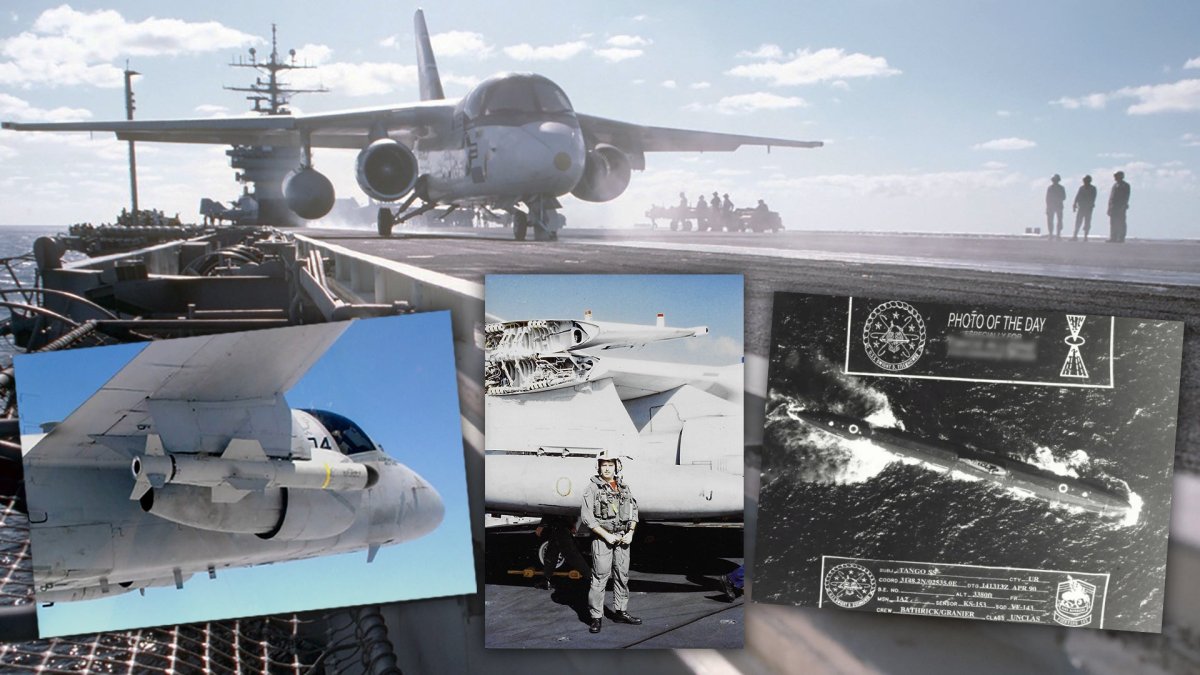
By Kevin Noonan and Tyler Rogoway
Updated Dec 30, 2020 4:07 PM EST
It was a time of peak naval aviation of sorts, with President Reagan’s military buildup having drastically expanded the Navy’s fleet , the movie Top Gun having become a pop culture sensation , and the Soviet Union sputtering towards its eventual collapse. To call it a colorful time in military and world history would be a vast understatement. It was here, during the twilight of the Cold War, that Kevin Noonan found himself hunting submarines from the cabin of a carrier-based S-3 Viking.
We followed Noonan through the trials and tribulations of training and learning the shadowy art of chasing submarines from the sky. Then went along with him on his first cruise aboard an aircraft carrier where we got a full understanding of how he plied his deadly sub-hunting trade. Now, in this the third part of our four-part exclusive series, we strap-in beside Kevin to see not only him, but also his beloved mount, the S-3 Viking, mature into wiser and more potent weapons of war.
After a major deployment, a carrier and its air wing tended to get a solid month of rest—rest being a relative term. At the squadron, during the first days at home, our sister squadrons would stand our hangar and Squadron Duty Officer (SDO) watches. But even for the first month, we operated with a skeleton crew with many of the squadron members on leave and a good portion more being transferred to their next duty station. Some, after a Mediterranean (Med) cruise, were more than happy to get out of the Navy if their enlistment was up.
We did very little flying during the first month back home at NAS Cecil Field. In fact, a returning squadron sometimes gave up their best birds to the squadron that was in line to deploy next. Other aircraft, particularly the notoriously broken ‘hangar queens,’ might be sent for major repair at a high-level maintenance station. My impression of this time around was that I had somehow rejoined the Naval Reserves! It was so quiet, but neither squadron nor aircraft carrier rests for long.
Oh, wait, we no longer had an aircraft carrier, at least for the time being.
S-3 Vikings based at NAS Cecil Field flying over Jacksonville, Flordia in 1988., USN
It was one hell of an interesting culture shock when we arrived aboard the then-latest Nimitz class aircraft carrier, the USS Theodore Roosevelt (CVN-71) in February of 1988. She was to be Air Wing Eight’s (CAG-8) new home.
One might think that one Nimitz class carrier is the same as any other Nimitz class carrier. They, however, would be wrong. Granted, the various decks remain the same and to the untrained eye, the ship’s outward appearance seems the same, but the personality of the ship, her crew, and the ship’s ‘soul’ are entirely different.
My fellow enlisted Naval Aircrewmen (AWs) and I of Sea Control Squadron 24 (VS-24) “Scouts” were excited to be aboard a brand-new boat. That is, until we discovered we did not have a special aircrew berthing or a space for our aircrew shop.
Misery quickly set in.
No one from CAG-8 had bothered to think about the needs of VS-24 other than the acquisition of Ready Room Four that occupied the same deck and spaces we had aboard Nimitz , as well as the maintenance shops required to allow our squadron to function. If memory serves, they failed to provide us with a place for our Personnel Department as well. As a result, that misery quickly transformed into being pissed off.
A squadron ready room aboard a Nimitz class carrier circa 1988. , USN
For our aircrew shop, we ended up getting a paint storage space…that had no air conditioning and no heat. We’d be in the Caribbean in a few days and above the Arctic Circle in a few months. Worse still, we ended up sharing sleeping spaces on the O-3 level that berthed over a hundred other sailors in the stern or in the bow. We moved back and forth between these two locales several times over the next two years.
The space in the bow was the most difficult to adjust too. That berthing lay just beneath the bow catapults. Every time an aircraft would be launched, we’d be entertained with resonating sound of the shuttle running the length of catapult track ending with a powerful ‘THUMP!’ as it stopped at the water brake.
If we slept, it was a fitful, angry sleep.
It may sound like I’m whining, but aircrew sleeping habits were dictated by NATOPS (Naval Air Training and Operating Procedures Standardization) and we actually needed a small, isolated space like we had on Nimitz that allowed us to sleep around the clock since we flew around that clock. Granted, we couldn’t avoid the bow catapult sounds and the Air Wing’s ‘Officer Country’ sleeping area was also in the bow on the 0-3 level, so us enlisted guys weren’t subject to that issue alone. What we could have avoided was the noise made by a whole bunch of sailors coming and going throughout the day and night slamming stand-up and coffin lockers, laughing, and doing the things tired sailors do.
Yes, this is me…still whining some 30 years later!
Otherwise, “ TR ” was a really great ship. Over the months ahead we adjusted to the black shoe crew (those that ran the ship), and they to us, and learned to commune with the spirit of this brand new, mighty aircraft carrier.
The culture shocks kept coming, however. On the flight deck, an airplane that looked suspiciously like a lawn dart had replaced that lovable, combat-proven Short Little Ugly Fucker, or SLUF, that was also known as the A-7 Corsair II. No longer did we share the flight deck with the Marauders of VA-82 and Sidewinders of VA-86.
F/A-18 Hornet taking to the catapult aboard the ‘TR.’ , USN
After a week or so of carrier qualifications for all the air wing aircraft, including the hybrid fighter-attack squadrons VFA-15 ‘Valions’ and VFA-87 ‘Golden Warriors’ and their shiny, new, low-viz grey F/A-18 Hornets, we headed to the Gitmo Op Area (just off Guantanamo Bay, Cuba ) for a shakedown cruise. Although it took time, ship and air wing began to find a mutual rhythm.
Oh, here’s something you all may not have considered: every time an Atlantic Fleet aircraft carrier pulled out of Norfolk or Mayport requiring its Air Wing to embark, the poor VAQ bastards (electronic attack squadrons) had to fly their EA-6B Prowlers and their squadron all the way across the length of the United States and meet their particular ship. And us Florida-based squadrons bitched and moaned…constantly…about our comparatively very short trek off our coast to the ship.
Since I had joined the Nimitz back in ’86, a month prior to her last Med deployment from the East Coast, I missed all the fun of the work-up cycle, which found a carrier and her squadrons going to sea very often. Sometimes, it lasted just a couple of weeks while at other times we’d be at sea for a month or two. The process of going back and forth made going to the boat a genuine pain-in-the-ass. Looking back, of course, I’d gladly haul cruise boxes up and down narrow ladders and through endless numbers of knee-knockers just for the chance to serve aboard today!
Sometimes, the ship pulled out of Norfolk without us. Consider this brief, interesting at sea period described in the Roosevelt’s official Command History:
Standardization and deceleration trials were conducted with David W. Taylor Naval Ship Research and Development Center observers at HECTOR RANGE on 23 and 24 April. Resulting data determined maximum speed for CVN-71 and filled in tactical data for NIMITZ class carriers.
Now that had to be fun!
The TR underway during training. , USN
As is the nature of an aircraft carrier’s flight deck, tragedy is just one distraction away, no matter how well the crew gels. On the morning of March 13th, we happily welcomed the arrival of a C-2 Greyhound COD. After she unloaded her mail and supplies and reloaded passengers who were leaving the boat, the E-2 squadron maintenance personnel started her up for taxiing to the cat where she would launch with the next cycle.
I was in our ready room and for some reason my eyes were glued to the PLAT TV screen , which was filled with the COD getting in position for launch. Then, to my horror, a young VAW-124 plane captain…mesmerized…walked into one of the C-2’s spinning propellers.
I just couldn’t understand what I just saw.
I do not remember much more of that day except the haunting sound of the call for a FOD (foreign object debris) walk-down on the flight deck after TR lost her first crew member.
Despite our tragic loss, we successfully completed a period of operations that had us learning how to work as an air wing again. The Roosevelt then sailed north out of the Caribbean and dropped anchor off of Fort Lauderdale, Florida on March 31st. Some of the aircraft and most of the CAG-8 personnel disembarked to make room for an oddly-timed Tiger Cruise that saw over 1,500 dependents join the Navy’s newest aircraft carrier.
At the end of the following month, we once again joined the TR for ops off of Virginia, Jacksonville, and in the Caribbean to accommodate the Reactor Department’s major readiness inspection known as the ORSE (or Operational Reactor Safeguards Examination). This at-sea period lasted from the 23rd of May to the 28th of June.
Once again, tragedy struck the flight deck. This time it was a member of my own squadron and a friend. William Berry, a young airman, was working to become an Aviation Electrician (AE), if memory serves. He was one of the most promising, gentle, professional, and kind individuals I had ever had the pleasure of meeting.
Despite the admonishment to keep your head on a swivel on the flight deck to see what is going on all around you at all times, you can’t account for everything, including not seeing a Tomcat turning its two powerful engines toward you. Berry was lifted off his feet by an F-14 and blown over the side of the flight deck, falling 90 feet into the ocean, the surface of which acts as essentially concrete from such a high fall.
Some said they witnessed him struggling, while others stated he didn’t move after impact. As the ship mustered for the man overboard, the plane guard helicopter searched and searched for him. Sadly, everyone quickly lost sight of him.
An SH-3 with rescue swimmer aboard circa the late 1980s. , USN
Once the ship-wide muster was complete—confirming he was the only soul missing—I went out onto the starboard aft sponson in what daylight remained…and stood there…willing my eyes to see him… just over there…
His body was never recovered.
It is a genuinely precious thing, when serving in the military and watching people die, to be forced to face the full weight of what it means to be human…particularly at that young age when you are certain you are not only infallible and indestructible, but also eternal.
From Russia With Love
An interesting at-sea period took place without us having to embark on the 7th of July, 1988. Again, the ship’s official Command History describes what was a truly historic event:
The top Soviet military officer, First Minister of Defense and Marshal of the Soviet Union Sergei F. Akhromeyev, and a dozen top-ranking Soviet military officers embarked. The Marshal’s visit was the first time a Soviet military leader had been aboard one of America’s sophisticated nuclear-powered aircraft carriers. Guests of the Chairman, Joint Chiefs of Staff, Admiral William J. Crowe, the Soviets were given a tour of TR, from galley to the bridge. Ship operations were explained by TR crew members. On the flight deck they observed aircraft being launched and recovered and Carrier Air Wing EIGHT’S air power demonstration.
First Minister of Defense and Marshal of the Soviet Union Sergei F. Akhromeyev aboard the TR , S-3 Viking looming in the background. , USN via Kevin Noonan
A month later, President Reagan was giving a speech for the 70th Annual National Convention of the American Legion and described what took place aboard TR during the Soviet visit. His words still give me the chills:
“We took Marshal Akhromeyev to visit our newest supercarrier, USS Theodore Roosevelt . We thought it would be a valuable education for him. And so he saw that magnificent ship go through its paces. He watched our superb aircraft perform. All in all, he spent a day on one of the technological wonders of the world, a floating airfield his Navy had nothing to equal; and yet, you know what he said he was most impressed with when he was through with the visit? Our enlisted men and women. I was told that he couldn’t get over the fact that we had them doing work that the Soviets would reserve exclusively for officers, in many cases, very superior officers. And he couldn’t believe that our enlisted people were so self-assured in speaking up when asked a question, so articulate in giving their replies, and so ready to add their opinions.”
It was a great time to be an American sailor and a great, great time to be an AW.
Then, on August 25th, the USS Theodore Roosevelt joined up with her full battlegroup for the first time and set sail toward the North Atlantic on one of the most realistic exercises I had ever been on or would be a part of. Teamwork ’88 most closely resembled what we would do in a war with the Soviet Union.
As we prepared to engage in a wartime penetration of the Greenland-Iceland-United Kingdom (GIUK) gap on our way to the aircraft carrier bastions that were, and still are, the Norwegian fjords, we were joined by over 200 allied warships and auxiliaries and over 500 aircraft of all types. Some of those ships would form an amphibious strike force that would conduct a landing on the northern part of Norway on the 16th of September to practice repelling an anticipated Soviet invasion. German and Dutch warships would form a Task Group that would escort a resupply convoy sailing from England to Central Norway. From there, a Norwegian Task group would takeover escort duty and resupply allied warships and bases at Bodo and Narvik.
The United States’ first supercarrier, the USS Forrestal (CV-59) would join the nation’s latest supercarrier in a simulated battle. A third flat top, the U.K. Royal Navy’s HMS Illustrious (R06), would meet us off Iceland as we ran the GIUK gauntlet.
The Brits would act as overall anti-submarine warfare (ASW) commanders for both carrier battle groups (CVBG) and the amphibious group.
To contrast a Cold War CVBG with today’s Carrier Strike Group (CSG), allow me to list my carrier’s battlegroup elements:
USS South Carolina (CGN-37) our primary carrier escort
USS Leyte Gulf (CG-55) air warfare commander and towed array ship
USS William V. Pratt (DDG-44)
USS Moosbrugger (DD-980) our most excellent towed array ship
USS Comte De Grasse (DD-974)
USS Charles F. Adams (DDG-2)
USS Conyngham (DDG-17)
USS Moinester (FF-1097) our towed array frigate.
USS Detroit (AOE-4) a “fast combat support ship” that was our one-stop-shop for fuel, weapons, snacks, and cigarettes.
We also had two nuclear fast attack submarines (SSNs) escorting us: the USS Jack (SSN-605), an old Permit class boat that was still fighting strong, and possibly the very unique and super quiet USS Narwhal (SSN-671). Overall, more than 10 submarines would be participating in the exercise.
Again, this was just my CVBG! The Forrestal had a similar composition of warships escorting her, as well.
As we made our way up the North American east coast with the amphibious strike group, we were joined by a Canadian Task Force off of Halifax, Nova Scotia. Then, just south of Iceland, we were further reinforced by the primary NATO ASW Strike Force under command of the British on board the “Harrier-carrier” HMS Illustrious (R06).
HMS Illustrious sailing alongside the TR during Teamwork ’88., Kevin Noonan
Over the next few days, we fought an opposed penetration of the GIUK Gap, simulating NATO’s failure to anticipate Soviet preparation for a war. Ideally, our forces would already be in the Norwegian fjords before the deployment of the Red Banner Northern and Baltic Fleets….ideally.
With the addition of some of our escorts with towed sonar arrays and the full Canadian task force, the NATO ASW Strike Force set about clearing the waters between Greenland, Iceland, the Faroe and Shetland Islands. The Ticonderoga class cruisers worked with our E-2s and Tomcats to defend against the various Soviet Naval Aviation threats that opposed us including:
Tu-16 Badgers (primarily the G and J variants) simulated by various aircraft including EP-3s, EA-3Bs, EA-6As, NKC-135s, British Canberras, and the unique EC-24 – the DC-8 the USN modified for electronic countermeasure (ECM) training.
Tu-95 Bears (primarily the D and F variants) simulated by EP-3s.
Su-24 Fencers simulated by Norwegian F-16s and British Tornados and Buccaneers.
Various anti-ship missiles primarily those fired by Badgers, Bears, from Nanuchka class missile boats, and from nuclear-guided missile submarines (SSGNs)— Charlie II s and the sole Papa class boat, during wartime. These missiles were simulated by Buccaneers and Canberras.
It was quite the battle just to penetrate this famous group of choke points.
The second phase of this evolution began on September 14th as we fought to enter Vestfjord. This was when we were joined by the USS Forrestal just coming from a six-month deployment in the Med. Now, even more assets were making their way from Europe to become a tremendous combined battle fleet. These were composed of NATO’s Standing Naval Force Atlantic and a German and Dutch Task Group that would add to our ASW Strike Force and escort actual convoys to reinforce the amphibious landings.
An ominous shot of the TR and Forrestal battle groups sailing together during Teamwork ’88., USN
The plan was to have our escorting SSNs creep into the fjord ahead of the CVBG and hunt any Soviet diesel submarines that would most assuredly be pre-positioned there. Also, the ASW Strike Force sent ships ahead to listen with their tails (towed sonar).
Once the carrier was safely tucked into the fjord, mines were laid to seal us in and keep additional submarines out. VS-24 and yours truly launched on several missions to radar-flood the Fjord in order to either catch a diesel snorkeling or a nuke boat’s periscope, or to keep them down, making them mission-ineffective.
There were definitely multiple sub-surface contacts made, some real and many false. We launched on these repeatedly and I got my first hard dose of reality of just how difficult it would be to hunt a diesel submarine in wartime.
On one particular mission we launched in support of an SH-3 sub-hunting helicopter from HS-9 that had gained intermittent contact on what appeared to be a CERTSUB—a submarine that has been positively identified. We dropped a couple of SSQ-62 DICASS (Directional Command Activated Sonobuoy System) sonobuoys and I began pinging.
Holy shit! I didn’t know what the hell I was looking at. I had never seen a display or heard echoes like I was now encountering. This was not the Med and it certainly wasn’t anything that our systems trainer could reproduce. The uncanny environment that is the nature of the fjords simply unnerved me!
But I kept trying and pinging. Finally, I got a very mushy contact. I called it. We dropped another DICASS closer and when it tuned up there was a solid ping. We told the world that we were in hot for an attack and I got one more, weaker ping and that was it. I never saw another return off of any of my buoys.
Later evaluation would confirm that it was an enemy boat and we were credited with a kill.
My mind was spinning. I really began to worry, for the first time, about my…about our ability to fight a Soviet diesel submarine in very real-world conditions. In the Med, we expected to go against the Echo II or Charlie II SSGNs and possibly the Juliett SSG, but the waters in the Med were much more conducive for what we do than what I saw in this disturbing echo chamber.
The TR inside the fjords., Kevin Noonan
My confidence would be shaken even more when, later, we went after a nuclear boat that had either been in Vestfjord lying in wait after the initial battles or had slipped past our minefields. The contact ranges were crazy-low one day and on the rare days when the water was a glass surface, we seemed to have ranges that went on forever. Among so many other realizations, it was clear that we weren’t preparing ourselves with detailed knowledge of how this body of water, and others like it all around the world, would play against or work for our sensors.
The good news was the submarines were having the same acoustic propagation problems as we were.
We spent several more days in the war against the “Soviets” flying many missions. Towards the end, the USS Forrestal joined us in Vestfjord—the first time, I believe, that two supercarriers had operated together in such an environment as part of a proof-of-concept showing that two full CVBGs could fight the ‘battle of the fjords.’
Surprise Viper Strike
I’ve got to tell you about my favorite mission while tucked away in the Fjord—the one where I got ‘shot down.’ We were launching a full Alpha-Strike and, as usual, the E-2 and the S-3s were first to get shot off the pointy end of the carrier.
I watched the E-2 run down CAT 1 (catapult one). Then it was our turn. As we went down CAT 2, I noticed a sudden flash go across the windscreen, about 500 yards off the bow. We got airborne and then another flash went by followed by flares popping out everywhere it seemed. At that point, we heard the Air Boss on guard frequency yelling at the attacking Norwegian F-16s (simulating Su-24 Fencers) to get the hell out of HIS air space, because they were endangering the launching aircraft!
Well, two immediate things struck my mind. First, I didn’t get the chance to hear what laughter sounded like in Norwegian because none of the F-16 pilots responded and the attack ended as quickly as it started. But I’m sure there was plenty of laughter and joy because these great pilots left a flaming strike force on the deck of the mighty Theodore Roosevelt and my helpless S-3 got shot down, as well as the E-2 and another Viking that was launching off one of the waist catapults, in the process.
A Norwegian F-16A carrying an AGM-119A Penguin anti-ship missile., USAF
On the other hand, I participated in the laughter in my cockpit as we all realized just how pure the brass was on the pair of balls each of those Norwegian pilots had. We also realized just how serious the people of Norway were (and are) about training for war since they lived under the shadow and certainty of attack from the Soviets and the memory of WWII. Those pilots didn’t give a shit about the ‘Boss’s’ precious air space. They wanted to teach the United States Navy and NATO the reality of the old adage:
You fight the way you train.
My crew and I were convinced and I’d like to think that any protests that were offered to the Norwegians about this attack were presented with a knowing smile.
What an amazing time it was up there, above the Arctic Circle, training for World War III during the final throws of the Cold War.
After the intense ops in Vestfjord, the TR and her escorts made their way to Wilhelmshaven, Germany for a well-earned port call. The air wing was invited to participate in one of the legendary “fly past” airshows being held at RAF Abingdon in Oxfordshire, England. Feeling quite fortunate to have been picked for this event, I manned Scout 710 with pilot Lt. ‘JT,’ Co-pilot/Tactical Coordinator (COTA) Lt. ‘SM’ and because we were going to an unfamiliar airfield, an Aviation Electrician’s Mate, AE3 ‘JR’ was joining us. He sat in the Sensor Operator (SENSO) seat, while I took the Tactical Coordinator (TACCO) seat.
We launched from the boat just as the TR entered the North Sea, an hour or so ahead of the other CAG-8 aircraft—one aircraft from each squadron, except one from our embarked helicopter squadron, HS-9. The combination of being worn out from the high-tempo ops and having to wear our drysuits made the flight seem longer than it actually was. Of course, I had to play with the radar and was awed by the on-rush of history as my APS-116 painted the English coastline. I was sharing the airspace that had been traversed by He-111s, Spitfires, Bf-109s, Ju-88s and Hurricanes during World War II.
Once we were ‘feet dry’ (over land), I finally understood all the talk about the English countryside and its patchwork quilt of farmland and hedgerows. Even from the tiny TACCO’s window, it was an absolutely magical sight to behold.
Our approach to RAF Abingdon was routine. However, as we entered the break running north to south over Runway 18, I distinctly heard the tower give us clearance to land calling the winds out of the west at “10 to 15 knots.” My pilot took note and discussed the direct crosswind with the COTAC as they went through the landing checklist amid the sound of deployed airbrakes, extending flaps, and lowering landing gear.
Keep in mind, since the carrier tends to launch aircraft into the wind and recover them with the winds almost always straight down the angled deck, my pilot didn’t encounter many opportunities to perform a crosswind landing over the past month. So, as JT attempted to put three landing gear on the northern end of Runway 18, we were all very surprised to find ourselves over the rich green English grass growing along the left side of the runway.
Instead of 10 to 15 knots, the direct crosswind was gusting up to 30 knots and was using our relatively large aircraft, that happens to have a particularly large tail, as a sail. JT fought to get us back over the asphalt-concrete mix, but our introduction to British windsurfing ate up nearly half of the runway.
Realizing how far along we were, he called for the tailhook to be dropped by LT SM as all three wheels finally found the deck. However, the hook either skipped or came down too late to engage the single down-field emergency arresting wire.
Once we had settled on the runway, I craned my upper body around the TACCO’s console—at least as much as my upper straps would allow—to see what the front-seaters were seeing. By doing so, I had thoughtlessly taken myself completely out of the ejection envelope. What I saw was a bit unnerving—a rapidly ending runway, a fast-approaching grassy field lined at the far end by one of those magical hedgerows, and a fence. Even more disturbing were the requisite British ‘aeroplane spotters’ standing along the fence line…and, ‘oh shit!’ a small van just went speeding across the windscreen from left to right along the narrow single-lane country road that ran along the southern edge of the airfield! And another…
‘OH, SHIT!…’ We weren’t stopping.
Then, the COTAC said “Hold on, boys, we’re going for a ride!”
Okay, so time slowed down in my mind to the speed required to ponder the various possible interpretations of what LT SM had just said. And then my mind started to race: ‘going for a ride?’ Van just flashed by—is there more traffic? Fence! People! Grass! All of this thankfully shocked me back into reality and time resumed normal speed. I immediately repositioned myself in the proper body position just in case the COTAC was reaching for his ejection handle.
The last thing I saw out the aircraft windscreen as I pulled myself back into my seat was all the plane-spotters scattering left and right to get out of the way of the approaching U.S. Navy aircraft, loaded with four colonists, about to join them on their prime airplane-watching real estate.
No ‘BOOM!’ of the ejection seat. No rocket motor firing, no rush up the rails and through the skin of the aircraft.
Along with the thick English grass, my pilot’s thicker flight boots—which were pushing the top of his rudder pedals, slowed us down considerably. After a final jolt, we simply came to a stop on Barrow Road. Unfortunately, our fuselage, nose wheel, and left main mount were now blocking the flow of any Friday afternoon traffic.
JT had wisely shut down the engines as we crossed onto the grass to keep from FODding one or both of them. I didn’t notice how quiet the cockpit was until the COTAC called to safe the ejection seats in a calm, professional, military manner.
Once all four of us acknowledged “head-knockers down,” I made sure AE3 JR was okay and unstrapped myself in order to check the avionics tunnel for smoke or possible fire. More awareness came as I noticed that the aircraft had come to a stop at a slight right wing down attitude. In light of that final jolt, I wasn’t sure if the main gear had collapsed or the crew hatch might be blocked by the fence, the hedge, or the roadway itself. If so, we would most likely have to egress through one of the hatches above either the SENSO or TACCO seats.
Again, thankfully, the hatch opened as it should and we all climbed out to inspect what damage had occurred just as the Abingdon crash trucks were arriving.
To our collective surprise and my pilot’s relief, there was only minor damage. The main gear tires had excessive wear and the brakes were understandably smoking but had not yet caught fire. All the landing gear were down and locked and in excellent shape.
It’s funny. Arrested landing after arrested landing aboard the carrier and I’d never given the landing gear’s durability a second thought. Now, after going four-wheeling across the English countryside, I was ready to kiss the hands of the Vought team who were wise enough to use the F-8 Crusader’s rugged main mounts and the A-7 Corsair II’s nose strut when Lockheed asked them to help with the design of their first carrier-based aircraft.
We also inspected the engine fan blades discovering they had no damage and only a minor amount of paint was scraped off where the lower leading edge of the intakes made contact with the fence. Finally, a lookover of the radome revealed only a minor gash from where the fence attempted to resist this 20th century Viking onslaught.
It was on this day that my respect and love for the Viking exceeded all prior indifference I might have had.
We waited for a tractor to tow our aircraft back to the flight line and once she was hooked up, we began to walk to a van the RAF had sent to retrieve us and whisk us away to the base dispensary to perform the requisite post-mishap pee-in-a-bottle. All of the excitement made me forget that my tired body was still wrapped in a dry-suit. It would be good to get out of the damned thing.
Overhead, a barely noticed Hawker Hunter had been making several low passes over the field. Now, we were all watching as she passed over our heads with her wheels down, about to land on Runway 36.
A collective gasp could be heard from all of us as we witnessed the effect of another strong gust of wind and the vulnerable Hunter was pushed onto her side, her right wingtip nearly connecting with the ground. The pilot recovered admirably, flying off with full throttle and raised landing gear—as we all wished we had done. Someone wondered aloud if the tower had, once again, failed to warn of the gusty crosswinds.
Just an hour or so later, after we had returned to our aircraft, I was inside the cockpit working with LT SM to get the auxiliary power unit (APU) started. We felt the earth move as if from an impact and then heard the explosion. We quickly stepped outside to witness a fireball rising into the sky just a few hundred yards away from where we were parked.
A bad day for us had just gone tragic for Flight Lt Chris Lackman and Flight Lt Jack Thompson, the pilot and Weapon Systems Officer of an RAF F-4M Phantom FGR.2. I’ll let the narrative from Aviation-Safety.net explain what happened:
On 23 September, 1988, [d]uring aerobatic practice at Abingdon, Oxfordshire, the aircraft performed a loop manoeuvre immediately following a 360-degree hard turn. The manoeuvre appeared slower than normal and the pilot was unable to recover from the loop. The aircraft struck the ground on the airfield tail first in a nose up attitude and exploded killing both crew.
Also, I recently learned from this blog that Chris Lackman had transitioned from the Vulcan to the Phantom and flew as a co-pilot on the Black Buck operations during the Falklands War. The loss of any aircrew is tragic, but when you learn things like this about pilots and crew who had served in such significant historical events, well, it adds an unbearable weight to the story.
Finally, one of my British hosts told me that Lackman and Thompson’s fellow aviators would come together at the Officer’s Club back at the Phantom’s home field and have a drink on the lost aircrew’s tab. The tab would then be closed out.
RAF Phantom FRG2., Rob Schleiffert/wikicommons
Over the next 10 days, a small team of our squadron techs and mechs who had flown over from Wilhelmshaven, along with our XO, checked the aircraft over completely, replacing all the tires and brakes. If memory serves, a strip of duct tape ensured that the gash in the radome would not affect aerodynamics. They also discovered that the seemingly fragile electronics had suffered no ill effects.
This amazing team, who had been ordered to volunteer to give up their liberty in Germany, ensured that aircraft 710 was fully airworthy. Thankfully, they did get to enjoy the British nightlife after each day’s work on the bird. Oh, and they were happy about one unexpected benefit of their volunteering: they didn’t have to share Oxfordshire with 6,000 other American sailors.
The Theodore Roosevelt pulled out of Wilhelmshaven and passed through the English Channel. With full and heavy hearts, we said farewell to our magnificent RAF hosts and manned aircraft 710. Our XO joined us in the cockpit after we discovered that AE3 JR had a ruptured eardrum from a cabin pressure dump we had experienced on the flight into Abingdon. Once airborne, we headed off the southern coast of England to return to our floating steel runway where the winds were almost always predictable.
And then it was time for another Mediterranean deployment.
This would be the final time the S-3A Viking flew over the Med with Air Wing Eight. Once we returned, we would begin our transition to the S-3B as our sister squadrons on the East Coast were doing. For now, we still had to deal with the limitations of the “A” at the end of the 1980s which meant the uncertainty of the computer working after a launch.
Our software engineers at VX-1 were always working with the manufacturer to fix the problems we faced, but they never went away completely. As is the nature of the Fleet sailor, we created a work-around.
I don’t recall which squadron initiated this plan, it might have been my Chief Aviation ASW Operator (AWC), he was brilliant like that, but we would now actively troubleshoot our system while airborne. We didn’t mess with the system prior to this because the electronics were expensive and the powers-that-be didn’t want a bunch of angry aviators messing with their stuff. However, our Naval Flight Officers (NFOs) and Chiefs argued to the point we were given the go-ahead to try and make the system work.
The four stations in the S-3. The left rear is where the SENSO worked., Youtube Screencap
Here are some of the things we did: just in case the Tape Transport Cartridge (TTC) wouldn’t load, or we had problems in flight, we sometimes brought a second one with us. If the OL-82A Acoustic Data Processor (ADPS) was giving us headaches, we learned to pull circuit breakers associated with specific elements of the system. Sometimes, a simple reset of the circuit breaker was all that was needed to fix the problem. If not, we’d pull them again and wait for the memory drums to slow to a complete stop. We would then pull the boxes from their connecting pins, inspect the rack and area behind the boxes to make sure nothing was out of place or broken, and reseat them…gently—they were very fragile and broke easy, particularly if an angry SENSO slammed the box back onto the pins.
Nine times out of 10, this worked! We started doing this with any system that failed and the days of having a malfunction and having to orbit overhead the carrier were pretty much gone!
We entered the Mediterranean during the first of January just as we had on Nimitz two years before. This time, however, a Soviet escort wasn’t waiting for us. Perhaps this was a sign of the times.
On the 15th January, 1989, we met the USS John F. Kennedy (CV-67) and transferred weapons. We then relieved the JFK and took on the mantle of Sixth Fleet Battle Force.
We operated in the Western Med and then anchored off the island of Palma de Mallorca for our first of many port calls. Already, we noticed a huge difference between this cruise and the one on Nimitz . We averaged four to seven days in each port instead of the meager two to three days at the most in 1987.
A major weapons transfer while the TR is underway. , USN
Back at sea again, we joined the French aircraft carriers Foch and Clemenceau for Phinia ’89, a major amphibious exercise. I’ll let the UPI news release tell the story:
French, U.S. troops begin war games TOULON, France — French and American troops prepared to invade a Mediterranean island and evacuate its population during 10 days of war games that began Sunday off the coast of Corsica, military officials said. Three aircraft carriers and 14,000 French and American soldiers were participating in ‘Operation Phinia 89,’ the largest U.S.-French maneuvers since war games in the Persian Gulf in 1987 and 1988, French military officials said. U.S. Marines, French Navy commandos and rapid deployment forces planned a coastal invasion of the French-administered island of Corsica Monday to evacuate the population from a ‘hostile environment.’ The maneuvers, directed by a French naval command center in Toulon, were being carried out from the French aircraft carriers Clemenceau and Foch and the U.S. aircraft carrier Roosevelt using the French landing ships Ouragan and Orage, the U.S. amphibious assault ship Guadalcanal and U.S. amphibious transport vessel Austin.
French, U.S. troops begin war games
TOULON, France — French and American troops prepared to invade a Mediterranean island and evacuate its population during 10 days of war games that began Sunday off the coast of Corsica, military officials said.
Three aircraft carriers and 14,000 French and American soldiers were participating in ‘Operation Phinia 89,’ the largest U.S.-French maneuvers since war games in the Persian Gulf in 1987 and 1988, French military officials said.
U.S. Marines, French Navy commandos and rapid deployment forces planned a coastal invasion of the French-administered island of Corsica Monday to evacuate the population from a ‘hostile environment.’
The maneuvers, directed by a French naval command center in Toulon, were being carried out from the French aircraft carriers Clemenceau and Foch and the U.S. aircraft carrier Roosevelt using the French landing ships Ouragan and Orage, the U.S. amphibious assault ship Guadalcanal and U.S. amphibious transport vessel Austin.
So, did any of you ever have to do that school science project where you drop an egg off the roof after having built what is hoped to be a durable container that will allow the egg to survive fully intact? We’ll come back to this in a moment.
One of the things we learned from this exercise was how the Marines weren’t able to get relatively real-time reconnaissance photos of the battlefield they were fighting on. Remember, this was 1989. We needed to figure out a way to get Tactical Airborne Reconnaissance Pod System (TARPS) photos taken by the Tomcats, whether of a changing battlefield or Bomb Damage Assessment (BDA), developed and analyzed and then transmitted to the boots on the ground.
F-14 with an intriguing loadout, including an electronic warfare pod and a TARPS pod. , USN
Some of our genius NFOs worked with Carrier Intelligence Center (CVIC) and came up with a styrofoam container and some other material (I don’t have a clear memory of it, just the event) that the photos could be stuffed in and we would launch it out of one or more of our sonobuoy chutes. They worked on it for a couple of months and ended up testing it during another exercise where the Marines were doing an amphibious landing.
I was on that flight.
We launched and headed to rendezvous with the Marines. Everyone was excited to see if this would work. We established comms with the ground Forward Air Controller (FAC) on the shoreline. The idea was to jettison the…well…egg…into the surf so the Marines wouldn’t have to go too far out and get it. We would also launch one over the sand to see if it would survive.
The FAC cleared us in and we punched out two containers. We then flew away while they retrieved them. Then, we were called in for the beach drop. Apparently, they were having a hard time breaking into the containers because they were packaged so well. So, we said our “goodbyes” and headed out on our secondary mission.
Upon returning to the boat, we all went into CVIC to find out what happened. As I recall, only one package survived the water landing (I think saltwater had penetrated the container and ruined the photos). The beach drop failed completely.
I never did do that science project at school and I’m not sure if anyone involved in this project did either. The concept was a good one for that time because, as I said, there just wasn’t any way to get those much-needed photos to the Marines faster. However, our idea simply didn’t work. But you gotta hand it to the S-3—fulfilling its role as NAVAIR’s Swiss Army Knife, she answered the call to perform yet another uncanny mission.
After the amphibious exercise, we pulled into Marseilles, France for another port call from the 10th to 17th of February. However, as was the case with winter in the Med, storms came along and made things interesting.
I was sitting in the Ready Room when we heard the call to “set the special sea and anchor detail” over the 1MC (ship-wide address system). This was very unusual since we still had a couple of days left in port. I believe either the XO or Navigator of the TR then came on and said we were having to repeatedly “sail to the anchor.”
A ‘mistral’ wind apparently caught us off guard and the CO of the boat decided it was too risky to attempt to stay at anchor. A mistral is a windstorm unique to that part of Europe, where winds are funneled from a high-pressure area off the northwestern and western coasts of France, down across the country through two river valleys, and out into the Med. This combines with a low-pressure area off the southern coast of France. The blow can sustain 60 knots and gust over 100. It can also last for up to a couple of weeks.
Supercarrier anchored off France. , USN
The order was given to do an emergency recall of all the ship’s company and members of the air wing still onshore. This was done in a very unique manner that we all were briefed about. I won’t go into exactly what it was because it still may be in use today. Unfortunately, not everyone could get back to the boat.
We were in danger of grounding, so the Skipper went ahead and executed an emergency sortie. It was my understanding that many of the soon-to-be stranded sailors were already heading to the boat in ferries provided by France. What a sight that would have been to see your aircraft carrier leaving without you! But two days later, we returned and picked up the rest of the crew.
Hey, the commercial did say “it’s not just a job, it’s an adventure!” right?
Sub Hunting From Sicily
With our full complement of sailors, we headed back out to sea and transited the Straits of Messina. From there we headed to the waters off Libya since Gaddafi was rattling his saber. For this period, the commander of the Navy’s Sixth Fleet (COMSIXTHFLT) decided to join us, just in case. Apparently, Gaddafi lost interest and we headed off to Alexandria, Egypt for yet another port call!
While there, the Egyptian Navy provided protection for our ships. For some reason, I had been asleep when we dropped anchor. Late in the day, I got up and went to the ready room because I was the night ASDO and was told by my fellow AWs that I had missed the Romeo class submarine that had sailed past us a couple of times along with some Osa II missile boats. I was pissed! Why the hell didn’t you wake me up?! The bastards! An AW not getting to see a submarine passing next to his aircraft carrier…!?
After the visit to Egypt, we headed back into the Eastern Med and conducted flight ops. Just prior to our visit to Antalya, Turkey—a favorite of mine—one of our aircraft had a major incident.
After leaving Turkey, it was my turn to head off to Naval Air Station Sigonella (“Sig”) in Sicily for a two-week detachment (DET). We took two aircraft to replace the ones that had been there already.
It was simply a fantastic time getting to leave the ship and continue flying missions. This would be one of two DETs to Sig I got to go on. During this first one, I experienced the drastic difference between the VP (P-3 squadrons) and VS (S-3 squadrons) philosophy of how we flew our missions.
CH-53 and CH-46s alongside a pair of S-3s at “Sig” circa the late 1980s., National Archives
There was always a VP squadron at Sig. On a particular day, we and a P-3 crew were tasked to do a photo recon flight over the Soviet anchorage at Hammamet, just off the coast of Tunisia. The ASW Operations Center (ASWOC) at Sig wanted to know which Soviet warships were there, as well as if a missing Tango class diesel submarine might have turned up.
Yes, a missing Tango .
They started the briefing, giving us flight information and reminded us to stay out of unfriendly airspace. We received intel briefings on the ships expected to be at anchor and how the Tango had slipped into the Med through the Strait of Gibraltar and then disappeared. After the weather brief, the ASWOC crew told us that was it for us. The P-3 guys, on the other hand, would now be individually briefed in detail. We shrugged our shoulders, knowing that that was all we needed anyway, and headed out to our airplane.
We launched out of Sigonella and immediately headed south across the Med to Tunisia. I was, of course, sweeping the whole area with radar checking to see just what we might encounter as we approached the anchorage. There was a single, large contact there and a few small ones. I dropped the FLIR in an attempt to identify everything before we ventured in to get some photos.
It was just a Soviet auxiliary and small boats…no warships…damn!…and no Tango …double damn!
Tango class Soviet submarine captured on the Mediterranean surface by a VF-143 F-14 TARPS camera., USN
We took some photos of the vessels and then headed out to the western coastline of Sicily. My pilot wanted to do a low-level from west to east. On our way, we plotted all the shipping traffic and sent the surface plot to the ASWOC via Link 11. I used the FLIR to ID some of them, making sure none of them were combatants.
We entered the low-level route and flew across the gorgeous Sicilian countryside. Just like England, it was breathtaking. At times, looking out my very small window, I had to look up to see the hilltop villages we flew beneath!
After the run to Hammamet, the surface plot, and the low-level, we were done. So, we returned to NAS Sigonella, entered the break and landed. As we were taxiing up to our parking area, we all noticed that the P-3 crew we had briefed with were just finishing their engine start and had begun to taxi.
We had launched, flew our mission, did a low-level, and landed in the time it took them to fully brief, pre-flight their aircraft, and start-up! I think it took almost two hours for our flight.
Of course, they were going on a 10 to 12-hour mission, not only to check on the Soviet anchorage, but to provide a much more detailed surface plot for the ASWOC and Sixth Fleet. They would also be dropping and monitoring a sonobuoy search pattern in hopes of netting that Tango. A helluva lot more to do than we did. Still, it was such a contrast between our two communities and the way we flew our missions.
Two weeks went by entirely too fast. We worked with the TR which was sailing all around the Med during my time in Sig. Let me list her gyrations for you: once again she had to tend to Gaddafi’s saber-rattling from 12-13 March. Then, she headed up to Naples, Italy for a five-day visit from 15-20 March. After that, she headed for Morocco and a rare two-day port visit. The central Med was calling and she proceeded to the fleet anchorage in Augusta Bay, just off the east coast of Sicily. For two days, the commander of Sixth Fleet hosted the Secretary of the Navy and our Mediterranean allies for a major naval conference on 29 and 30 March.
Quite the itinerary for a Carrier Battle Group!
She then weighed anchor and headed back to the Western Med where we flew out to rejoin her. We landed just in time for…another port visit! This time it was Toulon, France.
The weather once again picked up as we left Toulon and things quickly went from bad to worse. As a result, we made headlines when HS-9 and our escorting cruiser, USS South Carolina (CGN-37), participated in a major rescue at sea. The official USN history of the carrier tells the story:
A routine transit between port calls in Toulon and Monaco became drama on the high seas for USS THEODORE ROOSEVELT. Aircraft from Helicopter Anti-Submarine Squadron NINE (HS-9), embarked with CVW-8, aided by TR and USS SOUTH CAROLINA (CGN-37), rescued fifteen British yachtsmen from four sailboats foundering in hurricane-like seas. The sailboats were part of a 16-boat flotilla sailing from Toulon to Corsica. Search and rescue swimmers from HS-9 entered the chilly water in waves estimated at 35 feet and winds clocked at 70 knots. One survivor, who suffered a broken leg, was airlifted to Toulon for treatment while the others walked ashore the following day when TR arrived in Monaco. The rescue was broadcast on television in France, Italy and the United Kingdom, and reported in newspapers around the world.
I watched this drama unfold from the safety of the ready room, of course. We weren’t allowed to go on deck because of the 70 knot winds. It was stunning to see the aircrew and maintenance personnel fight just to get to the spots on the waist where their birds were tied down. The pilots masterfully got the engines and rotors started and lifted off to save those folks. Once on scene, the helo AWs then jumped into those 35-foot seas!
Such amazing souls manning those helicopters. In my mind, no one will ever approach the greatness and heroics of a Rescue Swimmer.
HS-9 Sea King alongside the TR ., USN
After the relatively short port visit to offload our guests and enjoy an always beautiful and towering Monaco, we headed back to sea for Dragon Hammer ’89 which ran from 20 April to 02 May. The AW who flew in this year’s rendering of the major Med exercise was not the same AW who flew in it back in ’87 off Nimitz .
I was a completely different person.
It was during this event that the S-3 Viking was paid the highest compliment she could have received…from a submariner.
The skipper of a Rubis class nuclear fast attack submarine (SSN) operating as an orange force (aggressor) boat sent out a message to COMSIXTHFLT expressing his deep frustration that every time he extended a mast, his ESM system (electronic support measures used for electronic intelligence gathering) picked up the S-3’s APS-116 radar. He said it made him extremely wary of being at periscope depth where he needed to be to get intel on the position of the ship. He congratulated VS-24 on our effectiveness at keeping him on edge and limiting his ability to target the carrier.
Someone said his flare (to signify he had fired on us) was the prettiest shade of green…
Rubis class submarine., French Navy
After the exercise, we sailed to Haifa, Israel for another of my favorite ports of call. While we were there, members of the Israel Defense Forces (IDF) were given tours of the carrier. I was on duty during one particular day and was delivering something somewhere on the ship when I entered a ladder well.
Coming down the latter were several members of an Israeli Airborne unit. I stepped aside to allow them clear passage. As one of the officers turned toward me our eyes met. He smiled, appreciating that I had given him and his men room to maneuver in the tightness of the compartment. His smile and face were kind, but his eyes…his eyes were oceanic blue and had a depth to them that I had never seen in a pair of human eyes. A depth that told me stories of the life of a genuine warrior who had done things and seen things I could never comprehend.
They were the coldest, deadliest eyes I had ever seen…I will never forget them.
When we pulled out of Haifa, I was told I was going back to Sigonella for another two weeks. An Echo II submarine had entered the Med and the carrier was going to transit all the way back to the Balearic Sea, just off the coast of Spain, with the hope of allowing the CVBG escorts some “time on-top” of the Soviet submarine. We would be flying against the Echo II , as well. The boat was scheduled for a second visit to Palma de Mallorca, which was everyone’s favorite.
I was not the slightest bit disappointed that I would miss it.
After we arrived at Sigonella, I got only one opportunity to fly on the Soviet boat. We launched and headed out over the central Med. At least two of the Roosevelt’s escorts were holding contact on the Soviet guided missile submarine (SSGN).
Years before, the USS Moinester (FF-1097), a Knox class frigate, had led the way in operational and tactical development of the towed array sonar system. She was one of our escorts and was joined by the Spruance class destroyer USS Moosbrugger (DD-980).
“The Moose,” as we affectionately called her, was manned by the greatest anti-submarine warfare crew…ever! To give you an idea of the captain and crew’s outstanding personality, she had a rack of moose antlers mounted to the bridge superstructure!
Unfortunately, (and with no disrespect intended to the Skipper and crew of the Echo II ), these two ASW warriors weren’t faced with a very challenging subsurface target. This Echo II class was a very noisy first-generation nuclear submarine, the last of which the Soviets commissioned in 1967. This crack ASW team deserved a Charlie II or an Oscar, at least.
We were vectored in by the “Moose” and dropped buoys on the Russian sub.
We ran her into an attack barrier and just as we were making our run, I noticed a significant change on her acoustic signature…something I hadn’t been trained for. It was nothing significant, but it reminded me that I still wasn’t the ASW expert I should have been and needed to be.
She was coming to periscope depth to take a look at the newest hunter that had arrived to harass her. I felt sorry for the Skipper, knowing that every time he raised his periscope a NATO aircraft filled his impotent crosshairs.
We made a low pass over her and we were joined by an SH-60B Sea Hawk from the Moosbrugger . It was our attack run, but we didn’t open the weapons bay doors. The crew of the submarine was humiliated enough and it probably would have created an international incident.
Soviet Echo II submarine., RAF
In what felt like 20 minutes, the four-hour flight had come to an end. The Echo II returned to her cruising depth, never finding the carrier. We checked out with the ASW commander on board the Moose and headed back to Sigonella.
On our way back, I started to think about what had just happened. The Cold War was not over yet and, had this been a hot war engagement, I realized we would have dropped a torpedo or two to destroy that submarine. For the first time since I became an AW, I thought about the 100 or so sailors working, living and fighting inside that hull. It struck me that they were human beings, just like me and that I would have to be a part of the ending of their lives had this been a combat mission.
I evaluated my feelings…could I do this? Could I be a part of killing so many souls during wartime? I understood…completely…that they were after my floating home with its 6,000 residents. They, too, would follow their orders and fire their missiles in an attempt to sink us.
Before we entered the break over NAS Sigonella, I knew that I could kill these men if I had to. My time on-top made me see them as the humans and warrior-sailors they were and I respected them and the Soviet Navy more than I ever had because of that flight.
One other thing about my second visit to Sigonella. On the evening of 06 June, I walked into the room of one of my NFO’s where world history was, once again, marking time. On his TV screen, a lone man was standing in front of a column of Chinese Type 59 tanks. The day-old news video showed the tank’s driver trying to move around him and this “Tank Man,” as he would later be known, kept moving in front of the armored vehicle. We marveled at the world that was changing for the good all around us.
We said goodbye to NAS Sigonella and rejoined the TR . On 15 June we rendezvoused with the USS Coral Sea (CV-43), off-loaded our weapons and handed the mantle of Task Force 60 to her.
The Coral Sea relieving the TR in the Mediterranean in June of 1989. , USN
On 20 June 1989, we left the Mediterranean Sea. I would never again sail on these beautiful, emotional waters.
A More Powerful Viking
When we returned from my second Med cruise, our squadron was scheduled to transition to the “B” model of the S-3. We were all excited but we really weren’t prepared for the exponential change that was about to occur.
As we were about to begin the transition, Sea Control Wing One, Atlantic, held its “Crew of the Quarter” competition. In those days, the competition was “flown” in the Training Command’s Weapon System Trainers (WST). This would be the last time a crew flying the “A” model of the Viking would compete.
VS-27’s training building only had one WST left that had the S-3A avionics and simulator software. My squadron, having just begun the transition to the “B,” was chosen to fly against a couple of squadrons that were already flying the S-3B. Unlike the VP community, we didn’t have set crews, so they just picked four of us to go over and fly the competitive mission. For me and the other three, it was a very routine experience.
In all honesty, this really didn’t mean much because we were so well versed in the “A,” and the other squadron’s crews were very new to the workings and manipulation of the “B’s” more advanced systems. The real story was just how different the S-3B’s acoustic system was. There was much more to do in preparation for the hunt and then critical things we needed to do to maintain contact.
Simply put, the “B” crews we competed against were a bit overwhelmed.
The S-3 Viking Weapon System Improvement Program (WSIP) was approved by the Chief of Naval Operations in 1977. Development began in 1981 and the first converted S-3A flew as a “B” on 13 September 1984.
S-3B Viking art from Lockheed public affairs booklet., Lockheed
The changes were significant: the APS-116 radar gave way to the APS-137 Inverse Synthetic Aperture Radar (ISAR), which greatly improved its periscope detection capability and, most importantly, allowed us to ‘image’ a radar contact.
LEFT: Starboard bow ISAR image of Knox class frigate. RIGHT: starboard bow ISAR image of a merchant ship. Superstructure is to the left of image with four king posts lining the deck as you move right., Texas Instruments/USN
Our ALR-47 ESM system was replaced by the ALR-76, which according to Brad Elward in his book The S-3 Viking In Action :
…provided greater frequency coverage and improved bearing accuracy within 2 degrees. The new ESM also gave Viking crews a basic missile threat warning, providing C-band through J-band coverage of both pulsed and continuous wave emissions.
Combining these two sensors made us an incredible war-at-sea asset to the CVBG. It also contributed to keeping our happy asses safe because the missile warning component could automatically launch chaff and flares from the new ALE-39 dispensers placed on either side of the aft fuselage, just behind the main landing gear wheel wells—the primary visual cue for telling an S-3A apart from an S-3B.
Our FLIR was updated and, of course, we could now launch AGM-84 Harpoon anti-ship missiles off of either wing hardpoint. We were also plumbed to carry the buddy store for refueling, as were the S-3As on the West Coast since they didn’t start getting the “B” until the early 1990s. We also got a new, more powerful APU for independent engine start and powering the aircraft for maintenance.
Finally, and what mattered most, was our new IBM UYS-1 Proteus Spectrum Analyzer Unit (SAU) that replaced the OL-82A Acoustic Data Processing System (ADPS). We were now on par with the P-3C Orion Update III and ready for the trend in Soviet submarine quieting efforts born out in the Victor III , Akula , and Sierra classes of SSNs, the Oscar SSGN, and had the Cold War not ended, the very latest Yasen class SSGN .
We also received the capability to monitor 99 radio frequency channels instead of just 31, which expanded our ability to deploy far more sonobuoys without interference between them.
And even though our General Purpose Digital Computer (GPDC) looked the same on the outside, thankfully, it was a completely new computer that could handle so much more processing. And that troublesome TTC? Well, it changed as well. I never had a single problem with the system loading and staying loaded when we were flying off the boat.
S-3B Packing a like AGM-84 Harpoon anti-ship missile. , USN
On the outside, the aircraft looked exactly the same with only subtle differences that you had to know to look for. Elward describes just how brilliant Lockheed and the software companies were in making this immense change work with little impact on the jet’s performance:
Overall, the WSIP modifications added a mere 601 pounds to the Viking, changing its characteristics only slightly and maintaining the aircraft’s center of gravity within existing limits. Power consumption for the new equipment increased less than 1KW.
As we progressed through the classroom training during VS-24’s transition to the “B,” I was in awe of what our new radar and acoustics could do. As with my training in LOFAR , understanding the ISAR imaging we were seeing was, once again, just like learning how to speak a new language. Initially, I couldn’t see a damn thing except the very obvious Knox class frigate and the box-like geometry of merchant ships. When trying to decipher all the other images from other warships, I felt certain that Texas Instruments (the creator of the APS-137) had hired Hermann Rorschach as a consultant.
The genuine tragedy in all of this? I would never get to take this new weapon system out and fly on top of a Soviet submarine in the Med or the North Atlantic. While I would get to operate the system against USN submarines, drastic winds of change were blowing in 1989 and throughout the early 1990s that would revolutionize everything…
The B is for Brilliant
Once we completed the transition to the S-3B, our time on the boat was never the same. We were suddenly the stars of the Air Wing. Everyone wanted our autograph!
Our Vikings were constantly asked to do more and more. Along with the obvious need to refuel CAG-8 aircraft, we were invited to join war-at-sea strikes against surface action groups (SAGs) by providing radar plotting and identification of the targets. Our ESM was recognized as a superior asset for at-sea and overland strikes and instead of just a couple of E-2s or EA-6Bs, the Carrier Air Group Commander now had 10 airframes he could distribute across the wide spectrum for his electronic surveillance needs.
Oh, and we still did ASW, too!
As was the case in 1988, we joined the Theodore Roosevelt frequently for various work-ups that would prepare the air wing for her next major deployment in 1991. We spent much of that time down in the Caribbean participating in a wide range of exercises. I was reaching my peak as an ASW operator and the tools provided by the “B” only made my ability to search, detect, localize, and track a submarine that much better.
On one mission, in particular—one of my all-time favorites—I was stunned to have made contact on three different submarines in the same search pattern. Two were “orange force” aggressor boats playing the bad guys and one was hunting the other two!
A few days later on another of my most memorable flights, my crew was returning to the carrier’s overhead stack in preparation for recovery after an anti-surface warfare (ASuW) mission against a surface action group. We were early and I decided to tune up an old defensive search pattern that had been seeded on the flank of the carrier hours before by a P-3 and S-3. Apparently, no one else was monitoring it.
Earlier in the day, an orange force boat had been ‘sunk’ by an S-3 Viking and an SH-3 Sea King and exercise rules required a sunken submarine to “reset” for a certain number of hours and relocate before coming back into play. Having tuned the buoys up, we started having problems with a particular black box that was unrelated to the ASW system and after safeing our ejection seats, I got up and went into the avionics tunnel to troubleshoot.
As I’m working, I glance back at my display. Lo and behold, a submarine signature started to build very close to one of the tuned buoys. I don’t recall its distance from the carrier, but it was about to arrive within torpedo range. While still in the back of the aircraft fiddling around, I called “subsurface contact” on the buoy. I reseated the black box and climbed back into my seat and informed the TACCO of the unique classification of this particular target.
The carrier’s anti-submarine warfare coordination center acknowledged and vectored a newly launched and already-tasked S-3 to the contact. Since we were low on fuel and the mission tanker was topping off the tanks of a strike that had just launched, we were told to land.
When I made my way to the aforementioned operations coordination center to deliver my analog tape recorder of the mission, the guys informed me that the submarine was the one that had been killed earlier. The skipper was “breaking the rules” by coming back into the game sooner than he was supposed to!
This is one of the amazing qualities that submariners are known for…just like those crazy-good Norwegians F-16 pilots, they are notorious for administering a strong dose of reality to a generally unrealistic naval exercise.
It was also during this time at sea that we had the chance to show just how valuable we were to the CVBG with our shiny new S-3Bs. This time it was in the use of our incredible APS-137 ISAR in support of an alpha-strike against a ‘Soviet’ surface action group.
The group was composed of four US warships simulating various units of the Russian Navy. A Spruance class destroyer was simulating a Slava class cruiser, an Oliver Hazard Perry (OHP) class frigate was simulating a Sovremenny class destroyer, another OHP was simulating a Kashin class destroyer, and a Knox class frigate simulated a Krivak class frigate.
Both the surface action group and my carrier battle group were under EMCON (restricted radio frequency emissions control) conditions. We set out to search for the task force before they could target us. To have to face a salvo of the Slava’s sixteen SS-N-12 Sandbox missiles, each with a range of 300 miles at Mach 2.5, was not something any of us had a stomach for.
An E-2 that was already airborne had gotten some over-the-horizon ‘sniffs’ from an SH-60B Seahawk’s radar—the Seahawk would be simulating the Soviet Ka-25 Hormone or Ka-27 Helix helicopter which could provide mid-course guidance for their deadly anti-ship missiles.
Based on the E-2’s bearings, we flew to a certain offset point before we turned on our radar. As I expanded my search, I gained contact on several curious forms that appeared to be sailing together in a loose formation. I switched to ISAR and painted each one. The first two were merchant ships. The next four were…the enemy! There were other contacts around, so it was clear that the SAG was trying to hide among the “lilies of the field.”
They were just about 180 miles from the carrier.
The carrier launched an alpha strike composed of A-6Es loaded with Harpoons, an EA-6B to electronically protect the strike, and some Hornets that were armed for an immediate follow-up strike. Of course, we had our Tomcat combat air patrol already airborne ready to use its Phoenix missiles should the Slava get her needed targeting data. We were well off the strike aircraft’s axis so we, too, were going to fire our simulated ‘Poons to give the surface action group something to think about.
I looked at each warship and identified the class. We then sent the data over Link 11 to allow the strike leader to determine the best approach for the Harpoon launch. They were impressed that we could ID, precisely, which contact was which.
The strike leader called for the launch of all weapons and we simulated the simultaneous release of our two missiles—had this been real, we would have only launched one since we had a buddy store on the left wing. Then, one of the A-6E Intruders broke away from the formation, simulating the flock of Harpoons, and flew out to greet the enemy flotilla.
A-6E and other elements of a strike package. , USN
A few hours later, after we had all recovered back at the ship for the day, the CO of VA-36—the Intruder Squadron—came into our ready room wanting to speak to our skipper. His face had a very big smile on it. Not knowing he was the one leading the strike, I listened with deep satisfaction as he described his approach to the surface action group.
He simply couldn’t believe it! Just as we had told him, he came upon each of the warships sailing in the exact formation we had plotted with the exact ship classifications a conveyed…despite the fact that none of us had seen them with the naked eye.
“Fucking magic!” was the phrase he used, if I recall correctly.
I think he subsequently demanded a flight with us just so he could see the wizardry himself!
It was on that day that the barely tolerated and often maligned S-3 Viking finally achieved her much deserved status as an integral part of Air Wing Eight’s strike capability.
Fucking magic indeed!
The Student Has Become The Master
During the final four years I was in the Navy, I was an S-3B SENSO Instructor teaching newly minted Naval Aircrewmen and old salts who were transitioning from P-3s or helos how to operate the system and fly safely in the Viking. This track took me back to Millington, Tennessee where I got to slay yet another one of my personal dragons at Basic Instructor School.
Ever since middle school, I refused to stand in front of a class or a group and commit the violent act of public speaking. However, on our first terrifying day at the Navy’s school…yep…I had to join my diverse class of petty officers and chiefs and stand in front of them offering a detailed resume about myself. I shook, stuttered and almost vomited my way through it. But then something remarkable happened. After I sat down, something literally changed my life. A very seasoned, stereotypical chief with an impressive set of ribbons adorning his khaki chest, stood at the head of the class and…shook, stuttered, and almost vomited while introducing himself.
I was stunned! To see a United States Navy Chief Petty Officer suffering just like me was such a powerful awakening. Over the next four weeks, to varying degrees, my shipmates and I overcame this fear and I fell deeply in love with idea and the practice of teaching.
My time as a SENSO instructor was rewarding professionally. I was very good in the classroom and very passionate about conveying what I knew and had experienced in the Viking and the aircraft carrier environment.
I did particularly well because I taught subject-matter I was an expert in and my students wanted to be there. However, I discovered character flaws that I wasn’t at all pleased with that shore duty seemed to amplify. I did some very dumbass things because…well…I was a dumbass.
I wasn’t alone in this discovery.
What I realize, now, is how valuable a mentor would have been to me during my first four years on sea duty. I needed a mature, guiding hand to befriend and critique my very narrow view of the world and even narrower view of myself. I desperately needed someone to kick my dumbass-ness with great force and regularity.
Unfortunately, my religious upbringing and inherent personality kept some incredible fellow AWs…particularly my AW chief…at arm’s length due to an unhealthy, self-righteous arrogance.
This is where having grown up a loner was of the greatest detriment to me.
Sailing Off Into The Sunset
During my 10 years in the US Navy, I accumulated 1,515 hours primarily in the S-3A/B and 222 traps, all but one in the Viking. I then made the very worst decision of my life and walked away from it all.
Prior to that fateful decision, in some ways, I could see the writing on the wall for my amazing airplane and decided to take orders to become a Sensor 3 (non-acoustic sensors) on P-3Cs based out of Hawaii. I wanted to see the rest of the world and satiate my deep affection for Asia and all the wonders it had to offer. My work with the APS-137 and ISAR seemed to indicate that my best years lie ahead working with radar and I needed a change of pace.
However, the Navy, with its tendency toward myopia, decided to offer AWs an exit bonus in light of the end of the Cold War and the ‘end’ of any real submarine threat. As I read that BuPers message, a sudden wave of stupid came over me and I decided to get out.
So, 10 years to the day, I left the United States Navy.
Kevin next to his beloved S-3. , Kevin Noonan
There have been innumerable consequences originating from that terrible decision to leave the Navy before I completed 20 years that have followed me to this day. Most importantly, I simply have never been able to adjust to civilian life.
It has been an immense struggle to live in a world that is bereft of a strong work ethic, genuine leadership, genuine camaraderie, and a sense of purpose and honor. I am at a complete loss with those I encounter, daily, who refuse to simply do their job and “leaders” who refuse to hold themselves and their employees accountable to human excellence.
The military was, and is, far from perfect, but it offers the tools and possibilities for every sailor, Marine, soldier, airman, and Coast Guardsmen to excel at being the very best human being he or she can be.
You just have to take hold of those tools and possibilities.
In the fourth and final installment in our Confessions Of An Ancient Sub Hunter series, we have a lively question and answer session with Kevin Noonan about all things S-3, ASW, and the Navy. It is a very in-depth and enlightening finale you can’t miss. You can read Part IV here. Contact the editor: Tyler@thedrive.com
Comments couldn’t be loaded. Please refresh the page.
作者:凯文·努南和泰勒·罗戈韦
更新于美国东部时间2020年12月30日下午4:07。
那是一个海军航空兵蓬勃发展的时代,里根总统的军事扩张计划大幅扩充了海军舰队,电影《壮志凌云》风靡一时,苏联也步履蹒跚地走向最终解体。称其为军事史和世界史上一个精彩纷呈的时期,简直是轻描淡写。正是在冷战的尾声,凯文·努南驾驶着一架舰载S-3“维京”反潜机,在机舱内执行着反潜任务。
我们跟随努南经历了训练中的种种磨难,学习了从空中追击潜艇的神秘技艺。随后,我们跟随他登上航空母舰,完成了他的首次巡航,全面了解了他如何执行这项致命的反潜任务。现在,在我们四集独家系列的第三集中,我们将与凯文并肩作战,见证他以及他心爱的坐骑——S-3“维京”反潜机——如何成长为更智慧、更强大的战争武器。
完成一次大规模部署后,航母及其舰载机联队通常会得到整整一个月的休整期——当然,休整只是相对而言。在中队,回港后的头几天,其他中队的队员会轮流值守机库和中队值班军官(SDO)。但即便在第一个月,我们也只能以精简的人员配置维持运转,因为许多中队成员都在休假,还有相当一部分人被调往下一个驻地。有些人在地中海巡航之后,如果服役期满,就非常乐意离开海军。
回到塞西尔海军航空站的第一个月,我们几乎没怎么飞行。事实上,返航的中队有时会把最好的飞机交给下一个即将部署的中队。其他飞机,特别是那些出了名的故障频发的“机库皇后”,可能会被送到高级维修站进行大修。我当时的感受是,我好像又重新加入了海军预备役!这里非常安静,但无论是中队还是航空母舰,都不会长时间闲着。
哦,等等,我们好像暂时没有航空母舰了。
1988年,驻扎在塞西尔海军航空站的S-3“维京”反潜巡逻机飞越佛罗里达州杰克逊维尔上空。(美国海军)
1988 年 2 月,我们登上当时最新的尼米兹级航空母舰“西奥多·罗斯福”号(CVN-71)时,经历了一次非常有趣的文化冲击。她将成为第八航空联队(CAG-8)的新家。
人们或许会认为所有尼米兹级航母都一样,但这种想法是错误的。诚然,各层甲板相同,在不了解内情的人看来,航母的外观也几乎相同,但航母的性格、船员以及它的“灵魂”却截然不同。
我和其他海军航空兵同僚,隶属于第24海上控制中队(VS-24)“侦察兵”,都非常兴奋能登上这艘崭新的舰艇。然而,当我们发现既没有专门的机组人员舱室,也没有地方放置我们的机组人员维修工具时,这种兴奋之情便戛然而止。
痛苦很快袭来。
第八航空联队(CAG-8)除了征用了与我们在“尼米兹”号航母上相同的甲板和空间的四号战备室,以及维持我们中队运转所需的维修车间之外,根本没人考虑过VS-24中队的其他需求。如果我没记错的话,他们甚至连人事部门的办公场所都没给我们安排。结果,这种不满很快就变成了愤怒。
约摄于1988年,尼米兹级航母上的一个中队战备室。(美国海军)
我们机组人员的维修车间最终被安排在一个油漆储藏室里……那里既没有空调也没有暖气。几天后我们就要飞到加勒比海,几个月后就要飞到北极圈以北。更糟糕的是,我们最终只能和一百多名其他水兵挤在O-3层的宿舍里睡觉,这些宿舍要么在船尾,要么在船头。在接下来的两年里,我们在这两个地方之间来回搬迁了好几次。
船首的空间也是最难调整的。那个泊位就在船首弹射器的正下方。每次飞机弹射时,我们都会听到飞机沿着弹射轨道疾驰而下,最后在水闸处停下时发出的一声巨响,令人兴奋不已。
即使睡着了,也是睡得断断续续、怒气冲冲的。
听起来我好像在抱怨,但机组人员的睡眠习惯是由北约航空训练和操作程序标准化(NATOPS)规定的,而且我们确实需要一个像“尼米兹”号航母上那样的小型独立空间,让我们能够全天候睡觉,因为我们也是昼夜不停地飞行。当然,我们无法避免舰艏弹射器的噪音,而且航空联队的“军官休息室”也在舰艏的O-3层,所以我们这些士官并非唯一受此困扰的人。我们真正可以避免的是,日夜不停地有大批水兵进进出出,砰砰地关上立式和棺材式储物柜,大笑,做着疲惫水兵常做的事,这些噪音本可以避免。
是的,这就是我……30年后还在抱怨!
除此之外,“TR”号真是一艘很棒的船。在接下来的几个月里,我们逐渐适应了船上的管理人员(黑鞋船员),他们也逐渐适应了我们,并学会了与这艘崭新而强大的航空母舰的精神相契合。
然而,文化冲击接踵而至。在飞行甲板上,一架外形酷似草坪飞镖的飞机取代了那架备受喜爱、久经沙场的“矮小丑陋家伙”(简称SLUF),也就是A-7“海盗II”攻击机。我们再也不能与VA-82中队的“掠夺者”和VA-86中队的“响尾蛇”共用飞行甲板了。
美国海军F/A-18“大黄蜂”战斗机正从“TR”号航母的弹射器上起飞。
经过大约一周的航母舰载机资格认证,包括VFA-15“勇士”和VFA-87“金战士”两支混合战斗攻击机中队及其崭新的低可视度灰色F/A-18“大黄蜂”战斗机后,我们前往关塔那摩作战区(位于古巴关塔那摩湾附近)进行试航。虽然花了一些时间,但舰艇和舰载机联队逐渐找到了彼此的配合节奏。
哦,还有一件事你们可能都没考虑到:每次大西洋舰队的航空母舰从诺福克或梅波特港起航,需要舰载机联队登舰时,那些可怜的电子攻击机中队(VAQ)就得驾驶着EA-6B“徘徊者”电子战飞机,带着全队飞越整个美国,才能赶上各自的航母。而我们这些驻扎在佛罗里达的中队,却总是抱怨我们离航母的航程相对较短……没完没了。
自从1986年加入尼米兹号航母以来,也就是在她从东海岸最后一次部署到地中海前一个月,我错过了所有精彩的准备周期——航母和她的中队经常出海。有时,出海只需几周,有时则长达一两个月。往返的过程让每次上船都成了件苦差事。当然,现在回想起来,我宁愿费力地把巡航物资箱搬上搬下狭窄的舷梯,还要忍受无数颠簸的船舷,只为了能有机会在今天服役!
有时,这艘船会不等我们就驶离诺福克。请看罗斯福号官方指挥史中对这段短暂而有趣的航海经历的描述:
4月23日和24日,在戴维·W·泰勒海军舰艇研究与发展中心观察员的陪同下,在赫克托靶场进行了标准化和减速试验。试验所得数据确定了CVN-71的最大航速,并补充了尼米兹级航母的战术数据。
那一定很有趣!
训练期间,TR正在进行中。(美国海军)
正如航空母舰飞行甲板的特殊性,无论船员配合多么默契,悲剧都可能随时发生。3月13日上午,我们欣喜地迎来了一架C-2“灰狗”运输机。它卸下邮件和补给品,并重新搭载了即将下船的乘客后,E-2中队的维护人员启动了发动机,准备滑行至跳板,在那里它将开始下一轮的起飞作业。
我当时在准备室里,不知为何我的目光一直盯着PLAT电视屏幕,屏幕上正播放着C-2运输机准备起飞的画面。然后,令我惊恐的是,一位年轻的VAW-124中队机长……仿佛着了魔似的……径直撞进了C-2运输机旋转的螺旋桨里。
我完全无法理解我刚才看到的一切。
除了在 TR 号失去第一位机组人员后,在飞行甲板上进行 FOD(外来物碎片)检查的令人难忘的呼叫声之外,我对那天的其他事情几乎没什么印象了。
尽管我们遭遇了惨痛的损失,但我们成功完成了一段时间的作战演练,重新学习了如何作为一个航空联队协同作战。“罗斯福”号随后驶出加勒比海向北航行,于3月31日在佛罗里达州劳德代尔堡附近抛锚。部分飞机和第8航空联队的大部分人员下船,为一次时间安排略显特殊的“虎式巡航”腾出空间。这次巡航共有1500多名家属登上了这艘海军最新的航空母舰。
次月底,我们再次加入TR,在弗吉尼亚州、杰克逊维尔和加勒比海附近海域执行任务,以配合反应堆部门的重要准备情况检查,即运行反应堆安全保障检查(ORSE)。此次海上作业从5月23日持续到6月28日。
悲剧再次降临飞行甲板。这次遇难的是我的同中队成员,也是我的朋友。年轻的空军士兵威廉·贝瑞,如果我没记错的话,当时正在努力成为一名航空电子技师(AE)。他是我有幸结识的最有前途、最温和、最专业、最善良的人之一。
尽管飞行甲板上一直告诫飞行员要时刻保持警惕,观察周围发生的一切,但你不可能面面俱到,包括看不到一架F-14“雄猫”战斗机正将两台强劲的引擎转向你。贝里被一架F-14战斗机掀翻在地,从90英尺(约27米)高处坠入海中,海面在如此高处坠落后几乎像混凝土一样坚硬。
有人说看到他挣扎,也有人说他撞击后一动不动。当船上的船员们聚集起来搜寻落水者时,飞机护卫直升机也一直在搜寻他。不幸的是,很快所有人都失去了他的踪迹。
一架SH-3直升机,机上载有救援游泳员,拍摄于20世纪80年代末期。(美国海军)
全船清点完毕——确认他是唯一失踪的人——我趁着剩下的日光走到右舷后舷侧浮筒上……站在那里……努力让我的眼睛看到他……就在那边……
他的遗体一直没有找到。
在军队服役,目睹人们死去,被迫面对身为人类的全部意义,这真是一件非常宝贵的事情……尤其是在年轻的时候,你确信自己不仅不会犯错、不会毁灭,而且是永恒的。
来自俄罗斯的爱
1988年7月7日,我们无需登船,却经历了一段有趣的海上航行时期。舰艇的官方指挥史再次描述了这一真正具有历史意义的事件:
苏联最高军事将领、国防部长兼苏联元帅谢尔盖·F·阿赫罗梅耶夫及其十几名高级军官登舰。这是苏联军事领导人首次登上美国最先进的核动力航空母舰。作为参谋长联席会议主席威廉·J·克罗海军上将的贵宾,苏联代表团参观了“罗斯福”号航母,从厨房到舰桥。舰员们向他们讲解了航母的各项操作。在飞行甲板上,他们观看了飞机的起降以及第八舰载航空联队的空中力量演示。
苏联国防部长兼元帅谢尔盖·F·阿赫罗梅耶夫登上“TR”号潜艇,背景中可见S-3“维京”反潜巡逻机。(图片来自美国海军,由凯文·努南提供)
一个月后,里根总统在美国退伍军人协会第70届全国年会上发表讲话,描述了苏联访问期间罗斯福总统座机上发生的事情。他的话语至今仍让我不寒而栗:
“我们带阿赫罗梅耶夫元帅参观了我们最新的超级航母——西奥多·罗斯福号。我们认为这对他来说是一次宝贵的学习机会。他亲眼目睹了这艘宏伟的战舰进行各种测试,观看了我们卓越的舰载机的飞行表演。总而言之,他在世界科技奇迹之一——一艘苏联海军无法匹敌的海上机场——上度过了一天。然而,你知道他参观结束后最印象深刻的是什么吗?是我们的士兵。我听说,他难以置信的是,我们竟然让他们从事苏联军官(在很多情况下,甚至是高级军官)才能做的工作。他简直不敢相信,我们的士兵在被问到问题时如此自信地发言,回答问题时如此条理清晰,并且如此乐于表达自己的意见。”
对于美国水手来说,那是一个美好的时代;对于空军士兵来说,那更是无比美好的时代。
随后,8月25日,“西奥多·罗斯福”号航空母舰首次与她的整个战斗群会合,驶向北大西洋,参加我经历过或将要参与的最逼真的演习之一。“团队合作88”演习最接近我们在与苏联开战时可能采取的行动。
当我们准备在战时突破格陵兰-冰岛-英国(GIUK)边境,直抵挪威峡湾——当时乃至现在都是航空母舰的堡垒——时,我们与200多艘盟军军舰和辅助舰艇以及500多架各类飞机汇合。其中一些舰艇将组成一支两栖打击部队,于9月16日在挪威北部进行登陆演习,以抵御预期的苏联入侵。德国和荷兰的军舰将组成一个特遣舰队,护送一支从英国驶往挪威中部的补给船队。之后,一支挪威特遣舰队将接替护航任务,为博德和纳尔维克的盟军军舰和基地提供补给。
美国第一艘超级航母“福莱斯特”号(CV-59)将与该国最新型的超级航母进行模拟战斗。第三艘航母,英国皇家海军的“光辉”号(R06),将在冰岛附近与我们汇合,届时我们将穿越GIUK(英伊苏)的重重包围圈。
英国人将担任航母战斗群(CVBG)和两栖战斗群的反潜作战(ASW)总指挥。
为了将冷战时期的航母战斗群(CVBG)与今天的航母打击群(CSG)进行对比,请允许我列出我所在航母战斗群的组成要素:
南卡罗来纳号(CGN-37)是我们的主要航母护航舰
“莱特湾”号巡洋舰(CG-55)空中作战指挥官和拖曳阵列舰
威廉·V·普拉特号驱逐舰(DDG-44)
“莫斯布鲁格”号驱逐舰(DD-980)是我们最优秀的拖曳阵列舰。
美国海军“德格拉斯伯爵”号驱逐舰(DD-974)
查尔斯·F·亚当斯号驱逐舰(DDG-2)
康宁汉姆号驱逐舰(DDG-17)
“莫伊内斯特”号(FF-1097)是我们的拖曳阵列护卫舰。
“底特律”号(AOE-4)是一艘“快速战斗支援舰”,是我们一站式的燃料、武器、零食和香烟供应站。
我们还有两艘核动力快速攻击潜艇(SSN)护航:一艘是老旧的“许可证”级潜艇“杰克”号(SSN-605),但依然性能强劲;另一艘可能是非常独特且极其安静的“独角鲸”号(SSN-671)。总共有超过10艘潜艇参加了此次演习。
再说一遍,这只是我的航母战斗群!福莱斯特号航母的护航舰艇组成也类似。
当我们率领两栖打击群沿北美东海岸北上时,在加拿大新斯科舍省哈利法克斯附近,我们与一支加拿大特遣部队会合。随后,在冰岛以南,我们又得到了由英国指挥的北约主要反潜打击部队的增援,该部队驻扎在“鹞式”航空母舰“光辉”号(R06)上。
在1988年“团队合作”活动中,“光辉”号航母与TR号并肩航行。(凯文·努南摄)
接下来的几天里,我们模拟了北约未能预料到苏联备战的情况,与敌军在格陵兰-英吉利海峡的渗透行动展开了对抗。理想情况下,我们的部队应该在红旗北方舰队和波罗的海舰队部署之前就已抵达挪威峡湾……理想情况下是这样。
随着部分配备拖曳式声呐阵列的护航舰艇和加拿大特遣部队的加入,北约反潜打击部队开始清理格陵兰岛、冰岛、法罗群岛和设得兰群岛之间的海域。提康德罗加级巡洋舰与我们的E-2预警机和F-14“雄猫”战斗机协同作战,防御苏联海军航空兵的各种威胁,其中包括:
Tu-16 Badger(主要是 G 和 J 型号)由各种飞机模拟,包括 EP-3、EA-3B、EA-6A、NKC-135、英国堪培拉以及独特的 EC-24——美国海军改装的用于电子对抗 (ECM) 训练的 DC-8。
EP-3 模拟 Tu-95 熊式轰炸机(主要是 D 型和 F 型)。
挪威的 F-16 和英国的“旋风”和“海盗”战斗机模拟了 Su-24“击剑手”战斗机的作战行为。
各种反舰导弹,主要是由“獾”式和“熊”式导弹艇、纳努奇卡级导弹艇以及核动力导弹潜艇(SSGN)(包括“查理二号”和唯一的“帕帕”级潜艇)在战时发射的导弹。这些导弹曾被“海盗”式和“堪培拉”式战斗机模拟发射。
仅仅是攻克这组著名的咽喉要道就已是一场艰苦的战斗。
这一演变的第二阶段始于9月14日,当时我们正奋力进入韦斯特峡湾。就在此时,刚刚结束在地中海为期六个月部署的“福莱斯特”号航空母舰加入了我们的行列。与此同时,更多力量正从欧洲赶来,组成一支强大的联合作战舰队。这些力量包括北约常备大西洋海军部队以及一支德荷联合特遣舰队,他们将增强我们的反潜打击力量,并为实际的运输船队提供护航,以加强两栖登陆作战。
一张不祥的画面:在1988年“团队合作”演习期间,西奥多·罗斯福号和福莱斯特号战列舰编队并肩航行。(美国海军)
计划是让我方的护航核潜艇先于航母战斗群进入峡湾,搜寻任何肯定会预先部署在那里的苏联柴电潜艇。此外,反潜打击部队也派出舰艇先行,利用拖曳声呐进行监听。
航母安全驶入峡湾后,我们布设了水雷,将我们封锁在峡湾内,并阻止其他潜艇进入。VS-24中队和我本人执行了多次任务,对峡湾进行雷达轰击,目的是捕捉到正在使用柴油动力通气管的潜艇或核潜艇的潜望镜,或者压制它们,使其无法执行任务。
确实多次与水下目标接触,其中一些是真实的,很多是虚假的。我们反复执行任务,我也第一次真切地体会到在战时猎杀柴电潜艇有多么困难。
在一次任务中,我们支援HS-9中队的SH-3反潜直升机,该直升机与一艘疑似CERTSUB(已被确认为潜艇)的目标断断续续地取得了联系。我们投放了几个SSQ-62 DICASS(定向指令激活声呐浮标系统)声呐浮标,然后我开始进行声呐探测。
我的天哪!我完全不知道自己看到了什么。我从未见过这样的景象,也从未听过这样的回声。这里不是地中海,也绝对不是我们的系统训练员能够模拟出来的。峡湾这种诡异的环境让我感到毛骨悚然!
但我坚持不懈地尝试,不断发出信号。最终,我收到一个非常微弱的联系。我宣布目标出现。我们又投放了一个DICASS近距离探测器,当它调谐完毕后,收到了一个清晰的信号。我们向外界宣布我们即将发起攻击,之后我又收到一个较弱的信号,然后就再也没有收到任何回复。我的浮标再也没有发出过任何信号。
后来的评估证实那是一艘敌舰,我们被记为击落敌舰。
我当时脑子一片混乱。我第一次真正开始担心……担心我们在真实海况下对抗苏联柴电潜艇的能力。在地中海,我们预计会遇到Echo II或Charlie II型核潜艇,也可能遇到Juliett型核潜艇,但地中海的海况远比我在这令人不安的回音室里看到的要好得多。
峡湾内部的旅行指南,凯文·努南
后来,当我们追击一艘核动力艇时,我的信心更是受到了极大的动摇。这艘艇要么是在最初的战斗结束后潜伏在韦斯特峡湾伺机而动,要么就是悄悄绕过了我们的雷区。有一天,我们的交战距离短得惊人;而在难得一见的平静水面下,我们的交战距离又仿佛无边无际。除此之外,我们还意识到,我们并没有充分了解这片水域,以及世界各地其他类似水域,会如何影响我们的传感器,或者如何为之助力。
好消息是,潜艇也遇到了和我们一样的声波传播问题。
我们在对苏作战中又待了几天,执行了许多任务。临近尾声时,“福莱斯特”号航母在韦斯特峡湾与我们汇合——我相信,这是两艘超级航母首次在这种环境下协同作战,作为概念验证,证明两个完整的航母战斗群能够打赢“峡湾之战”。
突袭毒蛇
我得跟你说说我在峡湾里执行的最喜欢的任务——就是我被“击落”的那次。当时我们正在进行一次完整的阿尔法打击,和往常一样,E-2 和 S-3 侦察机最先从航母的尖端被击落。
我看着E-2飞机从1号弹射器(CAT 1)滑行而下。然后轮到我们了。当我们从2号弹射器(CAT 2)滑行时,我注意到挡风玻璃上突然闪过一道闪光,大约在机头500码处。我们升空后,又一道闪光掠过,随后似乎到处都冒出了照明弹。这时,我们听到空中指挥官在警戒频率上对着正在攻击的挪威F-16战斗机(模拟苏-24“击剑手”)大喊,让他们滚出他的领空,因为他们正在危及弹射飞机!
嗯,当时我脑海里立刻浮现出两件事。首先,我没机会听到挪威语的笑声是什么样的,因为没有一个F-16飞行员回应,攻击来得快去得也快。但我确信当时肯定充满了欢声笑语,因为这些伟大的飞行员在强大的“西奥多·罗斯福”号航母甲板上留下了一支燃烧殆尽的攻击机群,而我那可怜的S-3被击落了,E-2和另一架正从腰部弹射器上弹射的“维京”侦察机也都被击落了。
一架挪威空军的F-16A战斗机携带一枚AGM-119A“企鹅”反舰导弹。
另一方面,当我意识到那些挪威飞行员个个胆识过人时,我也加入了驾驶舱里的笑声。我们也意识到,由于长期生活在苏联入侵的阴影下,以及二战的惨痛记忆,挪威人民对战争训练的重视程度可见一斑。这些飞行员根本不在乎“老板”的宝贵领空。他们想让美国海军和北约真正领教那句老话的真谛:
你的战斗方式取决于你的训练方式。
我和我的船员都深信不疑,而且我认为,我们向挪威人提出的任何关于这次袭击的抗议,都是带着心照不宣的微笑提出的。
在北极圈以北,冷战末期为第三次世界大战进行训练,那真是一段令人惊叹的时光。
在韦斯特峡湾的紧张作战行动结束后,TR及其护航舰艇前往德国威廉港进行一次当之无愧的停靠。航空联队受邀参加在英国牛津郡阿宾顿皇家空军基地举行的传奇“飞行表演”。我很荣幸能被选中参加此次活动,我与飞行员JT中尉、副驾驶兼战术协调员SM中尉一起驾驶Scout 710。由于我们要前往一个陌生的机场,一名航空电工JR(AE3)也加入了我们。他坐在传感器操作员(SENSO)的位置上,而我则坐在战术协调员(TACCO)的位置上。
我们刚好在TR号进入北海时从船上起飞,比其他CAG-8的飞机早了一个小时左右——除了我们舰载直升机中队HS-9的一架飞机外,每个中队都派出了一架飞机。由于高强度作战行动让我们疲惫不堪,再加上必须穿着干式潜水服,飞行时间感觉比实际要长得多。当然,我得摆弄一下雷达,当我的APS-116雷达划过英国海岸线时,历史的洪流涌来,令我震撼不已。我正与二战期间的He-111、喷火式、Bf-109、Ju-88和飓风式战斗机共享这片空域。
一旦我们“脚踏实地”(上了岸),我终于明白了人们常说的英国乡村景色,以及它那由农田和树篱交织而成的迷人景象。即使从那间小小的TACCO餐厅的窗户望出去,那也是一幅令人叹为观止的绝美画卷。
我们进近阿宾顿皇家空军基地的过程一切正常。然而,当我们从北向南飞越18号跑道进入空域时,我清楚地听到塔台允许我们着陆,并报告西风风速为“10到15节”。我的飞行员注意到这一点,并在放下减速板、襟翼和起落架的声音中,一边与空中交通管制员(COTAC)讨论着侧风的情况。
请记住,由于航母通常逆风起飞,并且几乎总是迎着垂直于倾斜甲板的风向回收飞机,我的飞行员在过去一个月里几乎没有机会进行侧风着陆。因此,当JT试图将三个起落架放在18号跑道北端时,我们都非常惊讶地发现飞机正位于跑道左侧茂盛的翠绿草地上。
原本预计的10到15节的侧风,阵风却高达30节,我们这架体型相对较大的飞机,尤其是它那特别长的尾翼,简直成了风帆。JT努力想让我们回到沥青混凝土混合跑道上,但我们这次“英式风帆冲浪”的初体验,几乎占用了半条跑道。
意识到我们已经滑行了多远,他命令中尉SM放下尾钩,此时三个轮子终于全部着地。然而,尾钩要么是跳了,要么是落得太晚,没能钩住那根位于前方的应急阻拦索。
飞机降落在跑道上后,我伸长上半身,绕过战术空中控制中心(TACCO)的控制台——至少在我的肩带允许的范围内——想看看前排乘客看到的景象。结果,我不假思索地把自己完全移出了弹射范围。我看到的景象有点令人不安:一条迅速消失的跑道,一片快速逼近的草地,尽头是那种神奇的树篱,还有一道围栏。更令人不安的是,围栏边站着一群典型的英国“飞机观察员”……“糟了!”一辆小货车突然从左到右飞驰而过,沿着机场南侧那条狭窄的单车道乡村公路!然后又来了一辆……
“哦,糟了!……”我们没打算停下来。
然后,COTAC 说:“伙计们,抓紧了,我们要出去兜风了!”
好吧,我的思绪仿佛慢了下来,慢到足以让我仔细琢磨中尉刚才那句话的各种可能含义。然后我的脑子开始飞速运转:“出去兜风?”一辆厢型车飞驰而过——后面还有车吗?栅栏!人!草地!谢天谢地,这一切把我拉回了现实,时间也恢复了正常流速。我立刻调整好姿势,以防万一战术指挥官伸手去拉弹射手柄。
当我重新坐回座位时,透过飞机挡风玻璃看到的最后一幕是,所有的飞机爱好者都四散奔逃,躲避即将接近的美国海军飞机,飞机上载着四名殖民者,他们即将加入他们,占据这片绝佳的观机地点。
没有弹射座椅的“砰!”的一声巨响。没有火箭发动机点火,也没有沿着轨道冲出机身的冲击力。
除了茂密的英国草丛,飞行员厚重的飞行靴——它们顶住了方向舵踏板的顶部——也大大减慢了我们的速度。最后颠簸了一阵后,我们终于在巴罗路停了下来。不幸的是,我们的机身、前轮和左侧主起落架挡住了周五下午的交通。
为了避免发动机被外来物损伤,JT明智地在我们驶入草地时关闭了引擎。直到作战指挥员以冷静、专业、军事化的方式呼叫弹射座椅安全装置,我才注意到驾驶舱里有多么安静。
我们四个人都意识到“头部受到撞击”后,我确认AE3 JR没事,然后解开安全带,检查航电通道是否有烟雾或起火迹象。我注意到飞机停下时右翼略微向下倾斜,这才意识到情况不对。考虑到最后那一下颠簸,我不确定是主起落架折断了,还是机组舱门被围栏、树篱或道路本身挡住了。如果是这样,我们很可能需要从SENSO或TACCO座椅上方的某个舱门逃生。
值得庆幸的是,舱门再次正常打开,我们都爬了出去查看损坏情况,这时阿宾顿的救援车也赶到了。
令我们所有人感到惊讶,也令我的飞行员松了一口气的是,飞机只有轻微损伤。主起落架轮胎磨损严重,刹车冒烟也在情理之中,但尚未起火。所有起落架都已放下并锁定,状态良好。
真有意思。在航母上一次又一次地进行阻拦着陆,我从未认真考虑过起落架的耐用性。现在,在英国乡村驾驶四驱车驰骋之后,我真想亲吻沃特团队的手,感谢他们当初明智地采用了F-8十字军战士坚固的主起落架和A-7海盗II的前起落架支柱,当时洛克希德公司邀请他们协助设计首款舰载机。
我们还检查了发动机风扇叶片,发现它们没有损坏,只有进气口下缘与防护罩接触处有少量油漆被刮掉。最后,对雷达罩的检查显示,防护罩在试图抵御这股20世纪“维京式”冲击时,留下了一个小小的裂口。
正是在这一天,我对维京人的敬意和爱超越了我之前可能存在的所有冷漠。
我们等着拖车把飞机拖回跑道,飞机挂好后,我们便走向皇家空军派来接我们的厢式货车,准备把我们送到基地医务室进行必要的事故后尿检。兴奋之余,我几乎忘了自己疲惫的身体还裹在干式潜水服里。真想赶紧脱掉这该死的玩意儿。
头顶上,一架几乎无人注意的霍克猎人战斗机已经多次低空掠过机场。现在,我们都注视着它从我们头顶飞过,起落架放下,即将降落在36号跑道上。
目睹又一阵强风袭来,脆弱的猎人飞机侧翻在地,右翼翼尖几乎触地,我们所有人都倒吸了一口凉气。飞行员表现出色,迅速控制住飞机,全速升起并收起起落架,重新起飞——这正是我们所有人都希望自己也能做到的。有人不禁低声质疑,塔台是不是又一次没有及时发出侧风预警。
大约一个小时后,我们返回飞机,我正和中尉一起在驾驶舱里启动辅助动力装置(APU)。我们感到地面仿佛被撞击般震动,然后听到爆炸声。我们迅速走到外面,看到一个火球在我们停放位置几百码外的地方升腾而起。
对我们来说糟糕的一天,对英国皇家空军F-4M“鬼怪”FGR.2战斗机的飞行员克里斯·拉克曼中尉和武器系统官杰克·汤普森中尉来说,更是雪上加霜。我将引用Aviation-Safety.net网站上的描述来解释究竟发生了什么:
1988年9月23日,在牛津郡阿宾顿机场进行特技飞行训练时,这架飞机在完成360度急转弯后立即进行环形机动。该机动动作的速度似乎比正常情况慢,飞行员未能从环形机动中改出。飞机尾部先着地,机头向上,撞击机场地面并爆炸,机上两名机组人员全部遇难。
此外,我最近从这个博客上了解到,克里斯·拉克曼曾驾驶过火神轰炸机,后来转而驾驶幻影战斗机,并在福克兰群岛战争期间担任“黑鹿行动”的副驾驶。任何机组人员的牺牲都是悲剧,但当你了解到这些曾在如此重要的历史事件中服役的飞行员和机组人员的遭遇时,这无疑会给这段历史增添难以承受的沉重感。
最后,我的一位英国接待人告诉我,拉克曼和汤普森的飞行员同伴们会回到“鬼怪”战斗机基地的军官俱乐部,为失踪的机组人员喝上一杯,账单会结清。
英国皇家空军幻影 FRG2.,Rob Schleiffert/wikicommons
接下来的十天里,我们中队一小队技术人员和机械师,连同我们的副指挥官,从威廉港飞来,对飞机进行了全面检查,更换了所有轮胎和刹车片。如果我没记错的话,一条胶带确保了雷达罩上的裂口不会影响空气动力学性能。他们还发现,看似脆弱的电子设备竟然毫发无损。
这支了不起的团队奉命自愿放弃在德国的自由,确保了710号飞机完全适航。值得庆幸的是,他们每天结束飞机维修工作后,还能享受英国的夜生活。哦,对了,他们还意外地获得了一项好处:不用和另外6000名美国水兵一起住在牛津郡。
西奥多·罗斯福号从威廉港起飞,穿过英吉利海峡。我们怀着既激动又不舍的心情,向我们英勇的英国皇家空军以及710号有人驾驶飞机告别。在飞往阿宾顿的途中,我们遭遇了一次机舱压力骤降,导致AE3 JR的耳膜破裂。之后,我们的副驾驶来到了驾驶舱。起飞后,我们沿着英格兰南部海岸飞去,返回我们那条几乎总是风向稳定的浮动跑道。
然后,又到了前往地中海部署的时候了。
这将是S-3A“维京”反潜巡逻机最后一次随第八航空联队飞越地中海。返回后,我们将像东海岸的兄弟中队一样,开始向S-3B过渡。目前,我们仍需应对20世纪80年代末期“A”型机的局限性,这意味着发射后计算机能否正常工作尚不确定。
VX-1 的软件工程师们一直与制造商合作解决我们遇到的问题,但这些问题始终未能彻底消除。正如舰队水兵的本性,我们找到了变通之法。
我不记得是哪个中队发起的这个计划了,可能是我的首席航空反潜作战官(AWC),他在这方面很有才华。总之,我们现在可以在空中主动排查系统故障。在此之前,我们从未动过这套系统,因为电子设备很贵,而且上级也不想让一群脾气暴躁的飞行员乱动他们的设备。然而,我们的海军飞行军官(NFO)和士官长们据理力争,最终获得了许可,让我们尝试让这套系统正常运行。
S-3 上的四个站台。左后方是 SENSO 工作的地方。(YouTube 截图)
以下是我们采取的一些措施:为了以防万一磁带传输盒 (TTC) 无法加载,或者飞行途中出现问题,我们有时会携带第二个磁带传输盒。如果 OL-82A 声学数据处理器 (ADPS) 出现故障,我们会尝试断开与系统特定元件相关的断路器。有时,只需简单地重置断路器即可解决问题。如果不行,我们会再次断开断路器,等待磁鼓完全停止运转。然后,我们会将盒子从连接引脚上拔出,检查机架和盒子后面的区域,确保没有任何部件错位或损坏,然后小心地重新安装——这些盒子非常脆弱,很容易损坏,尤其是如果愤怒的 SENSO 操作员用力将盒子摔回引脚上的话。
十次里有九次都奏效了!我们开始对所有出现故障的系统都采用这种方法,现在几乎再也不用担心系统故障,也不需要绕着航母盘旋了!
一月初,我们像两年前在尼米兹号航母上那样进入了地中海。然而这一次,没有苏联护航舰艇在等候我们。或许,这正是时代变迁的标志。
1989年1月15日,我们与“约翰·F·肯尼迪”号航空母舰(CV-67)会合并进行了武器交接。随后,我们接替了“约翰·F·肯尼迪”号,成为第六舰队战斗部队的一员。
我们在西地中海航行,然后在帕尔马·德·马略卡岛附近抛锚,开始了我们众多停靠港口中的第一个。我们已经注意到这次航行与乘坐“尼米兹”号时的航行截然不同。我们平均每个港口停留四到七天,而1987年最多只有两到三天。
在“全面恢复”演习期间进行的一项重大武器转移。(美国海军)
再次出海后,我们与法国“福煦”号和“克莱蒙梭”号航空母舰会合,参加了“菲尼亚89”大型两栖演习。以下是合众国际社(UPI)的新闻稿:
法国土伦——据军方官员称,法美军队于周日在科西嘉岛附近海域展开为期10天的联合军事演习,演习内容包括入侵地中海一座岛屿并疏散岛上居民。此次演习代号为“菲尼亚89行动”,共有三艘航空母舰和14000名法美士兵参与,是自1987年至1988年波斯湾联合军事演习以来规模最大的美法联合军事行动。美国海军陆战队、法国海军突击队和快速部署部队计划于周一从法国管辖的科西嘉岛沿岸发起入侵行动,以将岛上居民从“敌对环境”中撤离。此次演习由位于土伦的法国海军指挥中心指挥,参演部队包括法国“克莱蒙梭”号和“福煦”号航空母舰、美国“罗斯福”号航空母舰、法国登陆舰“飓风”号和“奥拉格”号、美国两栖攻击舰“瓜达尔卡纳尔”号以及美国两栖运输舰“奥斯汀”号。
法国和美国军队开始联合军事演习
法国土伦——军方官员称,法国和美国军队准备入侵地中海一座岛屿并撤离岛上居民。为期 10 天的军事演习于周日在科西嘉岛海岸开始。
法国军方官员表示,三艘航空母舰和 14000 名法国和美国士兵正在参加“菲尼亚 89 行动”,这是自 1987 年和 1988 年波斯湾战争演习以来规模最大的美法联合演习。
美国海军陆战队、法国海军突击队和快速部署部队计划于周一从法国管辖的科西嘉岛沿岸入侵,以将岛上居民从“敌对环境”中撤离。
此次演习由法国土伦海军指挥中心指挥,由法国航空母舰“克莱蒙梭”号和“福煦”号以及美国航空母舰“罗斯福”号执行,并使用了法国登陆舰“飓风”号和“奥拉格”号、美国两栖攻击舰“瓜达尔卡纳尔”号以及美国两栖运输舰“奥斯汀”号。
那么,你们当中有人做过那种学校科学项目吗?就是先做一个足够结实的容器,希望鸡蛋能完好无损地从屋顶扔下去?我们稍后再谈这个问题。
这次演习让我们了解到,海军陆战队无法相对实时地获取作战战场的侦察照片。要知道,这可是1989年。我们需要找到一种方法,将“雄猫”战斗机使用战术空中侦察吊舱系统(TARPS)拍摄的照片——无论是不断变化的战场景象还是炸弹破坏评估(BDA)照片——进行处理、分析,然后传输给地面部队。
这架F-14战斗机配备了引人注目的武器装备,包括电子战吊舱和TARPS吊舱。(美国海军)
我们一些才华横溢的声呐探测员与航母情报中心(CVIC)合作,设计出一种泡沫塑料容器和其他一些材料(我记不太清具体是什么材料了,只记得这件事),用来装照片,然后我们可以把它从一个或多个声呐浮标投放口发射出去。他们花了几个月的时间研究这个装置,最终在海军陆战队进行两栖登陆演习时进行了测试。
我当时就在那架航班上。
我们起飞后前往与海军陆战队会合。大家都很兴奋,想看看这个计划是否可行。我们与岸边的地面前线空中管制员(FAC)建立了通讯。我们的想法是把……嗯……那个蛋……抛入海浪中,这样海军陆战队员就不用游太远去捡了。我们还会把一个蛋抛到沙滩上,看看它能不能经受住考验。
前线空中管制员批准我们进入,我们打开了两个集装箱。然后我们飞走,他们去回收集装箱。之后,我们接到命令执行海滩空投任务。显然,他们很难打开集装箱,因为包装非常严实。于是,我们道别后,出发执行我们的第二项任务。
返回船上后,我们都去了CVIC(包裹信息中心)了解情况。我记得,只有一个包裹在水上着陆后幸存下来(我想是海水渗入了容器,毁了照片)。沙滩空投彻底失败了。
我当年在学校从来没做过那个科学项目,我也不确定参与这个项目的人有没有做过。当时这个想法确实不错,因为正如我所说,根本没有办法更快地把那些急需的照片送到海军陆战队。然而,我们的想法最终失败了。不过,你不得不佩服S-3——它不负众望,履行了海军航空系统司令部(NAVAIR)的瑞士军刀职责,再次出色地完成了任务。
两栖演习结束后,我们于2月10日至17日停靠法国马赛港。然而,正如地中海冬季常见的情况一样,暴风雪来袭,让情况变得复杂起来。
我当时正坐在值班室里,突然听到通过1MC(全舰广播系统)发出“启动特殊海上锚泊程序”的指令。这很不寻常,因为我们还有几天时间才能在港口停留。我记得当时可能是副舰长或领航员接过话筒,说我们不得不反复“驶向锚地”。
一股“密斯特拉”风显然让我们措手不及,船长认为继续抛锚风险太大。密斯特拉风是欧洲这一地区特有的风暴,风从法国西北部和西部沿海的高压区汇聚,穿过两条河谷,横穿法国,最终进入地中海。这与法国南部沿海的低压区交汇。这种风暴风速可达60节,阵风超过100节,持续时间可长达数周。
超级航母停泊在法国附近海域。(美国海军)
当时下达了紧急召回所有仍在岸上的舰员和航空联队成员的命令。召回方式非常特殊,我们都事先听取了简报。我不会详细说明具体情况,因为这种方式可能至今仍在沿用。遗憾的是,并非所有人都能够返回舰上。
我们当时面临搁浅的危险,所以舰长立即执行了紧急出动任务。据我了解,许多即将被困的水兵已经乘坐法国提供的渡轮前往航母。想想看,如果航母不等自己就离开,那该是多么令人难过!但两天后,我们返回并接回了其余船员。
嘿,广告里不是说“这不仅仅是一份工作,更是一次冒险!”吗?
从西西里岛进行潜艇猎杀
我们满员出海,穿过墨西拿海峡。之后,由于卡扎菲正在利比亚耀武扬威,我们便前往利比亚附近海域。在此期间,海军第六舰队司令(COMSIXTHFLT)决定加入我们,以防万一。显然,卡扎菲很快就失去了兴趣,于是我们前往埃及亚历山大港,进行又一次的港口访问!
在那里的时候,埃及海军为我们的舰艇提供了保护。不知什么原因,我们抛锚的时候我竟然睡着了。那天晚上,我因为是夜班航空安全官(ASDO)才起床去值班室,结果被其他航空兵告知,我错过了罗密欧级潜艇和几艘奥萨II型导弹艇几次从我们身边驶过的景象。我当时气疯了!你们为什么不叫醒我?!这帮混蛋!一个航空兵居然没看到潜艇从航母旁边经过……!?
结束埃及之行后,我们返回东地中海进行飞行作业。就在我们即将前往我最喜欢的土耳其安塔利亚之前,我们的一架飞机发生了一起重大事故。
离开土耳其后,轮到我前往西西里岛的锡戈内拉海军航空站(“锡格”)进行为期两周的轮换任务。我们调派了两架飞机替换原先驻扎在那里的飞机。
能够离开舰艇继续执行飞行任务,真是太棒了。这是我两次前往信号部队的调遣任务之一。在第一次调遣中,我亲身感受到了VP(P-3中队)和VS(S-3中队)在飞行任务理念上的巨大差异。
大约在 20 世纪 80 年代末,CH-53 和 CH-46 直升机以及两架 S-3 侦察机停放在“Sig”基地。(美国国家档案馆)
锡格海军航空站一直驻扎着一个反潜巡逻机中队。某天,我们和一架P-3巡逻机的机组人员奉命飞越位于突尼斯海岸附近的哈马马特苏联锚地进行侦察飞行。锡格海军航空站的反潜作战中心(ASWOC)想知道那里停泊着哪些苏联军舰,以及失踪的“探戈”级柴电潜艇是否有可能出现。
是的,少了一首探戈。
他们开始进行简报,告知我们飞行信息,并提醒我们避开敌对空域。我们听取了关于预计停泊船只的情报简报,以及“探戈”号如何通过直布罗陀海峡潜入地中海后消失的情况。天气简报结束后,反潜作战中心的机组人员告诉我们,我们的任务就到此为止了。而P-3巡逻机的机组人员则将接受详细的单独简报。我们耸了耸肩,知道这些就足够了,然后走向我们的飞机。
我们从锡戈内拉港出发,立即向南横渡地中海前往突尼斯。当然,我用雷达扫视了整个海域,查看接近锚地时可能会遇到什么情况。那里有一个较大的目标和几个较小的目标。我放下热成像仪,试图在进入锚地拍照前识别所有目标。
只有苏联的辅助舰艇和小艇……没有军舰……真可惜!……也没有“探戈”号……真是太可惜了!
美国海军VF-143中队的一架F-14 TARPS相机在地中海拍摄到一艘“探戈”级苏联潜艇水面照片。
我们拍了一些船只的照片,然后前往西西里岛西海岸。我的飞行员想从西向东低空飞行。途中,我们绘制了所有船只的航迹图,并通过Link 11数据链将水面航迹图发送给了反潜作战中心(ASWOC)。我使用前视红外(FLIR)识别了其中一些船只,确保它们都不是作战舰艇。
我们进入低空航线,飞越了美丽的西西里乡村。景色和英国一样令人叹为观止。有时,透过那小小的舷窗,我不得不抬头仰望,才能看到我们从下方飞过的山顶村庄!
完成飞往哈马迈特的航程、地面目标指示和低空飞行后,我们的任务就结束了。于是,我们返回锡戈内拉海军航空站,进入空域并降落。当我们滑行到停机坪时,我们都注意到之前与我们进行过简报的P-3机组刚刚完成发动机启动,也开始滑行了。
我们起飞、执行任务、进行低空飞行并降落的时间,竟然比他们完成所有简报、飞行前检查和启动飞机的时间还短!我想我们的飞行花了将近两个小时。
当然,他们要执行10到12个小时的任务,不仅是为了检查苏联的锚地,也是为了向反潜作战中心和第六舰队提供更详细的水面态势图。他们还要投放并监测声呐浮标搜索模式,希望能找到那架“探戈”级潜艇。他们的任务比我们多得多。不过,我们两个单位以及我们执行任务的方式确实截然不同。
两周时间过得太快了。我在西格玛服役期间,我们与“雷霆号”(TR)巡洋舰合作,它在地中海一带航行。让我来列举一下它的航程:3月12日至13日,它再次不得不应对卡扎菲的武力威胁。之后,它前往意大利那不勒斯,于3月15日至20日进行了为期五天的访问。随后,它前往摩洛哥,进行了一次难得的为期两天的港口访问。地中海中部海域的航行需求促使它前往位于西西里岛东海岸附近的奥古斯塔湾舰队锚地。3月29日至30日,第六舰队司令接待了海军部长和我们在地中海的盟友,举行了一次重要的海军会议。
航母战斗群的行程安排可真够长的!
随后她起锚返回西地中海,我们乘飞机前往与她会合。我们刚好赶上……又一次港口访问!这次是法国土伦港。
离开土伦后,天气再次恶化,情况急转直下。结果,HS-9中队和护航巡洋舰“南卡罗来纳”号(CGN-37)参与了一次重大海上救援行动,此事也因此登上了新闻头条。美国海军官方航母史料对此有详细记载:
“西奥多·罗斯福”号航空母舰在土伦和摩纳哥之间的一次例行航行中,却在公海上经历了一场惊心动魄的事件。隶属于第8舰载航空联队(CVW-8)的第九反潜直升机中队(HS-9)的飞机,在“西奥多·罗斯福”号和“南卡罗来纳”号航空母舰(CGN-37)的协助下,从四艘在飓风般巨浪中沉没的帆船上救起了十五名英国游艇爱好者。这些帆船是16艘帆船组成的船队的一部分,当时正从土伦驶往科西嘉岛。HS-9的搜救游泳员冒着估计高达35英尺(约10.7米)、风速达70节(约113公里/小时)的巨浪,跳入冰冷的海水中。一名腿部骨折的幸存者被空运到土伦接受治疗,其余幸存者则在第二天“西奥多·罗斯福”号抵达摩纳哥后自行上岸。此次救援行动在法国、意大利和英国的电视台播出,并在世界各地的报纸上进行了报道。
当然,我是在安全的准备室里目睹了这一切。由于风速高达70节,我们被禁止上甲板。看到机组人员和维修人员奋力挣扎,只为到达飞机系泊在船腰的位置,真是令人震惊。飞行员们技艺精湛地启动了发动机和旋翼,起飞去营救那些人。抵达现场后,直升机救援队随即跃入35英尺高的巨浪之中!
那些驾驶直升机的都是些了不起的人。在我看来,没有人能比得上救援游泳员的伟大和英勇。
HS-9 海王直升机与 TR 并排停泊,美国海军
在短暂的港口停留期间,我们卸下了客人,欣赏了摩纳哥这座美丽巍峨的城市,之后便返回海上参加“龙锤89”演习,该演习于4月20日至5月2日举行。今年参与地中海大型演习的AW飞机与1987年在尼米兹号航母附近参与演习的AW飞机并非同一架。
我完全变成了另一个人。
正是在这次活动中,S-3“维京”号潜艇获得了她所能获得的最高赞誉……来自一名潜艇兵。
一艘作为橙色部队(假想敌)潜艇执行任务的红宝石级核动力攻击潜艇(SSN)艇长向第六舰队司令部发出电报,表达了他极度不满的心情:每次他伸出桅杆时,他的电子支援措施系统(用于电子情报收集的电子支援措施)都会探测到S-3潜艇的APS-116雷达。他表示,这让他对潜望镜深度高度警惕,因为他必须待在潜望镜深度才能获取敌舰位置的情报。他赞扬了VS-24中队在让他保持高度警惕并限制其攻击航母方面所取得的成效。
有人说他发射的信号弹(表示他向我们开火了)是那种最漂亮的绿色……
法国海军鲁比斯级潜艇
演习结束后,我们驶往以色列海法,那是我最喜欢的另一个停靠港。在那里,以色列国防军(IDF)的成员参观了这艘航母。有一天我值班,在船上运送东西时,我走进了一个舷梯井。
沿着后门往下走的是几名以色列空降部队的士兵。我侧身让开,让他们顺利通过。其中一名军官转过身来,我们的目光相遇了。他微笑着,感激我给他和他的部下在狭小的车厢里留出了活动空间。他的笑容和面容都很友善,但他的眼睛……他的眼睛是海洋般的蓝色,深邃得我从未在任何人的眼中见过。那深邃的眼神仿佛在向我诉说着一位真正战士的传奇人生,他经历过我永远无法理解的种种磨难。
那是我见过的最冷酷、最致命的眼睛……我永远不会忘记它们。
当我们离开海法时,我被告知还要回锡戈内拉再待两周。一艘“回声II”级潜艇已经进入地中海,航母将一路航行返回西班牙海岸附近的巴利阿里海,希望航母战斗群的护航舰艇能够“监视”这艘苏联潜艇一段时间。我们也会与“回声II”级潜艇进行空战。航母还计划第二次访问帕尔马·德·马略卡岛,那是大家最喜欢的地方。
错过这次机会我一点也不失望。
抵达锡戈内拉后,我只获得了一次乘坐苏联潜艇的机会。我们起飞后驶向地中海中部。罗斯福号航母至少有两艘护航舰艇与苏联导弹核潜艇(SSGN)保持着联系。
多年前,诺克斯级护卫舰“莫伊内斯特”号(FF-1097)在拖曳阵列声呐系统的作战和战术发展方面处于领先地位。她是我们的护航舰艇之一,与斯普鲁恩斯级驱逐舰“穆斯布鲁格”号(DD-980)一同执行任务。
我们亲切地称她为“麋鹿号”,她由史上最伟大的反潜作战人员驾驶!为了让您了解舰长和船员们的杰出个性,她的舰桥上安装了一副麋鹿角!
遗憾的是(并非有意冒犯“回声II”号的艇长和全体船员),这两艘反潜战艇并没有遇到什么棘手的水下目标。“回声II”级是第一代核潜艇,噪音很大,苏联最后一艘同级潜艇于1967年服役。这支精锐的反潜小队至少应该获得一座查理二号奖杯或者一座奥斯卡奖。
我们按照“麋鹿”号的指示,向俄罗斯潜艇投放了浮标。
我们把她逼到攻击屏障前,就在我们准备撤退的时候,我注意到她的声学特征发生了显著变化……这是我之前没有接受过训练的内容。虽然变化并不严重,但这提醒我,我仍然不是我应该成为的反潜专家。
她正潜入潜望镜深度,观察最新出现的骚扰她的猎手。我同情舰长,因为我知道他每次抬起潜望镜,都会有一架北约飞机占据他无力瞄准的十字准星。
我们低空掠过她上方,一架来自“莫斯布鲁格”号的SH-60B“海鹰”直升机也加入了我们。这是我们的攻击任务,但我们没有打开武器舱门。潜艇上的艇员已经够丢脸了,而且这很可能会引发国际事件。
苏联回声II型潜艇,英国皇家空军
感觉只过了二十分钟,四个小时的飞行就结束了。“回声二号”返回了巡航深度,但始终没能找到那艘航母。我们向“驼鹿号”上的反潜指挥官汇报完毕,然后返回了锡戈内拉基地。
返程途中,我开始回想刚才发生的一切。冷战尚未结束,如果这是一场热战,我意识到我们会投下几枚鱼雷摧毁那艘潜艇。自从我成为一名航空兵以来,第一次想到了在那艘潜艇里工作、生活和战斗的一百多名水兵。我突然意识到,他们和我一样都是活生生的人,如果这是一次战斗任务,我将不得不亲眼目睹他们生命的终结。
我审视着自己的感受……我能做到吗?我能成为战时夺走这么多生命的人吗?我完全明白……他们的目标是我的家园,那艘船上有6000名居民。他们也会服从命令,发射导弹,试图击沉我们。
在飞越锡戈内拉海军航空站上空之前,我就知道如果需要的话,我可以杀了这些人。在高空的这段时间让我看到了他们作为普通人和战士水兵的本质,也让我对他们和苏联海军的敬意比以往任何时候都更加强烈。
关于我第二次访问锡戈内拉,还有一件事。6月6日晚上,我走进一位海军情报官的房间,电视屏幕上再次播放着世界历史的画面。画面上,一个男人孤零零地站在一列中国59式坦克前。前一天的新闻视频显示,坦克驾驶员试图绕过他,而这个后来被称为“坦克人”的男人,却始终挡在装甲车前面。我们惊叹于周围世界正在发生的积极变化。
我们告别了锡戈内拉海军航空站,重新加入了TR。6月15日,我们与珊瑚海号航空母舰(CV-43)会合,卸下了武器,并将第60特遣部队的指挥权移交给了她。
1989年6月,珊瑚海号在地中海接替了TR号的位置。(美国海军)
1989年6月20日,我们离开了地中海。我再也不会航行在这片美丽而又令人心潮澎湃的海域了。
更强大的维京人
当我第二次从地中海巡航回来时,我们中队计划换装S-3的“B”型。我们都很兴奋,但我们真的没有为即将发生的指数级变化做好准备。
在我们即将开始过渡之际,大西洋第一海上控制联队举行了“季度最佳机组”评选。当时,这项评选是在训练司令部的武器系统训练机(WST)上进行的。这将是驾驶“维京”A型飞机的机组最后一次参加这项评选。
VS-27中队的训练基地只剩下一架配备S-3A航电系统和模拟软件的WST(武器系统训练机)。我的中队当时刚刚开始换装S-3B,被选中与几个已经装备S-3B的中队进行对抗训练。与VP中队不同,我们没有固定的机组人员,所以他们随便挑了我们四个人去参加这次对抗训练。对我和其他三个人来说,这只是一次非常例行的训练。
说实话,这其实意义不大,因为我们对“A”型机非常熟悉,而其他中队的机组人员对“B”型机更先进的系统运作和操作还很陌生。真正的问题在于S-3B的声学系统有多么不同。为了准备这次搜索,我们需要做更多的工作,之后还要完成一些维持联系的关键任务。
简而言之,我们遇到的“B”级参赛队伍有点不知所措。
S-3“维京”武器系统改进计划(WSIP)于1977年获得海军作战部长的批准。研发工作于1981年开始,第一架改装后的S-3A于1984年9月13日作为“B”型首飞。
S-3B“维京”攻击机图片来自洛克希德公司公共事务手册。
这些变化意义重大:APS-116 雷达被 APS-137 逆合成孔径雷达 (ISAR) 取代,大大提高了潜望镜探测能力,最重要的是,使我们能够“成像”雷达目标。
左图:诺克斯级护卫舰右舷舰艏ISAR图像。右图:商船右舷舰艏ISAR图像。图像左侧为上层建筑,向右看,甲板上排列着四根主桅杆。(德州仪器/美国海军)
我们的ALR-47电子支援措施系统被ALR-76取代,布拉德·埃尔沃德在他的著作《S-3维京行动》中写道:
……提供了更广的频率覆盖范围,并将方位精度提高到2度以内。新的电子支援措施系统还为“维京”战机机组人员提供了基本的导弹威胁预警,覆盖C波段至J波段的脉冲波和连续波辐射。
这两种传感器的结合使我们成为航母战斗群海上作战的强大助力。它也极大地保障了我们的安全,因为导弹预警组件可以自动从安装在后机身两侧、主起落架轮舱后方的新型ALE-39投放器中发射箔条和干扰弹——这是区分S-3A和S-3B的主要视觉特征。
我们的前视红外系统(FLIR)进行了升级,当然,现在我们可以从两侧机翼挂架发射AGM-84“鱼叉”反舰导弹。我们还加装了用于空中加油的备用油箱,就像西海岸的S-3A一样,因为它们直到20世纪90年代初才开始配备“B”型。此外,我们还配备了新型、动力更强劲的辅助动力装置(APU),用于独立启动发动机和为飞机维护提供动力。
最后,也是最重要的一点,是我们新引进的IBM UYS-1 Proteus频谱分析仪(SAU),它取代了OL-82A声学数据处理系统(ADPS)。现在,我们的设备与P-3C猎户座III型升级版相当,足以应对苏联潜艇在维克托III级、阿库拉级和塞拉级攻击型核潜艇(SSN)、奥斯卡级核潜艇(SSGN)以及(如果冷战没有结束的话)最新型亚森级核潜艇(SSGN)上展现出的潜艇静音技术发展趋势。
我们还获得了监测 99 个无线电频率通道(而不是之前的 31 个)的能力,这大大扩展了我们部署更多声呐浮标的能力,而这些浮标之间不会相互干扰。
虽然我们的通用数字计算机 (GPDC) 外观看起来没变,但令人欣慰的是,它实际上是一台全新的计算机,处理能力大大提升。至于那个令人头疼的 TTC 系统?它也焕然一新。从船上起飞时,我再也没有遇到过系统加载或保持加载状态的问题。
S-3B 搭载类似 AGM-84 鱼叉反舰导弹。,美国海军
从外观上看,这架飞机与旧款完全相同,只有一些细微的差别需要仔细观察才能发现。埃尔沃德详细描述了洛克希德公司和软件公司是如何巧妙地完成这项巨大的变革,同时又几乎不影响飞机的性能:
总体而言,WSIP改装仅使维京飞机增加了601磅的重量,对其性能的影响微乎其微,并保持了飞机重心在原有范围内。新设备的功耗增加不到1千瓦。
在VS-24中队向“B”型舰艇过渡期间,随着课堂训练的深入,我对我们新雷达和声学设备的强大功能感到无比震撼。就像我之前接受LOFAR训练时一样,理解我们看到的ISAR图像,就像学习一门新的语言。起初,除了非常显眼的诺克斯级护卫舰和商船方方正正的轮廓之外,我什么也看不见。在试图解读其他军舰的图像时,我确信德州仪器公司(APS-137的制造商)肯定聘请了赫尔曼·罗夏担任顾问。
这一切真正的悲剧是什么?我永远无法驾驶这套新型武器系统,飞到地中海或北大西洋的苏联潜艇上空。虽然我有机会用这套系统对抗美国海军潜艇,但1989年以及整个90年代初期,变革之风正在席卷而来,彻底改变了一切……
B代表卓越
完成向S-3B的过渡后,我们在舰上的生活就完全不一样了。我们突然成了航空联队的明星。每个人都想得到我们的签名!
我们的“维京”战机不断被赋予越来越多的任务。除了为CAG-8舰载机加油这一显而易见的需求外,我们还应邀参与对水面作战群(SAG)的海上打击行动,负责提供雷达标绘和目标识别。我们的电子支援措施(ESM)被公认为海上和陆上打击行动中的卓越资产,舰载航空大队指挥官不再仅仅依靠几架E-2或EA-6B预警机,而是拥有10架战机,可以根据其广泛的电子监视需求进行部署。
哦,我们当时也还在做反潜作战!
就像1988年那样,我们频繁地登上“西奥多·罗斯福”号航母,进行各种训练,为舰载机联队1991年的下一次大规模部署做准备。那段时间,我们的大部分时间都在加勒比海地区,参加各种各样的演习。我的反潜作战能力正值巅峰,“B”型舰艇提供的装备更是让我搜索、探测、定位和跟踪潜艇的能力突飞猛进。
有一次任务,尤其令我震惊的是——那也是我最喜欢的任务之一——我竟然在同一搜索模式下与三艘不同的潜艇取得了联系。其中两艘是扮演坏人的“橙色部队”假想敌潜艇,而另一艘则在追捕另外两艘!
几天后,在另一次令我难忘的飞行中,我的机组人员正返回航母的顶部停机坪,准备从一次针对水面作战群的反水面作战任务中回收物资。我们提前到达,我决定重新调整一下几个小时前由一架P-3和一架S-3在航母侧翼布设的旧防御搜索模式。显然,当时没有人注意到这一点。
当天早些时候,一艘橙色潜艇被一架S-3“维京”反潜巡逻机和一架SH-3“海王”直升机“击沉”。根据演习规则,被击沉的潜艇必须“重置”一定小时并重新定位后才能再次投入演习。在完成浮标调试后,我们开始遇到一个与反潜系统无关的黑匣子故障。在弹射座椅锁定后,我起身进入航电隧道进行故障排除。
我正在工作时,瞥了一眼显示屏。突然,一个潜艇的信号开始在其中一个调谐浮标附近增强。我不记得它离航母有多远,但它很快就要进入鱼雷射程了。我还在飞机后舱里忙着操作,就报告浮标附近有“水下目标”。我重新装好黑匣子,爬回座位,并将这个特殊目标的特殊分类告知了战术空中指挥中心(TACCO)。
航母的反潜作战协调中心确认了目标,并引导一架新起飞且已接到任务的S-3侦察机前往目标区域。由于我们燃料不足,而任务加油机正在为刚刚起飞的打击任务补充燃料,我们接到命令降落。
当我前往之前提到的作战协调中心,准备把记录这次任务的模拟录音机交给他们时,他们告诉我,那艘潜艇就是之前被击沉的那艘。艇长“违反规则”,提前重返战场!
这是潜艇兵为人称道的惊人品质之一……就像那些技艺超群的挪威F-16飞行员一样,他们以在通常不切实际的海军演习中注入强烈的现实主义色彩而臭名昭著。
也是在这段海上航行期间,我们有机会用我们崭新的S-3B反潜巡逻机向海军航空战斗群展示我们的价值。这一次,我们运用了性能卓越的APS-137 ISAR反潜巡逻机,支援对苏联水面作战群的突袭。
该编队由四艘美国军舰组成,分别模拟俄罗斯海军的不同舰艇。一艘斯普鲁恩斯级驱逐舰模拟光荣级巡洋舰,一艘奥利弗·哈泽德·佩里级(OHP)护卫舰模拟现代级驱逐舰,另一艘OHP护卫舰模拟卡申级驱逐舰,一艘诺克斯级护卫舰模拟克里瓦克级护卫舰。
水面作战群和我的航母战斗群都处于电磁管制(EMCON)状态。我们出发搜索敌方特遣舰队,赶在他们锁定我们之前找到他们。要面对“光荣”号航母发射的16枚SS-N-12“沙盒”导弹齐射,每枚导弹射程300英里,速度2.5马赫,这可不是我们任何人能承受的。
一架已经升空的 E-2 预警机从 SH-60B 海鹰直升机的雷达上获得了一些超视距“嗅探”信息——海鹰直升机将模拟苏联的 Ka-25 荷尔蒙或 Ka-27 螺旋直升机,这些直升机可以为其致命的反舰导弹提供中段制导。
根据E-2的方位角,我们飞到一定偏移点后才开启雷达。随着搜索范围的扩大,我发现几个奇怪的物体,它们似乎以松散的队形一起航行。我切换到ISAR模式,逐一标记它们。前两个是商船。接下来的四个……是敌船!周围还有其他目标,显然,敌方小队正试图隐藏在“野百合”之中。
他们距离航母大约180英里。
航母出动了由A-6E攻击机(装载鱼叉导弹)、EA-6B电子战飞机(负责电子防护)以及几架准备立即进行后续打击的“大黄蜂”战斗机组成的首轮攻击。当然,我们的“雄猫”战斗机空中巡逻队也已升空待命,一旦“光荣”号航母获取到所需的目标数据,便会立即发射“不死鸟”导弹。由于我们远离攻击机的飞行轴线,所以我们也准备发射模拟鱼叉导弹,给水面作战群一些心理准备。
我仔细查看了每艘军舰,并确定了它们的舰级。然后,我们通过Link 11链路发送数据,以便打击指挥官确定鱼叉导弹的最佳发射路线。他们对我们能够如此精确地识别每个目标舰艇的舰级印象深刻。
攻击指挥官下令发射所有武器,我们模拟同时发射两枚导弹——如果这是实战,我们只会发射一枚,因为左翼还有备用导弹。随后,一架A-6E“入侵者”攻击机脱离编队,模拟鱼叉导弹群,飞向敌方舰队。
A-6E 和打击编队的其他组成部分。,美国海军
几个小时后,当我们都回到舰上休息完毕,结束了一天的行动后,VA-36——入侵者中队——的指挥官来到我们的作战准备室,想和我们的舰长谈谈。他脸上挂着灿烂的笑容。我当时并不知道他就是这次突击行动的指挥官,所以当他描述如何对付水面作战群时,我听得非常满意。
他简直不敢相信!正如我们告诉他的那样,他看到了每一艘军舰都按照我们事先计划的队形航行,舰艇的分类也完全正确……尽管我们谁也没有亲眼见过它们。
如果我没记错的话,他当时说的是“真是太神奇了!”。
我认为他后来要求和我们一起坐飞机,就是为了亲眼见证魔法!
就在那一天,备受冷落和诟病的 S-3 维京战机终于获得了它应得的地位,成为第八航空联队打击能力的重要组成部分。
真是神奇!
学生已成为大师
在海军服役的最后四年里,我担任S-3B“维京”反潜巡逻机的SENSO教官,负责培训新入伍的海军航空兵和从P-3反潜巡逻机或直升机转飞的老兵,教他们如何操作这套系统并安全驾驶。这份工作让我回到了田纳西州的米灵顿,在那里,我又一次在基础教官学校克服了自己一直以来的一大挑战。
从中学起,我就一直拒绝站在全班同学或一群人面前,进行那种令人胆战心惊的公开演讲。然而,在海军学校那可怕的第一天……没错……我不得不加入这群形形色色的士官和士官长,站在他们面前,详细地介绍自己的履历。我浑身颤抖,结结巴巴,差点吐出来。但随后发生了一件不可思议的事情。坐下后,我的人生发生了翻天覆地的变化。一位经验丰富、典型的士官长,胸前佩戴着一排令人印象深刻的勋章,站在教室前面……自我介绍时,也同样浑身颤抖,结结巴巴,差点吐出来。
我当时震惊了!看到一位美国海军士官长和我一样遭受痛苦,这对我来说是一次强烈的觉醒。在接下来的四周里,我和我的战友们在不同程度上克服了这种恐惧,我也深深地爱上了教学的理念和实践。
我担任SENSO教官的经历在职业上非常充实。我课堂教学能力很强,并且充满热情地将我在维京级潜艇和航空母舰环境中积累的知识和经验传授给学生。
我教得特别好,因为我教的是我擅长的科目,而且我的学生们也都很乐意来上课。然而,我发现了一些我非常不满意的性格缺陷,而岸上执教似乎放大了这些缺陷。我做了一些非常愚蠢的事情,因为……嗯……我就是个蠢货。
我发现这一点并非孤例。
现在我才意识到,在我海上服役的头四年里,如果有一位导师该有多好。我需要一位成熟稳重的导师,来引导我,纠正我狭隘的世界观,以及我对自己更加狭隘的认知。我迫切需要有人用强有力的、持续不断的鞭策,让我清醒过来。
不幸的是,我的宗教信仰和固有的性格使我与一些非常优秀的同事……特别是我的同事……保持了距离,因为我有一种不健康的、自以为是的傲慢。
这就是我从小独来独往对我最大的不利影响所在。
扬帆驶向夕阳
我在美国海军服役的十年间,累计飞行了1515小时,主要驾驶S-3A/B型水面反潜巡逻机和222型水上飞机,其中只有一小时是在维京水上飞机上完成的。之后,我做出了人生中最糟糕的决定,毅然决然地离开了海军。
在做出那个影响深远的决定之前,某种程度上,我已经预感到我那架性能卓越的飞机即将退役,于是决定接受调令,前往夏威夷,成为P-3C反潜巡逻机的3级传感器操作员(非声学传感器)。我渴望看看世界其他地方,满足我对亚洲及其所有奇观的深深向往。我在APS-137和ISAR方面的工作似乎表明,我职业生涯的黄金时期还在雷达领域,我需要换个环境。
然而,海军目光短浅,鉴于冷战结束和潜艇威胁“终结”,决定给航空兵发放离职奖金。当我读到人事局的那条消息时,一股愚蠢之感涌上心头,于是我决定退役。
整整十年后的今天,我离开了美国海军。
凯文站在他心爱的S-3旁边。,凯文·努南
当年我未满20年就离开海军,这个糟糕的决定给我带来了无数后果,至今仍困扰着我。最重要的是,我始终无法适应平民生活。
生活在一个缺乏强烈职业道德、真正领导力、真正友爱精神以及使命感和荣誉感的世界里,实在是一件极其艰难的事情。我每天都会遇到一些人,他们拒绝尽职尽责地做好自己的工作;而那些所谓的“领导者”却拒绝要求自己和员工对卓越的人性负责,这让我感到无比困惑。
军队过去是、现在也远非完美,但它为每一位水兵、海军陆战队员、陆军士兵、空军飞行员和海岸警卫队员提供了工具和机会,让他们能够成为最好的自己。
你只需要把握住这些工具和机会。
在“一位古代潜艇猎手的自白”系列的第四篇也是最后一篇中,我们与凯文·努南进行了一场精彩的问答环节,探讨了关于S-3、反潜作战和海军的方方面面。这是一篇内容深入、引人入胜的终章,绝对不容错过。您可以在这里阅读第四部分。联系编辑:Tyler@thedrive.com
评论加载失败,请刷新页面。