During the Vietnam War, the U.S. Army Turned Hueys Into “Mad Bombers”在越南战争期间,美国陆军将休伊直升机改装成了“疯狂轰炸机”。
Choppers dropped modified mortar bombs on Communist insurgents
By Joseph Trevithick
Updated Jul 3, 2020 4:09 AM EDT
In 2017, video and pictures of Islamic State fighters dropping modified and homemade grenades from quad-and hex-copter type drones highlighted the group’s ability to craft surprisingly advanced weapons. While novel, this particular combination is hardly the first time militants—and even established militaries—have turned to improvised aerial bombs in combat.
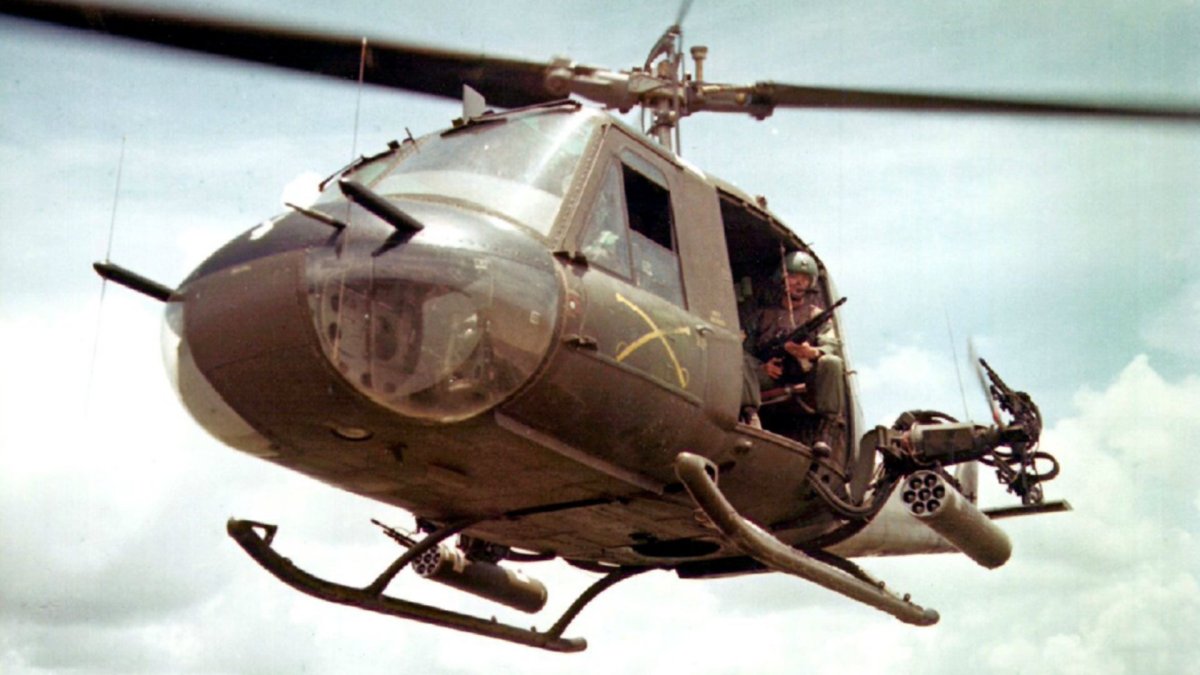
In September 1966, the U.S. Army’s top headquarters in South Vietnam told aviation units they were formally allowed to turn UH-1 helicopters into impromptu bombers. Yet for months already, Huey crews had been dropping modified mortar bombs on enemy positions.
The crews dubbed their creation the Mortar Aerial Delivery System (MADS), and some gave the choppers with the new gear installed the nickname “Mad Bombers.”
“Its simplicity of installation and operation provides a new dimension of fire support when difficult targets in mountainous areas are discovered,” one 1967 report from the 1st Cavalry Division declared.
To say the system was simple would be generous. The original setup devised by troops from the 173rd Airborne Brigade and 145th Aviation Battalion was little more than an open-topped wooden chute mounted in the main cabin of either short-fuselage UH-1B/C gunships or the longer UH-1D/H transports. The entire assembly held 20 modified 81mm high explosive mortar rounds.
A equally crude sketch of the MADS, US Army
The procedure to turn them into small air-dropped bombs was relatively easy. Ground crews would first remove the projectile’s nose and base fuzes, as well as the propellant charges. Then they would install a World War II-era M158 bomb fuze, which would detonate the mortar-bomb’s explosive charge on impact. These fuzes had been available during World War II and Korea for use on a variety of larger weapons, including the 115-pound M70 and M70A1 mustard gas bombs.
Delivering the bombs was a similarly uncomplicated procedure. At one end of the chute, technicians had cut a slot and slipped in a removable plywood board. At the right moment, a member of the crew would manually pull this stopper out and the mortar bombs would just roll out.
How would you know how when that moment had arrived? The pilot would point the chopper at the target while flying at approximately 2,500 feet high. Then he would wait until the target lined up with a part of his foot pedal through the small windows underneath the Huey’s nose.
“Sensing the mortar rounds as they detonate, adjustments for target sight picture and wind conditions can be made and greater accuracy will result,” a standard operating procedure the 145th drafted in April 1966 explained. In short, there was a lot of personal skill involved in putting the small bombs in the right place.
The weapon was perfect for scattering potential ambushers from landing zones, attacking enemy forces on the ground during aerial assaults, or simply blasting targets of opportunity, including reinforced bunkers the Viet Cong built in remote areas, according to the MADS procedures.
But wary of complaints from the U.S. Air Force about stealing its roles and missions, the Army aviators were quick to point out that “the ‘MAD’ system in no way duplicates or parallels the prestrike, or landing zone preparation and close air support mission of the USAF Tactical Air.”
After the Pentagon created the independent Air Force in 1947, it repeatedly sparred with the Army over which service would get to fly which missions and how. During Vietnam War, with the Air Force continued to complain about Army fixed-and rotary-wing encroaching on its turf.
So to read the reports, the “Mad Bomber” was just another piece of artillery. The gear simply allowed ground commanders to put more mortar rounds on target faster and more accurately.
Still, “a variety of targets may be engaged with accuracy and the tactical employment of this weapons system is unlimited,” the 145th’s guide declared. “Excellent results have been obtained when this weapons system is employed against targets located in dense jungle areas where secondary forest canopies are prevalent.”
And barred by agreement with the Air Force from flying fixed-wing attack aircraft, the Army was very interested in the potential of the new armament, no matter how crude. After learning about the weapon, and with the approval of the Army’s top officers in South Vietnam, the 1st and 25th Infantry Division and 1st Cavalry began to test out the MADS.
Marshall, S. L. A./US Army
The units’ experiences over the course in nearly three years of operations differed wildly. The 1st Cavalry Division, operating from bases in South Vietnam’s central highlands, found the setup effective in the rugged terrain.
In July 1967, the division went so far as to produce a study of MADS operations, which included “means of overcoming the factors which decrease the accuracy of the system, e.g., airspeed, altitude, moving targets, etc,” according to another report . The 2nd Battalion, 20th Artillery Regiment, an aerial rocket artillery unit equipped with UH-1 gunships toting 2.75-inch rockets, had developed their own version of the system, though it’s unclear what improvements the troops made to the initial design.
The next month, the Army added sections on dropping mortar and cluster bombs from helicopters to official field manuals. The official doctrine specifically described rotary-wing bombers—not mentioning of the Huey specifically, as CH-47 units were flying similar missions—as a substitute for mortars in challenging environments.
“The responsiveness of this support is reduced when the mortar and its ammunition must be transported over difficult terrain by foot-mobile units,” the amended manual explained. “The use of armed helicopters for delivery of droppable munitions, to include modified mortar projectiles, and cluster bomb units (CBU) can be integrated into the ground unit’s plan action.”
US Army via Ray Wilhite
But elsewhere, Army Major Gen. Fillmore Mearns, head of the 25th Infantry Division situated northwest of the country’s capital Saigon near the Cambodian border, decided the system wasn’t really all that useful. More than a year later, however, his successor Army Major Gen. Ellis Williamson apparently came to a different conclusion.
“This system has been found to be useful…to deliver ordinance that otherwise cannot be effectively placed due to heavy jungle canopy,” the division’s staff explained in January 1969 review of recent operations . “MADS is, in some situations…an effective substitute for infantry high angle of fire weapons that cannot be employed due to triple overhead canopy jungle.”
However, “the system is not recommended for use by other aviation units as in other types of terrain, the stand off
capability of armed helicopters employing rockets is considered an adequate fire support means,” the report added.
Shortly afterwards, the 1st Infantry Division, situated nearby, also arrived at the conclusion that the mortar bombs were in no way a substitute for artillery. Instead, the division’s 1st Aviation Battalion used the chutes to drop sensors to try and catch insurgents moving around in the jungle below. The aviators also dropped white phosphorus rounds to mark targets and even built a version that could handle larger 4.2-inch mortar rounds.
The improvised flare launcher that did make it into the 1971 report. , US Army via Ray Wilhite
The improvised flare launcher that did make it into the 1971 report.
Needless to say, units’ opinions of the “Mad Bomber” were decidedly mixed. A 1971 Army compendium of field expedient helicopter modifications in South Vietnam doesn’t mention the system at all, though a locally-made flare dispenser did get a mention. Despite the reported combat use, there are no readily available pictures of the MADS in action.
After the fighting in Southeast Asia ended, the Army made no effort to refine the MADS concept. Today, the weapon is just one footnote in the history of aviation operations during the Vietnam War.
However, the basic idea of a small, low cost aerial weapon never went away. In 2012, General Dynamics and the Army announced successful work on a kit to turn regular 81 mm mortar rounds into small guided bombs for small drones. It’s possible the U.S. military dropped one of these Roll Control Guided Mortars (RCGM), or a similar, improved weapon, on Al Qaeda deputy leader Abu Khayr al Masri in Syria in February 2017 . Of course, the RCGM’s GPS-guidance is decided more advanced than rolling bombs out the door of Huey.
Contact the author: joe@thedrive.com
Comments couldn’t be loaded. Please refresh the page.
作者:约瑟夫·特雷维西克
更新于美国东部时间2020年7月3日凌晨4:09
2017年,伊斯兰国武装分子使用四旋翼和六旋翼无人机投掷改装和自制手榴弹的视频和照片,凸显了该组织制造先进武器的能力。虽然这种武器组合新颖,但这并非武装分子乃至正规军首次在战斗中使用简易航空炸弹。
1966年9月,美国陆军驻南越最高司令部正式通知各航空部队,允许他们将UH-1直升机改装成临时轰炸机。然而,在此之前的几个月里,休伊直升机的机组人员就已经开始向敌方阵地投掷改装后的迫击炮弹了。
机组人员将他们的发明命名为迫击炮空中投放系统(MADS),有些人还给安装了新设备的直升机起了个绰号“疯狂轰炸机”。
“其安装和操作的简便性为在山区发现难以攻击的目标时提供了新的火力支援维度,”1967 年第一骑兵师的一份报告宣称。
说这套系统简单都算是客气的了。最初由第173空降旅和第145航空营的士兵设计的这套装置,不过是一个安装在短机身UH-1B/C武装直升机或长机身UH-1D/H运输机主舱内的敞篷木制滑槽。整个装置可容纳20枚改装过的81毫米高爆迫击炮弹。
另一幅同样粗略的美国陆军MADS草图
将它们改装成小型空投炸弹的过程相对简单。地勤人员首先会移除炮弹的弹头和弹底引信以及推进剂。然后,他们会安装二战时期的M158型炸弹引信,这种引信会在撞击时引爆迫击炮弹的装药。这些引信在二战和朝鲜战争期间曾被用于多种大型武器,包括115磅重的M70和M70A1芥子气炸弹。
投放炸弹的过程同样简单。在滑槽的一端,技术人员开了一个槽,并塞入一块可拆卸的胶合板。时机成熟时,一名工作人员会手动拉出这块挡板,迫击炮弹就会滚落出来。
如何判断时机是否成熟?飞行员会驾驶直升机在大约2500英尺的高空飞行,并将目标对准目标。然后,他会等待目标与他透过休伊直升机机头下方小窗口踩到的脚踏板上的某个部件对齐。
“通过感知迫击炮弹爆炸的瞬间,可以调整瞄准线以适应目标和风况,从而提高命中精度,”第145迫击炮兵团于1966年4月制定的一份标准作业程序解释道。简而言之,将这些小型炸弹投放到正确位置需要很高的个人技能。
根据 MADS 程序,这种武器非常适合将潜在的伏击者从着陆区驱散,在空中突袭期间攻击地面上的敌军,或者简单地轰炸机会目标,包括越共在偏远地区建造的加固掩体。
但由于担心美国空军会抱怨其窃取了自身的角色和任务,陆军飞行员很快指出,“‘MAD’系统绝不会重复或平行于美国空军战术空军的打击前准备、着陆区准备和近距离空中支援任务。”
1947年五角大楼创建独立的空军后,它与陆军就哪个军种可以执行哪些任务以及如何执行等问题屡次发生争执。在越南战争期间,空军继续抱怨陆军的固定翼和旋翼飞机侵犯了其领地。
因此,从报告中可以看出,“疯狂轰炸机”只不过是另一种火炮而已。这套装备的作用仅仅是让地面指挥官能够更快、更准确地将更多迫击炮弹命中目标。
不过,第145导弹联队的指南宣称,“该武器系统能够精确打击各种目标,其战术运用不受限制。在次生林冠层茂密的丛林地区,使用该武器系统打击目标时,已取得显著成效。”
由于与空军的协议禁止陆军使用固定翼攻击机,陆军对这种新型武器的潜力非常感兴趣,无论它多么粗糙。在了解了这种武器之后,并得到了驻南越陆军高级军官的批准,第1步兵师、第25步兵师和第1骑兵师开始测试MADS。
马歇尔,SLA/美国陆军
在近三年的作战行动中,各部队的经历截然不同。驻扎在南越中部高地基地的第一骑兵师发现,这种部署方式在崎岖的地形中行之有效。
1967年7月,该师甚至对MADS系统的操作进行了研究,其中包括“克服降低系统精度的因素(例如空速、高度、移动目标等)的方法”,另一份报告如此写道。第20炮兵团第2营是一支装备UH-1武装直升机的空中火箭炮部队,该直升机可携带2.75英寸火箭弹。该营也开发了自己的MADS系统版本,但目前尚不清楚部队对初始设计做了哪些改进。
次月,陆军在官方野战手册中新增了关于从直升机上投放迫击炮弹和集束炸弹的章节。官方条令明确指出,在复杂环境下,旋翼轰炸机(虽然没有具体提及休伊直升机,因为CH-47部队当时也在执行类似任务)可以替代迫击炮。
修订后的手册解释说:“当迫击炮及其弹药必须由步兵部队穿越崎岖地形运输时,这种支援的响应速度就会降低。使用武装直升机投放可空投弹药,包括改装迫击炮弹和集束炸弹(CBU),可以纳入地面部队的行动计划。”
美国陆军通过雷·威尔海特
但在其他地方,驻扎在首都西贡西北部、靠近柬埔寨边境的第25步兵师师长菲尔莫尔·米尔恩斯陆军少将却认为这套系统并非十分实用。然而,一年多后,他的继任者埃利斯·威廉姆森陆军少将显然得出了不同的结论。
“事实证明,这套系统很有用……可以投放那些由于茂密丛林树冠而无法有效投放的弹药,”该师参谋部在1969年1月对近期行动的回顾中解释道。“在某些情况下,MADS系统……可以有效地替代因三重丛林树冠而无法使用的步兵高角度射击武器。”
然而,“不建议其他航空单位在类似地形中使用该系统,因为在其他地形中,需要保持安全距离。”
报告还补充说:“武装直升机使用火箭的能力被认为是一种足够的火力支援手段。”
不久之后,驻扎在附近的第1步兵师也得出结论:迫击炮弹根本无法替代火炮。于是,该师第1航空营利用降落伞投放传感器,试图侦察下方丛林中活动的叛乱分子。飞行员们还投放白磷弹来标记目标,甚至还制造了一种可以投放更大口径4.2英寸迫击炮弹的降落伞。
1971年的报告中确实提到了这种简易照明弹发射器。(图片来自美国陆军,经Ray Wilhite提供)
1971 年的报告中确实提到了那款简易照明弹发射器。
毋庸置疑,各部队对“疯狂轰炸机”的评价褒贬不一。1971年美国陆军出版的一份关于南越战场上直升机临时改装方案的汇编中完全没有提及该系统,尽管其中确实提到了一种本地制造的照明弹发射器。尽管有报道称该系统曾被用于实战,但目前尚无现成的MADS实战照片。
东南亚战事结束后,陆军并未对MADS概念进行改进。如今,这种武器在越南战争的航空作战史上仅仅只是一个脚注。
然而,小型低成本空中武器的基本构想从未消失。2012年,通用动力公司和美国陆军宣布成功研发出一种套件,可以将普通的81毫米迫击炮弹改装成小型无人机使用的制导炸弹。美军很可能在2017年2月向叙利亚境内的基地组织副领导人阿布·海尔·马斯里投掷了这种“滚控制导迫击炮弹”(RCGM)或类似的改进型武器。当然,RCGM的GPS制导系统显然比从休伊直升机上发射滚弹要先进得多。
联系作者:joe@thedrive.com
评论加载失败,请刷新页面。