From NASA To Amtrak, These Are All The Government Agencies With Tactical Teams从美国国家航空航天局(NASA)到美国铁路公司(Amtrak),以下是所有拥有战术小组的政府机构。
A recent review of federal law enforcement tactical teams explores various units spread across 18 different government agencies.
新闻视频
By Joseph Trevithick
Updated Nov 27, 2020 6:24 PM EST
The Government Accountability Office, a Congressional watchdog, has released a new audit of “federal tactical teams,” or specialized law enforcement units, often generically referred to as SWAT teams, across the U.S. federal government. These range from better-known organizations, such as the Federal Bureau of Investigation’s Hostage Rescue Team and the U.S. Secret Service’s Counter Sniper Team , to much more obscure ones, including those that fall under the National Institutes of Health and Amtrak.
The report first appeared online on Sept. 10, 2020. It is a non-sensitive version of a restricted report that the Government Accountability Office (GAO) had published last month. GAO’s analysts identified 25 such teams spread across 18 different entities, as of the end of 2019, but this only reflects the total number of distinct types of units. For example, the review treats the Federal Bureau of Investigation’s (FBI) SWAT teams as a single collective organization, despite there being teams in each field office across the country and on call at the national level. A 2015 report from the Congressional Research Service identified 271 individual tactical teams across the federal government at that time.
This new report primarily also covers the activities of these units between 2015 and 2019, but there are added appendixes that cover some events in 2020. This includes the controversial deployments of tactical law enforcement units across the country in recent months. This has been in response to continued protests, which have at times led to violence, that have emanated from the police killing of George Floyd in Minneapolis, Minnesota in May, as well as other instances of police brutality that seem to disproportionately impact African Americans . Federal tactical teams have also taken part in aspects of the response to the COVID-19 pandemic .
“Many federal agencies employ law enforcement officers to carry out the agency’s law enforcement mission and maintain the security of federal property, employees, and the public,” the report says in its executive summary. “Some of these agencies have specialized law enforcement teams – referred to as federal tactical teams in this report – whose members are selected, trained, equipped, and assigned to prevent and resolve critical incidents involving a public safety threat that their agency’s traditional law enforcement may not otherwise have the capability to resolve.”
A table showing the various tactical teams across the U.S. federal government as of the end of 2019., GAO
The bulk of the federal government’s tactical teams, 17 of the total 25, are within agencies that fall under the Department of Homeland Security and Department of Justice. The remaining eight are spread between the Department of Defense, the Department of State, the Department of Energy, the Department of the Interior, and the Department of Health and Human Services, as well as NASA, an independent agency, and Amtrak, a U.S. government-managed corporation .
The GAO report also provides a basic overview of specialized weapons and equipment that tactical teams typically use and how many U.S. government teams have access to these assets. These general categories range from small arms and crowd control munitions to armored vehicles, small drones, and helicopters.
Only three tactical teams operate their own helicopters, while six utilize aerial drones, though the review does not say which units have these capabilities. Of course, many others receive aviation support from other units . The Federal Bureau of Investigation’s (FBI) Hostage Rescue Team (HRT) is one of the ones known to have its own helicopters, including a number of UH-60M Black Hawks, which you can read about in more detail in this previous War Zone piece .
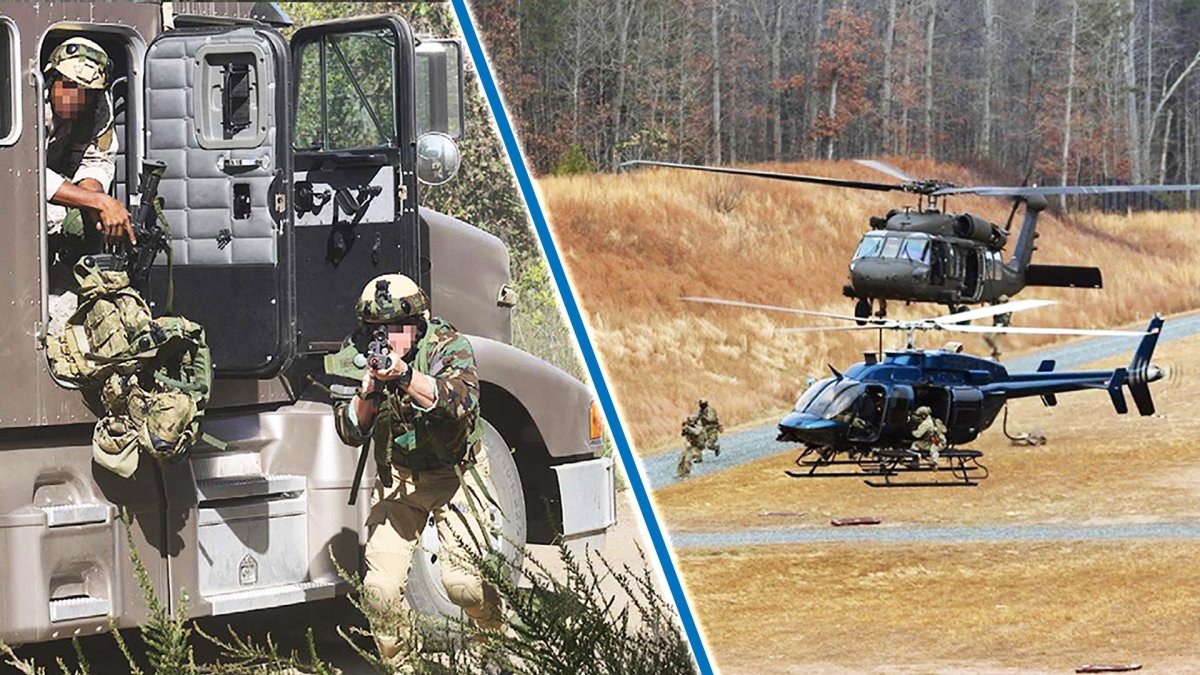
An FBI HRT UH-60M Black Hawk helicopter, behind, and one of its Bell 407 helicopters, in front, take part in an exercise to stop a suspect vehicle and detain its occupants., GAO
Another FBI HRT Bell 407 helicopter., GAO
Some of these organizations are very high-profile. For instance, the FBI’s HRT is a national-level top-tier direct-action counter-terrorism unit. The U.S. Secret Service’s Counter Assault , Counter Sniper , and Emergency Response Teams, which are charged with protecting and otherwise responding to threats to the President of the United States, the Vice President, their families, and foreign heads of state visiting the United States.
Members of the US Secret Service’s Counter Assault Team during training., GAO
Others are perhaps less well-known by their formal names. It is generally public knowledge that most major federal law enforcement agencies, including FBI, as well as the U.S. Coast Guard, Drug Enforcement Administration (DEA), the Bureau of Alcohol, Tobacco, Firearms, and Explosives (BATFE), the U.S. Marshals Service (USMS), Customs and Border Protection (CBP), and Immigrations and Customs Enforcement (ICE), have what would generally be considered SWAT teams of some kind.
Members of an ICE Homeland Security Investigations (HSI) Special Response Team help provide security in Minneapolis, Minnesota during Super Bowl LII in 2018., ICE
Many of these units are structured and trained to perform higher-risk missions, including counter-terrorism operations, protecting high profile government gatherings and other public events, and helping with disaster response. The U.S. Coast Guard, by law, straddles military and law enforcement functions, as well, and its Maritime Security Response Teams (MSRT), in particular, are closer in many respects to military special operations units. Its Tactical Law Enforcement Teams (TACLET) deploy on U.S. Navy ships and with other U.S. military elements specifically to perform law enforcement duties, especially as part of counter-drug operations.
A number of these teams have also been in the news more recently as part of the aforementioned controversial deployments in response to ongoing protests around the country. GAO says the following 16 specific units or types of teams have taken part in some way in what President Donald Trump’s Administration has dubbed Operation Legend :
BATFE Special Response Teams
Bureau of Prisons (BOP) Special Operations Response Teams (SORT)
U.S. Coast Guard’s Maritime Security Response Team
U.S. Coast Guard Maritime Safety and Security Teams
CBP’s Border Patrol Tactical Unit (BORTAC)
CBP Office of Field Operations Special Response Teams
ICE Enforcement and Removal Operations Special Response Teams
ICE Homeland Security Investigations Special Response Teams
The Pentagon Force Protection Agency’s (FPA) Emergency Response Team
USMS Special Operations Group (SOG)
U.S. Park Police’s SWAT Team
U.S. Secret Service’s Counter Assault Team
U.S. Secret Service’s Counter Sniper Team
U.S. Secret Service’s Emergency Response Team
Beyond the units that have been on the news lately, or those that regularly appear in blockbuster movies and popular television shows, especially procedural crime dramas, there are still more federal tactical teams that receive far less public attention. Despite their obscurity, many of these have very important functions.
For instance, GAO’s report includes the National Nuclear Security Administration’s Special Response Force, which supports the safe and secure movement of nuclear material, including nuclear weapons, around the country. This includes escorting highly-modified tractor-trailers, known as Safeguards Transporters, or SGTs, which have James Bond-esque security features that you can read about in more detail in this past War Zone story .
Members of NNSA’s Special Response Force train to protect an SGT tractor-trailer. This picture offers a rare look at the inside of the armored doors on the cab., GAO
There is also the oddly named Mobile Security Deployments, which fall under the State Department’s Bureau of Diplomatic Security, are prepared to respond to various crises abroad and at home. This includes contingencies that require added security at diplomatic facilities overseas and helping to safeguard major diplomatic events within the United States, such as the annual gathering of the United Nations General Assembly.
GAO’s review also makes mention of tactical units most Americans probably don’t even know exist, such as the National Institutes of Health’s (NIH) Special Response Team (SRT) and Amtrak’s Special Operations Unit (SOU).
NIH’s SRT, formally established in 2005, had previously been a hazardous materials response unit, but evolved to be able to respond to active shooters and other serious incidents at the Institute’s campus in Bethesda, Maryland. NIH works with radioactive materials for medical research and infectious diseases, among other hazards, all of which present potential security risks.
Members of NIH’s SRT., GAO
Amtrak’s SOU, part of the corporation’s larger Police Department, is on call to respond to terrorist attacks, active shooters, and other major crises that might happen along America’s critical railway networks. It also provides security details to protect VIPs traveling by train.
A rare picture of members of Amtrak’s SOU during training. Note the ladder that personnel could use to engage threats inside the train or otherwise gain access during a crisis., GAO
It’s also worth noting that a not insignificant number of the U.S. government’s tactical teams emerged, perhaps not surprisingly, in the aftermath of the 9/11 terrorist attacks. The total number continues to grow, as well. Just while GAO was working on its report, it received word from DEA that it formally established a standardized tactical team organization, known as Special Response Teams, to replace more ad hoc tactical units within 20 of its 23 field divisions.
You can read more about all of the U.S. federal government’s tactical teams in the GAO’s report, which a mirrored copy of which is available via The War Zone
here . It is likely to continue to be a valuable resource as these units look set to be an important, but often controversial component of federal law enforcement capabilities for the foreseeable future.
Contact the author: Joe@thedrive.com
Comments couldn’t be loaded. Please refresh the page.
作者:约瑟夫·特雷维西克
更新于美国东部时间2020年11月27日下午6:24。
美国国会监督机构——政府问责局(GAO)发布了一份针对美国联邦政府“联邦战术小组”(或称特种执法单位,通常统称为SWAT小组)的最新审计报告。这些小组既包括联邦调查局人质救援队和美国特勤局反狙击小组等较为知名的机构,也包括一些鲜为人知的组织,例如隶属于美国国立卫生研究院和美国铁路公司(Amtrak)的小组。
该报告于2020年9月10日首次在线发布。它是美国政府问责局(GAO)上月发布的一份受限报告的非敏感版本。GAO的分析师在2019年底确定了分布在18个不同机构的25个此类团队,但这仅反映了不同类型单位的总数。例如,该审查将联邦调查局(FBI)的特警队视为一个单一的集体组织,尽管FBI在全国各地的每个外勤办事处都有特警队,并且在国家层面也随时待命。国会研究服务处2015年的一份报告指出,当时联邦政府共有271个独立的战术小组。
这份新报告主要涵盖了这些部门在2015年至2019年间的活动,但附录也涉及了2020年的一些事件。其中包括近几个月来在全国范围内部署战术执法部门的争议性行动。这些行动是为了应对持续不断的抗议活动,这些抗议活动有时演变为暴力事件。这些抗议活动源于5月份明尼苏达州明尼阿波利斯市发生的乔治·弗洛伊德被警察杀害事件,以及其他一些似乎对非裔美国人造成不成比例影响的警察暴行事件。联邦战术小组也参与了应对新冠疫情的部分工作。
报告在其执行摘要中指出:“许多联邦机构雇用执法人员来执行机构的执法任务,并维护联邦财产、雇员和公众的安全。其中一些机构设有专门的执法小组——在本报告中称为联邦战术小组——其成员经过选拔、培训、装备和指派,负责预防和解决涉及公共安全威胁的重大事件,而这些事件可能是其机构的传统执法部门无力解决的。”
下表列出了截至2019年底美国联邦政府各战术小组的情况。(美国政府问责局)
联邦政府的战术小组中,25个小组中有17个隶属于国土安全部和司法部下属机构。其余8个小组则分布在国防部、国务院、能源部、内政部、卫生与公众服务部,以及美国国家航空航天局(NASA,一个独立机构)和美国政府管理的美国铁路公司(Amtrak)。
美国政府问责局的报告还概述了战术小组通常使用的专用武器和装备,以及有多少美国政府小组能够使用这些装备。这些装备涵盖范围广泛,从小型武器和人群控制弹药到装甲车、小型无人机和直升机,应有尽有。
只有三支战术小组拥有自己的直升机,另有六支使用无人机,但这份报告并未说明具体是哪些单位具备这些能力。当然,许多其他单位都从其他单位获得航空支援。联邦调查局(FBI)人质救援队(HRT)就是已知拥有自己直升机的单位之一,其中包括多架UH-60M黑鹰直升机,您可以在之前的《战区》文章中了解更多详情。
一架联邦调查局人质救援队(FBI HRT)的UH-60M黑鹰直升机(后方)和一架贝尔407直升机(前方)正在进行演习,目标是拦截嫌疑车辆并拘留车内人员。(美国政府问责局)
另一架联邦调查局人质救援队贝尔407直升机。(美国政府问责局)
这些组织中有些非常引人注目。例如,联邦调查局的恐怖反应小组(HRT)是国家级顶尖的直接行动反恐部队。美国特勤局的反突击队、反狙击队和紧急反应小组则负责保护美国总统、副总统及其家人以及来访美国的外国元首,并应对他们面临的威胁。
美国特勤局反突击队成员训练中的照片。(美国政府问责局)
其他一些机构的正式名称可能不太为人所知。众所周知,大多数主要的联邦执法机构,包括联邦调查局(FBI)、美国海岸警卫队、缉毒局(DEA)、烟酒枪械爆炸物管理局(BATFE)、美国法警局(USMS)、海关与边境保护局(CBP)以及移民与海关执法局(ICE),都拥有某种形式的特警队。
2018年,美国移民及海关执法局(ICE)国土安全调查处(HSI)特别反应小组的成员在明尼苏达州明尼阿波利斯市协助提供超级碗LII期间的安保服务。
这些部队大多经过专门的组织和训练,能够执行高风险任务,包括反恐行动、保护重要政府集会和其他公共活动,以及协助灾害应对。根据法律规定,美国海岸警卫队也兼具军事和执法职能,其海上安全响应小组(MSRT)尤其在许多方面更接近于军事特种作战部队。其战术执法小组(TACLET)部署在美国海军舰艇上,并与其他美国军事单位协同作战,专门执行执法任务,尤其是在禁毒行动中。
最近,其中一些队伍也因参与上述备受争议的部署行动而频频出现在新闻报道中,这些部署行动旨在应对全国各地持续不断的抗议活动。美国政府问责局(GAO)表示,以下16个特定单位或类型的队伍以某种方式参与了唐纳德·特朗普总统政府所谓的“传奇行动”(Operation Legend):
BATFE 特别反应小组
美国联邦监狱管理局(BOP)特种作战反应小组(SORT)
美国海岸警卫队海上安全响应小组
美国海岸警卫队海上安全保障队
美国海关与边境保护局边境巡逻战术部队(BORTAC)
美国海关与边境保护局现场行动办公室特别反应小组
ICE执法和遣返行动特别反应小组
美国移民及海关执法局国土安全调查特别反应小组
五角大楼部队保护局(FPA)应急响应小组
美国法警特种作战小组(SOG)
美国公园警察特警队
美国特勤局反突击队
美国特勤局反狙击小组
美国特勤局应急反应小组
除了最近新闻报道中频频出现的特警队,以及经常出现在热门电影和电视剧(尤其是刑侦剧)中的特警队之外,还有许多联邦特警队鲜为人知。尽管它们默默无闻,但其中许多特警队都发挥着至关重要的作用。
例如,美国政府问责局(GAO)的报告提到了国家核安全管理局的特种反应部队,该部队负责保障包括核武器在内的核材料在全国范围内的安全运输。这包括护送经过高度改装的拖车,这些拖车被称为“安全保障运输车”(Safeguards Transporters,简称SGT),其安全配置堪比詹姆斯·邦德电影中的特勤车,您可以在之前的“战区”专题报道中了解更多详情。
美国国家核安全管理局(NNSA)特种反应部队成员正在训练保护一辆SGT型半挂卡车。这张照片罕见地展现了驾驶室内部装甲门的内部结构。(美国政府问责局,GAO)
此外,还有一项名称略显古怪的行动——机动安全部署,隶属于国务院外交安全局,旨在应对国内外各种危机。这包括在海外外交机构需要加强安保的突发事件,以及协助保障美国境内重大外交活动的安全,例如联合国大会的年度召开。
GAO 的审查还提到了大多数美国人可能都不知道存在的战术部队,例如美国国立卫生研究院 (NIH) 的特别反应小组 (SRT) 和美国铁路公司的特别行动小组 (SOU)。
美国国立卫生研究院(NIH)的特别反应小组(SRT)正式成立于2005年,此前是一个危险品应急小组,后来发展成为能够应对位于马里兰州贝塞斯达的NIH园区内发生的枪击事件和其他严重事故的机构。NIH的工作涉及放射性物质在医学研究和传染病防治等领域的应用,所有这些都存在潜在的安全风险。
美国国立卫生研究院 (NIH) 特别反应小组 (SRT) 和美国政府问责局 (GAO) 的成员
美国铁路公司(Amtrak)的特别行动小组(SOU)隶属于该公司规模更大的警察部门,随时待命应对可能发生在美国关键铁路网络上的恐怖袭击、枪击事件和其他重大危机。该小组还为乘坐火车出行的贵宾提供安保服务。
一张罕见的美国铁路公司特种作战部队(SOU)成员训练照片。请注意照片中人员可以用来应对列车内部威胁或在危机情况下进入车厢的梯子。(美国政府问责局)
值得注意的是,美国政府相当数量的战术小组(或许并不令人意外)是在9/11恐怖袭击事件之后涌现的。而且,这些小组的总数还在持续增长。就在美国政府问责局(GAO)撰写报告期间,它收到美国缉毒局(DEA)的消息,DEA已正式建立了一套标准化的战术小组组织——特种反应小组(Special Response Teams),以取代其23个外勤分局中20个分局内较为临时组建的战术单位。
您可以阅读美国政府问责局 (GAO) 的报告,了解更多关于美国联邦政府所有战术小组的信息。该报告的镜像版本可通过“战区”网站获取。
这里。鉴于这些单位在可预见的未来将成为联邦执法能力的重要组成部分,但同时也常常引发争议,因此它很可能继续成为一项宝贵的资源。
联系作者:Joe@thedrive.com
评论加载失败,请刷新页面。