What It’s Like To Live And Work Inside White Sands Missile Range在白沙导弹靶场内生活和工作是怎样的体验
A fascinating snapshot of 1990s life at the birthplace of the atomic bomb, numerous modern missile systems, and so much more.
新闻视频
Updated Dec 22, 2021 6:00 PM EST
In the early 1990s, White Sands Missile Range went from belonging to Naval Sea Systems Command (NAVSEA) to Naval Air Systems Command (NAVAIR), which meant White Sands became part of China Lake , and my company’s support contract was extended to the Naval detachment there. Until that point, White Sands had petty officers running its information technology at the main White House building for the command. The range lacked any true, dedicated technical support — hence the job I applied for. Of course, with me being in-house and a known quantity, I got the job rather quickly. I was told New Mexico was a great place to live, and I would love it there.
My wife and I flew out of Ontario, Calif., to the closest airport to White Sands, which is in El Paso, Texas. For those who are from small towns, landing in El Paso for the first time is a real treat. I was immediately alarmed about what I had gotten myself into from seeing the area for the first time. I was used to being moved around all my childhood and had been to many places, but, after years of working at Naval Air Weapons Station China Lake, which you can read all about here , I was now acclimated to the small population of 35,000 in Ridgecrest. This was a little jolt that Toto wasn’t in Kansas anymore.
From there we went to Las Cruces and got a room for the night.
A map of New Mexico with an inset showing White Sands Missile Range and Holloman Air Force Base., Google Maps
We were not really interested in living in Los Cruces and had never commuted more than 15 minutes for a job in our lives. We were told that, if we asked the Army command sweetly enough, they might let us live in officer family housing on the base. The Army agreed and set us up. The cool part of it was they also gave us full access to the post exchange (PX), commissary, and the base schools. We were set and never needed to leave the base even for necessities — which later kind of became a curse.
We went back to Ridgecrest, packed up our house in a U-Haul, said our goodbyes, and made the trip to New Mexico.
Arriving At The Base
White Sands Missile Range is nestled on the east side of the Organ Mountains, about 27 miles from Las Cruces on US 70. To the left of the gate is a neat museum that showcases many of the things tested at White Sands, from captured German V-2 rockets to the first atomic bomb . There are static stands with all types of weaponry, including some interesting flying-saucer-looking things that some claim are what was seen in Roswell instead of a crashed alien spacecraft. Rolling up to the front gate, you get your usual gate-guard check-in scenario to be allowed access to the base.
The White Sands complex is quite large and inhabited mostly by the Army, but there also is a small Navy post where I would be working, plus some NASA facilities. There were no other contractors from my organization on-site, so I was pretty much the one and only to start.
As with many other naval installations, the White Sands command building is rather old. My wife and I met just about everyone in the building, including the petty officer who was holding the current computer infrastructure together by a shoestring. He was older and pretty close to retiring, and he didn’t take to me very well at first, but, eventually, I changed that.
The network infrastructure was rather dismal, just a few old Mac servers. One of them ran a version of Mail for Mac even as the rest of NAVAIR was switching to Microsoft Exchange. Half the rooms weren’t even wired for Ethernet at the time and used Phonenet adapters for Appletalk communication. As a tenant on an Army base, the Navy piggybacked off the Army’s networks for external communication and internet access, which was TCP-based (transmission control protocol) only. The Navy’s Appletalk network wasn’t allowed on the Army’s networks. The whole command definitely needed a modernization effort, which was right up my alley.
The first thing I did after getting settled was a tour of the locations where I would be working. I was headquartered at the command building, but there were outer locations to support as well. Heading out Nike Road took us on a journey to the Missile Assembly Facility (MAF), and farther down the road where the Desert Ship and LC-35 launch complex are. Navy missiles and the NASA Black Brant sounding rockets are tested there. Farther still was a little shop that maintained the orange-colored Firebee target drones.
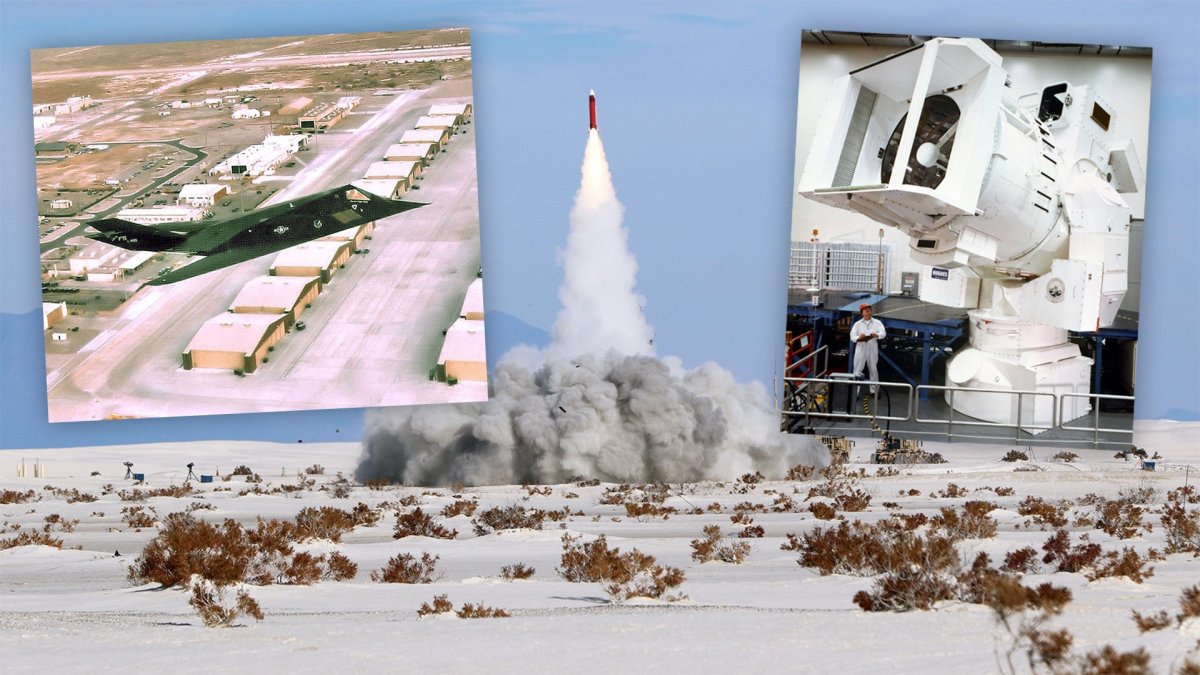
Outside the complex and some distance down US 70 is the High Energy Laser Systems Test Facility (HELSTF) complex, which houses a huge laser designed to fry unsuspecting objects out of the air (more on that later). And still farther down the US 70 is Holloman Air Force Base , which at the time housed all the operational F-117 combat squadrons .
Missile Assembly Facility
When you reach the MAF, you are greeted by a rather large building resembling a warehouse surrounded by a tall security fence with barbed wire and rotating warning lights every 50 yards to signal “Stay away!” when a missile was being assembled or tested. The entrance gate is located on the east side of the fence. The parking lot was a long walk away from the gate and building. Taking the tour of the facility is rather surreal, with big assembly stands in an open area, and everything positioned in a precise manner. Everything — from the walls to the doors — is blast-proof. There was even a blast-proof glassed-in control room facing into the area for testing rocket-propelled flying-death contraptions after they had been assembled. The area was clean enough to be a NASA probe assembly room.
Building 1558, a Mills building — or just “the Mill” — and designated as Assembly Building II, was constructed in 1946, according to an official history of the White Sands Missile Range. It is shown here in a picture taken around 1968., Library of Congress
The most striking thing in the building was an 8-inch-wide copper grounding bar that ran all along the walls within the building. Apparently, it is very necessary for you and whatever you are working with to be strapped to this bar when putting together missiles or rockets. If you aren’t grounded properly and there is a lightning strike in the area, or you are unfortunate enough to static out when working around live missiles, you and the whole place could end up a giant grease spot in the middle of the desert.
My first time visiting this facility alone to perform job duties was pretty exhilarating. I had set up a new PC and was delivering it to the MAF. When I approached the compound, the gate was open and the lights weren’t flashing, so I drove right in rather than huffing this thing 100 yards from the parking lot. A rather angry-looking lieutenant commander came flying out the door proclaiming that my damn truck shouldn’t be there, and if I didn’t immediately move it back to the parking lot he was going to get the forklift and move it himself. Having been around the salty Navy types a lot, I casually glanced over at him while I was unloading the computer and informed him that, if he came anywhere within 50 feet of my truck, it would be the last thing he did. He turned bright red, huffed and puffed, and told me to hurry it up.
I was a contractor, not one of his enlisted guys, so he knew there was very little he could do about it at the moment. Also, that guy had probably never in his life had someone stand up to him like that, and he was so impressed, we became best friends for the duration of my stay.
I love making friends like that.
LLS-1 – USS Desert Ship
The Desert Ship , built in the 1950s, was a very interesting place to behold. It’s constructed of thick concrete, like a bunker, in case an unfortunate accident occurs. Inside at the time was a variety of equipment to launch missiles that replicated what would be on a real ship. I’m pretty sure most of this older stuff is gone by now, but, in my time, the room still held equipment that used old school vacuum tubes! I was flabbergasted seeing this.
There was also various recording equipment for testing purposes. Then, facing the launcher, was the launch control room, which contained various screens, fun buttons, and little tiny windows where you could see the launcher. It was a complete mix of old and new, and the guys that were on duty there knew their stuff inside and out.
Outside was a vertical launcher located a little distance away from the main complex, connected via a long tunnel. I recall having a “pleasant” afternoon being claustrophobic in that tunnel while running cables one day.
At the time we were there, Standard Missile 2 was the hot item the Navy was testing. We actually had the pleasure of watching an early morning launch and intercept by the SM-2 right from the front door of our house. It was pretty slick watching it do spirals trying to scrub speed and then going on to kill its target. The Navy tested other weapons at that time, too: the RIM-116 Rolling Airframe Missile (RAM), Tomahawk cruise missiles , and the Sea Sparrow missile , among others. We only got to witness the one SM-2 test during the short time we were there, unfortunately.
The Ticonderoga -class guided-missile cruiser USS Antietam (CG-54) fires a Standard Missile (SM) 2., U.S. Navy / Mass Communication Specialist Seaman David Flewellyn
High Energy Laser Systems Test Facility
The most amazing location was HELSTF.
HELSTF is located in between White Sands and Holloman on US 70. This compound houses one of the most powerful chemical lasers in the world. Nobody I knew had any idea how powerful — because that was top secret. Unless you know what you are looking for, you will drive right past the entrance road to get there. It’s not a highly publicized place, located far off the highway.
A basic overall layout of WSMR and its surrounding features., WSMR
The complex has various strange-looking buildings in different places connected by above-ground pipes with steam coming out of them in spots and HVAC farms all over the place. On my initial tour, I was told by our guide that in the future the whole complex setup would be shrunk down to fit on destroyers.
We entered the multistory building where the Mid-Infrared Advanced Chemical Laser (MIRACL) system is housed. What can be seen on the bottom floor is nothing short of astounding. I recall many pipes and hydraulic rams connected to a huge moving wall that had channels in it for the mixture of whatever chemicals and energy to travel through on its path to the laser emitter. Apparently, this was to ensure the pathways inside were able to be inspected and cleaned when the two halves were separated.
The SeaLite Beam Director, commonly used as the output for the mid-infrared chemical laser (MIRACL) at White Sands., U.S. Army via Wikimedia
Going up to the second level, we found mirrors in cordoned-off areas. I assume — from the huge “DANGER!” signs everywhere — that’s where the energy flows from the bottom level. You probably would not want to be around those areas when this thing lit off or you would be incinerated instantly. The mirrors appeared to bounce the beam up another level that we didn’t go to.
From the outside, the building doesn’t look like much — until the whole structure actually starts to move backward. What gets exposed after the building moves is a giant maneuverable laser emitter. There are several missile- and drone-kill markings on it, signifying what this thing has brought down in testing.
Not too long before we arrived at WSMR, the MIRACL shot at a drone, in a test. Attached to the bottom of the drone was a two-inch-thick steel diamond plate. The plate was proudly displayed in the lobby, a melted hole about two feet in diameter in the middle of it. I remember thinking, “This is some serious Star Wars shit right here.”
HELSTF has had its share of ups and downs over the years. At the time we were there, the entire complex was pretty much shut down because TRW (the contractor that built it) had their contract expire. Nobody else knew how to run the thing, so it was dormant. There was talk about using the laser system to recharge satellites, but I guess it eventually was shut down for good.
LC-35 is where NASA launches sounding rockets to test things in low-earth orbit. One of the NASA guys worked in the main shop with us and basically was the event recording and AV person for the launches. He had a need for a heavy-duty Macintosh with AV capabilities so he could edit launch movies and recordings from cameras attached to the rockets. He used it to stitch together a video of various scientific atmospheric reentry test instruments dropped from a rocket for the Mars lander test that took place when we were there. The video was mainly made for the Wallops Flight Facility in Virginia, but, on some copies, he dubbed in music from Pink Floyd with the video.
Again, very cool to be remotely involved in interesting science, even if I was part of it only indirectly.
The large tilting launch rails used for Aerobee rockets at LC-35. These rockets could travel dozens of miles into the upper atmosphere. , UC Boulder
Down The Road At The Air Force Base
Outside of work, the White Sands community was really involved in kids’ sports. White Sands teams often played against those of nearby towns, as well as a team at Holloman AFB. One day, we got an opportunity to go there for my son’s baseball game. Of course, there were F-117s all over, as the baseball diamond wasn’t far from the airfield. They were taking off and landing the whole day. So I was obviously ecstatic to be around cool aircraft again, because there wasn’t much to be seen from the missile range.
Home On The Missile Range
Like China Lake, WSMR’s personnel are a very tight-knit group. I knew just about everyone tied to the installation and, for the most part, we were one big family. My wife eventually got hired on and worked at the command building with me. She had worked as a civilian at China Lake for a number of years, so she fit right in, and everyone loved her.
At one point, everyone who lived at the facility had to take an explosive recognition course with the explosive ordnance disposal (EOD) guys. Apparently, someone was driving out on the road that takes you from White Sands to El Paso and decided to stop and take a stroll. They found something on the ground. Not thinking, they picked it up. It was unexploded ordnance, and — of course — it exploded when they grabbed it. EOD reminded us to treat the whole entire facility as an active bombing range because sometimes undetected strays could be found. Comforting.
The range is also inhabited with wild Oryx, a species of large antelope that have very long, sharp horns. They are not native to North America (they come from Africa), but the missile range experimented with introducing exotic animals in the 1960s, and now they are all over.
An Oryx at the White Sands Missile Range in New Mexico. Oryx are native to Africa., Chris Short (FLICKR) via Wikimedia. CC 2.0
Oryx are not very nice. One day, we passed a family pulled off the side of the road that had stopped to see one. Apparently, they were trying to feed it when it promptly decided it didn’t care for them much and chased them back to their minivan. It then proceeded to run its horns completely through the van’s passenger door, much to the dismay of its terrified passengers.
Working at White Sands was really fun, but, in hindsight, making the decision to live on the base was a pretty bad idea for my family and me. Though it was cheap, the living conditions were often rather isolating. No radio relays reached into the valley, so you pretty much were locked out of any current musical entertainment. The housing regulations and restrictions were rather strict regarding maintaining your yard, curfew, animal control, etc. — and rightfully so; it’s a military base. But we had a neighbor who was batshit crazy and liked to call the cops on me just for sitting on my porch in the evenings. My family wasn’t happy with it, and we began to discuss if maybe it was time to go back to China Lake. But by that time, the people in the command building were head over heels about what I had been doing and really didn’t want me or my wife leaving. I was told they would rather shoot me than see me leave.
We had a change of command, and the new captain was impressed with my support but wanted to know what type of training I had. I told him self-taught, and he said that wouldn’t fly and requested my employer to get me classes to get Microsoft Systems Certification. I saw this as an opportunity to market myself better to get another job and get out of there. I studied and took tests every two weeks to get my certification. There were days I didn’t see daylight, because all I did was study the whole time.
Within eight weeks, I was certified. Not long after, I landed a job at Lake Tahoe, of all places. I didn’t want to leave a job associated with the DOD, but we definitely didn’t want to stay there any longer.
After what my wife terms as exactly “2.4 years,” we announced we would be moving on. We made some pretty cool friends, not only with the enlisted guys, but also with many of the officers. The command threw us a party and gave us a few traditional mementos usually reserved for military personnel, which made us feel very much part of this unique team. It was a great job, and I would miss the camaraderie greatly.
Editor’s Note: This article was updated on 12/22/21 to correct references to US 70 that originally used “I-70.”
Contact the Editor: Brian@thedrive.com.
Comments couldn’t be loaded. Please refresh the page.
更新于美国东部时间2021年12月22日下午6:00。
上世纪90年代初,白沙导弹靶场从海军海上系统司令部(NAVSEA)划归海军航空系统司令部(NAVAIR),这意味着白沙靶场成为了中国湖海军航空站的一部分,而我公司的支持合同也延伸到了驻扎在那里的海军分遣队。在此之前,白沙靶场的信息技术工作由驻扎在白宫主楼的士官负责。靶场缺乏任何真正意义上的、专门的技术支持——这正是我申请这份工作的原因。当然,由于我是公司内部员工,而且大家都认识我,所以我很快就得到了这份工作。有人告诉我新墨西哥州是个很棒的居住地,我肯定会喜欢那里。
我和妻子从加利福尼亚州的安大略市飞往离白沙导弹靶场最近的机场——德克萨斯州的埃尔帕索。对于来自小镇的人来说,第一次降落在埃尔帕索绝对是一种惊喜。然而,当我第一次看到这片区域时,我立刻意识到自己即将面对的是什么。我从小就经常搬家,去过很多地方,但在海军航空武器站中国湖分站工作多年后(你可以在这里阅读相关内容),我已经适应了里奇克雷斯特这个只有3.5万人口的小地方。托托不在堪萨斯州,这让我有点措手不及。
之后我们去了拉斯克鲁塞斯,在那里住了一晚。
新墨西哥州地图,插图显示了白沙导弹靶场和霍洛曼空军基地。(谷歌地图)
我们其实对住在洛斯克鲁塞斯没什么兴趣,而且这辈子上班通勤时间从来没超过15分钟。有人告诉我们,如果我们好好跟陆军指挥部说说,他们或许会让我们住在基地里的军官家属宿舍。陆军同意了,帮我们安排好了。更棒的是,他们还让我们完全可以使用军人服务社(PX)、超市和基地学校。一切都安排妥当了,我们甚至连生活必需品都不用离开基地——但这后来却成了个麻烦。
我们回到里奇克雷斯特,把家里的东西装进一辆 U-Haul 搬家车里,道别后,便启程前往新墨西哥州。
抵达基地
白沙导弹靶场坐落在奥根山脉东侧,距离拉斯克鲁塞斯约27英里,沿70号美国国道即可到达。大门左侧有一座精致的博物馆,展示了白沙靶场曾经测试过的许多东西,从缴获的德国V-2火箭到第一颗原子弹,应有尽有。馆内设有各种武器的静态展台,其中还包括一些外形奇特的飞碟状物体,有人声称这些才是罗斯威尔事件中人们看到的物体,而不是坠毁的外星飞船。抵达正门后,你需要像往常一样接受门卫的登记,才能获准进入基地。
白沙导弹靶场规模相当大,主要驻扎着陆军,但也包括我将要工作的那个小型海军基地,以及一些NASA的设施。我们单位没有其他承包商在那里,所以基本上只有我一个人开始工作。
和许多其他海军基地一样,白沙导弹靶场的指挥大楼也相当老旧。我和妻子几乎认识了大楼里的所有人,包括那位靠着微薄的预算勉强维持着现有计算机系统的士官。他年纪比较大,也快要退休了,起初他对我不太友好,但最终我改变了他的看法。
网络基础设施相当糟糕,只有几台老旧的Mac服务器。其中一台服务器甚至还在运行Mac版的邮件应用,而当时海军航空系统司令部(NAVAIR)的其他部门都在转向微软Exchange。当时一半的房间甚至没有以太网接口,只能使用Phonenet适配器进行AppleTalk通信。由于海军是陆军基地的租户,所以只能借用陆军的网络进行外部通信和互联网接入,而且这些网络仅支持TCP(传输控制协议)。海军的AppleTalk网络不允许接入陆军的网络。整个司令部显然需要进行现代化改造,而这正是我擅长的领域。
安顿下来后,我做的第一件事就是参观我即将工作的各个地点。我的总部设在指挥大楼,但还需要支援一些外围地点。沿着耐克路出发,我们先到了导弹组装厂(MAF),再往前走,就到了沙漠之船和LC-35发射场。海军导弹和NASA的黑雁探空火箭都在那里进行测试。再往前走,还有一个小车间,那里维护着橙色的火蜂靶机。
在基地外,沿着70号公路往下走一段距离,就是高能激光系统测试设施(HELSTF)基地,那里有一台巨大的激光器,专门用来摧毁空中毫无防备的物体(稍后会详细介绍)。再往前走,沿着70号公路就是霍洛曼空军基地,当时所有F-117战斗机作战中队都驻扎在那里。
导弹组装设施
抵达导弹发射场(MAF)后,首先映入眼帘的是一座相当大的建筑,形似仓库,四周环绕着高高的安全围栏,围栏上布满了铁丝网,每隔50码就有一个旋转的警示灯,在导弹组装或测试期间发出“远离!”的警告。入口大门位于围栏东侧。停车场距离大门和建筑还有一段距离。参观这座设施颇为奇特,开阔区域内设有大型组装台,所有部件都摆放得井然有序。从墙壁到大门,所有设施都具备防爆功能。甚至还有一个防爆的玻璃控制室,正对着组装完毕的火箭推进式飞行器进行测试。整个区域干净整洁,堪比NASA的探测器组装室。
根据白沙导弹靶场的官方历史记载,1558号楼,即米尔斯建筑(或简称“米尔斯”),被指定为第二装配楼,建于1946年。图中所示照片拍摄于1968年左右。(图片来源:美国国会图书馆)
这座建筑里最引人注目的是一根8英寸宽的铜接地棒,它沿着建筑内部的墙壁贯穿始终。显然,在组装导弹或火箭时,你和你正在操作的任何物品都必须连接到这根接地棒上。如果你没有正确接地,而附近又发生了雷击,或者你不幸在实弹导弹附近作业时被静电击中,那么你和整个建筑最终都可能变成沙漠中央的一大块油渍。
我第一次独自一人去这个设施执行公务,真是刺激极了。我装好了一台新电脑,正准备把它送到MAF(海军航空设施)。我开到院子附近时,大门开着,警示灯也没闪,所以我直接开进去了,没费劲地把这玩意儿从停车场挪到一百码外。这时,一个看起来很生气的海军中校突然冲出来,嚷嚷着我的卡车不应该停在这里,如果我不马上把它开回停车场,他就要自己开叉车把它挪走。我经常跟海军里那些脾气暴躁的人打交道,所以在卸电脑的时候,我漫不经心地瞥了他一眼,告诉他,如果他敢靠近我的卡车五十英尺以内,那就等着瞧吧。他顿时脸涨得通红,气喘吁吁地催我快点。
我是个承包商,不是他手下的士兵,所以他知道当时他对此无能为力。而且,他这辈子可能都没遇到过像我这样敢跟他顶嘴的人,他被我气到了,在我待在那里的这段时间里,我们成了最好的朋友。
我喜欢这样结交朋友。
LLS-1 – 沙漠之舰
这座建于20世纪50年代的“沙漠之船”真是一个令人叹为观止的地方。它像个碉堡一样,用厚厚的混凝土建造而成,以防万一发生意外。当时,船舱里配备了各种导弹发射设备,模拟了真实舰船上的发射系统。我确信现在大部分老设备都已经不见了,但在我参观的时候,房间里竟然还保留着使用老式真空管的设备!看到这些,我真是目瞪口呆。
那里还有各种用于测试的录音设备。发射器对面是发射控制室,里面有各种屏幕、有趣的按钮,以及可以观察发射器的小窗口。那里新旧设备混杂,值班人员对一切都了如指掌。
外面有一个垂直发射装置,距离主建筑群不远,通过一条长长的隧道与主建筑群相连。我记得有一天下午,我在那条隧道里铺设电缆,感觉非常幽闭,度过了一个“愉快”的下午。
我们当时在那儿的时候,海军正在测试标准2型导弹(SM-2),这可是当时的热门项目。我们有幸亲眼目睹了SM-2在清晨从家门口发射和拦截目标的场景。看着它盘旋减速,最终击落目标,真是赏心悦目。海军当时还测试了其他武器,比如RIM-116“滚体导弹”(RAM)、“战斧”巡航导弹和“海麻雀”导弹等等。可惜的是,在我们短暂的停留期间,只看到了那一次SM-2的测试。
提康德罗加级导弹巡洋舰“安提坦”号(CG-54)发射了一枚标准2型导弹。美国海军/大众传播专家水兵大卫·弗莱韦林
高能激光系统测试设施
最令人惊叹的地方是 HELSTF。
HELSTF位于白沙导弹靶场和霍洛曼导弹靶场之间,沿70号美国国道即可到达。这里拥有世界上最强大的化学激光器之一。我认识的人都不知道它究竟有多强大——因为这是最高机密。除非你知道自己要找什么,否则很容易错过入口。这个地方鲜为人知,位置也远离高速公路。
WSMR及其周边设施的基本整体布局。
这个建筑群由分布在不同地点的各种奇形怪状的建筑组成,这些建筑通过地上管道连接,管道上不时冒出蒸汽,到处都是空调机组。我第一次参观时,导游告诉我,未来整个建筑群的规模将会缩小,以便能装进驱逐舰上。
我们进入了存放中红外先进化学激光(MIRACL)系统的多层建筑。底层景象令人叹为观止。我记得许多管道和液压缸连接到一面巨大的移动墙,墙上设有通道,各种化学物质和能量的混合物通过这些通道到达激光发射器。显然,这样做是为了确保在将墙体两部分分开时,可以检查和清洁内部通道。
SeaLite光束导向器,通常用作白沙导弹靶场中红外化学激光器(MIRACL)的输出装置。(图片来自美国陆军维基媒体)
上到第二层,我们发现一些被围起来的区域里有镜子。我猜——从到处都是的“危险!”标志来看——能量就是从底层流过来的。这玩意儿启动的时候,你最好别待在那些区域附近,否则你会瞬间被烧成灰烬。那些镜子似乎把光束反射到了我们没去的上一层。
从外面看,这座建筑毫不起眼——直到整个结构开始向后移动。建筑移动后,露出的是一个巨型可移动激光发射器。上面有几处导弹和无人机拦截标记,表明它在测试中击落了哪些目标。
在我们抵达白沙导弹靶场(WSMR)前不久,MIRACL导弹进行了一次测试,目标是一架无人机。无人机底部安装着一块两英寸厚的菱形钢板。这块钢板被骄傲地展示在大厅里,中间被炸出了一个直径约两英尺的熔洞。我当时心想:“这简直就是《星球大战》里的场景啊!”
这些年来,HELSTF经历了不少起伏。我们去的时候,整个设施几乎完全关闭了,因为承建商TRW的合同到期了。没人知道怎么操作,所以它就一直处于闲置状态。当时有人提议用激光系统给卫星充电,但我想最终还是彻底放弃了。
LC-35是NASA发射探空火箭进行近地轨道测试的地方。一位NASA的工作人员和我们一起在主车间工作,他主要负责发射活动的录像和音视频制作。他需要一台性能强劲、具备音视频处理能力的Macintosh电脑,以便剪辑发射视频和火箭上摄像机拍摄的录像。他用这台电脑剪辑了一段视频,记录了我们当时在场时,一枚火箭释放的各种用于火星着陆器测试的大气层再入科学仪器。这段视频主要是为弗吉尼亚州的沃洛普斯飞行中心制作的,但在一些拷贝中,他还配上了平克·弗洛伊德乐队的音乐。
再次强调,能够远程参与有趣的科学研究非常酷,即使我只是间接参与其中。
LC-35发射台用于Aerobee火箭的大型倾斜发射导轨。这些火箭可以飞入数十英里外的高层大气。——科罗拉多大学博尔德分校
沿着路走,就到了空军基地
除了工作之外,白沙社区的居民都非常热衷于儿童体育运动。白沙的球队经常与附近城镇的球队以及霍洛曼空军基地的球队进行比赛。有一天,我们有机会去那里观看我儿子的棒球比赛。当然,到处都是F-117战斗机,因为棒球场离机场不远。它们整天都在起降。所以,能再次见到这些酷炫的飞机,我自然非常兴奋,因为在导弹靶场上几乎看不到什么。
导弹靶场上的家
和中国湖一样,白沙导弹靶场的人员关系非常紧密。我几乎认识所有与靶场有关的人,我们就像一个大家庭。后来我妻子也加入了白沙导弹靶场,和我一起在指挥大楼工作。她之前在中国湖靶场做过几年文职人员,所以很快就适应了新环境,大家都喜欢她。
曾经有一段时间,所有住在该设施的人都必须参加爆炸物识别课程,由爆炸物处理小组(EOD)负责。据说,有人开车沿着从白沙到埃尔帕索的公路行驶,途中停下来散步。他们在地上发现了一些东西。他们没多想就捡了起来。那是未爆弹药,不出所料,在他们抓起它的时候爆炸了。爆炸物处理小组提醒我们,要把整个设施都当作一个活跃的轰炸靶场来对待,因为有时会发现一些未被发现的未爆弹药。真是让人安心。
这片区域还栖息着野生长角羚,这是一种体型较大的羚羊,长着又长又尖的角。它们并非北美本土物种(原产于非洲),但该导弹靶场在20世纪60年代曾尝试引进外来动物,如今它们已遍布这里。
新墨西哥州白沙导弹靶场的一只羚羊。羚羊原产于非洲。图片来自Wikimedia,Chris Short (FLICKR) 提供,CC 2.0 协议授权。
羚羊可不怎么友善。有一天,我们路过路边,看到一家人停车看羚羊。他们似乎想喂它,结果羚羊很快就对他们不感兴趣,追着他们回到面包车旁。然后,它竟然用角把面包车的副驾驶车门都顶穿了,把车里吓坏了的乘客们吓得魂飞魄散。
在白沙导弹靶场工作确实很有趣,但现在回想起来,当初决定住在基地里对我和我的家人来说是个很糟糕的决定。虽然生活成本低,但居住条件常常令人感到与世隔绝。山谷里没有无线电信号,所以你几乎听不到任何现代音乐。住房规定和限制非常严格,包括庭院维护、宵禁、动物管理等等——这当然是理所应当的,毕竟这是个军事基地。但我们有个邻居简直疯了,他喜欢因为我晚上坐在自家门廊上就报警。我的家人对此很不满意,我们开始讨论是不是该搬回中国湖了。但那时,指挥部的人对我之前的行为非常不满,他们真的不想让我和妻子离开。他们甚至告诉我,他们宁愿枪毙我也不愿看到我离开。
我们换了指挥官,新上任的指挥官对我的支持印象深刻,但他想知道我接受过哪些培训。我告诉他我是自学的,他说这不行,要求我的雇主安排我参加微软系统认证课程。我把这看作是一个提升自身竞争力、找到下一份工作并离开那里的机会。为了拿到认证,我每两周都学习并参加考试。有些日子我甚至见不到阳光,因为我所有的时间都花在了学习上。
八周后,我拿到了资格证。不久之后,我竟然在太浩湖找到了一份工作。我不想离开国防部的工作,但我们绝对不想再待在那里了。
在我妻子所说的“两年半”之后,我们宣布即将离开。我们结交了一些非常棒的朋友,不仅是士兵,还有很多军官。部队为我们举办了欢送会,并赠送了一些通常只有军人才有的传统纪念品,这让我们感觉自己真正融入了这个独特的团队。这是一份很棒的工作,我会非常想念这种战友情谊。
编者注:本文于 2021 年 12 月 22 日进行了更新,更正了最初使用“I-70”而对 US 70 的引用。
联系编辑:Brian@thedrive.com。
评论加载失败,请刷新页面。