The Pentagon Has Slowly Fallen In Love With H&K’s Take On The AR-15五角大楼逐渐爱上了H&K公司对AR-15步枪的改进版本。
The HK416 and its derivatives are quickly becoming the combat rifle that all others are judged by—and the Pentagon is having a hard time denying that fact.
新闻视频
Updated Jul 3, 2020 4:07 AM EDT
Operationally, its career in the US Military started out among the highest rungs of the special operations community, and was made famous by SEAL Team Six as the assault rifle that was used on the raid that killed terror mastermind Osama Bin Laden. Now, a half-decade later, the Army and the Marine Corps have selected versions of the rifle, but for wildly different uses. The Marines in particular have anted up with orders for thousands of units, and these weapons also represent an evolutionary change in tactics for the UMSC, one spurred by hard lessons learned over the past 15 years of perpetual warfare in the Middle East.
German small arms manufacturer Heckler & Koch is world renowned for making some of the finest, most durable firearms on the planet, and they aren’t afraid to go their own way when it comes to design. From being the first adopter of polymer for combat firearms to their super-accurate “lemon squeezer” P7 series of handguns to firearms designed to be used by combat divers underwater—as well as legendary and widely used weapons like the MP5 submachine, PSG sniper rifle, USP handgun, to the G3 battle rifle. The company’s achievements go on and on. But outside the special operations community, where budgets aren’t so generous or flexible and procurement is a precarious bureaucratic maze, H&K has struggled to achieve big orders from the Pentagon. Price has a lot to do with it. The company’s firearms aren’t cheap to say the least, even when manufactured in large quantities. But this situation has slowly started to change with the advent of the HK416 assault rifle.
For a company that likes to go their own way design-wise, building yet another AR-15 derivative seems too pedestrian. But after being spurred by the Army’s tier one counter-terrorism force, better known as the 1st Special Forces Operational Detachment-Delta or just “Delta Force,” it wound up being a wildly good business decision. Built with the special operator in mind, the HK416 adopts the usual AR-15 format but gets rid of the direct impingement style gas system that Eugene Stoner came up with well over a half century ago. Instead, a gas piston and pushrod is used to cycle the weapon when it’s fired, similar to the famously indestructible AK-47 and similar to H&K’s G36 assault rifle.
Gas-piston AR-15s have been around for some time, and they have become increasingly popular, offering the same ergonomics and modularity of the AR-15, but with a cleaner and more reliable action. H&K also packaged their gas piston AR-15 derivative with a series of smaller additions, include a proprietary grip, butt-stock, recoil buffer system, iron sights, accessory quad rail and even a heavy-duty steel box magazine. But most importantly, the design included a medium contour match-grade barrel, with different lengths available, that had no chrome plating inside its bore to affect accuracy. All this added up to an incredibly usable, durable, adaptable and reliable design that felt familiar in operators’ hands. Most of all, it was incredibly accurate. The HK416 rifle was chambered in 5.56 NATO just like its AR-15 based cousins (M-16, M4 etc), and a 7.62 NATO/.308 Winchester variant was also developed similar to the AR10/LR308. This rifle was dubbed the HK417.
Although the first units were delivered to Special Operations Command for “testing” around the middle of decade, with Delta Force trying the weapon out originally, the HK416s were still pretty rare within SOCOM on May 2nd, 2011, when SEAL Team Six took down Bin Laden. The gun that did the job was the HK416 . Once this leaked, interest in the HK416 exploded, but the writing was already on the wall for the rifle. Its reputation inside firearms and special operations circles was already on fire, and other special operations and law enforcement units from around the globe and at home begun to purchase it for their most elite operators. H&K also developed slightly downgraded, semi-automatic models for the civilian market—the MR556 and the MR308.
While SOCOM was playing with the HK416 back in the mid and late 2000s, the USMC was evaluating a variant of it as well as part of their decade-long Infantry Automatic Rifle (IAR) initiative. About a half dozen competitors put forward designs to fulfill the Marines’ needs. By 2009 H&K’s entrant was selected as the winner. It was quickly designated M27.
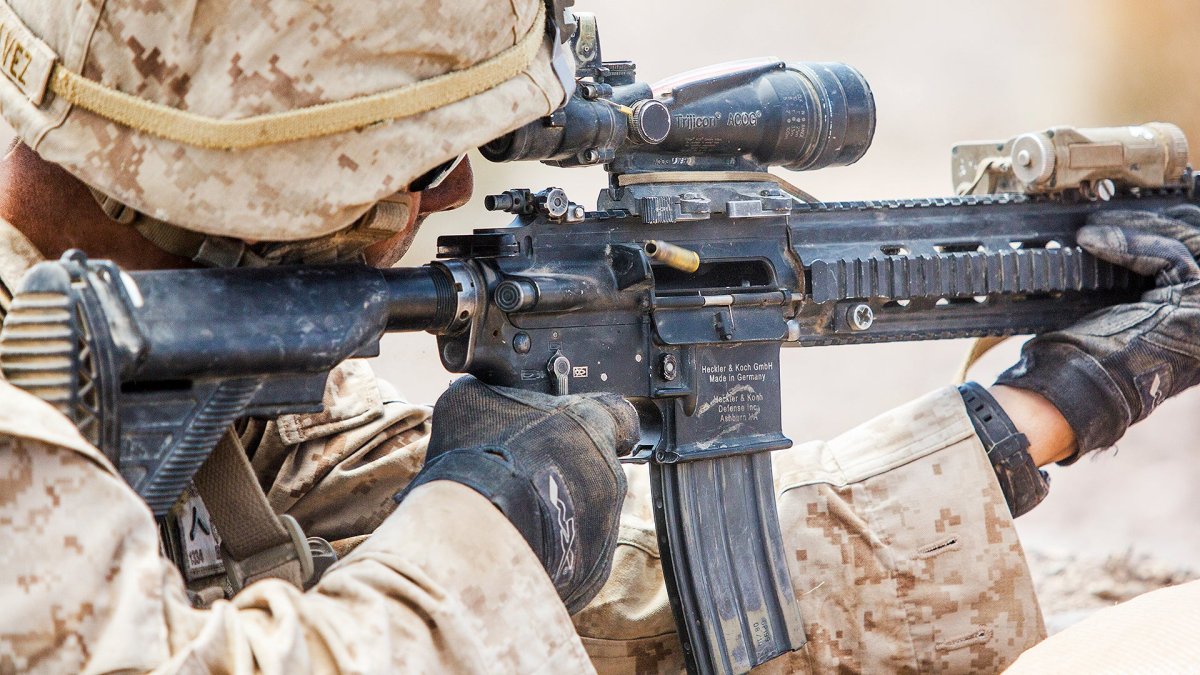
Marine firing M27 in full auto. Note the Trijicon optic, and bipod., USMC
The IAR competition, and the resulting M27 that came out of it, aimed to replace the belt-fed M249 Squad Automatic Weapon (SAW) with a lighter more conventional automatic rifle that put an emphasis on accuracy and range over raw volume of fire. It is a large departure from a fairly well proven and established model, but it’s just one example out of many regarding the changing ways in how USMC ground combat forces fight, and even how they are configured.
The M27 paired with a Trijicon 3.5X magnification ACOG sight and a bipod could reach out to 600 meters in a highly precise manner, and could perform area/suppressive fire out to 800 or so meters. Instead of carrying ammunition in 200 round box magazines or belts, the M27’s automatic rifleman would carry 20 30-round PMAGs that can also be used in M16s and M4s. The idea is that not only is the M27 less than half the weight of the SAW, but ammo could be more easily spread across a Fireteam. The M27s heavier contour 16.5 inch barrel and piston system could handle extended continuous fire, but it could also be extremely accurate, offering more maneuverability and overall flexibility.
The need for such a change came out of the lessons learned primarily in Afghanistan, where being able to hit a target at range was more useful than just spraying suppressive fire over closer ranges. The weight of the SAW, and it’s less than favorable handling at extremely close range has also been a long-time drawback for the weapon.
The M249 can weigh over 22 pounds with its magazine and optics, more than double that of a loaded out M27., USMC
After selecting the M27, the USMC spent the next few years deeply evaluating the weapon in multiple environments and combat-like situations. By 2011, four battalions that were deploying to Afghanistan were issued roughly 500 M27s as the exploration of the concept expanded into the operational realm. After glowing reviews from soldiers in the field, 6,500 M27 IARs were ordered, with all the rifles delivered by the end of 2013. Each Marine Fireteam has one automatic rifleman with an M27 or a M249 SAW, the SAW sticking around still for now as an option for certain missions where shear volume of fire is needed over the more balanced M27.
Then just this month, the USMC has put out an order for a whopping 11,000 M27s, which made some believe the Marines were looking to replace their assault rifles with the HK416 variant, or at least beginning to do so. There have been some signs that the Marine Corps may be interested in actually doing this. Just last November an entire battalion was equipped with M27s instead of M4s during an exercise as an experiment. Now it seems that the force wants to at least insert more M27s into arsenal, further increasing their Fireteams’ overall reach, accuracy, and if need be, volume of fire.
The M27s aren’t cheap, costing about four times that of the $750 M4, and the USMC moved to universally adopt the M4 for its rifleman over the M16 and longer barreled M16A4 just last year . As such it is unlikely the force will totally divest itself of M4s at this time, but it would seem that a slow, quiet transition could be afoot.
1st Marine Division Major General Daniel O’Donohue told Military.com the following last November:
“I think the fundamental is the accuracy of the weapon, the idea that you’re going to use it for suppressive fires. And at first contact you have the overwhelming superiority of fire from which all the tactics evolve… So it starts with the fire team and the squad, if you give them a better weapon with better fire superiority, you’ll just put that vicious harmony of violence on the enemy.
As for what those more involved with the actual trigger-pulling think of the weapon, Chief Warrant Officer Christian Wade, the infantry weapons officer for the 2nd Marine Division, stated simply:
“It is the best infantry rifle in the world, hands down … Better than anything Russia has, it’s better than anything we have, it’s better than anything China has. It’s world-class.”
While the USMC falls deeper in love with H&K’s take on the AR-15, the US Army is doing the same for its bigger brother, a derivative of the .308/7.62 chambered AR-10/LR308, the HK417. A variant of the type won the Army’s Compact Semi-Automatic Sniper System contract last April which aimed to replace the Knight’s Armament M110 , which itself replaced the venerable M24 (Remington 700) bolt-action sniper rifle about a decade ago. Dubbed the G28, H&K’s semi-automatic sniper rifle is lighter (by about 3 pounds) and shorter (by about 3 inches) than the M110, but has familiar layout and does not sacrifice anything in terms of accuracy. About 75 percent of the parts used in the G28 are interchangeable with the standard HK417.
The Army’s contract for roughly 3,650 sniper rifles is slated to cost $44.5 million, which works out to roughly $12,200 per rifle, although the contract includes other items, like support and spare parts. Either way, the G28 isn’t cheap to say the least, but the best never is.
So what’s next for H&K’s AR-15 like rifle that has reached near mythical status? There has been some rumors that the Army may look at it as a replacement for their M4A1s, but this is unlikely, or at least it was unlikely under the past administration. The M4A1 supposedly takes the lessons learned from Afghanistan and Iraq and incorporates them into an overhauled version of the M4 carbine, which itself is really a shorter version of the M16A2 with some other small alterations. The M4A1 includes a heavier profile barrel for better durability during sustained firefights. The M4’s selector switch, which has semi-auto or three round burst, has also been replaced with one that allows for fully automatic fire. Ambidextrous controls have also been added.
US Army soldiers on the range with their M4A1s, US Army
The M4A1, the latest government reboot of Eugene Stoner’s direct impingement design that had its roots in the special operations community, has had generally good reviews from the field, but it not comparable to the HK416. And even the M4A1 was slated for another light upgrade under the M4A1+ program , which would add a quad-rail handguard and free-floating barrel design for enhanced customization and accuracy. Other smaller changes were also included like detachable iron sights, pre-camouflaged parts, flash suppressor and improved trigger group. Now that the Army is shelving these plans, there may be an opportunity to introduce the HK416, even if in a limited manner, although the basic M4A1 upgrade path still has years to go and will presumably continue until the end of the decade.
When it comes to “big Army” procurement, price is key. Doling out $3,000 rifles to infantry would mark a monumental increase in what the Army spends on each soldier’s weaponry. Also, the massive Army bureaucracy has an absolutely miserable—so funny if it weren’t true—track record when it comes to following through with long and meandering small arms replacement initiatives. But now that may be changing, as the service did just pick a new sidearm after many years of trying, and a fairly unorthodox one at that. Also, change is clearly afoot in Washington when it comes to sequester and defense budgets. If the Trump Administration opens the floodgates on military spending, maybe the Army will trade in its Chevy Corvettes for Mercedes GTs—metaphorically speaking of course.
One thing is for certain, the HK416 and its many outgrowths is becoming the automatic rifle by which all others are judged. And considering it is packaged in a very American design concept, its penetration into the Pentagon’s small arms portfolio will only continue to deepen.
Contact the author: Tyler@thedrive.com
*Text updated to reflect Delta Force’s involvement in the genesis of the HK416.
Comments couldn’t be loaded. Please refresh the page.
更新于美国东部时间2020年7月3日凌晨4:07
从作战角度来看,这款步枪在美国军方的服役生涯始于特种作战部队的最高层,并因海豹突击队第六分队在击毙恐怖组织头目奥萨马·本·拉登的突袭行动中使用的突击步枪而闻名。如今,五年过去了,陆军和海军陆战队也选择了该步枪的改进型,但用途却截然不同。特别是海军陆战队,他们订购了数千支该型步枪,这些武器也代表着海军陆战队特种作战司令部(UMSC)战术的演变,而这种演变源于过去15年在中东持续不断的战争中汲取的惨痛教训。
德国小型武器制造商黑克勒-科赫(Heckler & Koch,简称H&K)以生产世界上最精良、最耐用的枪械而享誉全球,他们在设计方面也勇于突破常规。从率先将聚合物材料应用于战斗枪械,到其精准度极高的“柠檬榨汁机”P7系列手枪,再到专为水下作战潜水员设计的枪械,以及MP5冲锋枪、PSG狙击步枪、USP手枪和G3战斗步枪等传奇且广泛使用的武器,H&K的成就数不胜数。然而,在预算有限、采购流程繁琐的特种作战领域之外,H&K一直难以从五角大楼获得大订单。价格是主要原因。即使批量生产,H&K的枪械价格也相当昂贵。但随着HK416突击步枪的问世,这种情况正在逐渐改变。
对于一家向来在设计上特立独行的公司来说,再推出一款AR-15衍生枪型似乎显得过于平庸。然而,在陆军一级反恐部队——更为人熟知的“三角洲特种部队”(1st Special Forces Operational Detachment-Delta,简称“三角洲部队”)的推动下,最终却成就了一项极其明智的商业决策。HK416的设计以特种作战人员的需求为核心,沿用了AR-15的经典布局,但摒弃了尤金·斯通纳半个多世纪前发明的直接导气式系统。取而代之的是,它采用类似AK-47和H&K G36突击步枪的活塞式导气系统来完成射击循环。
气动活塞式AR-15步枪问世已有一段时间,并且越来越受欢迎。它们保留了AR-15的人体工程学设计和模块化特性,但操作更加流畅可靠。H&K公司在其气动活塞式AR-15衍生产品中加入了一系列小型配件,包括专用握把、枪托、后坐力缓冲系统、机械瞄具、四面导轨以及高强度钢制弹匣。但最重要的是,该设计采用了中等轮廓的比赛级枪管,并提供多种长度选择,枪膛内壁未镀铬,从而避免了影响精度。所有这些优势共同造就了一款极其易用、耐用、适应性强且可靠的步枪,让使用者倍感熟悉。最重要的是,它的精度非常高。HK416步枪与它的AR-15系列同系产品(如M-16、M4等)一样,使用5.56 NATO口径子弹。此外,H&K还开发了类似AR10/LR308的7.62 NATO/.308温彻斯特口径版本。这支步枪被命名为HK417。
尽管首批HK416步枪于本世纪中期交付特种作战司令部进行“测试”,最初由三角洲部队试用,但在2011年5月2日海豹突击队第六分队击毙本·拉登时,HK416在特种作战司令部内部仍然相当罕见。完成任务的正是HK416。消息泄露后,人们对HK416的兴趣激增,但这款步枪的命运早已注定。它在枪械和特种作战圈内的声誉早已如日中天,来自世界各地和美国本土的其他特种作战部队和执法单位也开始为其最精锐的特战队员采购HK416。H&K公司还为民用市场开发了性能略有降低的半自动型号——MR556和MR308。
在2000年代中后期,当美国特种作战司令部(SOCOM)对HK416步枪进行测试时,美国海军陆战队也在评估其衍生型号,这也是他们长达十年的步兵自动步枪(IAR)计划的一部分。大约有六家竞争者提交了设计方案以满足海军陆战队的需求。到2009年,H&K公司的方案最终胜出,并很快被命名为M27。
海军陆战队员正在使用M27全自动步枪射击。请注意Trijicon瞄准镜和两脚架。美国海军陆战队
IAR竞标以及最终胜出的M27步枪旨在用一款更轻便、更常规的自动步枪取代使用弹链供弹的M249班用自动武器(SAW),这款步枪更注重精度和射程而非单纯的射速。这与一款久经考验的成熟型号截然不同,但这只是美国海军陆战队地面作战部队作战方式乃至编制配置发生变化的众多例证之一。
M27 搭配 Trijicon 3.5 倍 ACOG 瞄准镜和两脚架,可在 600 米范围内实现高精度射击,并可在 800 米左右进行区域/压制火力压制。M27 的自动步枪手无需携带 200 发弹匣或弹链,而是携带 20 个 30 发 PMAG 弹匣,这些弹匣也可用于 M16 和 M4 步枪。M27 的设计理念是,其重量不到 SAW 的一半,而且弹药更容易在火力小组内分配。M27 的 16.5 英寸重型枪管和活塞系统使其能够承受长时间的连续射击,同时还能保持极高的精度,从而提供更好的机动性和整体灵活性。
这种改变的必要性主要源于阿富汗战争的经验教训。在阿富汗,远距离精准打击目标比近距离压制射击更有用。此外,SAW机枪的重量以及近距离操控性不佳也是其长期以来的缺点。
M249步枪加上弹匣和光学瞄具后重量超过22磅,是满载M27步枪的两倍多。(美国海军陆战队)
在选定M27之后,美国海军陆战队在接下来的几年里,在多种环境和模拟实战情况下对该武器进行了深入评估。到2011年,即将部署到阿富汗的四个营已配发了约500支M27步枪,标志着该概念的探索已扩展到作战层面。在获得一线士兵的高度评价后,海军陆战队订购了6500支M27 IAR步枪,所有步枪均于2013年底交付完毕。每个海军陆战队火力小组都配备一名自动步枪手,装备M27或M249 SAW自动步枪。目前,SAW仍作为某些需要比火力更均衡的M27提供更大火力输出的任务的备选方案。
就在本月,美国海军陆战队订购了多达11000支M27突击步枪,这让一些人认为海军陆战队正计划用HK416的衍生型号替换现有的M4突击步枪,或者至少已经开始着手这项工作。一些迹象表明,海军陆战队可能确实有意这样做。就在去年11月,一个营在一次演习中被换装为M27突击步枪,作为一项试验。现在看来,海军陆战队至少希望在武器库中增加M27突击步枪的数量,从而进一步提升其火力小组的整体射程、精度,并在必要时增强火力。
M27步枪价格不菲,大约是750美元M4步枪的四倍。美国海军陆战队去年才开始全面采用M4步枪取代M16和长枪管的M16A4步枪。因此,目前海军陆战队不太可能完全弃用M4步枪,但缓慢而悄然的过渡似乎正在进行中。
美国海军陆战队第一师少将丹尼尔·奥多诺霍去年11月告诉Military.com网站以下内容:
我认为最根本的是武器的精准度,以及将其用于压制火力的理念。在最初接触时,你拥有压倒性的火力优势,所有战术都由此展开……所以一切都始于火力小组和小队,如果你给他们更好的武器和更强的火力优势,你就能将这种猛烈的火力压制在敌人身上。
至于那些实际扣动扳机的人对这种武器的看法,第二海军陆战师步兵武器官克里斯蒂安·韦德准尉简单地说道:
“毫无疑问,这是世界上最好的步枪……比俄罗斯的任何步枪都好,比我们任何步枪都好,比中国的任何步枪都好。它是世界一流的。”
美国海军陆战队对H&K公司生产的AR-15步枪情有独钟,而美国陆军则对其“大哥”——基于.308/7.62口径AR-10/LR308步枪衍生而来的HK417——青睐有加。去年四月,HK417的衍生型号赢得了陆军的紧凑型半自动狙击系统合同,该合同旨在取代奈特军械公司生产的M110狙击步枪。M110本身也是在大约十年前取代了久经考验的M24(雷明顿700)栓动式狙击步枪。H&K公司生产的这款半自动狙击步枪被命名为G28,它比M110更轻(约3磅)更短(约3英寸),但布局相似,精度也毫不逊色。G28使用的零件约有75%可以与标准的HK417互换。
陆军订购约3650支狙击步枪的合同总价为4450万美元,平均每支步枪约12200美元,不过合同还包括其他项目,例如支持和备件。无论如何,G28的价格都不便宜,但最好的东西从来都不是便宜的。
那么,这款被誉为近乎神话般的H&K AR-15式步枪,下一步又将何去何从呢?坊间传闻,陆军可能会考虑用它取代现有的M4A1步枪,但这不太可能,至少在上一届政府执政期间不太可能。据说,M4A1吸取了阿富汗和伊拉克战争的经验教训,并将其融入到M4卡宾枪的改进版本中。而M4卡宾枪本身实际上是M16A2的短款版本,并做了一些其他的小改动。M4A1配备了更粗的枪管,以提高其在持续交火中的耐用性。M4的半自动或三发点射选择开关也被替换成了可以进行全自动射击的开关。此外,它还增加了左右手均可操作的控制装置。
美国陆军士兵在靶场上使用M4A1步枪,美国陆军
M4A1是政府对尤金·斯通纳设计的直接导气式步枪的最新改进,该设计源于特种作战部队。M4A1在实战中总体评价良好,但与HK416相比仍有差距。M4A1原本计划在M4A1+计划下进行一次轻度升级,增加四面导轨护木和自由浮动式枪管,以增强定制化程度和精度。其他一些小改动还包括可拆卸机械瞄具、预涂迷彩部件、消焰器和改进型扳机组。如今陆军搁置了这些计划,或许有机会引入HK416,即便规模有限。不过,M4A1的基本升级计划仍需数年时间才能完成,而且很可能会持续到本十年末。
对于“大规模陆军”采购而言,价格至关重要。如果给步兵配发价值3000美元的步枪,陆军在每名士兵武器装备上的支出将大幅增加。此外,庞大的陆军官僚机构在推进冗长而曲折的小型武器更换计划方面,有着极其糟糕的记录——如果不是事实,简直令人啼笑皆非。但现在情况可能正在改变,因为经过多年的尝试,陆军终于选定了一款新的手枪,而且是一款相当非传统的手枪。同时,华盛顿在自动减支和国防预算方面也显然正在酝酿变革。如果特朗普政府大幅增加军费开支,或许陆军会用雪佛兰克尔维特跑车换成奔驰GT跑车——当然,这只是个比喻。
可以肯定的是,HK416及其众多衍生型号正逐渐成为衡量其他自动步枪的标杆。考虑到它采用了非常美国化的设计理念,它在五角大楼轻武器装备体系中的渗透率只会继续加深。
联系作者:Tyler@thedrive.com
*文本已更新,以反映三角洲部队参与 HK416 的诞生。
评论加载失败,请刷新页面。