The U.S. Navy Has A Critically Important Submarine Test Base Tucked Away In Alaska美国海军在阿拉斯加州深处藏着一个至关重要的潜艇试验基地。
Not since the Cold War has underwater stealth tech been so important and a remote test site in Alaska makes sure U.S. Navy subs remain invisible.
Updated Aug 15, 2018 7:28 PM EDT
If you venture just north of Ketchikan, Alaska, around the picturesque Behm Canal, you may stumble upon something very unexpected—the sinister black silhouette of a nuclear fast attack or ballistic missile submarine.
The waterway is the home of the United States Navy’s Southeast Alaska Acoustic Measurement Facility, more commonly known as SEAFAC. Built in 1991, it’s located roughly 675 miles from the major submarine bases in Washington State. For years it seems its existence was kept relatively hush-hush, although locals clearly knew a major submarine testing facility had been established. But to this very day, the place catches people off-guard. I have received roughly a half-dozen emails over the years from various individuals, from pilots to visitors to the area, who wondered why they saw a huge submarine plowing the waters in a fjord near Ketchikan.
SEAFAC is where new technologies and equipment configurations are tested aboard multi-billion dollar American nuclear submarines and where their acoustic signature is measured while underway.
Acoustic signature—literally the noise something makes—is the primary survivability factor of a modern submarine. Every aspect and component of a submarine’s construction takes this reality into account. And it’s not just about quieter mechanical systems, pump-jets, or coatings on a submarine’s hull, but also about how systems are mounted inside a submarine to isolate vibrations and sound waves as well. Even the shape of a submarine and the water flowing around it can be a noise factor.
Just like how the military aerospace research and development community has a vast array of facilities related to signature management—including radar cross-section test facilities , flying infrared and radar signature evaluation testbeds, anechoic chambers , live-flight radar signature evaluation ranges, infrared signature live-fire ranges , and even soundstage-like facilities used to test various forms of sensor engagement technology—submarines have a similar, albeit less well-known test and evaluation infrastructure.
This includes a key submarine test facility in Idaho that I profiled in this story from four years ago. Other testing installations can be found in the eastern United States and in the Bahamas, each with various capabilities and missions, but SEAFAC focuses exclusively on the most critical element of a submarine’s survivability.
Behm Canal is an ideal setting for an underwater acoustic test range because it is shielded from the ocean and from large amounts of vessel traffic, and thus from ambient noise. Its basin is also ideal, with a smooth tub-like contour that provides as close to lab-like acoustic conditions as possible. It can also be cordoned off relatively easily when tests are underway.
The facility allows for static and dynamic acoustic tests, the latter of which can take place throughout the submarine’s performance envelope. Two acoustic arrays are attached to the seafloor, which has a depth of roughly 1250 feet, to capture a submarine’s audible signature as it travels back and forth across the canal while executing various test profiles.
The Navy describes this range as such :
“The Underway Measurement Site acquires the signature of the ship while it is moving through the water. Measurements during movement ensure that propulsion and flow noises can be captured. The measurement process is slow and takes about 30 minutes to conduct 6 minutes of data acquisition for every single measurement. The remainder of the time is spent repositioning the ship for the next measurement. Typically, a submarine will spend two to five days conducting underway testing.”
You can read more about the range’s acoustic arrays, which were upgraded in 2006 and are called High Gain Measurement Systems (HGMS), as well as how they are installed, here .
Navy document linked above.
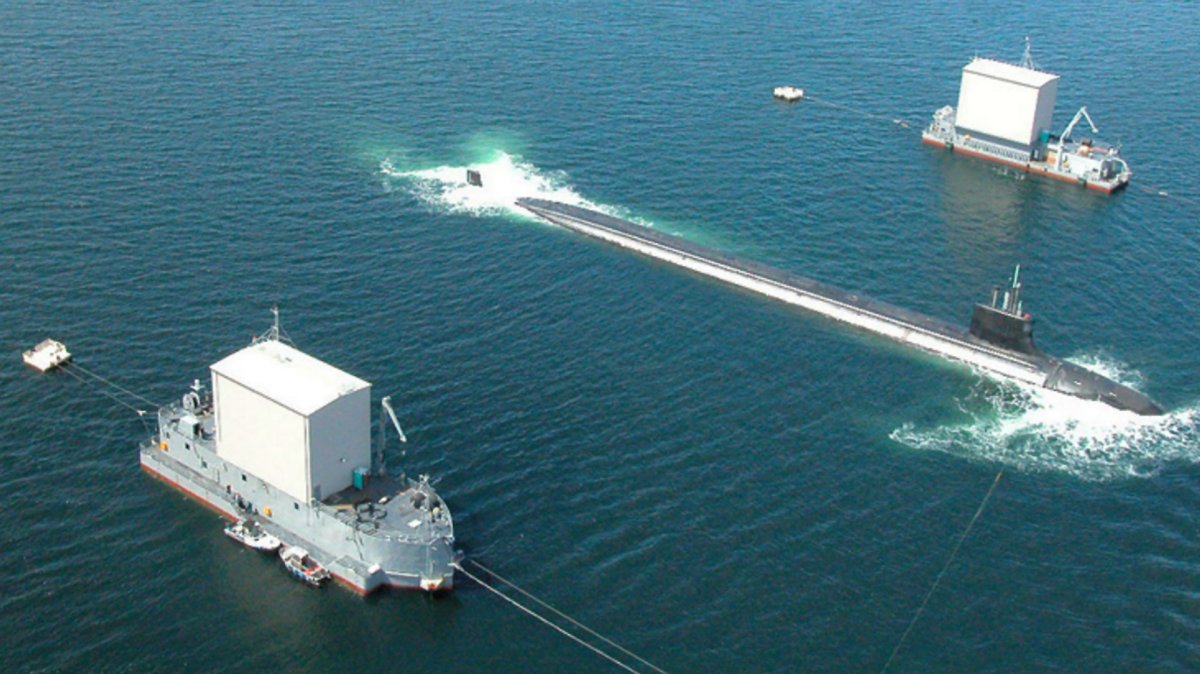
There is also a pair of custom barges that provides support for static tests. These tests can include an entire submarine or components of a submarine being submerged while suspended on cables between two hydrophone arrays at various depths. The barges can provide external power to the submarine so that all but the systems being evaluated can be turned off while testing occurs.
In some cases, a full submarine isn’t needed for these evaluations and just a unique piece of machinery or mounting concept can be tested on its own before being installed aboard a submarine and evaluated in an integrated manner.
The Navy explains how the static site works in some detail:
“At the Static Site, suspension barges lower the submarine on cables to hold it in a stable position. The submarine can be suspended at various depths to evaluate how sea pressure affects the acoustic signature. The Static Site primarily measures the signature of rotating equipment onboard the vessel. The vessel does not have to maneuver so the testing can be conducted more rapidly. Also, better communication lines exist between the vessel and the Operations Center, therefore, the testing is more controlled and efficiently conducted. Typically, the submarine will spend one to seven days conducting Static Site testing.”
A data analysis site and general base of operations is located on Back Island which sits on the eastern edge of the restricted test area.
From data collected at SEAFAC, the performance of new components and submarines both new and old can be evaluated and signature control practices and methods can be developed, validated, and improved upon. There also is a validation aspect to SEAFAC’s mission, wherein submarines that have undergone overhauls or major work can have their acoustic signature thoroughly checked before heading out on patrols. The facility also does some work with surface vessels as well and continues to receive upgrades as America realigns its naval forces for high-end peer-state naval combat in the future.
With all this in mind, and considering that U.S. Navy submarines carry the country’s second-strike nuclear deterrent and provide critical intelligence-gathering abilities in addition to some of their more traditional tactical purposes , this unassuming test range north of Ketchikan is an incredibly valuable tool for U.S. Navy.
The submarine can fight where no other vessel can—as long as it remains undetected. With SEAFAC’s help, the future of American underwater stealth technology is better assured.
Contact the author: Tyler@thedrive.com
Comments couldn’t be loaded. Please refresh the page.
更新于美国东部时间2018年8月15日晚上7:28
如果你冒险前往阿拉斯加州凯奇坎以北风景如画的贝姆运河附近,你可能会偶然发现一些意想不到的东西——一艘核动力快速攻击潜艇或弹道导弹潜艇的阴森黑色轮廓。
这条水道是美国海军东南阿拉斯加声学测量设施(简称SEAFAC)的所在地。该设施建于1991年,距离华盛顿州的主要潜艇基地约675英里。多年来,它的存在似乎一直秘而不宣,尽管当地人显然知道这里建立了一个大型潜艇测试设施。但直到今天,这个地方仍然会让人感到意外。这些年来,我收到过大约六封来自不同人士的电子邮件,包括飞行员和来此地的游客,他们都好奇为什么在凯奇坎附近的一个峡湾里看到一艘巨大的潜艇在水面上航行。
SEAFAC 是测试价值数十亿美元的美国核潜艇上的新技术和设备配置的地方,也是测量其航行中声学特征的地方。
声学特征——也就是物体发出的声音——是现代潜艇生存能力的首要因素。潜艇建造的每一个方面和部件都充分考虑了这一点。这不仅关乎更安静的机械系统、喷水推进器或潜艇艇体涂层,还关乎潜艇内部系统的安装方式,以隔离振动和声波。甚至潜艇的形状和周围水流也会影响噪声。
就像军用航空航天研发界拥有大量与特征管理相关的设施——包括雷达横截面测试设施、飞行红外和雷达特征评估测试平台、消声室、实弹飞行雷达特征评估靶场、红外特征实弹射击靶场,甚至还有用于测试各种传感器交战技术的类似录音棚的设施——潜艇也拥有类似的测试和评估基础设施,尽管这种基础设施不太为人所知。
这其中包括位于爱达荷州的一处重要的潜艇测试设施,我曾在四年前的报道中对其进行过介绍。其他测试设施则分布在美国东部和巴哈马群岛,每个设施的功能和任务各不相同,但SEAFAC专注于潜艇生存能力中最关键的要素。
贝姆运河是水下声学测试场的理想场所,因为它与海洋和大量船舶交通隔绝,因此也免受环境噪声的干扰。其水池也十分理想,光滑的桶状轮廓能够提供尽可能接近实验室的声学条件。此外,在测试进行时,也可以相对容易地将其封闭起来。
该设施可进行静态和动态声学测试,后者可在潜艇的整个性能范围内进行。两套声学阵列安装在约1250英尺深的海底,用于捕捉潜艇在运河中来回航行并执行各种测试程序时的声学特征。
海军对这一范围的描述如下:
“水下测量站会在舰艇航行时采集其特征信号。航行中的测量可以确保捕捉到推进系统和水流噪声。测量过程较为缓慢,每次测量需要约30分钟才能完成6分钟的数据采集。剩余时间用于调整舰艇位置以进行下一次测量。通常情况下,潜艇需要花费两到五天的时间进行水下测试。”
您可以在这里阅读更多关于该靶场声学阵列的信息,这些阵列在 2006 年进行了升级,被称为高增益测量系统 (HGMS),以及它们的安装方式。
以上链接为海军文件。
此外,还有两艘定制驳船,用于支持静态测试。这些测试可以包括将整艘潜艇或潜艇部件悬挂在两组不同深度的水听器阵列之间,并通过缆绳将其下潜。驳船可以为潜艇提供外部电源,以便在测试期间关闭除待测系统以外的所有系统。
在某些情况下,这些评估不需要完整的潜艇,只需对独特的机械部件或安装概念进行单独测试,然后再将其安装到潜艇上进行综合评估即可。
海军详细解释了静态网站的工作原理:
在静态测试场地,悬吊驳船通过缆绳将潜艇缓缓放下,使其保持稳定。潜艇可以悬停在不同深度,以评估海压对声学特征的影响。静态测试场地主要测量艇上旋转设备的声学特征。由于潜艇无需机动,测试可以更快地完成。此外,潜艇与作战中心之间拥有更完善的通信线路,因此测试过程更加可控高效。通常,潜艇在静态测试场地进行测试需要一到七天的时间。
数据分析站点和一般行动基地位于禁区东缘的巴克岛上。
通过SEAFAC收集的数据,可以评估新旧潜艇及新型部件的性能,并开发、验证和改进声呐特征控制方法。SEAFAC的任务还包括验证工作,即对经过大修或重大改装的潜艇进行彻底的声呐特征检查,确保其在执行巡逻任务前达到最佳状态。该设施也为水面舰艇提供服务,并随着美国未来为应对高端海战而调整海军力量,持续进行升级改造。
考虑到所有这些因素,以及美国海军潜艇除了承担一些更传统的战术用途外,还承载着该国的二次核打击威慑力量并提供关键的情报收集能力,位于凯奇坎北部这个不起眼的试验场对于美国海军来说是一个极其宝贵的工具。
只要不被发现,潜艇就能在其他舰艇无法到达的地方作战。有了SEAFAC的帮助,美国水下隐身技术的未来更有保障。
联系作者:Tyler@thedrive.com
评论加载失败,请刷新页面。