An Army Marches On Its Stomach And A Fleet Deploys On Maintenance, Especially Its Carriers军队靠粮食行军,舰队靠维护部署,尤其是航母。
Surging carriers and other Navy ships comes at a big cost that must be paid down the line the form of disruptive and time-consuming deep maintenance.
By Chris "Ox" Harmer
Updated Dec 1, 2019 5:55 AM EST
“An army marches on its stomach.” This truism of military mobility from the pre-industrial era has been attributed to both Napoleon Buonaparte and Frederick the Great. Nobody is sure if either actually said it, but both certainly experienced the reality of the maxim. In their time, not only did the vast armies of the era move by foot on the battlefield, they moved by foot to the battlefield. It was not uncommon for infantrymen to march hundreds of miles between major battles, and all that marching meant the soldiers had to be adequately fed. If they weren’t, they died of starvation, sickness, or were too weak to fight effectively and were slaughtered en masse, which is exactly what happened to Napoleon’s Grande Armée as a result of his poorly resourced invasion of Russia.
I was reminded of this pithy saying recently when I read that the US Navy aircraft carrier USS Harry S. Truman (CVN-75) would be leaving on its third deployment in just four years. While Navy officials insist the deployment was planned in advance, the fact that it was announced shortly after the USS Dwight D. Eisenhower (CVN-69) finished up an 18 month-long maintenance period that was originally scheduled for six months sparked speculation that the Navy was deploying the Truman to cover for the fact that Eisenhower simply wasn’t able to deploy.
In the same way that pre-industrial armies marched on their bellies, modern navies deploy on their shipyard maintenance cycles. Modern warships require a lot of maintenance, both for the physical and mechanical components of the ship, as well as for the advanced electronic combat systems. Scheduled maintenance cycles can be delayed, deferred, or shortened, but that inevitably results in more expensive maintenance down the line, and a decrease in net operational availability for the ship overall. This is a reality the U.S. Navy is encountering with increasing frequency, as a result of just under two decades of high operational tempo deployments following the attacks on 9/11.
While the Navy has not necessarily skipped maintenance across the fleet, the high operational tempo has generated a massive maintenance backlog. Whether the maintenance backlog is a result of inadequate programmed maintenance or excessive operational wear and tear, the net result is the same. The Navy has a massive pile of deferred maintenance that will take years to work off. As a result, it is reasonable to conclude that it has less “surge capacity” now than at any time since the end of the Cold War.
USS Harry S. Truman (CVN-75)., USN
Was The Truman Really Scheduled For Three Deployments In Four Years?
For obvious security reasons , the Navy does not publish ship deployment schedules. In this age of instantaneous communication, an aircraft carrier deployment can’t possibly be hidden. Once it deploys, it is common knowledge, but there is no need to give potential adversaries a long-lead heads up on which ships are deploying when.
For equally obvious operational reasons, sometimes those ship deployment schedules are adjusted. For example, shortly after the attacks of 9/11, the Navy surged a total of six Carrier Strike Groups to participate in Operation Enduring Freedom (OEF). So, ship deployment schedules are set in advance by Navy leadership, not shared publicly, and are adjusted to meet operational requirements. With that said, there is no reason to doubt the Navy officials who say that Truman was always scheduled for this third deployment in four years, following missions to the Middle East in 2015 and 2018. But whether or not Truman was actually scheduled for this most recently announced deployment, or was surged to cover for the non-availability of Eisenhower , is a distinction without a difference.
The fact remains, Eisenhower is not available for deployment because a planned six month maintenance period turned into an 18 month maintenance period. While the ship itself is now out of drydock and physically capable of operating at sea, it is not remotely ready to deploy. The Eisenhower can float, but floating and fighting are two different things. It takes a lot of time and practice to get the ship’s equipment calibrated, the ship’s crew retrained, the air wing integrated, etc. Throw in combined training for the support vessels and the command staff, and the Eisenhower Carrier Strike Group is at least six months from being deployable, probably closer to a year.
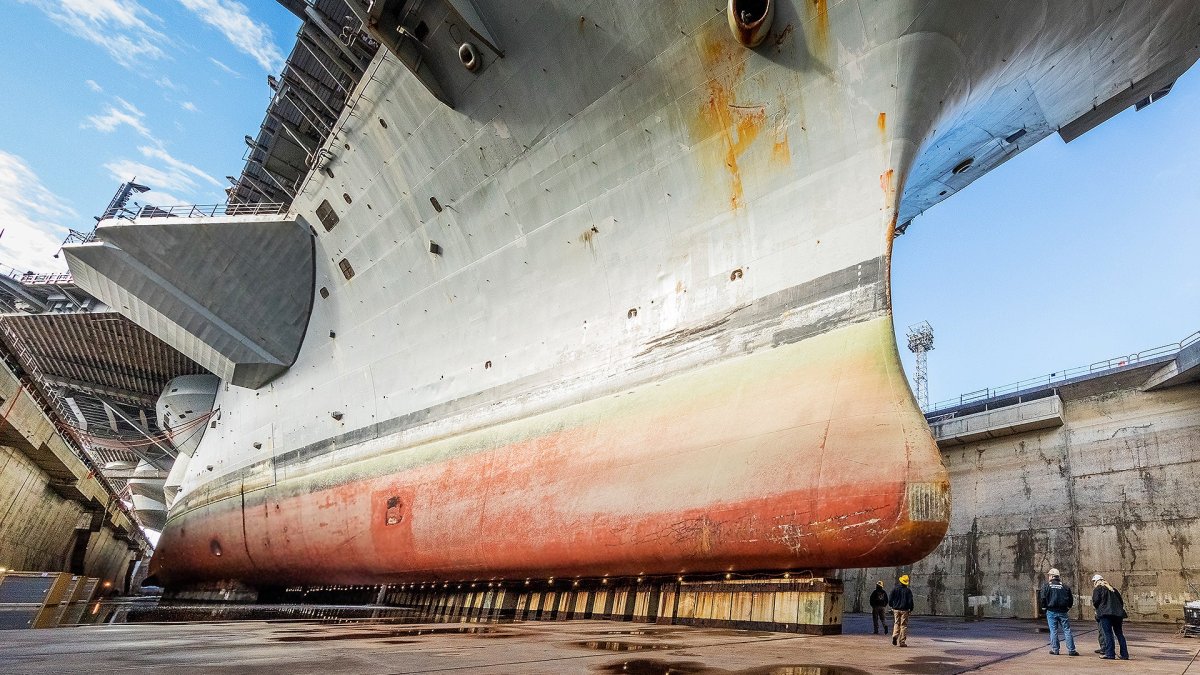
USS Dwight D. Esenhower in drydock., USN
Eisenhower’s Refueling and Complex Overhaul
The longest and most complicated maintenance period in a carrier’s lifespan occurs about halfway through its expected 50-year service life when the Refueling and Complex Overhaul (RCOH) maintenance takes place. Readers may recall that Navy leadership recently threatened to cancel Truman’s RCOH. It’s a complex issue, but in reality, the Navy never had any intention of retiring Truman early. It was simply a budget maneuver to try to force Congress to fully fund both the carrier procurement program as well as the carrier maintenance program. The White House quickly put its foot down on its own Pentagon’s budget request to sideline the carrier.
The RCOH centers around refueling the twin nuclear reactors that power the carrier plus inspecting, repairing, replacing, or rebuilding virtually every major component on the ship. It is an extremely complicated and expensive evolution and takes about four years to accomplish. Eisenhower started its RCOH in early 2001 and came out of the yards in 2005. At that point, in terms of materiel condition, it was the most capable carrier in the Navy, and it was returned to the fleet just in time to get tasked with multiple back to back-to-back deployments to the Middle East.
Eisenhower conducts hard turns during a shakedown period after being returned to service following a maintenance period in 2011. , USN
Groundhog Decade And The Never-Ending Deployment: 2005 To 2017
Eisenhower exited RCOH just as several other carriers were reaching the limits of their mechanical endurance. Keep in mind, while the Navy advertises a “surge capacity” for aircraft carriers, and executed that surge capacity in 2001-2002 for Operation Enduring Freedom (OEF), and again in 2003-2004 for Operation Iraqi Freedom (OIF), that surge capacity comes with a big maintenance bill.
Every time a carrier surges on an unplanned deployment, it inevitably racks up maintenance gripes that have to be worked off back in the shipyard. For Eisenhower , it became the backfill carrier that got tagged to cover the dip in carrier availability following the unscheduled surges from 2001-2004. As a result, Eisenhower deployed in 2006, 2009, 2010, 2012, 2013 and 2016.
Most people reading this article will understand that those deployments were packed with combat sorties over Afghanistan, Iraq, Syria, and Libya. Keeping a high operational tempo going—like six wartime deployments in ten years—takes its toll on even the most robust equipment. Such was the case with Eisenhower .
Eisenhower started that never-ending deployment cycle fresh off the RCOH, with brand new or reworked equipment. 12 years later, it was in dire need of major maintenance.
Hornets launch from the Ike during a 2009 deployment to the CENTCOM area of operations. , USN
How A Six Month Shipyard Maintenance Period Turned Into 18 Months
Any modern warship is a complicated piece of machinery. A nuclear aircraft carrier is the most expensive and complicated piece of machinery on earth. There is a certain amount of service life in it, and the more you use it, the harder you work it, the sooner that service life is depleted. If you drive it to the breaking point, it will take time and effort to rebuild it. So, between the fact that the Eisenhower is at year 42 of its programmed 50-year service life, and the decade-long world tour it just completed, by the time it went into the shipyard for its planned six month maintenance period, a lot of other problems were just waiting to be discovered.
And discovered they were.
Eisenhower entered the Norfolk Naval Shipyard in August of 2017 and did not return to seagoing status until March of 2019. Ships go into the shipyard with a list of known problems and planned maintenance. If everything goes right, the planned maintenance fixes the known problem and that’s that. For Eisenhower , on the tail end of over a decade of high operational tempo and in the twilight of her career, it was assumed that some unexpected problems would crop up once the ship was in drydock. But nobody thought the maintenance issues would be as extensive as they were.
As soon as Eisenhower was in the shipyard, and opened up for repairs, a host of other, unforeseen problems came into view. At that point, the only responsible option was to fix all the problems that were uncovered, which in this case extended the maintenance period from six months to 18 months.
The stern, rudder, and screws of Eisenhower seen while in drydock., USN
Inadequate Maintenance Facilities Are Also To Blame
There is no mystery here. What happened to Eisenhower was completely predictable and the same or similar problems are presenting across the fleet on other platforms. While the obvious cause of the problem is excessive deployments, inadequate maintenance facilities are also to blame. The Navy force structure is currently about 280 commissioned warships, with an extremely ambitious plan of growing the fleet to 355 commissioned warships in just 15 years. But as this article shows, that goal of a 355 ship Navy seems wildly unrealistic, given the current woeful state of Navy support infrastructure, specifically shipyards capable of executing heavy, in-depth maintenance and repairs.
Considering that the Navy’s current maintenance infrastructure is inadequate to execute a maintenance plan for 280 ships, absent a truly sustained investment in building shipyard and maintenance capacity, the Navy won’t be able to sustain a fleet of 355 ships, even if it gets them built, which seems unlikely at this point.
The problem of inadequate maintenance facilities is most apparent with the attack submarine force. According to the General Accounting Office, inadequate capacity at Navy shipyards certified to work on nuclear attack submarines has resulted in a significant maintenance backlog for those platforms. As a result, USS Boise (SSN-764), has not been certified to dive, let alone deploy, for two years while awaiting maintenance. In total, Navy attack submarines have lost over two decades of operational availability while waiting pier-side for maintenance.
Those submarines that are not in a deployable status while waiting for repairs are carried on the books as commissioned warships of the U.S. Navy, but are not capable of deployed operations. The Navy pays the financial cost of keeping the ships in commission, but gets no operational utility out of them because they are not deployable. As Napoleon said, an army marches on its belly. Likewise, a fleet deploys, or in this case, does not deploy, on the basis of its shipyard maintenance program.
USS Boise photographed during better days while deployed in 2014. , USN
Why Is Unscheduled Carrier Maintenance A Problem?
Henry Kissinger famously said that the first question during any crisis was “Where are the carriers?” To paraphrase another one of his sayings, “An aircraft carrier is 100,000 tons of diplomacy.” Point being, aircraft carriers are unique in the U.S. force structure in terms of executing both “tip of the spear” force projection as well as less kinetic, but still important “presence” missions.
Exercises with allied navies and port calls to “show the flag” remind potential foes, with the exception of Russia and China, that if a Navy aircraft carrier deploys to any given region in the world, on arrival it is the most capable air force in that area. Aircraft carriers are not important to U.S. strategy—they are indispensable and irreplaceable. Nothing else can do what they do.
Due to a whole lot of deferred maintenance, the Navy has fewer deployable aircraft carriers right now than at any time since the end of the Cold War. At a glance, Eisenhower is not deployable as previously discussed. USS Nimitz (CVN-68) just got out of the shipyards in Washington State, and like Eisenhower , is at least six months from deployability, and probably closer to a year. USS Carl Vinson (CVN-70) just entered the shipyards in Washington for a planned maintenance period. USS George Washington (CVN-73) just entered drydock in Norfolk and is out of service for at least four years for RCOH. USS George H.W. Bush (CVN-77) is in the shipyards in Norfolk for maintenance.
Finally, the Navy’s newest aircraft carrier, the USS Gerald R. Ford (CVN-78) was commissioned in 2017, but is nowhere near ready for deployment. Ford recently experienced some serious emergent problems with its propulsion plant , as well as the ongoing chronic problems with its completely redesigned and technologically advanced aircraft launch and recovery systems, and a litany of other issues.
That leaves a maximum of five carriers available for deployed operations. To be clear, it would be extremely difficult, if not impossible, for all five to deploy at once. Point being, with six of 11 carriers either in maintenance, or doing post maintenance workups, it is possible that the remaining five deployable carriers will experience an extremely high operational tempo which may, in turn, lead to deferred maintenance accumulating as was the case with Eisenhower . While this worst-case scenario is not inevitable, it is certainly plausible, and if it takes place, it will result in a death spiral of decreased availability and readiness that will be very difficult to recover from.
To be clear, the current situation is not permanent and hopefully will prove to be the exception, rather than the rule. Navy leadership has clearly committed to working off the deferred maintenance issues and is working hard to protect the carriers from being tasked with anything other than regularly scheduled deployments, in order to restore a surge capacity. With that said, the increasingly dire situation paired with the dream of reaching a 355 ship fleet in the coming decades, resulted in the Navy recently looking into the possibility of bringing the USS Kitty Hawk (CV-63) back in to service, 58 years after it was commissioned, and nearly a decade after it was decommissioned.
While bringing a 58-year old decommissioned aircraft carrier back to life was deemed unrealistic in the end, keeping the USS Nimitz (CVN-68) in commission past its expected 50-year life span is not. Nimitz is scheduled to be decommissioned in 2023, and as this article observes, the Navy is taking a serious, in-depth look at what it would take in terms of maintenance support to extend the operational service life of Nimitz beyond that. Extending the service life of a class of ships beyond its planned duration is not limited to carriers. The Navy is also looking at extending the service life of surface combatants , as well.
USS West Virginia (SSBN-736) departs Norfolk Naval Shipyard in Portsmouth, Virginia. The Navy is finally trying to improve the crumbling infrastructure that is tasked with keeping its fleet alive. , USN
A Constant Tension Between Presence, Combat Operations, Surge Capacity, and Sustainability
The fundamental issue that is playing out here is the constant tension between what Combatant Commands (COCOMs) want and what Navy leadership wants. In a time of war, COCOMs are responsible for fighting the conflicts our country is engaged in. During peacetime, COCOMs are responsible for maintaining our alliances and deterring our enemies. In contrast, Navy leadership is tasked with “manning, training, and equipping” the fleet. In other words, the Navy prepares the fleet for deployment, then once those ships actually deploy, it turns them over to the COCOMs for employment, whether that is peacetime presence, alliance building, exercises, or wartime combat operations.
Inevitably, COCOMs always want as much carrier presence in their Area of Responsibility (AOR) as possible. In peacetime, there is an almost limitless demand signal by our allies to have engagement with Navy aircraft carriers. For example, both South Korea and Japan are acquiring F-35s. Japan is also modifying its helicopter carriers to support F-35 operations. As Japan and South Korea develop their abilities to operate F-35s, they will want to exercise, demonstrate, and validate that skill set by operating at sea with Navy carriers and/or amphibious assault ships operating Marine Corps F-35Bs.
There are a dozen other peacetime scenarios involving carriers from high-profile exercises, such as the biennial Rim of the Pacific exercise (RIMPAC) with its always entertaining live-fire Sinking Exercises (SINKEX) , to more mundane peacetime operations like port calls in Singapore, a country that is also acquiring F-35s and will undoubtedly want more exercises with the US Navy as a result.
At the same time, our allies are asking for US Navy carrier presence in order to exercise their ability to operate with us and to validate their status as allies. U.S. forces are also engaged in combat operations in Afghanistan, Iraq, and Syria. The current pace of operations is low enough that the Air Force can handle manned strike operations in Syria without any help from the Navy, but this is the exception, rather than the rule. Be that as it may, this relative lull in combat operations is almost certainly temporary.
In addition to peacetime presence operations and wartime combat operations, there is the issue of Iran. The U.S. is not at war with Iran, but the ongoing tension between the two countries results in a constant demand signal for aircraft carriers to be physically present in the Persian Gulf to serve as a deterrent to further aggression. While the USS Abraham Lincoln (CVN-72) was always scheduled to spend at least part of this year deployed in the Persian Gulf, its deployment to the region was accelerated in May to respond to an updated threat assessment by the U.S. Intelligence Community (IC). Lincoln has been in the US Central Command (CENTCOM) AOR since then and will be for some time to come.
What the COCOMs want is maximum carrier availability in their AOR. What Navy leadership wants is to meet their legal mandate to maintain, train, and equip the Navy, and preserve the long-term materiel viability and surge capacity of the fleet. The more the COCOMs use the carrier fleet, the less “surge capacity” there is. These demand signals are in constant tension.
USS Ronald Reagan alongside Japan’s ‘helicopter carrying destroyer’ Izumo . The ship is going to be refitted to accommodate F-35Bs. The Reagan will eventually receive F-35Cs, as well. , USN
Rotational Deployments, Fleet Response Plan, And Optimized Fleet Response Plan
From the end of the Cold War until the attacks of 9/11, the Navy balanced the competing priorities of COCOMs and the requirement to maintain, train, and equip the fleet for future availability by using a rotational deployment policy. Essentially, the Navy set maintenance, training, and deployment schedules for carrier strike groups far in advance. For the most part, the Navy and the COCOMs adhered to the schedule. Each COCOM was guaranteed a certain amount of carrier presence, with the caveat that the real world no-fly-zone operations and any associated combat operations would take priority.
For the most part, Operation Provide Comfort I and II, Operation Northern Watch , Operation Southern Watch , Operation Deny Flight , Operation Deliberate Force , and Operation Desert Fox took place using regularly scheduled assets. Rotational deployment cycles were great for ensuring maintenance and training requirements were met, but the only real flexibility on the deployment side of the equation was extending carrier strike deployment beyond the planned six months. In short, rotational deployments were a supply-side construct, ensuring a steady, but a relatively inflexible supply of carrier strike groups would deploy to COCOM AORs.
Following the attacks of 9/11, it was clear that rotational deployments would no longer be adequate. The demand signal generated was so large and enduring, it seemed obvious that short term surge requirements would be on the table for the foreseeable future. As a result, the Navy instituted the Fleet Response Plan (FRP) in 2003. The FRP had the same basic elements as rotational deployments. A given carrier strike group would go through maintenance, training and deployment phases, with an added emphasis on the sustainment phase following deployment. In other words, carrier strike groups returning from deployment would not immediately stand down into a maintenance phase, but would remain in a sustainment phase, capable of responding to a surge requirement.
In 2014 the FRP was updated into the Optimized Fleet Response Plan (OFRP). OFRP was a nominal 36-month cycle, with 16 months for maintenance and training, followed by a seven-month deployment, then 13 months of sustainment training, with the carrier ready to execute a surge deployment if required.
Nimitz, the Navy’s oldest operational carrier, seen during a recent drydock period. , USN
Mattis And Dynamic Force Employment
Even though the FRP and OFRP were less predictable than the rotational deployment model, they were still fundamentally predictable. As part of the 2018 National Defense Strategy, the term Dynamic Force Employment was used to describe a new approach to deployments, intended to produce certainty for the maintenance facilities and ships crews with respect to maintenance and training periods, but uncertainty in the minds of adversaries regarding the timing and duration of deployments. Both Secretary of Defense James Mattis and Chairman of the Joint Chiefs of Staff General Joseph Dunford championed the use of Dynamic Force Employment as a necessary construct in order to deal with the return to great power competition.
At the beginning of this article, we talked about Truman getting hit with back to back deployments. In actuality, that was the first iteration of the unpredictable carrier deployment pattern that is the heart of the maritime component of Dynamic Force Employment. In the case of Truman, it went on deployment in April of 2018 to the Mediterranean, returned to homeport Norfolk, Virginia, in July of 2018, left on deployment again in August of 2018, returned to Norfolk in December of 2018, and is now preparing to deploy again later this summer or early fall of 2019.
Having three carriers train together in the West Pacific, as had occurred in 2017 , sends a strong deterrent message and makes for some great pictures, but it also adds to the strain on the Navy’s carrier fleet that will have to be made up for down the line., USN
So What’s The Answer?
We’ve looked at a lot of symptoms that are reflective of some obvious causal factors. The Navy is too small for what it is being tasked to do, and has inadequate maintenance resources in terms of time allocated to maintenance, as well as shipyard capacity to perform that maintenance. Fortunately, we’ve caught a bit of a break. While the four front war in Afghanistan, Iraq, Syria, and Libya is not remotely close to being over, for the moment, at least, it is not generating an excessive demand signal for Close Air Support (CAS) or Time Sensitive Targeting (TST) on call, which is what the carriers spend a lot of time doing when deployed. So, if luck holds and there is no additional excess requirement for carriers to surge, and if the maintenance budget is fully funded for the foreseeable future, and the Navy is able to recapitalize and modernize its maintenance infrastructure, then the it might be able to work off some of the massive backlog of deferred maintenance and restore a little additional surge capacity back into the fleet.
Aside from the temporary (trust me, it’s always temporary) lull in demand signal for excess carrier deployments, Big Navy itself has finally generated a comprehensive plan to address the “supply-side” of the problem, namely, taking on inadequate capacity at Navy shipyards, issues with the maintenance supply chain, and fixing the ship maintenance industrial base at large. The “Long Range Plan For Maintenance And Modernization Of Naval Vessels” can be found here .
Bottom line, if Congress continues to fully fund the maintenance plan, if external circumstances allow us to avoid significant unplanned surge deployments, if the Navy’s industrial base maintenance plan is implemented, the Navy should be able to restore some surge capacity in the not so distant future. As the saying goes, the enemy always gets a vote, but in terms of the things we can control, we are—just barely, and for the time being—getting back on the right track.
Contact the editor: Tyler@thedrive.com
Comments couldn’t be loaded. Please refresh the page.
作者:克里斯·“奥克斯”·哈默
更新于美国东部时间2019年12月1日凌晨5:55
“军队行军靠的是粮食。”这句前工业时代关于军事机动性的至理名言,据说是拿破仑·波拿巴和腓特烈大帝都曾说过。虽然无法确定他们是否真的说过这句话,但他们无疑都亲身经历了这句格言的现实。在他们那个时代,庞大的军队不仅在战场上徒步行军,而且前往战场也是徒步的。步兵在两场大战之间行军数百英里并不罕见,而如此漫长的行军意味着士兵必须得到充足的食物。如果食物不足,他们就会死于饥饿、疾病,或者因为体力不支而无法有效作战,最终被集体屠杀。拿破仑的“大军团”正是因为物资匮乏而入侵俄国,最终惨遭覆灭。
最近,当我读到美国海军“哈里·S·杜鲁门”号航空母舰(CVN-75)将在短短四年内进行第三次部署时,我不禁想起了这句精辟的格言。尽管海军官员坚称此次部署是事先计划好的,但“杜鲁门”号的部署消息是在“德怀特·D·艾森豪威尔”号航空母舰(CVN-69)完成长达18个月(原计划6个月)的维护后不久发布的,这引发了人们的猜测:海军部署“杜鲁门”号是为了弥补“艾森豪威尔”号无法部署的事实。
就像前工业时代的军队靠肚子行军一样,现代海军的部署也依赖于船厂的维护周期。现代军舰需要大量的维护,包括舰体物理和机械部件的维护,以及先进电子战系统的维护。计划的维护周期可能会被推迟、延期或缩短,但这必然会导致后续维护成本的增加,并降低舰艇的整体作战可用性。由于9·11事件后近二十年来高强度的作战部署,美国海军正日益频繁地面临这一现实。
虽然海军并非完全停止了舰队的维护工作,但高强度的作战节奏造成了大量的维护积压。无论积压的维护工作是由于计划维护不足还是过度运行磨损造成的,最终结果都是一样的:海军积压了大量的延期维护工作,需要数年时间才能完成。因此,可以合理地得出结论:海军目前的“应急能力”比冷战结束以来的任何时候都要弱。
美国海军“哈里·S·杜鲁门”号航空母舰(CVN-75)。
杜鲁门号航母真的计划在四年内执行三次部署任务吗?
出于显而易见的安全考虑,海军不会公布舰艇部署计划。在这个信息瞬息万变的时代,航母的部署根本不可能隐瞒。一旦部署完成,便会成为公开信息,但没有必要提前很久就让潜在对手知道哪些舰艇何时部署。
出于同样显而易见的作战原因,舰艇部署计划有时会进行调整。例如,在9·11事件发生后不久,海军紧急调派了六个航母打击群参与“持久自由行动”(OEF)。因此,舰艇部署计划由海军领导层提前制定,不对外公开,并根据作战需要进行调整。话虽如此,我们没有理由怀疑海军官员的说法,即“杜鲁门”号航母原本就计划在四年内进行第三次部署,此前它曾于2015年和2018年执行过中东任务。但是,“杜鲁门”号是否真的计划执行最近宣布的这次部署,还是为了弥补“艾森豪威尔”号航母无法出动而紧急调派,其实并无本质区别。
事实仍然是,艾森豪威尔号航母目前无法部署,因为原计划的六个月维护期延长至十八个月。虽然该舰已出坞,具备海上作战能力,但距离部署还相差甚远。艾森豪威尔号可以航行,但航行和作战是两码事。舰上设备的校准、舰员的再训练、舰载机的整合等等,都需要大量的时间和演练。再加上支援舰艇和指挥人员的联合训练,艾森豪威尔号航母打击群距离部署至少还需要六个月,很可能接近一年。
“德怀特·D·埃森豪威尔”号航空母舰正在干船坞中。
艾森豪威尔的加油和复杂大修
航母服役生涯中最漫长、最复杂的维护期出现在其预期50年服役期的中期,即换料和大修(RCOH)阶段。读者或许还记得,海军领导层最近曾威胁要取消“杜鲁门”号航母的换料和大修。这是一个复杂的问题,但实际上,海军从未打算提前让“杜鲁门”号退役。这仅仅是海军为了迫使国会为航母采购项目和航母维护项目提供全额拨款而采取的预算策略。白宫迅速否决了五角大楼提出的旨在搁置该航母项目的预算请求。
核动力大修(RCOH)的核心是为航母的两座核反应堆更换燃料,并对舰上几乎所有主要部件进行检查、维修、更换或重建。这是一项极其复杂且耗资巨大的工程,大约需要四年时间才能完成。“艾森豪威尔”号于2001年初开始进行核动力大修,并于2005年完成。当时,就装备状况而言,它是海军中性能最强的航母,并及时返回舰队,执行了多次连续的中东部署任务。
2011年,艾森豪威尔号航母在完成维护保养后重新服役,目前正在进行试航,期间进行了急转弯测试。(美国海军)
“土拨鼠十年”与永无止境的部署:2005年至2017年
艾森豪威尔号航母完成大修时,其他几艘航母的机械耐久性也已接近极限。需要注意的是,尽管海军宣称航母具备“增援能力”,并在2001-2002年的“持久自由行动”(OEF)和2003-2004年的“伊拉克自由行动”(OIF)中都发挥了这种能力,但这种增援能力也伴随着巨额的维护费用。
每次航母执行计划外部署任务,都不可避免地会积累一些维护问题,这些问题必须在船厂解决。对于“艾森豪威尔”号来说,它成为了一艘备用航母,用于弥补2001年至2004年计划外部署任务后航母可用性的下降。因此,“艾森豪威尔”号分别在2006年、2009年、2010年、2012年、2013年和2016年执行了部署任务。
大多数读者都会明白,这些部署行动包括对阿富汗、伊拉克、叙利亚和利比亚的大量作战任务。保持高强度的作战节奏——比如十年内六次战时部署——即使是对最坚固的装备也会造成损耗。艾森豪威尔号就是这种情况。
艾森豪威尔号战机每次完成大修后,都会投入使用全新的或经过翻新的装备,开启其永无止境的部署周期。12年后,它就急需一次大修。
2009年部署至中央司令部作战区域期间,大黄蜂战机从艾森豪威尔号航空母舰上起飞。
原本六个月的船厂维护期为何延长至十八个月
任何现代军舰都是复杂的机械装置。核动力航空母舰更是地球上最昂贵、最复杂的机械装置。它的使用寿命是有限的,使用越频繁、负荷越大,使用寿命消耗得就越快。如果过度使用,甚至达到极限,修复起来将耗费大量时间和精力。因此,考虑到“艾森豪威尔”号航母在其50年预定服役期内已服役42年,并且刚刚完成了为期十年的环球航行,当它进入船厂进行为期六个月的计划维护时,许多其他问题早已暴露出来。
结果发现确实如此。
艾森豪威尔号于2017年8月进入诺福克海军造船厂,直到2019年3月才恢复航行状态。舰艇进厂前都会列出已知问题和计划维护项目。如果一切顺利,计划维护可以解决已知问题,一切就此结束。对于艾森豪威尔号而言,在经历了十余年的高强度作战后,在其服役生涯的暮年,人们预料到该舰进坞后会出现一些意想不到的问题。但谁也没想到,维护问题会如此广泛。
艾森豪威尔号刚一进船厂开始维修,就出现了一系列意想不到的问题。此时,唯一负责任的做法就是修复所有发现的问题,这也导致维修周期从六个月延长到了十八个月。
艾森豪威尔号战列舰在干船坞中维修时,其舰尾、舵和螺旋桨清晰可见。(美国海军)
维护设施不足也是原因之一。
这其中并无秘密可言。艾森豪威尔号的遭遇完全在意料之中,其他舰艇也面临着相同或类似的问题。虽然部署过度是显而易见的根源,但维护设施不足也是罪魁祸首之一。目前,美国海军拥有约280艘现役军舰,并制定了一项雄心勃勃的计划,要在短短15年内将舰队规模扩大到355艘现役军舰。但正如本文所示,鉴于海军后勤保障基础设施,特别是能够执行重型、深度维护和修理的造船厂的糟糕现状,355艘舰艇的目标似乎极不现实。
考虑到海军目前的维护基础设施不足以执行 280 艘舰艇的维护计划,如果没有对造船厂和维护能力进行真正持续的投资,即使海军能够建造 355 艘舰艇,也无法维持一支 355 艘舰艇的舰队,而这在目前看来不太可能。
维护设施不足的问题在攻击型潜艇部队中最为突出。据美国总审计署称,经认证可进行核动力攻击型潜艇维护的海军造船厂产能不足,导致这些平台的维护工作严重积压。因此,“博伊西”号(SSN-764)在等待维护期间,已经两年没有获得下潜认证,更遑论部署。总的来说,海军攻击型潜艇因在码头等待维护而损失了超过二十年的作战可用性。
那些因维修而无法部署的潜艇,虽然在账面上仍属于美国海军的现役军舰,但实际上并不具备部署作战能力。海军承担着维持这些舰艇服役的费用,却无法从中获得任何作战效用,因为它们无法部署。正如拿破仑所说,“军队靠肚子行军”。同样,舰队的部署,或者像现在这样,是否能够部署,取决于其船厂的维护计划。
2014年部署期间,博伊西号航空母舰在风光旖旎之时拍摄的照片,美国海军
为什么计划外运营商维护会成为问题?
亨利·基辛格曾说过一句名言:任何危机发生时,首要问题都是“航母在哪里?” 套用他的另一句名言,“一艘航空母舰就是10万吨的外交力量。” 关键在于,就执行“尖刀”兵力投送以及动能要求较低但同样重要的“存在”任务而言,航空母舰在美国的军事结构中具有独特的地位。
与盟国海军的联合演习和“展示实力”的港口访问,都在提醒除俄罗斯和中国以外的潜在对手,如果美国海军的航空母舰部署到世界任何特定地区,那么抵达后,它就拥有该地区最强大的空军力量。航空母舰对美国战略而言并非重要——它们是不可或缺、无可替代的。没有任何其他舰艇能够取代它们的作用。
由于大量维护工作被推迟,目前美国海军可部署的航空母舰数量比冷战结束以来的任何时候都少。一眼就能看出,正如之前讨论过的,艾森豪威尔号目前无法部署。尼米兹号(CVN-68)刚刚离开华盛顿州的造船厂,和艾森豪威尔号一样,距离部署至少还有六个月,可能接近一年。卡尔·文森号(CVN-70)刚刚进入华盛顿州的造船厂进行计划内的维护。乔治·华盛顿号(CVN-73)刚刚进入诺福克的干船坞,将进行大修,至少需要四年时间才能再次服役。乔治·H·W·布什号(CVN-77)目前也在诺福克的造船厂进行维护。
最后,海军最新型的航空母舰“杰拉尔德·R·福特”号(CVN-78)于2017年服役,但距离部署还遥遥无期。“福特”号近期动力装置出现了一些严重的突发问题,此外,其完全重新设计且技术先进的飞机起降系统也存在长期存在的各种问题,以及其他一系列问题。
这样一来,最多只有五艘航母可以部署作战。需要明确的是,这五艘航母同时部署几乎是不可能的。关键在于,11艘航母中有6艘处于维护或维护后检修状态,剩余的五艘可部署航母可能会面临极高的作战节奏,这反过来又可能导致维护工作积压,就像“艾森豪威尔”号航母的情况一样。虽然这种最糟糕的情况并非不可避免,但确实有可能发生。一旦发生,将会造成可用性和战备水平不断下降的恶性循环,而且很难从中恢复过来。
需要明确的是,目前的情况并非永久性的,希望这只是例外,而非常态。海军领导层已明确承诺解决延期维护问题,并正努力确保航母只执行定期部署任务,以恢复其应急能力。尽管如此,日益严峻的形势,加上未来几十年内实现355艘舰艇舰队规模的愿景,促使海军近期开始考虑让“小鹰”号航空母舰(CV-63)重新服役的可能性。该舰服役已58年,退役也已近十年。
尽管最终认为让一艘服役58年的退役航母重新服役并不现实,但让“尼米兹”号航空母舰(CVN-68)的服役寿命超过其预期的50年却并非不可能。“尼米兹”号计划于2023年退役,正如本文所述,海军正在认真深入地研究如何通过维护保障来延长其服役寿命。延长某一类型舰艇的服役寿命并非仅限于航母,海军也在考虑延长水面作战舰艇的服役寿命。
“西弗吉尼亚”号核潜艇(SSBN-736)离开位于弗吉尼亚州朴茨茅斯的诺福克海军造船厂。美国海军终于开始着手改善其舰队赖以生存的破旧基础设施。
存在、作战行动、应急能力和可持续性之间始终存在着一种紧张关系
这里所体现的根本问题是作战司令部(COCOM)的需求与海军领导层的需求之间持续存在的张力。在战时,作战司令部负责指挥我国参与的冲突。在和平时期,作战司令部负责维护盟友关系并威慑敌人。相比之下,海军领导层的任务是“人员配备、训练和装备”舰队。换句话说,海军负责舰队的部署准备工作,一旦这些舰艇实际部署完毕,海军便将其移交给作战司令部,由其负责执行和平时期的存在、联盟建设、演习或战时作战行动等任务。
不可避免地,各联合作战司令部(COCOM)总是希望在其责任区(AOR)内尽可能多地部署航母。在和平时期,我们的盟友对与海军航母进行联合作战的需求几乎是无限的。例如,韩国和日本都在采购F-35战斗机。日本还在对其直升机航母进行改装,以支持F-35的作战行动。随着日本和韩国不断提升其F-35的作战能力,它们将希望通过与搭载海军陆战队F-35B战斗机的海军航母和/或两栖攻击舰进行海上联合作战,来演练、展示和验证其作战技能。
还有十几个其他涉及航母的和平时期场景,从备受瞩目的演习(例如每两年一次的环太平洋军演 (RIMPAC),其中总是包含精彩的实弹击沉演习 (SINKEX)),到更平凡的和平时期行动(例如访问新加坡港口)。新加坡也在采购 F-35 战机,因此无疑会希望与美国海军进行更多演习。
与此同时,我们的盟友要求美国海军航母出动,以检验其与我方协同作战的能力,并巩固其盟友地位。美军目前也在阿富汗、伊拉克和叙利亚参与作战行动。当前的作战节奏较为缓慢,空军可以独立在叙利亚开展有人驾驶打击行动,无需海军协助,但这只是例外,而非普遍现象。即便如此,这种相对平静的作战状态几乎可以肯定只是暂时的。
除了和平时期的存在行动和战时作战行动之外,还有伊朗问题。美国并未与伊朗交战,但两国之间持续的紧张关系导致各方不断发出信号,要求美国在波斯湾部署航空母舰,以威慑伊朗进一步的侵略行为。虽然“亚伯拉罕·林肯”号航空母舰(CVN-72)原本就计划在今年至少部分时间部署在波斯湾,但为了应对美国情报界更新的威胁评估,其部署于5月提前。“林肯”号自那时起便一直驻扎在美国中央司令部责任区内,并将持续驻扎一段时间。
各作战司令部希望在其责任区内最大限度地保证航母的可用性。海军领导层则希望履行其维护、训练和装备海军的法定职责,并保持舰队的长期物资生存能力和应急能力。各作战司令部越频繁地使用航母舰队,其“应急能力”就越少。这两种需求始终处于紧张状态。
美国海军“罗纳德·里根”号航空母舰与日本“出云”号直升机驱逐舰并排停泊。该舰将进行改装以搭载F-35B战斗机。“里根”号最终也将接收F-35C战斗机。
轮换部署、舰队响应计划和优化舰队响应计划
从冷战结束到9·11事件,海军通过轮换部署政策,平衡了各联合作战司令部(COCOM)的优先事项与维护、训练和装备舰队以确保未来可用性的需求。本质上,海军会提前很久就制定航母打击群的维护、训练和部署计划。在大多数情况下,海军和各联合作战司令部都遵守了这些计划。每个联合作战司令部都保证了一定数量的航母在海域的存在,但前提是实际的禁飞区行动和任何相关的作战行动将优先执行。
总体而言,“提供舒适行动 I”和“提供舒适行动 II”、“北方守望行动”、“南方守望行动”、“禁飞行动”、“审慎力量行动”以及“沙漠之狐行动”均使用定期部署的资源。轮换部署周期有利于确保满足维护和训练需求,但部署方面唯一真正的灵活性在于将航母打击群的部署时间延长至原计划的六个月以上。简而言之,轮换部署是一种后勤保障机制,确保向联合司令部责任区提供稳定但相对缺乏灵活性的航母打击群。
9·11事件后,轮换部署显然已不足以应对当前形势。由此产生的需求信号如此巨大且持续,显然在可预见的未来,短期增援需求将不可避免。因此,海军于2003年启动了舰队响应计划(FRP)。FRP的基本要素与轮换部署相同。一个航母打击群将经历维护、训练和部署阶段,并更加重视部署后的保障阶段。换句话说,从部署返回的航母打击群不会立即进入维护阶段,而是会保持保障状态,随时准备应对突发增援需求。
2014年,舰队响应计划(FRP)更新为优化舰队响应计划(OFRP)。OFRP的周期通常为36个月,包括16个月的维护和训练,随后是7个月的部署,再之后是13个月的维持性训练,在此期间,航母随时准备在需要时执行紧急部署。
美国海军现役最老的航母“尼米兹”号,近期在干船坞进行维护保养期间的照片。
马蒂斯和动态力运用
尽管固定部署计划(FRP)和轮换部署计划(OFRP)的可预测性不如轮换部署模式,但它们本质上仍然是可预测的。作为2018年《国防战略》的一部分,“动态兵力运用”一词被用来描述一种新的部署方式,旨在确保维护设施和舰艇人员在维护和训练周期方面的确定性,同时让对手对部署的时间和持续时间产生不确定性。国防部长詹姆斯·马蒂斯和参谋长联席会议主席约瑟夫·邓福德将军都力主采用“动态兵力运用”这一策略,认为这是应对大国竞争回归的必要手段。
本文开头我们提到“杜鲁门”号航母遭遇了连续部署。实际上,这只是动态兵力运用海上作战核心要素——不可预测的航母部署模式的首次尝试。以“杜鲁门”号为例,它于2018年4月部署至地中海,2018年7月返回位于弗吉尼亚州诺福克的母港,2018年8月再次部署,2018年12月返回诺福克,目前正在准备于2019年夏末或初秋再次部署。
三艘航母在西太平洋进行联合训练,就像2017年那样,不仅发出了强烈的威慑信号,也拍出了一些精彩的照片,但同时也加重了海军航母舰队的压力,而这种压力最终需要弥补。——美国海军
那么答案是什么?
我们已经观察了许多反映出一些显而易见的因果因素的症状。海军规模太小,无法胜任其承担的任务,而且在维护时间分配和船厂产能方面都存在资源不足的问题。幸运的是,我们迎来了一线生机。虽然阿富汗、伊拉克、叙利亚和利比亚的四线战争远未结束,但至少目前来看,它并没有对近距离空中支援(CAS)或时间敏感目标打击(TST)等随时待命的空中支援产生过大的需求,而这些正是航母部署期间的主要任务。因此,如果运气好的话,没有额外的航母增援需求,而且在可预见的未来维护预算能够得到充分保障,海军又能够对其维护基础设施进行更新和现代化改造,那么海军或许能够处理掉一些积压的维护工作,并为舰队恢复一些额外的增援能力。
除了航母部署过剩需求暂时(相信我,这总是暂时的)下降之外,海军自身也终于制定了一项全面的计划来解决问题的“供给侧”,即解决海军造船厂产能不足、维护供应链问题以及整体改善舰艇维护工业基础。这份名为《海军舰艇维护与现代化长期规划》的文件可在此处查阅。
总而言之,如果国会继续全额资助维护计划,如果外部环境允许我们避免大规模的计划外增援部署,如果海军的工业基地维护计划得以实施,那么海军应该能够在不久的将来恢复部分增援能力。正如俗话所说,敌人总有发言权,但就我们能够控制的方面而言,我们——尽管只是勉强,而且目前来看——正在重回正轨。
联系编辑:Tyler@thedrive.com
评论加载失败,请刷新页面。