The Talos Missile Had A Wonderfully Complex Shipboard Assembly Line Of A Launch System塔洛斯导弹拥有极其复杂的舰载发射系统装配线。
Everything was giant when it came to the atomic-age Talos, but the system that conveyed the missiles from storage to launcher was the biggest of all.
新闻视频
Published Aug 2, 2018 8:37 PM EDT
Looking back now, it’s downright amazing what weapons designers were able to accomplish with 1950s technology during the early days of the Cold War. This was a time when the most basic of computers took up a large room or even an entire floor of an office building. Yet with slide rules and protractors, engineers designed remarkably complex and usable weapons that pushed the boundaries of what was even thought possible a handful of years, or even months before. One of those systems was the Navy’s hulking RIM-8 Talos long-range naval surface-to-air missile system.
Talos emerged out of the U.S. Navy’s Operation Bumblebee —a protracted endeavor aimed at developing ‘mid-layer’ defensive umbrella (tactically situated between deck guns and carrier-borne aircraft) to protect ships from bombers carrying anti-ship missiles. The initiative was spurred by tough lessons learned in WWII, where Japanese kamikaze and German guided missile attacks haunted military planners. From those experiences, the future of naval combat and the emerging threats that would go along with it seemed alarmingly clear. As did the glaring reality that the WWII era weapons concepts that existed at the time were no match for confronting it.
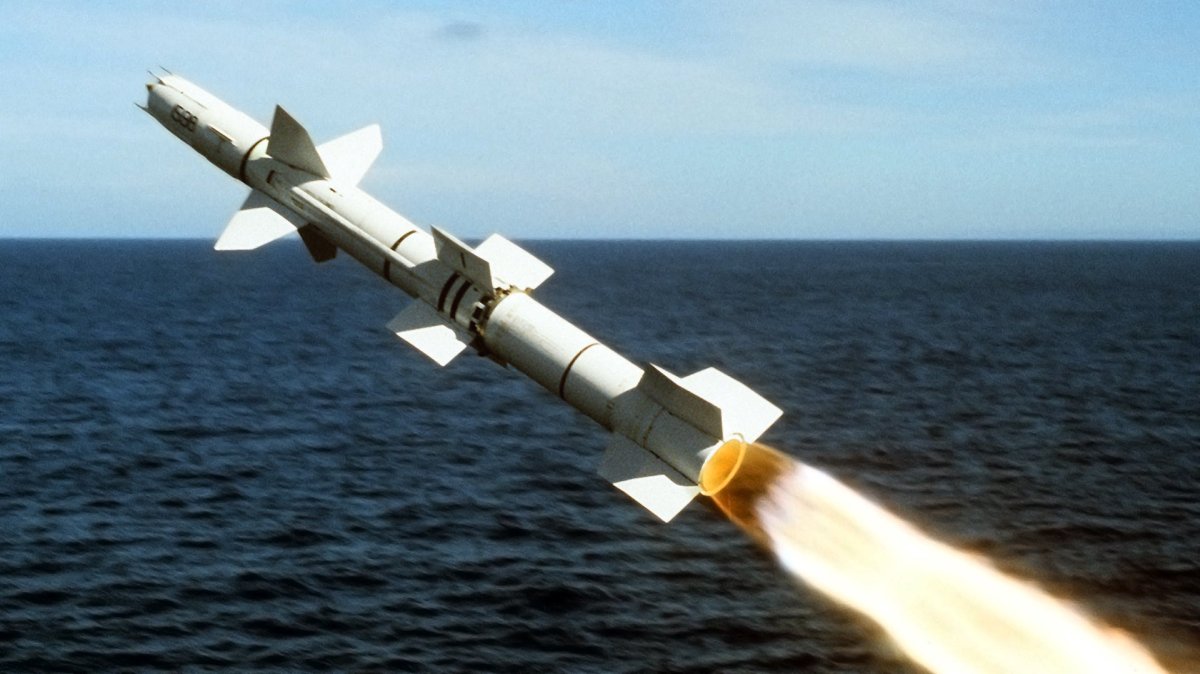
Talos during testing., USN
By the mid-1950s, a number of systems resulted from the project—some of which still share ‘DNA’ with weapons currently in the Navy’s current arsenal. The hardest hitting was Bendix’s Talos surface-to-air missile system which would equip the Navy’s heaviest surface combatants. This was truly an ‘atomic age’ missile, capable of packing a big 465 pound conventional warhead or a W30 nuclear warhead with a two to five kiloton yield.
The missile was guided semi-actively throughout its entire flight by two separate high-power emitters, the monstrous AN/SPG-49 Tracking Radar and the AN/SPW-2 Guidance Radar that worked to continuously illuminate a path for the missile to travel on as it headed out to its target. All this was coordinated by the then state-of-the-art Mk77 Fire Control System.
AN/SPG-49 and AN/SPW-2 radars that provide guidance for Talos seen onboard USS Oklahoma City (CLG-5)., USN
After being launched by its solid-rocket booster, a Talos missile was basically a flying ramjet engine that would sustain speeds of around mach 2.7 and reach out between 50 and 100 miles depending on the variant. Talos could also be used for launching tactical nuclear attacks on surface targets by sending the missile into an automated dive at a certain point along its flight path. It wasn’t a pinpoint operation, but it was accurate enough to take out a flotilla of ships or an area target on land. The same warhead could be used to take out formations of enemy bombers.
Talos was truly a modular design, with three distinct components—missile, booster, and control fins—needing to be mated together and tested before being declared ready to use. The complex and outsized nature of Talos—the missile was 32 feet long and weighed nearly 8,000 pounds when fully configured—meant that it couldn’t be stored in large numbers in a ready-to-use fashion aboard a ship. So a huge, elaborate, and wonderfully automated storage, mating, and launch system was devised in order to make the missile deployable in a naval combat environment. This support system was literally an armored missile assembly line that has to be one of the coolest and quirkiest Cold War naval innovations.
Dubbed Mark 7 Mod 0 Guided Missile Launching System, this half a million pound, heavily armored, hangar-like installation used a complex overhead crane, elevator, and “rammer” system to move Talos missile components from storage, along the assembly line, and out onto the launcher’s rails. Taking up two stories, it was primarily separated into three distinct sections.
The Mk7 Guided Missile Launch System. , via Okieboat.com
The aft-most section, Area 3, was the Missile Magazine and had two levels where Talos missiles and boosters were stowed. A strike-down elevator and crane would move the missiles around in a complex puzzle-like manner. Once a missile was selected, the system would bring it up and place it along one of two tracked carts located on either side of the warehouse-like like magazine. 30 missiles were typically stored in Area 3 during normal operations.
The missile would then be rammed through an armored and hydraulically operated hatch and into Area 2, the Ready Service Area. Here sailors would mate a hulking 4,400lb solid rocket booster to a Talos missile, readying it for launch. 14 mated missiles were usually stored in trays within this section at any given time. Once that was done, the rammer would push the missile along its track through another automated armored door and into Area 1, the Test Cell.
This section is where sailors installed missile’s control fins and wings—a dozen in all. The missile was transferred from its railed cart to overhead launch rails to do this. The missile was then put through a quick series of diagnostic checks using a computer system before one of two large armored hatches flung open and the rammer would seamlessly push the missile out onto the rails attached to the twin-armed Mk7 launcher turret. Once fire control made sure that there were no ships near the first nine miles of missiles path that could be impacted by its huge booster as it fell away or if the missile failed, the Talos round was sent into the air, roaring and belching smoke as it ascended towards its target.
Area 1 also had a number of other duties. For instance, it collected telemetry day on ultraviolet paper of each flight. This tape-like paper had to be exposed by bright light and would continue to pour out of an imprinting system as the missile flew off. Post-flight analysis of this information would prove confirmation that the missile hit its target as advertised or malfunctioned.
Oh, and there was the whole warhead storage aspect of all this too. Unmated warheads were stored dozens of feet below Area 1 in their own separate and heavily armored magazine located deep in the keel of the ship. Another elaborate set of cranes and elevators were used to load warheads through a hatch atop of Area 1 and all the way down into the magazine, and to bring the warheads up for fitment on missile rounds as needed. A unique fire suppression system would immediately flood the warhead storage magazine, and drown anyone in it, if a large increase in temperature was detected.
How I explained this process was just about as simplified as possible while still being at least somewhat accurate. This was an incredibly complex system that was loaded with intricate processes, many of which are done only at a missile factory today. It also worked in reverse when missiles were taken apart and their components sent back into storage. Luckily, we have this awesome Navy video circa the 1950s that details how the entire system works and showed it in action. Talk about fascinating!:
Suffice it to say, this was an incredibly complex system that relied on the best possible technology available at the time. But for sailors working within the launching system, it was dangerous and stressful work. Just having an arm in the path of a Talos as it was forced out onto the launcher or a hand in the wrong place while components were in motion could cause horrific injury. And considering that we are talking about tubes filled with rocket fuel being scurried about in an environment surrounded by 1950s electronics, one spark or other mishaps could lead to a devastating chain of explosions.
Because nuclear weapons were stored in the Warhead Magazine and in Area 3 and would traverse the entire set of compartments if need be, security was very tight throughout the Talos handling facility and its spaces were alarmed. Anyone with access to the areas needed a high-security clearance and had to be approved by the ship’s captain. An embarked Marine security contingent monitored access in and out of the areas and a two-man rule was implemented at all times.
Firing a nuclear-armed Talos was also far more involved process than firing a conventionally configured missile. If the missiles were ordered into the Area 2 where they would be mated with a booster for quick use during a crisis, a number of safeguards were put in place that would keep them from being launched accidentally or by a saboteur.
The cruiser USS Albany (CG-10) seen firing two Talos and one Tartar missile during an exercise in 1963., USN
In Area 2, a locked rig was attached to the missile in its tray that would keep it from being loaded onto the missile launcher rails. This could only be unlocked by the ship’s Weapons Officer. A safing plug was also installed that would be detected by the automated Talos diagnostic system and it would not allow it to be moved to the launcher’s rails. A special purple-colored arming plug would have to be put in its place and those were locked in safes in Area 1. Only the captain had the safe combo and it would be conveyed from the bridge to the compartment by the captain in the event that a nuclear launch was ordered.
Finally, a large switch-like handle had to be thrown in both Area 1 and in Weapons Control. The one in Weapons Control was locked and could only be unlocked by a key held by the Weapons Officer. Only then could the Talos system proceed with the launch sequence.
So considering that Talos could start Armageddon, it couldn’t happen without a number of fail-safes being unlocked by multiple people both in the Mark 7 Guided Missile Launching System and in two other command areas on the ship.
Maybe what’s most amazing about the Talos Guided Missile Launching System is that it took under a minute to launch a Talos missile once it was moved from Area 2 to Area 1, and interval times decreased after the first salvo was fired (two missiles were used to attack a single airborne). So considering how convoluted, clunky, and manpower intensive it was, the system was remarkably efficient in combat.
Talos was truly one of the most intricate combat systems of the era and its huge launching mechanism is just one aspect of its story. But it remains one of the most representative contraptions that captured the unique mix of heavy industrial ingenuity, atomic weaponry, emerging computerized systems, heavy manpower, and the all-American production line mindset that permeated the era. In comparison, today, a missile with similar range and far more capability and reliability comes packed in an ‘all up round’ container and can be launched in an instant from an enclosed vertical launch cell remotely. A human being may not even touch the missile for an entire cruise or even much longer.
An all-up round gets loaded in a Mark 41 vertical launch cell aboard an Arleigh Burke-class destroyer., USN
This won’t be the last you will hear from me about the Talos systems or its two cousins, Tartar and Terrier, which made up the Navy’s ‘Three Ts’ missile complex from that colorful era. But there is no better source on the ins and outs of the Tartar system than over at Okieboat.com . It is one of the best-produced sites on a single military subject on the net and just the diagrams and the description of Mark 7 Guided Missile Launching System alone is worth the click!
Contact the author: Tyler@thedrive.com
Comments couldn’t be loaded. Please refresh the page.
发布于美国东部时间2018年8月2日晚上8:37
现在回想起来,武器设计师在冷战初期利用20世纪50年代的技术所取得的成就简直令人惊叹。当时,最基本的计算机都需要占用一个大房间,甚至整整一层办公楼的空间。然而,工程师们仅凭计算尺和量角器,就设计出了极其复杂且实用的武器,其性能远超几年前,甚至几个月前的人们的想象。海军庞大的RIM-8“塔洛斯”远程舰载空导弹系统便是其中之一。
“塔洛斯”系统源于美国海军的“大黄蜂行动”。这是一项旷日持久的计划,旨在开发一种“中层”防御体系(战术上位于舰炮和舰载机之间),以保护舰艇免受携带反舰导弹的轰炸机攻击。这项计划的启动源于二战中惨痛的教训,当时日本神风特攻队和德国导弹袭击的阴影始终笼罩着军事策划者。从这些经验中,海战的未来以及随之而来的新兴威胁变得清晰可见,令人警醒。同时,二战时期的武器概念已无法应对这些威胁,这一残酷的现实也显而易见。
塔洛斯号在测试期间,美国海军
到20世纪50年代中期,该项目催生了一系列系统——其中一些系统至今仍与海军现役武器库中的某些武器有着“基因”。其中威力最强的是本迪克斯公司研发的“塔洛斯”(Talos)地对空导弹系统,该系统将装备海军最重型的水面作战舰艇。这是一款名副其实的“原子时代”导弹,能够携带重达465磅的常规弹头或当量为2至5千吨的W30型核弹头。
导弹在整个飞行过程中都由两个独立的高功率发射装置进行半主动制导:分别是威力巨大的AN/SPG-49跟踪雷达和AN/SPW-2制导雷达。这两个装置持续为导弹照亮飞行路径,直至其飞向目标。所有这些都由当时最先进的Mk77火控系统协调完成。
在俄克拉荷马城号巡洋舰(CLG-5)上可以看到为“塔洛斯”导弹系统提供制导的AN/SPG-49和AN/SPW-2雷达。
塔洛斯导弹由固体火箭助推器发射后,本质上就是一台飞行冲压发动机,能够以约2.7马赫的速度飞行,射程根据型号不同在50到100英里之间。塔洛斯导弹还可以用于对地面目标进行战术核打击,方法是让导弹在飞行路径上的特定点自动俯冲。虽然打击精度不高,但足以摧毁一支舰队或陆地上的一个区域目标。同样的弹头也可以用来摧毁敌方轰炸机编队。
“塔洛斯”导弹采用真正的模块化设计,由导弹、助推器和控制翼三个独立部件组成,需要组装并测试后才能投入使用。由于“塔洛斯”导弹结构复杂且体积庞大——完全组装后长32英尺,重达近8000磅——因此无法以随时可用的方式大量储存在舰船上。为了确保导弹能够在海战环境中部署,人们设计了一套庞大、精密且高度自动化的存储、组装和发射系统。这套支持系统实际上是一条装甲导弹装配线,堪称冷战时期最酷炫、最奇特的海军创新之一。
这套名为Mark 7 Mod 0的导弹发射系统重达50万磅,装甲厚重,外形如同机库,它利用复杂的架空起重机、升降机和“撞击器”系统,将“塔洛斯”导弹的部件从仓库运送到装配线上,最终安装到发射架的轨道上。该系统占据了两层楼,主要分为三个独立的部分。
Mk7型导弹发射系统。(图片来自Okieboat.com)
最尾部的区域,即3号区,是导弹库,共有两层,用于存放塔洛斯导弹及其助推器。一个升降机和起重机以复杂而精细的方式移动导弹。一旦选定一枚导弹,系统就会将其提升到位,并放置在仓库式导弹库两侧的两个履带式推车之一上。正常情况下,3号区通常存放30枚导弹。
随后,导弹将被撞入一个装甲液压舱门,进入2号区域——战备服务区。在这里,水兵们会将一枚重达4400磅的巨型固体火箭助推器与塔洛斯导弹对接,做好发射准备。该区域通常同时存放着14枚对接好的导弹。对接完成后,撞弹机将推动导弹沿着轨道穿过另一扇自动装甲门,进入1号区域——测试舱。
在这个区域,水兵们安装导弹的控制翼和机翼——总共十二个。为此,导弹先从轨道车转移到头顶的发射导轨上。随后,导弹通过计算机系统进行一系列快速诊断检查。之后,两个大型装甲舱门中的一个猛然打开,装弹机将导弹顺利地推到连接双臂Mk7发射炮塔的导轨上。火控部门确认导弹飞行路径最初九英里内没有舰船,以免其巨大的助推器在坠落过程中或导弹发射失败时撞击目标后,塔洛斯导弹便会升空,伴随着轰鸣声和滚滚浓烟,朝着目标飞去。
1号区域还承担着其他一些职责。例如,它负责收集每次飞行的遥测数据,并将数据记录在紫外线纸上。这种类似胶带的纸张需要强光照射才能显影,并在导弹飞行过程中持续从印迹系统中流出。飞行后对这些信息的分析将确认导弹是否如预期击中目标,或者是否发生故障。
哦,还有整个弹头储存系统。未组装的弹头储存在1号区域下方数十英尺处,位于舰体龙骨深处的独立重型装甲弹库中。另一套复杂的起重机和升降机系统用于将弹头从1号区域顶部的舱口装入弹库,并根据需要将弹头提升到导弹发射井进行安装。一套独特的灭火系统会在检测到温度大幅升高时立即向弹头储存库注水,将其中的任何人淹死。
我解释这个过程的方式已经尽可能简化,同时又保证了一定的准确性。这是一个极其复杂的系统,包含许多精细的工序,其中很多工序如今只有在导弹工厂才会进行。导弹拆解后,部件会被送回仓库,整个流程也会反向运行。幸运的是,我们有一段非常棒的海军视频,拍摄于上世纪50年代,详细讲解了整个系统的工作原理,并展示了它的实际运行情况。真是太精彩了!
毋庸置疑,这是一个极其复杂的系统,它依赖于当时最先进的技术。但对于在发射系统内工作的海军官兵来说,这是一项危险且压力巨大的工作。仅仅是手臂挡在被强行发射到发射器上的“塔洛斯”火箭的路径上,或者手在部件运动时放在了错误的位置,都可能造成可怕的伤害。考虑到我们谈论的是装满火箭燃料的管道在充斥着上世纪五十年代电子设备的环境中快速移动,任何一个火花或其他意外都可能引发毁灭性的连锁爆炸。
由于核武器储存在弹头库和3号区域,必要时需要经过所有舱室,因此“塔洛斯”号处理设施的安保措施极其严密,所有区域都设有警报系统。任何进入这些区域的人员都需要持有高安全许可,并经舰长批准。舰上配备了一支海军陆战队安保小组,负责监控进出这些区域的人员,并始终实行两人一组的规则。
发射一枚携带核弹头的“塔洛斯”导弹比发射一枚常规配置的导弹要复杂得多。如果导弹被命令送往2号区域,在那里与助推器对接以便在危机期间快速使用,那么就会设置一系列安全措施,以防止导弹被意外发射或被破坏分子破坏。
1963年,美国海军巡洋舰“奥尔巴尼”号(CG-10)在一次演习中发射了两枚“塔洛斯”导弹和一枚“鞑靼人”导弹。
在2号区域,导弹托盘上安装了一个锁定装置,防止导弹被装载到导弹发射架导轨上。只有舰上的武器官才能解锁该装置。此外,导弹上还安装了一个安全塞,该安全塞会被塔洛斯自动诊断系统检测到,并阻止导弹被移动到发射架导轨上。必须使用一个特殊的紫色启动塞来替换安全塞,这些启动塞被锁在1号区域的保险箱中。只有舰长知道保险箱的密码,一旦下达核弹发射命令,舰长会将保险箱从舰桥带到导弹舱室。
最后,必须同时拨动1号区域和武器控制室内的大型开关状手柄。武器控制室内的手柄已被锁定,只有武器官才能用钥匙打开。只有这样,塔洛斯系统才能继续执行发射程序。
考虑到塔洛斯可能会引发世界末日,如果没有多人解锁 Mark 7 制导导弹发射系统和舰上另外两个指挥区域内的多个安全装置,这种情况就不会发生。
塔洛斯导弹发射系统最令人惊叹的地方或许在于,从2号区域移动到1号区域后,发射一枚塔洛斯导弹只需不到一分钟,而且在第一轮齐射之后(两枚导弹攻击一个空中目标),发射间隔时间还会进一步缩短。考虑到该系统结构复杂、笨重且耗费人力,其在实战中的效率之高令人惊叹。
“塔洛斯”导弹系统堪称那个时代最复杂的作战系统之一,其庞大的发射机构只是它众多特点中的一个方面。但它仍然是最具代表性的装置之一,完美地融合了重工业的独创性、原子武器、新兴的计算机系统、大量的人力以及贯穿那个时代的美国流水线生产思维。相比之下,如今射程相近、性能更强、可靠性更高的导弹,只需装入一个“全封闭圆形”容器,即可从封闭的垂直发射单元中远程瞬间发射。甚至在整个巡航阶段,乃至更长的时间里,都不需要人为干预导弹。
一枚完整的炮弹被装入阿利·伯克级驱逐舰上的Mark 41型垂直发射单元。(美国海军)
这绝不会是我最后一次提到塔洛斯系统,以及它的两个“兄弟”——鞑靼人和猎犬系统。这三个系统曾是海军在那个辉煌时代“三T”导弹系统的组成部分。但要说了解鞑靼系统的方方面面,没有比Okieboat.com更好的资料来源了。它是网络上制作最精良的军事专题网站之一,光是Mark 7导弹发射系统的图解和描述就值得你点击浏览!
联系作者:Tyler@thedrive.com
评论加载失败,请刷新页面。