Navy Orders 30 Drone Ships To Finally Advance Its ‘Medium’ Uncrewed Vessel Ambitions海军订购30艘无人舰艇,最终推进其“中型”无人舰艇的雄心壮志
The Navy has taken an important new step toward to fielding larger USV fleets, an area where it has persistently struggled in the past.
By Joseph Trevithick
Published Sep 29, 2026 6:14 PM EDT
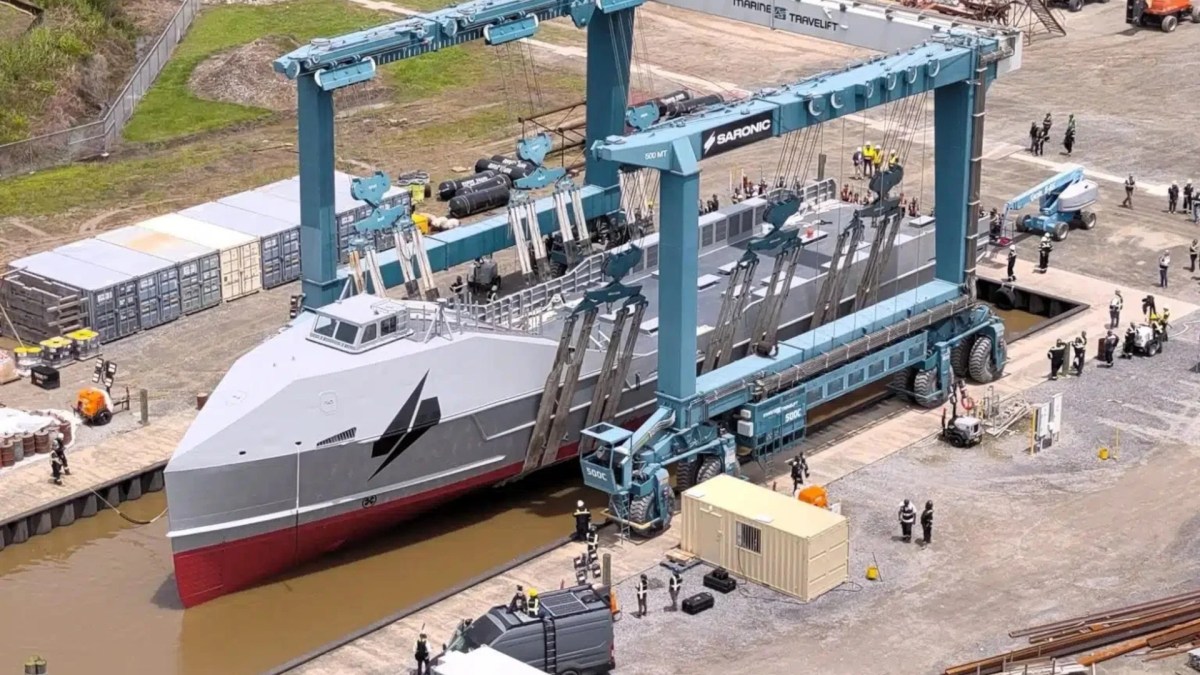
Saronic, which submitted the Marauder design seen here to the MUSV program, is one of the companies to have received a contract today. Saronic
The Navy has announced plans to buy 30 new drone boats, 10 from each of three companies, under its Medium Unmanned Surface Vessel (MUSV) program . The deals are an important step forward for the Navy’s latest attempt to field larger USVs after years of setbacks and shakeups , but it remains to be seen when these new capabilities might actually become operational.
Galliano Marine Services, Huntington Ingalls Industries (HII), and Saronic Technologies each received so-called Other Transaction Authority (OTA) agreements in relation to the MUSV program today. OTA is a contracting mechanism designed to support rapid prototyping and other research and development work without having to use more traditional and often lengthy processes.
The awards “mark a significant step forward in translating the strategic vision into a tangible fleet capability,” Chris Miller, the Navy’s Acting Direct Reporting Portfolio Manager for Robotic and Autonomous Systems (DRPM RAS), told TWZ and others at a media roundtable earlier today. “Each agreement is for the procurement of 10 MUSV at an average procurement cost of $40 million per vessel.”
A rendering of HII’s Romulus design. HII
Saronic and HII submitted their Marauder and Romulus designs , respectively, to the MUSV Phase I competition. Galliano Marine Services, which does business as Edison Chouest , does not appear to have announced its entrant publicly. At a unit cost of $40 million, the total price tag for 30 MUSVs, regardless of type, would be $1.2 billion.
“Production will begin immediately at shipyards in Loreauville, Houma, and Franklin, Louisiana, with deliveries starting as early as the fourth quarter of [Fiscal Year] 2027,” Miller added.
To take a step back quickly, the Navy has used a variety of definitions for what qualifies as a “medium” USV over the years . It’s also important to note that the Navy already fields several speedboat and jet ski-type USVs operationally that are capable of performing various different missions, including employment as one-way attack munitions .
Saronic’s Corsair, seen here, is an example of a speedboat-sized USV already in operational Navy service. Saronic
Threshold MUSV program requirements the service put out in March included a range of at least “2500 nm [nautical miles] at 25 knots while carrying a 25 MT [metric ton] load on the payload deck in NATO STANAG 4194 Sea State 4.” Sea State 4 is characterized by wind speeds of 17 to 21 knots and wave heights between four and eight feet, per that NATO standard. The MUSVs also had to be able to carry forty-foot equivalent units (FEU) containerized payloads and refuel at sea at a rate of “2,000 gallons per minute of fuel through deck connections.” Various other operational and sustainment requirements were laid out at that time, as you can read more about here .
The OTAs announced today were awarded “following successful at sea testing” under Phase I of the MUSV program, according to a press release the Navy put out today. A total of seven companies competed in this initial phase , with the others being Birdon, Leidos, PacMar Technologies, and Sea Machines. That work was conducted under an earlier round of OTAs.
“The testing evaluated, among other things, the vessel’s ability to see and understand the surrounding maritime environment, how well the vessels navigated autonomously according to the international regulations for preventing collisions at sea, and the vessel’s ability to conduct a long-duration mission,” the Navy’s Miller said at the roundtable earlier today. “The demonstrations had to prove that the designs were mature enough to meet the Navy’s operational standards and our requirements.”
In terms of the long-duration mission requirements, “the test was that they had to be able to execute [over] roughly 26 hours and over 360 nautical miles with only a single input during that time from a C2 [command and control] station allowed,” Milleter further explained. “So, it basically demonstrated that the vessel could run for an excess of 24 hours at an extended range with very minimal input from the actual operator from a C2 station. This provided basically our input and our ability to assess how truly autonomous the functionality was of the platforms.”
Overall, the OTA awards “were based on the optimal mix of autonomy, performance, design, production schedule, and cost,” he added.
The MUSV Phase II contracting notice outlines additional parameters, including that submitted designs cannot be more than 295 feet (90 meters) long or displace more than 5,000 metric tons. The USVs also have to be able to accommodate “at least 2x Twenty-foot Equivalent Unit (TEU) [containerized payloads] weighing 24,000 kg each and consuming 25 kW each” and be “capable of executing multi-day unmanned operations of at least 10 days.” The drone boats need to be “operable in NATO STANAG 4194 Sea State 4 and survivable in Sea State 6,” as well. The full lists of threshold requirements and desired attributes are reproduced below.
In addition, “to be considered for this Call for Solutions, the proposed MUSV must be ready for operational demonstration at the time of solution submission,” according to the Phase II contracting notice. “An MUSV requiring substantial modifications for the production platform compared to the as-demonstrated platform will not be considered.”
“The Phase II solicitation allows entrants to compete and existing vendors to submit updated product blocks and modular payload configurations,” Miller, the Acting DRPM RAS, said today. “Testing evaluations will begin as early as November 16th, and proposals will be assessed on a continually rolling basis over the next five years.”
Miller also drew attention to the elimination of the speed and at-sea refueling targets previously outlined in Phase I.
“What we learned from Phase I is that as you increase the speed requirements and some of these other things, it does present certain challenges for industry,” according to Miller. “So I’m trying to actually find the sweet spot in the market where there is healthy competition, and there’s opportunities, and we can have more things that potentially are dual use, both military and civilian.”
A rendering of Saronic’s Marauder with containerized payloads. Saronic
So far, the Navy has only offered limited insights into exactly what specific mission sets it wants the MUSVs to perform, even initially.
The “MUSV Phase I requirements were closely tailored to fulfill operational requirements for a specific mission set focused on demonstrated ability to carry containerized payloads while meeting specific vessel performance requirements for speed and range,” Miller said during today’s roundtable. “However, there is an ever-increasing demand signal that we must be ready to meet. To ensure scalability across the broader mission sets and to support our joint force, we issued a formal call for solutions for MUSV Phase II integration and testing.”
He also stressed that the modularity of the designs being acquired now would allow for the continued evolution of their capabilities as time goes on.
With the focus on containerized payloads, “honestly, inside you could have a sensor, you could have repair equipment for ships,” Rebecca Gassler, who was the Navy’s Portfolio Acquisition Executive for Robotic and Autonomous Systems (PAE RAS) until August, also told TWZ and other outlets back in March. “You could have any number of payloads inside those, and you basically are able to just swap them on.”
In announcing the new OTAs today, as well as discussing the Phase II MUSV plans, the Navy also highlighted continued opportunities for the other companies that had been involved in Phase I.
“Leidos, PAC MAR, and Sea Machines were determined to complete the project provided for in their prototype other transaction agreement and will receive a $15 million award as part of the previously established terms of the prototype OTs,” the Navy’s MUSV announcement today adds. “Alongside the OT awardees, will be accepted onto the Drones.mil hosted Maritime Marketplace, where they are now eligible to receive follow-on production agreements from authorized acquisition authorities across the DOW [Department of War].”
A rendering of Steamracer, a larger USV design Sea Machines has pitched to the US Navy in the past. Sea Machines
Birdon did not complete the required testing. Based on the terms of the Phase I OTAs, Galliano, HII, and Saronic will also receive $15 million awards and be included in the marketplace. The aforementioned Phase II CFS is intended “to expand its acquisition pipeline through a Maritime Marketplace to broaden offerings and satisfy future MUSV mission sets,” as well, per the Navy.
The Navy stressed the importance of this open-ended “marketplace” model as a way to accelerate the acquisition process when it first outlined the MUSV program to the public back in March, as you can read more about here . Just last week, the service also established a new Robotic and Autonomous Systems Warfighting Development Center (RASWDC) to serve as a focal point for “the development, operational integration, and employment of robotic and autonomous systems (RAS) across the maritime domain,” to include the MUSV effort.
The Drones.mil marketplace also extends to all branches of the U.S. military and beyond just USVs. Miller today did highlight the potential for possible cooperation with other services on drone boat efforts through this framework. He also said the Navy might be willing to consider additional acquisition strategies, including leasing uncrewed platforms, in the future.
Larger USVs have long been seen as key to bolstering the U.S. Navy’s overall operational capacity above the waves, and doing so in a cost-effective and rapidly producible manner. They are also viewed as central to enabling new, more distributed concepts of operations designed to help expand operational coverage and reduce the vulnerability of crewed ships, especially in any future high-end fight in the Pacific with China .
A pair of optionally-crewed vessels the Navy has been experimenting with for years now seen sailing together with a Japanese Mogami class frigate. USN
“Unmanned technology is redefining operations and providing our combatant commanders with unprecedented scale, persistence, and risk tolerance,” the Navy’s Miller said at the roundtable.
At the same time, as mentioned, the Navy has attempted to acquire operational fleets of larger drone boats in the past without success. Today, the service’s capabilities in this regard remain limited to a pocket force of still largely experimental optionally-crewed designs.
Since the Navy first unveiled it in March, MUSV has already faced certain hurdles. This includes a major leadership shakeup in August that saw PAE RAS Rebecca Gassler, the first person to ever hold that post, removed from her post after just eight months for reasons that are still not immediately clear.
In July, it also emerged that Blue Water Autonomy and Saildrone had filed suit against the Navy over being left out of Phase I of the MUSV competition. The companies alleged that the service did not follow its own selection criteria. That lawsuit is still ongoing. Blue Water Autonomy, among others, had also previously made investments in response to requirements the Navy had laid out for a previous effort called the Modular Surface Attack Craft (MASC) last year. The MUSV program has now fully supplanted MASC.
In speaking at the roundtable today, Miller acknowledged potential budget limitations and other hurdles that could still impact MUSV going forward. “I’m trying to be prepared depending on where that demand goes,” he said.
As said at the start, today’s MUSV announcement is an important new step forward for the Navy’s efforts to acquire fleets of larger USVs, but the service still has to transition these efforts into operational realities.
Contact the author: joe@twz.com
Comments couldn’t be loaded. Please refresh the page.
作者:约瑟夫·特雷维西克
发布于美国东部时间2026年9月29日下午6:14
萨罗尼克公司向MUSV项目提交了图中所示的“掠夺者”潜艇设计方案,该公司是今天获得合同的公司之一。
美国海军宣布计划根据其中型无人水面舰艇(MUSV)项目,从三家公司各采购10艘新型无人艇,共计30艘。这些交易是海军在经历多年挫折和重组后,最新一次尝试部署大型无人水面舰艇的重要一步,但这些新能力何时才能真正投入使用仍有待观察。
今天,Galliano Marine Services、Huntington Ingalls Industries (HII) 和 Saronic Technologies 分别获得了与 MUSV 项目相关的其他交易授权 (OTA) 协议。OTA 是一种合同机制,旨在支持快速原型制作和其他研发工作,而无需采用更传统且通常耗时的流程。
海军机器人与自主系统代理直接报告项目经理克里斯·米勒今天早些时候在与TWZ和其他媒体举行的圆桌会议上表示,这些授标“标志着在将战略愿景转化为切实可行的舰队能力方面迈出了重要一步”。“每份协议都涉及采购10艘多用途海上支援舰(MUSV),平均每艘舰艇的采购成本为4000万美元。”
HII公司罗穆卢斯设计的效果图。
萨罗尼克(Saronic)和HII分别向MUSV第一阶段竞赛提交了他们的“掠夺者”(Marauder)和“罗慕路斯”(Romulus)设计方案。以爱迪生·舒斯特(Edison Chouest)名义开展业务的加利亚诺海事服务公司(Galliano Marine Services)似乎尚未公开宣布其参赛计划。按每艘4000万美元的单价计算,无论何种类型,30艘MUSV的总造价将达到12亿美元。
米勒补充道:“路易斯安那州洛雷奥维尔、霍马和富兰克林的造船厂将立即开始生产,最早将于 2027 财年第四季度开始交付。”
简单回顾一下,多年来,海军对“中型”无人水面艇的定义各不相同。此外,值得注意的是,海军目前已部署多种快艇和水上摩托艇类型的无人水面艇,它们能够执行各种不同的任务,包括用作单程攻击弹药。
图中所示的萨罗尼克“海盗”号无人水面艇,是目前已在海军服役的快艇大小的无人水面艇的一个例子。
该部门三月份公布的MUSV项目基本要求包括:在北约STANAG 4194海况4级条件下,有效载荷甲板上载有25公吨货物时,续航里程至少达到2500海里,航速为25节。根据北约标准,4级海况的特征是风速17至21节,浪高4至8英尺。MUSV还必须能够运载40英尺当量单位(FEU)的集装箱式有效载荷,并通过甲板接口以每分钟2000加仑的速率进行海上加油。当时还列出了其他各种作战和保障要求,您可以在这里了解更多信息。
根据海军今天发布的新闻稿,今天宣布的OTA(其他交易协议)是在MUSV项目第一阶段“海上测试成功”后授予的。共有七家公司参与了第一阶段的竞争,其他四家分别是Birdon、Leidos、PacMar Technologies和Sea Machines。这项工作是在之前几轮OTA下完成的。
海军的米勒今天早些时候在圆桌会议上表示:“测试评估了舰艇对周围海域环境的感知和理解能力、舰艇根据国际海上避碰规则自主航行的能力,以及舰艇执行长时间任务的能力。演示必须证明这些设计足够成熟,能够满足海军的作战标准和我们的要求。”
关于长时间任务的要求,米勒特进一步解释说:“测试要求他们能够在大约26小时内航行超过360海里,期间仅允许指挥控制站进行一次输入。因此,这基本上证明了该舰艇能够在远距离航行超过24小时,且指挥控制站的实际操作员只需进行极少的输入。这为我们提供了评估平台自主性所需的数据和信息。”
他补充说,总体而言,OTA 奖项“是基于自主性、性能、设计、生产进度和成本的最佳组合而评定的”。
MUSV第二阶段合同公告列出了更多参数,包括提交的设计方案长度不得超过295英尺(90米),排水量不得超过5000公吨。无人水面艇(USV)还必须能够容纳“至少2个标准集装箱(TEU),每个集装箱重24000公斤,耗电量25千瓦”,并且“能够执行至少10天的多日无人作业”。此外,无人艇还需“能够在北约STANAG 4194标准4级海况下作业,并在6级海况下生存”。完整的阈值要求和所需属性清单如下。
此外,根据第二阶段合同通知,“要参与本次解决方案征集,拟议的MUSV必须在提交解决方案时已准备好进行运行演示”。“与演示平台相比,需要对生产平台进行重大修改的MUSV将不予考虑。”
“第二阶段招标允许新入围者参与竞争,现有供应商也可以提交更新的产品模块和模块化有效载荷配置,”代理研发项目经理米勒今天表示。“测试评估最早将于11月16日开始,提案将在未来五年内持续滚动评估。”
米勒还特别指出,第一阶段中先前概述的速度和海上加油目标已被取消。
米勒表示:“我们从第一阶段了解到,随着速度要求和其他一些因素的提高,这确实给行业带来了一些挑战。因此,我正在努力寻找市场上的最佳平衡点,既要有良性竞争,又要有发展机遇,这样我们才能拥有更多军民两用产品。”
萨罗尼克“掠夺者”运输机搭载集装箱式有效载荷的渲染图。萨罗尼克
到目前为止,海军对于MUSV究竟要执行哪些具体任务,即使是最初阶段,也只提供了有限的信息。
“MUSV第一阶段的要求是根据特定任务的作战需求量身定制的,重点在于验证其携带集装箱式有效载荷的能力,同时满足船舶在速度和航程方面的特定性能要求,”米勒在今天的圆桌会议上表示。“然而,不断增长的需求信号表明,我们必须做好准备。为了确保其能够扩展到更广泛的任务领域,并支持我们的联合部队,我们正式发布了MUSV第二阶段集成和测试的解决方案征集公告。”
他还强调,目前所采用的设计具有模块化特性,可以随着时间的推移不断发展其功能。
海军机器人与自主系统项目采购主管丽贝卡·加斯勒(Rebecca Gassler)在3月份接受TWZ和其他媒体采访时也表示,鉴于集装箱式有效载荷的重点在于“说实话,里面可以装传感器,也可以装舰船维修设备”。加斯勒曾于今年8月卸任海军机器人与自主系统项目采购主管一职。“里面可以装任意数量的有效载荷,而且基本上可以随时更换。”
在今天宣布新的OTA以及讨论第二阶段MUSV计划时,海军还强调了参与第一阶段的其他公司将继续获得机会。
海军今天发布的MUSV公告补充道:“Leidos、PAC MAR和Sea Machines决心完成其原型机交易协议中规定的项目,并将根据此前确定的原型机交易协议条款获得1500万美元的奖励。与这些交易协议的中标者一样,他们将被纳入Drones.mil平台的海事市场,并有资格从美国陆军部各授权采购机构获得后续生产协议。”
这是Steamracer的效果图,Steamracer是Sea Machines公司过去曾向美国海军推销的一款大型无人水面艇(USV)设计方案。
Birdon号未能完成所需的测试。根据第一阶段其他交易协议(OTA)的条款,Galliano、HII和Saronic也将获得1500万美元的奖励,并被纳入市场竞争。海军方面表示,上述第二阶段联合采购系统(CFS)旨在“通过海事市场扩大其采购渠道,以丰富产品种类并满足未来多用途舰艇(MUSV)的任务需求”。
海军在3月份首次向公众概述MUSV项目时,就强调了这种开放式“市场”模式对于加快采购流程的重要性,您可以在这里阅读更多相关信息。就在上周,海军还成立了一个新的机器人与自主系统作战发展中心(RASWDC),作为“在整个海上领域开发、作战集成和运用机器人与自主系统(RAS)”的中心,其中也包括MUSV项目。
Drones.mil市场不仅涵盖无人水面艇,还覆盖美国所有军种。米勒今天强调了通过这一框架与其他军种在无人艇项目上开展合作的潜力。他还表示,海军未来可能愿意考虑其他采购策略,包括租赁无人平台。
大型无人水面艇(USV)长期以来被视为提升美国海军整体水上作战能力的关键,而且能够以经济高效且快速生产的方式实现这一目标。它们也被视为实现新型、更分散的作战概念的核心,旨在扩大作战覆盖范围并降低有人舰艇的脆弱性,尤其是在未来与中国在太平洋地区可能发生的任何高端冲突中。
美国海军多年来一直在试验的两艘可选乘员舰艇,最近被发现与一艘日本最上级护卫舰一同航行。
“无人技术正在重新定义作战方式,并为我们的作战指挥官提供前所未有的规模、持久性和风险承受能力,”海军的米勒在圆桌会议上说。
与此同时,正如前文所述,海军过去曾多次尝试采购可操作的大型无人艇舰队,但均以失败告终。如今,海军在这方面的能力仍然局限于一支规模很小的、主要由实验性可选载人型无人艇组成的舰队。
自海军3月份首次公布MUSV项目以来,该项目已面临一些挑战。其中包括8月份的一次重大领导层变动,PAE RAS Rebecca Gassler——首位担任该职位的人员——在任职仅8个月后便被免职,具体原因目前尚不清楚。
今年7月,Blue Water Autonomy和Saildrone两家公司也提起诉讼,指控海军将他们排除在MUSV项目第一阶段竞标之外。这两家公司声称,海军没有遵循其自身的遴选标准。该诉讼目前仍在进行中。Blue Water Autonomy等公司此前也曾根据海军去年提出的模块化水面攻击艇(MASC)项目的要求进行过投资。如今,MUSV项目已完全取代了MASC项目。
米勒在今天的圆桌会议上发言时承认,预算限制和其他障碍仍可能对MUSV的未来发展产生影响。他说:“我正在努力做好准备,以应对未来的需求变化。”
正如开头所说,今天宣布的 MUSV 项目是海军在获取更大规模无人水面艇舰队方面迈出的重要一步,但海军仍需将这些努力转化为实际作战行动。
联系作者:joe@twz.com
评论加载失败,请刷新页面。