Life On The High Seas Aboard A Tin Can Destroyer During The Cold War冷战时期,一艘破旧军舰上的海上生活
A sailor's life is never easy, but there can be some great times among the challenges.
Updated Oct 21, 2021 8:32 PM EDT
In my previous article, I described two intense days frantically hunting a Soviet submarine in the Strait of Gibraltar back in 1967. I was a low-ranking sailor serving aboard the USS Steinaker — the World War II-era Gearing class destroyer I sailed on for two years. Now I’d like to describe some of our other high-seas adventures, and what life was like living aboard a destroyer in those days.
Like A Living, Breathing Thing
A warship like Steinaker is never left unattended, or completely powered down. Walking around the ship, you would always be aware of machinery noises, and powerful exhaust fans venting hot air from deep in the ship’s engineering spaces. You could always feel small vibrations, as if the ship was alive, and in a way it was. The ship was powered by high-pressure superheated steam produced by two large boilers that were heated with a thick, foul-smelling type of oil called bunker fuel.
The boilers were housed in their own space. When I was a new crewman, I got a tour of the boiler room. I remember a crewman leaning over near a steam line and lighting his cigarette by touching it to the line. The heat was intense in that compartment — in some areas up to 150 degrees. The inlet end of the exhaust fans was in the boiler room, and you could stand under them to try to cool off. The steam was piped to the engine room, where it turned two turbines and probably other equipment such as generators. It would then be returned to the boiler room to be reheated.
What we usually think of as steam is really water vapor suspended in steam. Steam is a dry colorless gas. When you heat water to the boiling point, it changes state from a liquid to a gas, and you produce steam, but it doesn’t contain much energy. If you lower the temperature even slightly, it will change states from a dry gas back to a liquid again. To make the steam useful, the energy needs to be greatly increased by raising the temperature and pressure. That way it can release tremendous energy while turning the turbine and still remain a dry gas.
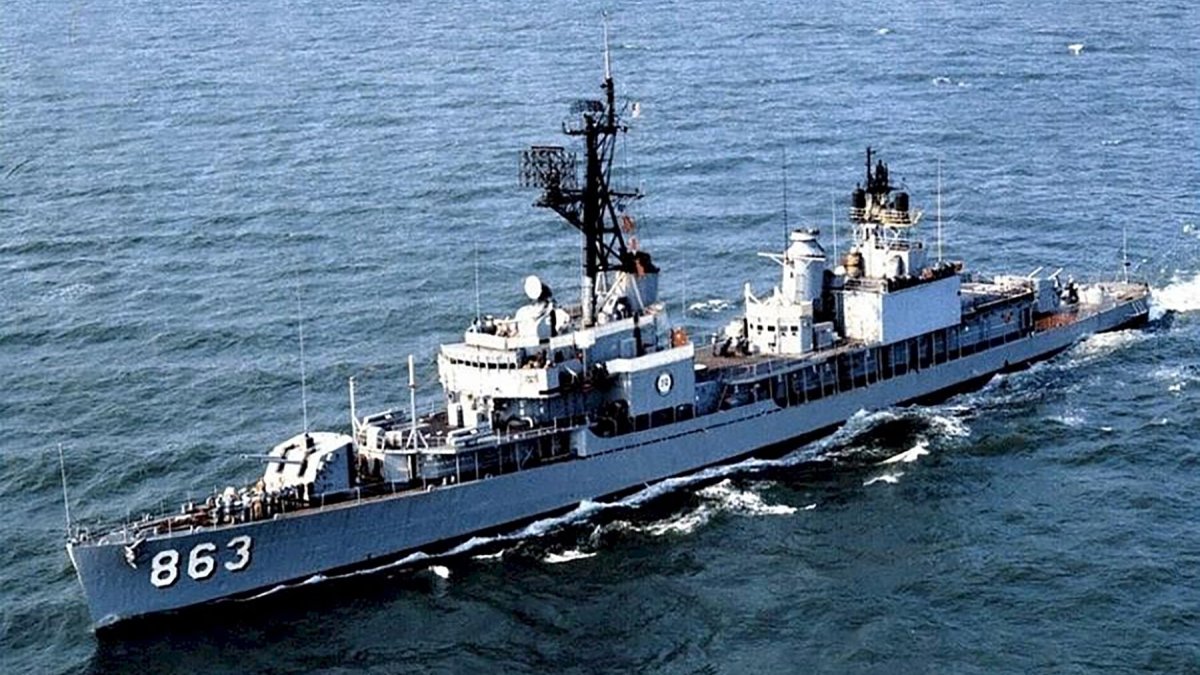
USS Steinaker, its bow soaked—a normal occurrence., USN
The ship produced 60,000 horsepower from two steam lines that were about six inches in diameter. It’s hard to wrap your mind around the power of high-pressure superheated steam. You can’t see steam. That makes a leak extremely dangerous. A leak would create a huge white cloud of vapor in the compartment, but the actual steam leak could be many feet away because the white cloud would only form once the steam had cooled and the water began changing state from a gas to microscopic liquid droplets.
When looking for a steam leak, the boiler room folks were taught to wave a broom in front of them as they slowly approached a possible source. When they waved the broom in front of the leak it would cut all the bristles off, leaving a stump at the end of the pole.
Nowadays, U.S. Navy destroyers are powered by large gas-turbine engines — just like the engines you might see on a large passenger jet but designed to turn a shaft instead of producing thrust. Gas turbines take up much less space, and the ship should be able to get underway from a cold start faster than a ship that had to fire up its boilers and slowly produce steam. The cost of running a gas turbine-powered ship must be impressive. Bunker fuel is cheap, but jet fuel is not.
Clearly, in the last five decades, just about everything on a destroyer has changed — propulsion, weapon systems, sensors, navigation, and communications. But some things have not. The mission to project power and protect the sea lanes remains the same, and destroyers are still making cruises to the same destinations we did.
The ocean remains the same, and the Navy is still faced with the same design issue — how do you cram a lot of sailors into a relatively small ship?
Challenging Living Conditions
In the picture above, Steinaker is sailing at a moderate speed through calm seas. I spent half of my two years on Steinaker living in the forward berthing compartment, which was located about where you see “863” painted on the bow. In heavy weather, the bow constantly rose up (as in the photo) and then plunged into the next wave and was often completely submerged. Tons of water rolled across the deck, slamming into that forward gun mount, and was blasted high into the air where it landed on top of the 03-level where the bridge and Combat Information Center (CIC) were located.
More about that later…
Sea states are described using the Beaufort Scale, which runs from zero to 12. In the picture, I would say this was maybe three on the scale, and that’s probably a stretch. Here are the descriptions of sea states three and twelve, for comparison:
My point is that destroyers can be rough-riding ships, even in calm conditions, but why do I mention sea state 12? Because Steinaker went through a hurricane while I was aboard. Ships do not normally steam into the middle of a hurricane, but hurricane paths are difficult to predict, and Steinaker wasn’t the first ship to relocate to avoid a hurricane only to have the storm change course and run it down.
In our case, I remember being tied up at a small pier in Key West when we got the word that a hurricane was building in intensity and heading right for us. Ships do not want to get caught in shallow or restricted water when a big storm is headed their way, so we departed to the east to get some sea room, only to have the storm unexpectedly veer to the east and run us over.
I remember the anemometer in Combat (the Combat Information Center, or CIC) hovering around 75 knots and occasionally peaking at around 100 knots. I honestly do not remember it being that big a deal. Of course, that was over 50 years ago, and I am reminded of the definition of “the good old days” — a good imagination and a bad memory. Maybe I was terrified while trapped in a windowless compartment listening to tons of water landing on top of us and hanging on for dear life.
All the chairs in CIC had seatbelts for a reason!
We had a public address system on the ship called the 1MC. I just Googled it and found that “MC” is short for “Main Circuit.” Anyway, it was common to hear, “Now hear this. All hands stand clear of the weather decks while maneuvering at high speed through heavy seas.” I took this picture with my little Minox camera showing why you would want to heed that warning:
A view of the ocean from the Steinaker in rough weather., Courtesy of the Author
This picture was typical of what I remember — the sea was always a dull gray and so was the sky. The only time in the two years I saw blue water was on a short trip to Guantanamo Bay in Cuba. The water in the bay was beautiful and the bottom was white sand — that visit is for another time. …
There were 21 of us housed in the forward berthing compartment, which was the size of the average apartment’s living room. Each person had a rack that consisted of a tubular aluminum frame with a canvas sheet stretched tight inside it. On top of the canvas was a thin mattress enclosed in a “fart sack,” which was like a large pillowcase.
Racks were stacked three high and lined up in rows. Some rows were freestanding, and others were attached to the bulkheads. I was in the middle between the lower and upper racks. That was a plus, as I was less likely to break my neck when I was tossed out of my rack and landed on the deck during a storm.
My row of racks was attached to the bulkhead with hinges, and the outer side was held in place with a chain at each end. When I lay flat on my back, with my elbows at my side, I could touch the top guy’s mattress with my fingers.
Between me and the bulkhead was a high-pressure steam line that ran from the boiler room to the engine room. It was insulated with asbestos and was about six inches in diameter. At my feet was a small fan. At night, when I managed to get to sleep, I occasionally stretched and stuck my toe into the fan.
Enlisted berthing racks similar to those found on Gearing class destroyers, NHHC
Below the bottom racks were small lockers where we stored all our possessions. If that bottom rack was occupied you could not get to your locker. That often happened since we were not all in the same watch sections — half were on watch while the other half slept. So, by necessity, you might go on watch, leaving your small “douche kit” or a paperback book laying on your rack. Our chief would make regular visits into our compartment and collect any loose items he could find and lock them away in a locker he had commandeered. Each week there was a reckoning, and we were given two hours of extra duty for each item he collected.
We soon caught on to the chief’s schedule — the reckoning always took place on Friday, so each Thursday we simply pounded the hinge pin out of his locker, redistributed his confiscated items, and then replaced the hinge pin. The chief was no fool. He soon figured out our scheme and added a second padlock. He insisted that the compartment lights always be on during daylight hours, and no towels or other items could be hung from the racks above to block the light. He was beloved by all, and we all enjoyed his petty torments. Eventually, it came to the attention of the officers that some of us seemed to have a bad attitude, but I digress …
Picture yourself totally exhausted from long hours on watch and trying desperately to get some sleep. In heavy weather the bow moved up and down about 15 feet as the ship plowed through the waves. One second you were pressed down in your rack as the bow rose up the side of a wave, and the next you were floating weightless as the bow dropped into a trough. The only way to not get tossed out of your rack and onto the deck was to sleep on your stomach and wrap your arms and legs around the rack’s frame like a spider.
Each rack had some straps that you could use to tie yourself in with, but no one seemed to like those. You could also get a shipmate to tip your rack way up and shorten the chains, so you were wedged in, but then you could not get out by yourself, and that could be a big problem.
To these many layers of misery, you need to add the constant sound of the entire compartment going underwater and the noise of the sonar, which was not far below us. Actually, after a while I found the sonar restful. About once every five seconds, it made the sound you hear in every submarine war movie you’ve ever seen. Because my rack was against the bulkhead, I could hear the sonar pulse and the echoes reverberating.
At some point in my two years, I was also assigned to live in the aft berthing compartment. That was infinitely better, with no constant up and down motion, and at the far end of the ship from the sonar dome.
So far, I’ve just been bitching about normal everyday physical misery and discomfort. Now I want to talk about a storm ! You may be asking yourself, what is he going to whine about now? I’m sure destroyers are completely safe in all weather conditions, right?
For example, on Dec. 18, 1944, Task Force 38 was struck by Typhoon Cobra — sometimes called “Halsey’s Typhoon” — off the Philippines. The destroyers USS Hull (DD-350), Spence (DD-512), and Monaghan (DD-354) all capsized and sank. Seven hundred ninety men were killed and 80 injured.
A destroyer can only roll so far before it capsizes. I think we came awfully close in the story I am going to tell you now.
During my first Med cruise, we found ourselves tied up next to this magnificent cruise ship — the Michelangelo . I took this picture while we were both pierside in Genoa, Italy. That day, I had occasion to climb to the surface-search radar platform on the main mast with a shipmate to do some maintenance. I remember looking across at Michelangelo and commenting that it was so huge its main deck was higher than we were!
The cruise ship Michaelangelo in Genoa, Italy, in 1966., Courtesy of the Author
For an idea of just how tall the cruise ship’s hull was, this is what it looked like from where the author was viewing the ship., Courtesy of the Author
On the seventh of April 1966, we both sailed out of Genoa and headed for the Atlantic. Steinaker was heading home. Five days later, on the morning of April 12, we both found ourselves mid-Atlantic and caught in a monstrous storm. The waves were massive — the size of large buildings. Steinaker had 60,000 shaft horsepower, twin screws, and twin rudders. Normally that would result in a very capable and maneuverable ship. But on that day we were completely helpless. One minute we would be pointed north, the next east – totally out of control. The extremely odd thing was that there was no wind to speak of and the sky was blue.
Whatever had caused these massive waves was gone.
When we were at the top of a wave, we could see for several miles. There was a large merchant ship about one mile away. I remember seeing it with the bow buried in a wave and the bronze propeller completely out of the water, turning slowly and with the sun glinting off the blades. Then we would slide down into a trough and lose sight of the ship. The next time we rose, that ship would be pointed in a completely different direction. We were both in big trouble.
The little destroyer, seen here pre-upgrade, was not the smoothest ride when waves were present., USSSteinaker.org
Above our bridge windows at the center, there was an inclinometer, which consisted of a curved glass tube filled with an amber liquid. Inside the tube was a black marble that was free to roll to the lowest point in the tube. The inclinometer was marked off in degrees. While sliding down a wave sideways, we took a starboard roll of 56 degrees. We had been told we would capsize somewhere around 65 degrees. Time seemed to freeze. Would we right ourselves or capsize? I can still see the little bubbles in the inclinometer tube in my head.
With a 56-degree roll, it is easier to walk on the bulkhead than on the deck. These extreme rolls caused everything to go flying in every direction. I ended up on my butt, jammed up against the starboard bridge-wing door at the lowest spot formed by the sloping deck and starboard bulkhead, a pile of loose items in my lap. I remember straining my neck to look out the bridge-wing window. All I could see was a massive, malevolent wall of gray water that stretched up and out of sight above us. We never practiced abandoning ship, and I don’t remember ever seeing a life jacket. We had a few lifeboats that had to be lowered by pulleys. Totally useless in rough seas.
It was clear we would all go down with the ship, or we would all make it out alive. It was just a question of physics.
Meanwhile, on the Michelangelo , a huge wave came across the main deck and crushed a large section of the ship. Four passengers were killed, and 50 were injured. Damage was extensive. The ship managed to limp into New York Harbor. Michelangelo estimated the wave height at 18 meters, or 60 feet. Sebastian Junger described this storm in his book The Perfect Storm .
This picture was shot from the bridge on Michelangelo during the storm. Remember that Michelangelo ‘s main deck was higher than the top of Steinaker’s main mast!, Courtesy of the Author
Fine Dining, Destroyer Style
Food on Steinaker was … different from my mother’s cooking. Sometimes the cooks would get bored and use food coloring to dye our scrambled eggs bright green. They also had a habit of serving really greasy slimy food when the weather was unusually rough. This leads seamlessly into another topic — sea sickness. But first, a bit more reminiscing.
I do remember with great fondness the mashed potatoes. The potatoes were stored on the main deck in large cabinets with many holes for air circulation. In rough weather, they would get drenched with seawater, but the potatoes didn’t seem to mind. Mashed potatoes were universally good. I don’t think the cooks bothered to peel them, so there were small pieces of peel mixed in. I have to say that my favorite dinner ingredient was those mashed potatoes.
In my previous article about the encounter with the Russian Foxtrot submarine, I described two very intense days, but there were also times when we were simply steaming independently through the night. During times like that, things were very relaxed. Most of the crew would be sleeping, and my world would consist of the three lookouts, the bridge talker, and whoever was in Combat with me. We were all on the same sound-powered voice circuit. I remember killing time by asking everyone a brain teaser, such as “I have ten coins in my pocket. They add up to sixty-four cents. What are they?”
I’d also try to keep the lookouts company, since I’d been one earlier in my short career. If there was a surface contact on the radar I thought was visible, I’d give the lookout facing that way the bearing. The visible horizon from their height above the sea was about 13 miles to the top of another ship’s masthead lights. If you had very good eyesight, you could catch momentary glimpses of them. Anyway, occasionally, around three in the morning, the smell of baking bread would manage to work its way all the way to the top deck on the ship. One of us would go down and get a hot loaf of bread from the cook, along with a brick of butter and a jar of jam.
Man, that hot bread tasted good! I look back on rare times like that with fondness.
In general, food — especially perishable items — is loaded at the last minute before a trip. As a low-ranking crewman, I got tagged for all the working parties, and loading provisions was a common one. I remember bringing a large box of frozen beef on board. On the box it said, “USDA Good.” I’m not sure you can find that grade at the supermarket. It must be a special-order item.
Milk deserves a special category all to itself. I think the Navy tried hard to always get the very freshest milk delivered to the ship at the very last minute. Once underway, one of two possibilities would happen — either we would run out, or the milk would start to go bad. In the latter case, the cooks would attempt to forestall the inevitable by using a series of clever steps. At first adding a bit of canned milk might disguise the taste and slightly brown color. Eventually, that would no longer pass the gag test, and they would have to add sugar, and maybe some powdered milk. Finally, it became a lost cause.
Once the milk ran out, other substitutes were called for. We used to have those small cereal packs that had ten choices in a carton. For the Navy, they were packed for ocean shipment by covering them in some sort of tar paper and then vacuum-sealing them in aluminum foil. We must have gotten a batch that had been in storage since the Korean War, because the tar paper taste had permeated into the corn flakes. One morning, I remember eating a bowl of tar-flavored corn flakes with purple Kool Aid instead of milk.
Steinaker, sometime after her 1965 fleet revitalization and modernization upgrade in 1965., NHHC
Normally, the new watch section can go to the front of the chow line, eat, and then get up to CIC to relieve the watchstanders, who then have to rush down to get whatever is left. I remember arriving one day at the back of the chow line with a serious hunger. The evening meal was supposed to be chicken stew. When I arrived in front of the stew pot, I glanced inside. It looked like dirty dishwater with a few small flakes of meat floating in it. But at the bottom I could see a big juicy piece of meat. I told the cook I wanted that piece. An argument ensued, in which he wanted to know why I should get special treatment. I insisted and eventually he relented and granted my request.
I soon joined my shipmates and began attempting to cut my big juicy piece of meat. I remember that my knife was serrated, and it seemed to be scraping off crumbs. I tried reorienting the knife to cut the meat with the grain, but it didn’t seem to have any grain. Eventually, I turned it over, and it had printing on it.
I was trying to eat part of the cardboard box the chicken came in.
The largest compartment on the ship was where we ate, and it sat directly over the midship berthing compartment. There were long tables that ran across the compartment from side to side. Food was served on metal trays like school kids probably use. The table edges were lined with a small lip to help keep the trays from sliding off in rough weather. That happened so frequently that we had a name for it — Chow Course.
One particular evening, spaghetti was the main course, and I was hungry. I piled my tray high and then found a spot to sit at the end of a table. I sat my tray down, judged that the ship was fairly steady, and headed over to the bug juice dispenser. Just as I was headed back to my spot, the ship took a sickening roll that angled the table in a downward direction from my end. The tray started sliding — slowly at first. As it picked up speed, each person simply raised their tray off the table to let it pass. By the time it reached the other end of the table, it was moving! It hit that little lip like a ski jump, and it was catapulted into the air. As if in slow motion, it floated through the air without losing a single noodle and dropped straight down the hatch leading to the midship berthing compartment. Time stood still. … Imagine the boatswain’s mate’s surprise when a fully laden tray of spaghetti descended straight down that hatch and landed squarely on his head!
That wasn’t the only unexpected roll, and, in short order, people were slipping and sliding all over the place. Noodles and spaghetti covered the deck. It started to look like a tag-team mud-wrestling contest with noodles instead of mud.
Just another navy day at sea on a destroyer.
How’s this for a segue? When I first arrived on the ship, they were already preparing for my first Med cruise. One of the more common modes of entertainment on any ship is to mess with the new arrivals. I was almost immediately sent looking for a pot of “ relative-bearing grease.”
I had been learning to fly before I joined the Navy, and I knew what a relative bearing was, so they switched to plan B: Speak constantly about how rough the ocean would be once we got underway. The goal was to get into the new guy’s head and get him worrying. Once you achieved that, nature would do the rest.
I didn’t fall for that one either. I had experience. When I was a kid, my parents moved us to New York for a few years and I had ridden the Staten Island Ferry several times. I never got seasick.
The waterway leading from the Norfolk Naval Base to the Atlantic Ocean is long and complicated. This whole complex collection of waterways is called Hampton Roads. It takes quite a while to reach the ocean. Once underway, I spent the time convincing myself that the ship wasn’t any different than the Staten Island ferry boat. Eventually, we reached the ocean, and I realized I was in big trouble.
It wasn’t long before I was leaning over the side and praying to the god of seasick sailors, O’Roark. That was the only time I lost my lunch, but I spent most of the remaining two years with a headache.
There is a reason for that. Fear of the unknown and lack of experience are huge problems, but easily overcome. Once you’ve been through rough weather a few times, you will know what to expect.
You can also take precautions. We used to eat an entire box of saltine crackers before heading out after being in port for a while. The theory was that having a big wad of cracker dough in your stomach instead of your stomach contents sloshing around with normal food would help.
Comparison of two U.S. Navy Gearing -class destroyers from World War II and after the Fleet Fleet Rehabilitation and Modernization (FRAM) I refit in the early 1960s. USS Sarsfield (DD-837) is shown on 23 August 1945, about three weeks after her commissioning. She features three 12.7-cm/38 twin mounts, 16 40-mm Bofors AA guns, and 5 53.3 cm torpedo tubes between the funnels. USS Rowan (DD-782) is shown circa early 1965, after her FRAM I refit: she has two 12.7-cm mounts, Mk 32 torpedo launchers, SPS-37 radar, ASROC launcher between the funnels, and a Drone Anti-Submarine Helicopter (DASH) hangar and flight deck aft., Wikimedia
This next story takes place somewhere in the middle of the ocean at night in rough weather. It makes no difference where it happened, and I tell it not to show that I had a cast-iron stomach or was tougher than everyone else, but to prove there is a very strong mind-over-matter aspect to seasickness.
It was a miserable night. The ship’s motion was nauseating in the extreme. There is a best course to sail for the smoothest ride, but that may not be the direction you need to go. As seems to be the case in my stories, I was on the surface-search radar and responsible for preventing collisions with other ships. I don’t remember, but if we were operating with a carrier task force there would have been a lot going on. Everything conspired to make us all want to die. Water was probably being thrown on top of our compartment, the wind was probably howling, and the smell of vomit was strong. Everyone in CIC was sick but me. That included our division officer, who was lying face down on the deck with his head near the entrance to CIC. Anyone entering would bang the door into his head. He lay near a trash can, and every now and then he would raise his head to puke into the can. I had a splitting headache, but I wasn’t incapacitated for the simple reason that I couldn’t afford to be. The safety of the ship depended on me.
If someone else had been on that position they would not have had the luxury to be sick either.
More Random Memories…
When we were in a foreign port, the crew would be allowed to go ashore after they had completed their duties for the day, but we all had to return by midnight. The age of the average junior enlisted man was probably about 20, and most had never been away from home prior to joining the Navy. Their favorite activity seemed to be to find the closest bar and proceed to get as drunk as possible.
Some thought starting a large bar fight only added to the fun. I didn’t drink, but wandering the dock area of a strange foreign port alone in the middle of the night was a bad idea. There were a lot of people that didn’t like American sailors. So, often, I would end up in a bar anyway. I could act as the designated sober guy for some of my shipmates.
In addition to the small individual lockers we each had, there was a communal locker where we kept our large pea coats. Each was kept in a plastic bag with a zipper. I bring this up because, after waking one morning, after we had all been ashore the night before, I mentioned that I had had a vivid dream. I dreamt that someone had taken a piss in the pea coat locker. It was such a vivid dream that I felt compelled to look.
I guess it wasn’t a dream after all.
The bottom of one bag was swollen with what looked like a gallon of urine. The bottom of the pea coat was immersed and it acted as a wick, so the entire bottom of the coat was saturated.
No problem. It wasn’t my bag!
One more sea story. This one also takes place in our berthing compartment. The aisle between rows of racks was narrow. On the top rack of one row lived a sailor with a temper. Adjacent to him was a sailor who snored loudly. I dreamt that they were having a fight in the middle of the night. In the morning, the sailor who snored was complaining he had been attacked by bed bugs during the night because his face was covered with welts. I glanced across to the grouchy guy’s rack and there was a metal clothes hanger that was bent up like a pretzel.
I was the only one who knew what had happened while they both slept. I kept it to myself.
Okay … One more sea story. At some point, a first-class electronics tech came aboard. A first class is a pretty high enlisted rank — an E-6. It takes years to attain that rank, but he had served his entire Navy career up to that point working ashore. This was to be his first experience on a ship. He was a genuinely nice guy and wanted to get off on the right foot with the rest of the crew, so he asked if there was anything he could do.
A hand-painted Steinaker seal., NHHC
One of the first things you learn is to never volunteer, unless you are extremely bored and want to roll the dice. Anyway, it was suggested that he could stand mail-buoy watch on the bow, which would be most appreciated. Of course, never having served aboard a ship, he was unfamiliar with how we received our mail at sea. It was explained that the Navy always knew where we were, and our intended course, so they could pack our mail in a waterproof sack attached to a bright red buoy with a flashing light attached and chuck it out of a plane directly in our path. That was such a masterful load of BS that I almost believed it myself!
Standing on the bow, searching for the mail buoy, you are visible to everyone on the bridge. No one stands on the bow underway because it’s cold and windy, and you’re going to get blasted with spray, even on a good day.
I think he lasted at least one hour.
That might have been a record!
Second Cruise Into The Med And Then To The Gulf
My aforementioned run-in with a Russian Foxtrot submarine occurred as we were heading for the Mediterranean Sea via the Strait of Gibraltar. Once in the Med, we made several port calls — probably Italy, France, Greece, and Spain. Then we headed through the Suez Canal to the Red Sea and into the Indian Ocean. If you’ve never been in that part of the world in summer, you do not know the meaning of the word “hot.”
The ship had a seawater intake near its bottom, where water could be drawn in to feed the evaporators to make fresh water. I think it was probably about ten feet below the surface. I remember being told that the seawater injection temperature was 96 degrees. Fortunately, during a fleet rehabilitation and modernization upgrade, the ship’s berthing compartments, critical machinery spaces, and CIC had been air-conditioned.
One of the favorite dispensers in the mess area was a soft-serve machine that produced a frozen vanilla concoction resembling ice cream. The prepackaged mix came in a five-gallon bladder inside a cardboard box. It had to be kept refrigerated. As the saying goes, bread tends to land buttered side down, so of course the refrigerator failed, and those soft-serve bladders began to ferment. As the mix began to putrefy, gas was created, and the plastic bags began to expand and break through the cardboard boxes. It was only a matter of time before those bags exploded, showering the area with unimaginable putrefaction.
So, as a junior enlisted man, I was among the lucky sailors tasked with jettisoning the bags overboard. The path from the refrigerator, or “reefer,” involved scaling a vertical ladder to the main deck. There was no way for two sailors to share the load, so we each had to shoulder a bulbous sloshing 50-pound bag and attempt to scale the ladder with one hand on the bag and the other on the ladder.
One of two things usually happened: Either the sailor lost control of the bag and it fell to the deck where it exploded, showering the area, or, worse yet, the bag burst near the head of the unfortunate sailor hanging by one hand halfway up the ladder.
Even using a thesaurus, I can’t find words to describe the stench. The phrase “gag a maggot” comes to mind.
Operating In The Gulf
Fifty-three years ago, we were the only U.S. naval vessel in the entire Persian Gulf. Currently, I believe there are oftentimes two complete carrier task forces in the area. In terms of manpower, the Navy has gone from a few hundred sailors in the region to many thousands.
A map showing the eastern Mediterranean, Red, and Arabian Seas, with the Persian Gulf just to the right of the center., Google Maps
A naval vessel is unique. There is a diplomatic component to any foreign port visit. Often, the captain would welcome foreign dignitaries aboard and host them for tea in the wardroom, while we were busy in the electronic countermeasures room collecting all their military radar signatures. The information collected would be sent to the nearest electronic intelligence (ELINT) center for analysis. The data collected helped determine a potential adversary’s order of battle. This may seem cynical, but history has shown that it is necessary. Charles de Gaulle is credited with the observation that nations have no friends, only interests.
After transiting the Suez Canal, we headed south in the Red Sea toward our first scheduled port visit in Yanbu, Saudi Arabia. When we arrived at the entrance to the port, we were navigating using a British Admiralty chart that had been last updated in the late 1800s . The bottom was shallow and did not match the chart, so the captain turned us around, and we left, leaving the local poobah standing pier-side with his entourage and wondering what just happened. It turned out that a lot of diplomatic effort had gone into organizing that little get-together, and the State Department was not happy.
Next, we stopped to refuel in Yemen, in the Port of Aden, where the USS Cole was attacked in 2000. It was considered a dangerous port even in 1967, and it was the first time we posted armed sentries. Once we had refueled, we turned east toward the Arabian Sea and our next port call.
The USS Cole (DDG-67) is towed away from the port city of Aden, Yemen, into the open sea by the Military Sealift Command ocean-going tug USNS Catawba (T-ATF-168) on Oct. 29, 2000., Department of Defense/Sgt. Don L. Maes, USMC
If you look at a map showing the extent of the British Empire in the early 1900s, it resembles a map of the world. They seemed to be everywhere, including the Persian Gulf.
In 1967 the Brits were still active in the region and had small bases all along the southern Arabian Peninsula. Our next stop was Salalah, a small speck on the chart and home to an isolated little Royal Air Force (RAF) Base and an adjacent village that was completely walled off with a huge gate for access. It looked like a set from the movie King Kong.
Once we were tied up at the small pier, we were met by a wild-looking bunch of Brits wearing some bits of RAF uniforms, local articles of clothing, and checkered red-and-white headscarves. They definitely had a relaxed uniform standard! They picked us up in a big flatbed truck, and we sped off at high speed toward their base. When we finally arrived, I asked why they drove so fast. The answer was that it was harder to toss a grenade into the truck at that speed, and if they hit a mine, it might only blow the back of the truck off.
The bloke that told me that was not smiling.
Once at the entrance of the base, we were met by the ceremonial guards supplied by the sheik that ruled the village. Here’s a picture my shipmate Bob White took:
Courtesy of the author
You thought I was exaggerating, didn’t you? The land there was as flat as a pancake, with mountains way in the distance. We spent the evening with the Brits. They had a piano and liked to get drunk and sing together. I think I was told that, unlike us, once you were assigned somewhere, you usually stayed there until you left the service, and some of those guys had been there for 10 years or more.
As I mentioned, the village was run by a sheik, an educated man who loved Elvis Presley. Each night some of the officers and one enlisted man would hop in their Land Rover and go to the village, where the enlisted man acted as a projectionist and showed a movie.
Every now and then Marxist rebels would swoop down from the mountains and shoot the place up, and then take off on their camels. The Brits would put a patrol together and chase after them. It sounded harmless until they mentioned that the RAF base to their west had been wiped out in a recent attack. I failed to mention that the villagers had no running water and did not know what electricity was. Each morning the villagers would open that huge gate and drag a big longboat out into the water and proceed to go fishing.
This is what Salalah looks like now:
The Port of Salalah, Oman., Getty Images
To put this in perspective, their deep-water general cargo terminal can handle 20 million tons annually, and the liquid bulk terminal can handle another six million tons.
After Salalah, we paid a visit to Cochin, India, and Karachi, Pakistan. In Cochin, I remember a legless beggar sitting by the side of a dirt road with his beggar cup as a Mercedes with tinted windows thundered by. One of my shipmates and I spent the evening on the roof of a local hotel chatting with a Peace Corps volunteer who was giving up and going home.
Karachi was the most hostile place I have ever been. I think they had just had an election, and there were red hammer-and-sickle flags hanging everywhere. As we walked the streets in our sailor suits, the locals glared at us from every direction.
After leaving those two garden spots, we headed into the Persian Gulf, through the Strait of Hormuz, and north to the island country of Bahrain. Bahrain’s claim to fame seemed to be that the huge oil pipeline from Saudi Arabia ended there where ships could load up. We were able to visit an oil refinery for lunch. I remember that there were hovels outside the main gate with a sorry-looking camel tied up, but inside it looked like a scene from Leave It To Beaver — rows of small houses with white picket fences and a window box with flowers on each one. As we soon found out, Brits, Germans, and American engineers were at the top of the food chain, and so-called OFNs — other foreign nationals — did most of the work. OFNs were usually skilled Indians, Filipinos, or sometimes Bangladeshis.
Lunch consisted of the best steak I have ever tasted. I found out that the chef was lured away from some Michelin three-star restaurant in Europe to keep the honchos happy. Food was shipped in from all over the world for their dining pleasure.
Later, we took the strangest bus ride I have ever been on. We drove out into the middle of the island and saw nothing but pipes heading in various directions. Eventually, we stopped beside an exceptionally large pipe, with a large valve. Our guide had us all exit the bus and then he pointed to the valve and I think he said something like, “This is the valve!” We then reboarded the bus and returned.
I think it might have been the valve that controlled the world’s oil supply.
The things that seem to stand out after all these years include the few intense experiences, but mainly the funny ones. Looking back, I think getting a loaf of freshly baked bread from the cook in the middle of the night and eating it with my buddies rises to the top. It was while steaming along late at night, when almost all the crew were sleeping, that I enjoyed my time aboard Steinaker the most. It was then that all the stress and petty annoyances of being at the bottom of a rigid hierarchical organization faded away and I was free to simply do my job to the best of my ability.
I helped to keep my shipmates safe while they slept. Maybe that was enough.
Contact the editor: Tyler@thedrive.com
Comments couldn’t be loaded. Please refresh the page.
更新于美国东部时间2021年10月21日晚上8:32
在上一篇文章中,我描述了1967年在直布罗陀海峡与苏联潜艇展开的两天紧张而惊心动魄的搜寻行动。当时我只是“斯坦纳克”号驱逐舰上的一名低级水兵——这艘二战时期的基林级驱逐舰,我在这艘舰上服役了两年。现在,我想讲述一下我们其他的海上冒险经历,以及当年在驱逐舰上的生活是怎样的。
像一个有生命、有呼吸的生物
像“施泰纳克”号这样的战舰绝不会无人看管,也不会完全断电。在舰上行走,你总能听到机械的轰鸣声,以及强劲的排气扇将热空气从舰体深处的机舱排出。你总能感受到轻微的震动,仿佛这艘船是有生命的,某种程度上来说,它的确如此。这艘船的动力来自两台大型锅炉产生的高压过热蒸汽,而锅炉则使用一种名为“船用燃料油”的浓稠且气味难闻的油类进行加热。
锅炉房独立设置。我刚入职时,参观过锅炉房。我记得有个船员俯身靠近蒸汽管道,用烟头触碰管道点烟。那个舱室里热得要命——有些地方温度高达150度。排气扇的进气口也在锅炉房里,你可以站在下面降降温。蒸汽通过管道输送到机舱,驱动两台汽轮机,可能还会带动发电机等其他设备运转。之后,蒸汽会返回锅炉房重新加热。
我们通常所说的蒸汽,实际上是悬浮在蒸汽中的水蒸气。蒸汽是一种干燥无色的气体。当水被加热到沸点时,它会从液态变为气态,产生蒸汽,但蒸汽本身并不含有太多能量。即使温度略微降低,它也会再次从干燥气体变回液态。为了使蒸汽能够被利用,需要通过提高温度和压力来大幅增加其能量。这样,蒸汽才能在驱动涡轮机运转时释放出巨大的能量,同时仍然保持干燥气体的状态。
“斯坦纳克”号驱逐舰舰首被海水浸透——这是正常现象。
这艘船通过两条直径约六英寸的蒸汽管道产生六万马力。高压过热蒸汽的威力难以想象。蒸汽是无色无味的,因此泄漏极其危险。泄漏会在舱室中形成一大团白色蒸汽云,但实际的蒸汽泄漏点可能在几英尺之外,因为只有当蒸汽冷却、水开始从气态转变为微小的液滴时,才会形成白色蒸汽云。
锅炉房的工人们在寻找蒸汽泄漏点时,被教导要一边慢慢靠近可能的泄漏源,一边在泄漏点前挥舞扫帚。当他们挥舞扫帚时,扫帚的刷毛就会被刮掉,只留下一根短杆。
如今,美国海军驱逐舰采用大型燃气轮机发动机——就像大型客机上的发动机一样,只不过燃气轮机的作用是驱动轴旋转,而不是产生推力。燃气轮机占用空间更小,而且舰艇冷启动速度也比需要点燃锅炉缓慢产生蒸汽的舰艇更快。燃气轮机动力舰艇的运行成本必然十分惊人。船用燃料油价格低廉,但航空燃油却价格不菲。
显然,在过去的五十年里,驱逐舰上的几乎所有东西都发生了变化——推进系统、武器系统、传感器、导航和通信。但有些东西却始终未变。投射力量和保护海上航道的任务依然如故,驱逐舰也依然执行着同样的巡航任务。
海洋依旧如故,海军依然面临着同样的设计难题——如何将大量的水兵塞进一艘相对较小的船上?
艰苦的生活条件
上图中,“施泰纳克”号正以中等速度航行在平静的海面上。我在“施泰纳克”号上的两年时间里,有一半都住在船首的卧舱里,大概就在船首标有“863”字样的地方。遇到恶劣天气时,船首会不断抬升(如图所示),然后又猛地扎入下一个浪头,经常完全被淹没。大量的海水涌过甲板,猛烈地拍打着前炮座,被高高抛向空中,最终落在三层甲板上,那里正是舰桥和作战信息中心(CIC)的所在地。
稍后会详细介绍……
海况用蒲福风级来描述,等级从0到12。图中所示的海况,我估计大概是3级,但这可能有点夸张。以下是3级和12级海况的描述,供您比较:
我的意思是,驱逐舰即使在风平浪静的情况下也可能颠簸,但我为什么要提到12级海况呢?因为我在“施泰纳克”号上的时候,它就遭遇过飓风。通常情况下,船只不会驶入飓风中心,但飓风的路径难以预测,“施泰纳克”号并非第一艘为了躲避飓风而转移航向,结果却被飓风改变方向并最终遭遇的船只。
我记得当时我们正停泊在基韦斯特的一个小码头,突然接到消息说飓风正在增强,而且正朝我们袭来。船只都不想在大风暴来袭时被困在浅水区或狭窄水域,所以我们向东驶去,希望能获得一些航行空间,结果风暴却出乎意料地转向东边,把我们掀翻了。
我记得作战信息中心(CIC)里的风速计读数徘徊在75节左右,偶尔会飙升到100节左右。说实话,我并不觉得这有多严重。当然,那已经是50多年前的事了,这让我想起了“美好的旧时光”的定义——丰富的想象力加上糟糕的记忆。也许当时我被困在没有窗户的舱室里,听着海浪不断拍打着我们,只能拼命抓住舷窗,心里充满了恐惧。
CIC 的所有椅子都配有安全带是有原因的!
船上有一套公共广播系统,叫1MC。我刚谷歌了一下,发现“MC”是“主电路”(Main Circuit)的缩写。总之,经常会听到这样的广播:“注意!在高速航行于巨浪中时,所有人员请远离甲板。” 我用我的小型Minox相机拍下了这张照片,展示了为什么你应该听从这个警告:
这是从施泰纳克号上看到的恶劣天气中的海景。(图片由作者提供)
这张照片正是我记忆中的典型景象——大海总是灰蒙蒙的,天空也是如此。两年间,我唯一一次见到蓝色的海水,是在去古巴关塔那摩湾的一次短暂旅行中。海湾里的水很美,海底是白色的沙子——那次旅行以后再说吧。
我们21个人挤在前舱的卧铺里,那地方跟普通公寓的客厅差不多大。每个人都有一个床铺,床铺是用管状铝架做的,里面绷着一块帆布。帆布上面铺着一张薄薄的床垫,床垫外面套着一个“放屁袋”,就像一个大枕套。
行李架三层高,整齐排列。有些是独立式的,有些则固定在舱壁上。我的行李架位于上下两层行李架的中间位置。这倒是个优点,因为这样一来,即使暴风雨中被甩出行李架摔到甲板上,也不太容易扭伤脖子。
我的那排床架用铰链固定在舱壁上,外侧两端各用一条链子固定住。当我平躺着,双肘贴着身体两侧时,手指就能摸到最上面那位船员的床垫。
我和舱壁之间隔着一条从锅炉房通往机舱的高压蒸汽管道。管道用石棉保温,直径大约六英寸。我的脚边有个小风扇。晚上,当我好不容易睡着的时候,偶尔会伸个懒腰,把脚趾伸进风扇里。
士兵铺位架与基林级驱逐舰上的铺位架类似,NHHC(海军历史与遗产司令部)
最下面的架子下面是一些小储物柜,我们把所有东西都放在里面。如果最下面的架子被占了,你就拿不到自己的储物柜。这种情况经常发生,因为我们不是所有人都在同一个值班组——一半人值班,另一半人睡觉。所以,你不得不去值班,把你的小洗漱包或者一本平装书留在架子上。我们的长官会定期到我们的牢房巡视,把所有散落的物品都收起来,锁进他征用的储物柜里。每周都要清点一次,每收走一件物品,我们就得额外值两个小时的班。
我们很快就摸清了局长的作息规律——清算总是在周五,所以每个周四,我们只需把他的储物柜铰链销敲出来,重新分配没收的物品,然后再把铰链销装回去。局长可不是傻子。他很快就识破了我们的诡计,又加了一把挂锁。他坚持白天储物柜的灯必须一直开着,而且上面的架子上不许挂毛巾或其他东西挡光。他深受大家喜爱,我们也乐于捉弄他。后来,狱警们注意到我们当中有些人态度不太好,不过,我扯远了……
想象一下,你值班时间很长,筋疲力尽,拼命想睡一会儿。在恶劣天气下,船头随着船只劈波斩浪,上下晃动约15英尺。前一秒,船头被浪头托起,你被压在卧铺上;下一秒,船头又落入波谷,你感觉自己轻飘飘的,仿佛失去了重量。唯一能避免被甩出卧铺、摔到甲板上的办法,就是趴着睡,像蜘蛛一样用胳膊和腿紧紧缠住卧铺的框架。
每个架子上都有一些可以用来把自己绑起来的带子,但似乎没人喜欢用。你也可以让同伴把架子抬高,缩短链条,这样你就被卡住了,但这样你就无法自行脱身,这可能会很麻烦。
除了这些层层叠叠的痛苦之外,你还得加上整个舱室不断下沉的声音,以及就在我们下方不远处的声呐的噪音。实际上,过了一会儿,我发现声呐的声音还挺让人放松的。大约每隔五秒钟,它就会发出你在所有潜艇战争电影里都能听到的那种声音。因为我的床铺紧贴着舱壁,所以我能清楚地听到声呐的脉冲和回声的回荡。
在我服役的两年期间,有一段时间我还被安排住在船尾的铺位舱里。那里的条件好得多,没有持续的上下颠簸,而且位于船的另一端,远离声呐罩。
到目前为止,我一直在抱怨一些日常的身体不适和痛苦。现在我想聊聊暴风雨!你可能会问,他现在又要抱怨什么了?我敢肯定,驱逐舰在任何天气条件下都绝对安全,对吧?
例如,1944年12月18日,第38特遣舰队在菲律宾附近海域遭遇了“眼镜蛇”台风(有时也被称为“霍尔西台风”)。驱逐舰“赫尔”号(DD-350)、“斯宾塞”号(DD-512)和“莫纳汉”号(DD-354)全部倾覆沉没。790名官兵阵亡,80人受伤。
驱逐舰的翻滚距离是有限的,再远就会倾覆。我觉得在我接下来要讲的故事里,我们差点就翻覆了。
在我的第一次地中海邮轮之旅中,我们停靠在一艘宏伟的邮轮——米开朗基罗号旁边。这张照片是我和米开朗基罗号在意大利热那亚码头边拍的。那天,我和一位船友爬上主桅杆上的水面搜索雷达平台进行维护。我记得当时望着米开朗基罗号,不禁感叹它真是太大了,主甲板都比我们高!
1966年,米开朗基罗号游轮停靠在意大利热那亚。(图片由作者提供)
为了让大家对这艘游轮的船体高度有个概念,以下是作者从观察位置拍摄的照片。(图片由作者提供)
1966年4月7日,我们两艘船都从热那亚起航,驶向大西洋。“施泰纳克”号正要返航。五天后,4月12日清晨,我们两艘船都身处大西洋中部,遭遇了一场可怕的风暴。巨浪滔天,如同高楼大厦般巍峨。“施泰纳克”号拥有6万轴马力、双螺旋桨和双舵。通常情况下,这样的配置足以造就一艘性能卓越、操控灵活的船只。但那天,我们却完全束手无策。前一秒船头还指向北方,下一秒就转向东方——彻底失去了控制。极其诡异的是,当时几乎没有风,天空湛蓝。
引发这些巨浪的因素已经消失了。
当我们站在浪尖时,视野能延伸好几英里。大约一英里外有一艘大型商船。我记得当时看到它的船头扎进浪里,青铜螺旋桨完全露出水面,缓缓转动,阳光在桨叶上闪闪发光。然后我们会滑入浪谷,消失在船的视线中。等我们再次浮出水面时,那艘船的船头已经指向了完全不同的方向。我们俩都遇到大麻烦了。
这艘小型驱逐舰(图中为升级前照片)在遇到波浪时航行并不平稳。(USSSteinaker.org)
在我们驾驶舱中央的舷窗上方,有一个倾角仪,它由一根装满琥珀色液体的弯曲玻璃管组成。管内有一颗黑色弹珠,可以自由滚动到管子的最低点。倾角仪上标有度数刻度。我们侧身滑过一个浪头时,船体向右舷倾斜了56度。之前有人告诉我们,船体倾斜到65度左右就会倾覆。时间仿佛静止了。我们能扶正船身还是会倾覆?我至今仍能清晰地看到倾角仪管内的小气泡。
56度的横摇让在舱壁上行走比在甲板上行走更容易。这种剧烈的横摇导致所有东西四处乱飞。我最终摔了个屁股墩儿,被挤在右舷驾驶台翼门上,那是倾斜甲板和右舷舱壁形成的最低点,一堆零散的物品堆在我的腿上。我记得我伸长脖子想从驾驶台翼门往外看。我看到的只有一堵巨大的、阴森森的灰色海墙,一直延伸到我们头顶的尽头。我们从未进行过弃船演习,我也不记得见过救生衣。我们只有几艘救生艇,需要用滑轮放下来。在波涛汹涌的海面上,它们完全没用。
很明显,我们要么会和船一起沉没,要么会全部活着回来。这只是一个物理定律的问题。
与此同时,在“米开朗基罗”号上,一个巨浪席卷了主甲板,摧毁了船体的大部分。四名乘客遇难,五十人受伤。船只损毁严重。最终,这艘船艰难地驶入了纽约港。米开朗基罗估计浪高约18米,即60英尺。塞巴斯蒂安·荣格在他的著作《完美风暴》中描述了这场风暴。
这张照片是在暴风雨期间从“米开朗基罗”号的舰桥上拍摄的。请记住,“米开朗基罗”号的主甲板比“斯坦纳克”号的主桅杆顶端还要高!(图片由作者提供)
精致餐饮,毁灭者风格
斯坦纳克号上的食物……和我母亲做的完全不一样。有时候厨师们会觉得无聊,用食用色素把我们的炒鸡蛋染成亮绿色。他们还有个习惯,就是在天气异常恶劣的时候,会给我们上一些油腻腻的食物。这自然而然地引出了另一个话题——晕船。不过,先让我们再回忆一下吧。
我至今仍对土豆泥念念不忘。土豆被存放在主甲板上的大柜子里,柜子上有很多透气孔。遇到恶劣天气,海水会把柜子淋湿,但土豆似乎毫不在意。土豆泥人人都爱吃。我想厨师们大概懒得削皮,所以里面混着一些土豆皮碎屑。说实话,我最喜欢的晚餐食材就是土豆泥。
在我之前那篇关于与俄罗斯“狐步”号潜艇遭遇的文章中,我描述了两个非常紧张的日子,但也有一些时候,我们只是在夜里独自航行。在那种时候,气氛非常轻松。大部分船员都在睡觉,我的世界里只有三个瞭望员、舰桥通讯员,以及和我一起作战的战友。我们都使用同一套声控语音系统。我记得我经常问大家一些脑筋急转弯来打发时间,比如“我口袋里有十枚硬币,加起来是六十四美分。它们分别是什么?”
我也会尽量陪陪瞭望员,因为我早年也当过瞭望员。如果雷达上显示有水面目标,我会告诉面向那个方向的瞭望员方位。从他们所在的高度,可以看到大约13英里外的地平线,那里可以看到另一艘船的桅杆灯。如果视力很好,或许能瞥见一眼。总之,偶尔在凌晨三点左右,烤面包的香味会飘到船上的顶层甲板。我们中的一个人会下去从厨师那里拿一块热面包,再加一块黄油和一罐果酱。
天哪,那热乎乎的面包真好吃!我怀念那些难得的美好时光。
一般来说,食物——尤其是易腐品——都是在航行前最后一刻才装船。作为一名低级船员,我被分配到各种工作小组,装载补给品就是其中一项常见的任务。我记得有一次带了一大箱冷冻牛肉上船。箱子上写着“美国农业部良好等级”。我不确定超市里能不能买到这种等级的牛肉。这应该是需要特别订购的。
牛奶值得单独列为一类。我想海军总是竭尽全力在最后一刻才把最新鲜的牛奶送到船上。一旦出海,就会出现两种情况——要么牛奶用完了,要么牛奶开始变质。如果是后者,厨师们会想方设法延缓这一不可避免的情况发生。一开始,加一点罐装牛奶或许能掩盖牛奶变质的味道和略微泛黄的颜色。但最终,这种方法也经不起考验,他们不得不加糖,或许还要加一些奶粉。最终,一切都无济于事了。
牛奶喝完了,就得找别的替代品。以前我们常吃那种小包装的麦片,一盒十种口味。海军为了海运,会用某种油毡纸包起来,再用铝箔真空密封。我们拿到的那批肯定是从朝鲜战争时期就一直存放着,因为玉米片里都渗进了油毡纸的味道。我记得有一天早上,我吃了一碗有焦油味的玉米片,兑的是紫色的酷爱饮料粉,而不是牛奶。
斯坦纳克号,摄于1965年舰队整修和现代化升级之后。(美国海军历史与遗产司令部)
通常情况下,新值班的人员可以先去排队吃饭,吃完饭后再去指挥中心接替值班人员,这样值班人员就得赶紧跑下去拿剩下的食物。我记得有一天,我饿得不行,排在队伍的最后面。晚饭应该是炖鸡。我走到炖锅前,往里瞥了一眼。锅里看起来就像脏兮兮的洗碗水,漂着几小块肉。但在锅底,我看到了一大块鲜嫩多汁的肉。我跟厨师说我要那块肉。我们争论了一番,他问我凭什么要特殊照顾我。我坚持己见,他最终还是让步了,满足了我的要求。
我很快和同伴们会合,开始尝试切开那块鲜嫩多汁的大肉。我记得我的刀是锯齿状的,切的时候好像只能刮掉一些碎屑。我试着调整刀的方向,顺着肉的纹理切,但肉似乎根本没有纹理。最后,我把肉翻过来,发现刀面上印着图案。
我当时正试图吃掉装鸡肉的纸箱的一部分。
船上最大的舱室就是我们的餐厅,它正位于船体中部的卧铺舱上方。舱室里摆放着长长的餐桌,从一侧延伸到另一侧。食物盛放在金属托盘上,就像小学生用的那种。桌子边缘有一圈小小的挡板,防止托盘在风浪较大时滑落。这种情况经常发生,所以我们给它起了个名字——“一顿饭”。
一天晚上,主菜是意大利面,我饿极了。我把托盘堆得满满的,然后找了个桌子尽头的位置坐下。我放下托盘,觉得船身还算稳,就走向饮料机。正当我准备回到座位时,船身突然剧烈摇晃,桌子从我这边向下倾斜。托盘开始滑动——起初速度很慢。随着速度加快,每个人都抬起自己的托盘让它过去。等它滑到桌子另一头时,已经滑得飞快!它像滑雪跳台一样撞上桌沿,被弹射到空中。仿佛慢动作一般,它在空中飘荡,一根面条都没掉,然后径直落入通往船中舱室的舱口。时间仿佛静止了……想象一下,当一盘满满的意大利面从舱口直直落下,正好砸在水手长的头上时,他该有多么惊讶!
那并非唯一一次意外,很快,人们开始四处滑倒。面条和意大利面铺满了甲板。看起来就像一场用面条代替泥巴的泥浆摔跤比赛。
在驱逐舰上,又是一个普通的海上海军日。
这样过渡怎么样?我刚上船的时候,他们就已经开始为我的第一次地中海之旅做准备了。在任何一艘船上,捉弄新来的乘客都是常见的娱乐方式之一。我几乎立刻就被派去找一罐“轴承润滑脂”。
加入海军之前我就学过飞行,知道什么是相对方位,所以他们启动了B计划:不停地渲染出海后海面会有多么汹涌。他们的目的是扰乱新兵的思绪,让他感到焦虑。一旦达到目的,剩下的就交给大自然了。
我也没上当。我有经验。小时候,我父母带着我搬到纽约住了几年,我坐过好几次斯塔滕岛渡轮。我从来没晕过船。
从诺福克海军基地通往大西洋的水道漫长而复杂。这一系列错综复杂的水道统称为汉普顿锚地。抵达大西洋需要相当长的时间。启航后,我一直在努力说服自己,这艘船和斯塔滕岛的渡轮没什么两样。最终,我们抵达了大海,我这才意识到自己麻烦大了。
没过多久,我就趴在船舷边,向晕船水手的神奥罗克祈祷。那是我唯一一次吐了午饭,但在接下来的两年里,我大部分时间都头痛欲裂。
这其中是有原因的。对未知的恐惧和缺乏经验是巨大的问题,但很容易克服。只要经历过几次恶劣天气,你就会知道会发生什么。
你也可以采取一些预防措施。以前,我们会在港口待了一段时间后,出海前吃掉一整盒苏打饼干。理论是,胃里有一大团饼干面团,而不是像平时那样和普通食物一起晃来晃去,这样会有帮助。
对比两艘美国海军基林级驱逐舰,一艘是二战时期的,另一艘是在20世纪60年代初完成舰队改造和现代化升级(FRAM I)改装后的。图中所示为“萨斯菲尔德”号驱逐舰(DD-837),拍摄于1945年8月23日,大约是其服役三周后。该舰配备三座12.7厘米/38倍径双联装炮、16门40毫米博福斯高射炮,以及位于烟囱之间的5具53.3厘米鱼雷发射管。“罗文”号驱逐舰(DD-782)拍摄于1965年初,即完成FRAM I改装后。该舰配备两座12.7厘米炮、Mk 32鱼雷发射器、SPS-37雷达、位于烟囱之间的ASROC反潜导弹发射器,以及位于舰尾的无人反潜直升机(DASH)机库和飞行甲板。(图片来自Wikimedia)
接下来这个故事发生在某个夜晚,在波涛汹涌的大洋中央。事情发生的地点并不重要,我讲这个故事也不是为了炫耀我肠胃强健或者比别人更坚强,而是为了证明,克服晕船很大程度上取决于意志力。
那是一个糟糕透顶的夜晚。船身剧烈摇晃,令人作呕。虽然有最佳航线能让航行最平稳,但这未必是你需要的方向。正如我故事里常有的情况,我当时在水面搜索雷达上,负责防止与其他船只相撞。我不记得了,但如果我们当时正与航母特遣舰队一起行动,那场面肯定很混乱。一切都仿佛在合谋让我们生不如死。水可能正往我们舱室上泼,狂风呼啸,呕吐物的气味浓烈刺鼻。除了我,作战信息中心(CIC)里的每个人都病倒了。这其中也包括我们的分队军官,他脸朝下趴在甲板上,头就在CIC入口附近。任何人进来都会撞到他的头。他躺在一个垃圾桶旁边,时不时地抬起头往桶里吐。我头痛欲裂,但我没有失去行动能力,原因很简单,我不能失去行动能力。整艘船的安全都系于我一人之身。
如果换作其他人处于那个位置,他们也没有生病的余地。
更多零散的回忆……
当我们停靠在外国港口时,船员们完成当天的任务后可以上岸,但我们所有人都必须在午夜前返回。初级士官的平均年龄大概在20岁左右,而且大多数人在加入海军之前从未离开过家乡。他们最喜欢的活动似乎就是找到最近的酒吧,然后尽可能地喝个烂醉。
有些人觉得在酒吧里挑起一场大斗殴只会更有趣。我不喝酒,但半夜独自一人在陌生外国港口的码头区闲逛可不是什么好主意。很多人不喜欢美国水手。所以,我经常最终还是会去酒吧。我可以充当一些船友的“指定清醒者”。
除了我们每个人的小储物柜之外,还有一个公用的储物柜,用来存放我们的大号呢子大衣。每件大衣都装在一个带拉链的塑料袋里。我之所以提起这件事,是因为有一天早上醒来后——前一天晚上我们都上岸了——我提到我做了一个非常逼真的梦。我梦见有人在存放呢子大衣的储物柜里撒尿。这个梦太逼真了,以至于我忍不住想去看看。
看来那终究不是一场梦。
其中一个袋子的底部鼓胀起来,看起来像灌了一加仑的尿液。呢子大衣的下摆浸在尿液里,就像灯芯一样,把尿液吸得干干净净。
没问题。那不是我的包!
再讲一个海上故事。这次的故事也发生在我们的卧铺舱里。床铺之间的过道很窄。一排床铺的最上面一层住着一个脾气暴躁的水手。他旁边睡着一个鼾声如雷的水手。我梦见他们半夜打了起来。早上,打鼾的水手抱怨说他晚上被臭虫咬了,脸上全是红肿的包。我瞥了一眼那个脾气暴躁的水手的床铺,发现那里有个金属衣架,被他弄得像个麻花一样扭曲了。
只有我知道他们睡着时发生了什么。我一直保守着这个秘密。
好吧……再讲一个海上故事。后来,一位一级电子技师上了船。一级技师是军衔很高的士官——E-6。要晋升到这个军衔需要好几年时间,而他此前一直在岸上服役。这将是他第一次上船。他是个非常友善的人,想和船员们好好相处,所以就问有没有什么需要帮忙的。
一枚手绘的施泰纳克印章,美国国家历史与遗产委员会
你学到的第一件事就是永远不要主动请缨,除非你无聊到极点,想碰碰运气。总之,有人建议他去船头值守邮件浮标,说他会非常感激。当然,他从未在船上服役过,所以不了解我们在海上是如何接收邮件的。有人解释说,海军总是知道我们在哪里,以及我们的航向,所以他们可以把我们的邮件装进防水袋,系在一个亮红色的、带闪光灯的浮标上,然后从飞机上直接扔到我们的航线上。这简直是天方夜谭,我差点就信了!
站在船头寻找邮件浮标时,驾驶台上的所有人都能看到你。航行时没人会站在船头,因为又冷又刮风,即使在风和日丽的日子里,也会被浪花拍打得浑身湿透。
我认为他至少坚持了一个小时。
那可能创造了一项纪录!
第二次邮轮之旅,先进入地中海,然后前往墨西哥湾
我之前提到的与一艘俄罗斯“狐步”级潜艇的遭遇,发生在我们经直布罗陀海峡前往地中海的途中。进入地中海后,我们停靠了几个港口——可能是意大利、法国、希腊和西班牙。之后,我们穿过苏伊士运河进入红海,最终抵达印度洋。如果你从未在夏天去过世界那个地区,你根本无法体会“热”这个词的含义。
船底附近有个海水进水口,可以从那里抽取海水,为蒸发器提供淡水。我估计它大概在水面以下十英尺左右。我记得有人告诉我,海水注入温度是96华氏度。幸运的是,在舰队整修和现代化升级期间,这艘船的舱室、关键机舱和作战信息中心都安装了空调。
食堂里最受欢迎的机器之一是软冰淇淋机,它能做出类似冰淇淋的冷冻香草混合物。预包装的混合物装在一个五加仑的塑料袋里,外面套着一个纸箱。它必须冷藏保存。俗话说,面包总是涂了黄油的那一面朝下,所以冰箱不出所料地出了故障,那些软冰淇淋的塑料袋开始发酵。随着混合物开始腐烂,产生了气体,塑料袋开始膨胀并撑破纸箱。这些塑料袋爆炸只是时间问题,爆炸会将难以想象的腐臭味洒遍整个区域。
所以,作为一名初级水兵,我很幸运地成为负责把冷藏袋扔到海里的水兵之一。从冷藏室(或称“冷藏柜”)到主甲板的路程需要爬上一架垂直的梯子。两个水兵根本无法分担重量,所以我们每个人都得扛着一个重达50磅、晃来晃去的笨重袋子,一手扶着袋子,一手扶着梯子,试图爬上去。
通常会出现两种情况:要么水手失去对袋子的控制,袋子掉到甲板上爆炸,溅到周围;要么更糟糕的是,袋子在不幸的水手头部附近爆炸,当时他一只手还挂在梯子一半的位置。
即使查阅同义词词典,我也找不到合适的词语来形容这种恶臭。“令人作呕”这个词倒是最能形容我的。
在海湾地区运营
五十三年前,我们是整个波斯湾唯一的美国海军舰艇。而现在,我相信该地区经常有两支完整的航母特遣舰队。就兵力而言,海军在该地区的驻扎人数也从几百人增加到数千人。
一张地图,显示了东地中海、红海和阿拉伯海,波斯湾位于地图中心偏右的位置。(谷歌地图)
海军舰艇独具特色。任何一次外国港口访问都包含外交成分。通常,舰长会欢迎外国政要登舰,并在军官餐厅招待他们喝茶,而我们则在电子对抗室忙着收集他们的所有军事雷达信号。收集到的信息会被发送到最近的电子情报(ELINT)中心进行分析。这些数据有助于确定潜在对手的作战序列。这或许听起来有些冷酷无情,但历史已经证明这是必要的。戴高乐曾说过一句名言:国家没有朋友,只有利益。
穿过苏伊士运河后,我们驶入红海南下,前往预定的第一个停靠港——沙特阿拉伯的延布。抵达港口入口时,我们正使用一张19世纪末期更新的英国海军部海图导航。由于海底较浅,与海图不符,船长只好调转船头,我们离开了港口,留下当地一位大人物和他的随从站在码头边,一脸茫然地看着刚才发生的一切。后来才知道,为了促成这次会面,外交部门费了不少心思,而美国国务院对此很不高兴。
接下来,我们在也门亚丁港停靠加油。2000年,美国海军“科尔”号驱逐舰曾在此遭到袭击。即使在1967年,亚丁港也被认为是一个危险的港口,这也是我们第一次在那里部署武装哨兵。加油完毕后,我们转向东,驶向阿拉伯海,前往下一个停靠港口。
2000年10月29日,美国海军“科尔”号驱逐舰(DDG-67)被美国海军海运司令部远洋拖船“卡托巴”号(T-ATF-168)从也门亚丁港拖入公海。(美国国防部/海军陆战队中士唐·L·梅斯摄)
如果你看一下20世纪初大英帝国疆域的地图,你会发现它就像一张世界地图。他们似乎无处不在,甚至包括波斯湾地区。
1967年,英国在该地区仍然十分活跃,在阿拉伯半岛南部沿线设有许多小型基地。我们的下一站是萨拉拉,地图上只是一个小小的点,却坐落着一个与世隔绝的英国皇家空军基地,旁边还有一个被围墙完全封闭的村庄,入口处是一道巨大的大门。这里看起来就像电影《金刚》的场景。
我们在小码头靠岸后,一群打扮得花枝招展的英国人迎了上来,他们穿着一些皇家空军的制服碎片、当地的传统服饰,头上还戴着红白相间的格子头巾。他们的着装标准真是相当随意!他们开着一辆大型平板卡车来接我们,然后我们便飞驰向他们的基地。到达目的地后,我问他们为什么开得这么快。他们的回答是,在这种速度下往卡车里扔手榴弹比较困难,而且万一触雷,可能只会把卡车的后半部分炸飞。
告诉我这件事的那个人脸上没有笑容。
抵达基地入口时,我们受到了统治该村酋长派来的仪仗队迎接。这是我的战友鲍勃·怀特拍的照片:
承蒙作者惠允
你觉得我夸张了,对吧?那里的地势平坦得像煎饼一样,远处只有几座山。我们晚上和英国人待在一起。他们有一架钢琴,喜欢喝得酩酊大醉,然后一起唱歌。我好像听说,和我们不一样,英国人一旦被分配到某个地方,通常就会一直待到退伍,有些人甚至在那里待了十年以上。
正如我之前提到的,这个村子由一位酋长统治,他是一位受过良好教育的人,非常喜欢猫王埃尔维斯·普雷斯利。每天晚上,一些军官和一名士兵会开着他们的路虎车去村子里,那名士兵会担任放映员,放映电影。
时不时地,马克思主义叛军会从山上俯冲下来,扫射一番,然后骑着骆驼逃走。英国人会组织巡逻队追赶他们。这听起来似乎没什么大不了的,直到他们提到西边的皇家空军基地在最近的一次袭击中被摧毁了。我没说的是,村民们没有自来水,也不知道电是什么。每天早上,村民们都会打开那扇巨大的大门,把一艘大长船拖到水里,然后出海捕鱼。
这就是萨拉拉现在的样子:
阿曼萨拉拉港,盖蒂图片社
换个角度来看,他们的深水通用货物码头每年可处理 2000 万吨货物,液体散货码头每年可处理 600 万吨货物。
从萨拉拉出发后,我们去了印度的科钦和巴基斯坦的卡拉奇。在科钦,我记得一个没有腿的乞丐坐在土路边,手里拿着乞讨用的杯子,一辆贴着深色车窗的奔驰车呼啸而过。那天晚上,我和一位船友在当地一家酒店的屋顶上,和一个即将放弃和平队志愿服务、准备回家的志愿者聊天。
卡拉奇是我去过的最不友好的地方。我想他们刚举行过选举,到处都挂着红色的镰刀锤子旗。我们穿着水手服走在街上,当地人从四面八方怒视着我们。
离开那两个花园后,我们驶入波斯湾,穿过霍尔木兹海峡,一路向北,来到岛国巴林。巴林最引以为傲的似乎是沙特阿拉伯延伸至此的巨型输油管道的终点站,船只可以在这里装载石油。我们参观了一家炼油厂,并在那里吃了午饭。我记得大门外是一些简陋的棚屋,拴着一头看起来很可怜的骆驼,但里面却像极了情景喜剧《留给比弗》(Leave It To Beaver)里的场景——一排排小房子,白色的栅栏围着,每间房子窗台上都摆着鲜花。我们很快发现,英国人、德国人和美国的工程师是这里的高层,而所谓的“其他外籍人士”(OFN)则承担了大部分工作。这些OFN通常是技术娴熟的印度人、菲律宾人,有时也有孟加拉国人。
午餐吃到了我吃过最棒的牛排。后来我才知道,为了讨好高层,厨师是从欧洲一家米其林三星餐厅挖过来的。为了满足他们的味蕾,餐厅从世界各地空运食材。
后来,我们坐了一辆我这辈子坐过最奇特的巴士。车开到岛中央,沿途除了四通八达的管道什么也看不到。最后,我们停在一根异常粗大的管道旁,管道上有一个巨大的阀门。导游让我们都下车,然后他指着阀门,好像说了句类似“就是这个阀门!”的话。之后我们又上了车,返回了目的地。
我认为它可能是控制世界石油供应的阀门。
这么多年过去了,最让我印象深刻的还是那些难忘的经历,其中不乏一些惊心动魄的时刻,但更多的是那些趣事。回想起来,半夜从厨师那里拿到新鲜出炉的面包,和伙伴们一起享用,绝对是最美好的回忆。在“施泰纳克号”上,当夜深人静,几乎所有船员都已入睡时,我才真正体会到航行的乐趣。那时,身处等级森严的组织底层所带来的压力和琐碎烦恼都烟消云散,我可以全身心地投入到工作中,做到最好。
我尽力确保船员们睡觉时的安全。也许这就足够了。
联系编辑:Tyler@thedrive.com
评论加载失败,请刷新页面。