The Amazing Story Of How This Nazi Recon Plane Ended Up Being Tested In The U.S. During WWII二战期间,这架纳粹侦察机最终在美国接受测试的惊人故事
The World War II warplane’s extraordinary journey began with a Romanian defector and ended at the National Museum of the U.S. Air Force.
Updated Nov 27, 2020 6:05 PM EST
Considering that the Junkers Ju 88 was the most versatile combat aircraft operated by Nazi Germany’s Luftwaffe in World War II, it is somewhat surprising that only two fully intact examples survived the conflict and can be seen today. One of those aircraft is the sole reconnaissance version of the Ju 88 that made it out of the war unscathed — and the story of how, aided in part by a Romanian defector, Nicolae Teodoru, it eventually made it to the United States, is a remarkable one.
Teodoru, then a Sergeant in the Romanian Air Force, brought the German-made Ju-88D-1, construction number 430650, to Limassol airfield in July 1943. At the time, Romania was an ally of Nazi Germany and had acquired various combat aircraft and other weaponry from that country.
By that point, the Ju 88 had been a key component of the Luftwaffe’s combat fleets for years and, despite originally being designed as a bomber, proved readily adaptable to a host of other missions. Different records state that between 14,500 and 15,000 Ju 88s, in total, were churned out by different factories between 1939 and 1945, in as many as 60 different variants and sub-variants. The twin-engine type served in almost every conceivable role: bomber, heavy fighter, reconnaissance aircraft, night-fighter, anti-tank aircraft, anti-shipping aircraft, unpiloted missile , and more.
The Ju 88D-1 was a long-range reconnaissance aircraft, powered by a pair of Junkers Jumo 211J inverted V12 engines, providing 2,400 horsepower between them. The aircraft had a maximum speed of around 295 miles per hour and a range of over 1,500 miles. The D-1 had a normal crew of four and defensive armament of three MG 15 machine guns of 7.92-millimeter caliber.
Although of poor quality, this is a rare photo of a Ju 88D long-range reconnaissance aircraft in Luftwaffe service., San Diego Air and Space Museum Archives
The D-1 had first entered Luftwaffe service in the summer of 1940, but was also widely exported to Nazi allies, along with other variants. Ju 88s of various types also flew in the hands of Croatia, Finland, Hungary, and Italy.
At the time of Teodoru’s defection, Romania had only been operating the type for a matter of months. The country received its first batch of 50 Ju 88s, including a dozen Ju 88D-1s, in the first half of 1943, and their crews were trained in Ukraine, by Luftwaffe instructors. These aircraft were part of a larger effort by the Nazis to build up the air force of its Axis partner, which was also fighting against the Soviet Union on the Eastern Front.
A somewhat inaccurate depiction of the Ju 88 published by the U.S. Office of War Information for recognition purposes. Accompanying views show the arcs of fire provided by the defensive machine guns. , NATIONAL ARCHIVES
The Ju 88D-1s were assigned to the Romanian Air Force’s 2nd Reconnaissance Squadron, based at Mariupol, in southeastern Ukraine. Sergeant Teodoru, a civil pilot who had been called up for duty at age 28, was among the personnel assigned to that unit.
Between June and July 1943, he flew 11 missions over the Eastern Front, without incident. He was, however, less than happy with military service and hatched a plan to defect to the Allies. In the words of Romanian aviation historian Danut Vlad, Teodoru was “unable to accept military discipline.”
Teodoru planned an escape in one of the Ju-88s, which would involve him crossing the Sea of Azov via Novorossiysk, on Russia’s Black Sea coast, to Aleppo in Syria. There, he would refuel before taking off for the final leg of his mission, to Beirut in Lebanon, which was then a major Allied base for its naval operations in the Mediterranean.
The Romanian sergeant set out on the afternoon of July 22, 1943, taking off from Mariupol, a major city in what then Germany-occupied Soviet Ukraine, in Ju 88D-1 430650. He was alone in the cockpit and carried no maps so that his plan would not be revealed if he were to be shot down or crash.
The cockpit of Teodoru’s Ju 88D-1., U.S. Air Force/Ken LaRock
Things were proceeding smoothly until Teodoru made his way over Novorossiysk, after which a strong easterly wind over the Black Sea began to blow him off course, towards Turkey. He eventually arrived in that country’s airspace somewhere near Anamur on the coast of the Black Sea. Whether aware or not of the error, he continued to fly over Turkish territory and then entered the Mediterranean, on a course headed for Cyprus, which was home to an important Allied air base.
Four British Royal Air Force Hawker Hurricane IIB fighters were duly scrambled from their base at Nicosia in Cyprus once Teodoru’s Junkers arrived over the island. The Romanian clearly managed to signal to the RAF pilots that he intended to land and was not on a combat mission. They escorted him down to a landing at Limassol airfield, where he touched down in the early evening.
After landing, Teodoru reportedly handed his aircraft over to his RAF hosts, declaring that it was a “gift from the Führer.”
The Ju 88D-1 was a very useful intelligence windfall for the British and, with only 50 flying hours, was ideal for extensive evaluation. Duly repainted in RAF colors and markings, the Ju 88 was moved to Heliopolis near Cairo in Egypt for flight testing. Here, a series of trials were undertaken under the command of test pilot Wing Commander Charles Sandford Wynne-Eyton.
What became of Nicolae Teodoru is unclear, but an individual with this name appears again in a CIA report on the post-war Romanian Air Force, dated April 1953. This document identifies the individual in question as commander of the 6th Bomber Regiment at Brasov Airfield, as of 1949, and that the unit was established with pilots who had “multiple-engine experience.” This could suggest that Teodoru eventually made his way back to Romania and continued his career in the Communist-era air force.
As for the Ju 88D-1 he had defected in, after concluding its test campaign, the British decided to transfer it to the United States. Earlier that summer, the United Kingdom had acquired a more advanced variant, a Ju 88R-1 night-fighter, which had landed in Scotland as the result of another defection from within the Luftwaffe.
After providing the United Kingdom with first-hand experience of the performance and capabilities of one of its enemy’s key aircraft, the Ju 88D-1 would now provide similar insight for the U.S. Army Air Force (USAAF), which was also engaged against Axis forces in North Africa, Italy, and Western Europe.
Teodoru’s preserved Ju 88D-1 restored in Romanian Air Force colors and markings. The Fritz X guided bomb between the main wheels was not part of its armament., U.S. AIR FORCE
In October 1943, a USAAF crew flew the Ju 88D-1 from Heliopolis to Deversoir Air Base, near Cairo, where they then became familiarized with the aircraft, with the aim of flying it to the United States where it could be more extensively assessed. Heading up the USAAF team was then-Captain Warner E. Newby , who already had useful experience on the B-25 Mitchell , a comparable American twin-engine bomber.
The Junkers required considerable modifications for its multi-leg flight to the United States, including additional external fuel tanks that were obtained from a crashed USAAF P-38 Lightning fighter, rigged up to the fuel system using pumps “borrowed” from a B-24 Liberator bomber. Meanwhile, instead of German fuel, oil, and coolant, the team used U.S.-specification equivalents.
The aircraft’s machine guns and cameras were removed and an ARN-7 direction-finder added to help with long-range navigation over the route. The conversion work and subsequent flight testing were far from straightforward and on one occasion an external fuel tank was accidentally jettisoned and exploded, showering the aircraft with shrapnel and injuring several crew members.
The forward fuselage of the Ju 88D-1 with its various defensive machine guns removed., U.S. AIR FORCE
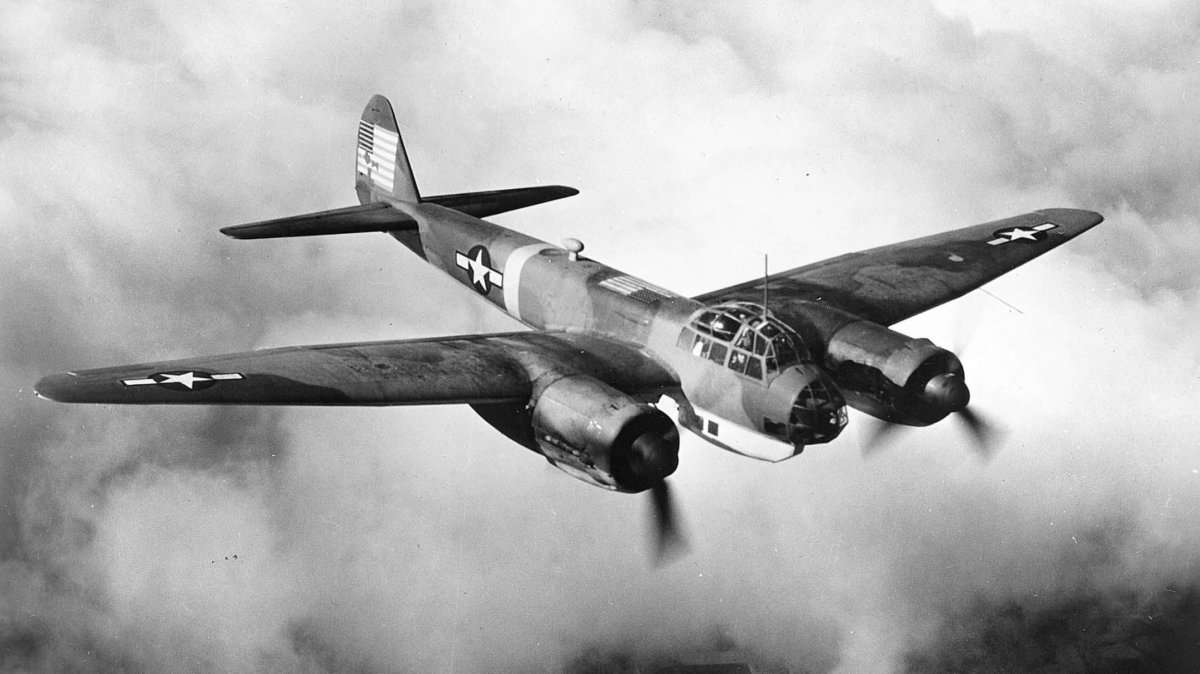
Now nicknamed “Baksheesh,” an Arabic word meaning a charitable monetary gift, the aircraft received its final preparations for the flight to its new home: extra-large USAAF markings, American flags on the wings, and, reportedly, a golden band around the rear fuselage.
With Captain Newby again heading up the crew, the flight to the United States began on October 8, 1943, and the distance of 10,400 nautical miles was completed in seven days. Refueling and crew rest stops were made in Sudan, Nigeria, the Gold Coast (today, Ghana), the United Kingdom’s Ascension Island in the Atlantic Ocean, Brazil (two stops), British Guyana, Puerto Rico, and West Palm Beach in Florida.
There were a few problems en route, including a lack of the correct fuel on Ascension Island. The crew was forced to use the wrong fuel type, risking potential engine failure. During one of the landings in Brazil, the aircraft’s landing gear also failed to deploy properly, forcing the crew to resort to emergency manual override.
In American hands, the Ju 88D-1 received the serial FE-1598, signifying Foreign Evaluation., San Diego Air and Space Museum Archives
Finally, on October 14, the Baksheesh touched down at Wright Field in Dayton, Ohio, and began its test career with the Flight Test Engineering Division. It was test-flown there between November 1943 and March 1944, before going to Arizona for yet more trials.
The huge effort required to bring the Ju 88 to Dayton shows the lengths to which the United States was willing to go to get its hands on foreign aircraft equipment for analysis and evaluation, what is known today as foreign materiel exploitation (FME). During the Cold War, these efforts would result in an ex-Iraqi Air Force MiG-21 being loaned from Israel and tested over Groom Lake, Nevada, before the 4477th Test and Evaluation Squadron “Red Eagles” conducted highly classified missions with a fleet of Soviet-bloc jet fighters operated from the secluded Tonopah Test Range (TTR).
The aircraft at Dayton, Ohio, in the 1960s, wearing an inauthentic Luftwaffe-style camouflage pattern., U.S. AIR FORCE
However, by 1946, the Ju 88D-1 had ceased to be of use, and it was decided to store it at Davis-Monthan Field (later Davis-Monthan Air Force Base ) in Arizona, which, today, is home to the Air Force’s famed aircraft storage boneyard. In the meantime, the United States had acquired at least five other Ju 88s, but it was the Baksheesh that was destined to be preserved. In 1950, it was transferred to what was then the Air Force Technical Museum, in whose hands it remains today.
Despite the enormous production total, only two Ju 88 ultimately survived the war in complete condition, as opposed to having been recovered from crash sites or pieced together using surviving parts from more than one aircraft. One of those is 430650, the only remaining D variant and the only World War II-era Romanian Air Force combat aircraft in a museum collection anywhere in the world.
Teodoru’s Ju 88D-1 is preserved today at the National Museum of the U.S. Air Force , adjacent to what is now Wright-Patterson Air Force Base in Dayton. It stands testament to a unique intertwined wartime story, one that took it, and those who flew it, from Ukraine to North Africa, via the Mediterranean, and then finally on to the United States.
Contact the author: thomas@thedrive.com
Comments couldn’t be loaded. Please refresh the page.
更新于美国东部时间2020年11月27日下午6:05
考虑到容克Ju 88是二战期间纳粹德国空军使用的最通用的作战飞机,令人惊讶的是,只有两架保存完好的Ju 88幸存至今。其中一架是唯一一架毫发无损地从战争中幸存下来的Ju 88侦察机——而它最终如何抵达美国,并在罗马尼亚叛逃者尼古拉·特奥多鲁的帮助下,最终抵达美国,其故事堪称传奇。
1943 年 7 月,时任罗马尼亚空军中士的特奥多鲁将德国制造的 Ju-88D-1(生产编号 430650)带到了利马索尔机场。当时,罗马尼亚是纳粹德国的盟友,并从该国获得了各种战斗机和其他武器。
到那时,Ju 88 已成为德国空军作战机队的重要组成部分多年,尽管最初设计为轰炸机,但事实证明它能够轻松胜任各种其他任务。不同的记录显示,从 1939 年到 1945 年,不同的工厂总共生产了 14,500 到 15,000 架 Ju 88,衍生出多达 60 种不同的型号和子型号。这种双引擎飞机几乎承担了所有可以想象到的角色:轰炸机、重型战斗机、侦察机、夜间战斗机、反坦克飞机、反舰飞机、无人导弹等等。
Ju 88D-1 是一款远程侦察机,由两台容克斯 Jumo 211J 倒置 V12 发动机提供动力,总功率为 2400 马力。该机最大速度约为每小时 295 英里,航程超过 1500 英里。D-1 的常规机组人员为四人,防御武器为三挺 7.92 毫米口径的 MG 15 机枪。
虽然照片质量不佳,但这却是一张罕见的德国空军Ju 88D远程侦察机照片。(圣地亚哥航空航天博物馆档案馆藏)
D-1型飞机于1940年夏季首次加入德国空军服役,但同时也与其他型号一起广泛出口到纳粹盟国。克罗地亚、芬兰、匈牙利和意大利也曾装备过各种型号的Ju 88飞机。
特奥多鲁叛逃时,罗马尼亚装备Ju 88轰炸机才几个月。1943年上半年,罗马尼亚接收了首批50架Ju 88,其中包括12架Ju 88D-1型。这些飞机的机组人员在乌克兰接受了德国空军教官的训练。这些飞机是纳粹德国为加强其轴心国盟友——罗马尼亚空军——实力而采取的更大规模行动的一部分。罗马尼亚当时也在东线战场与苏联作战。
这是美国战争信息办公室为便于识别而发布的Ju 88轰炸机的略有不准确的描述。附图展示了防御机枪的射击弧线。(美国国家档案馆)
这些 Ju 88D-1 飞机被分配到驻扎在乌克兰东南部马里乌波尔的罗马尼亚空军第二侦察中队。28 岁的民航飞行员特奥多鲁中士是该部队的成员之一,他被征召入伍。
1943年6月至7月间,他驾驶战机在东线执行了11次任务,平安无事。然而,他对军旅生涯并不满意,并密谋叛逃至盟军。正如罗马尼亚航空史学家达努特·弗拉德所说,特奥多鲁“无法接受军纪”。
特奥多鲁计划驾驶一架Ju-88飞机逃脱,他将途经俄罗斯黑海沿岸的新罗西斯克,飞越亚速海抵达叙利亚的阿勒颇。在那里,他将加油后起飞,执行任务的最后一程——前往黎巴嫩的贝鲁特。当时的贝鲁特是盟军在地中海开展海军行动的重要基地。
1943 年 7 月 22 日下午,这位罗马尼亚中士驾驶 Ju 88D-1 430650 从当时被德国占领的苏联乌克兰的一个主要城市马里乌波尔起飞。他独自一人在驾驶舱内,没有携带地图,这样即使被击落或坠毁,他的计划也不会暴露。
Teodoru 的 Ju 88D-1 驾驶舱。(美国空军/Ken LaRock)
一切进展顺利,直到特奥多鲁飞越新罗西斯克上空。之后,黑海上空一股强劲的东风开始将他吹离航线,朝土耳其方向飞去。他最终在黑海沿岸阿纳穆尔附近进入了土耳其领空。无论他是否意识到错误,他都继续飞越土耳其领空,然后进入地中海,朝着塞浦路斯方向飞行,那里驻扎着一个重要的盟军空军基地。
当特奥多鲁的容克飞机抵达塞浦路斯岛上空时,英国皇家空军位于塞浦路斯尼科西亚的基地立即紧急升空了四架霍克飓风IIB战斗机。这位罗马尼亚飞行员显然向皇家空军飞行员发出信号,表明他打算降落,并非执行战斗任务。他们护送他降落在利马索尔机场,他于傍晚时分着陆。
据报道,特奥多鲁着陆后将飞机交给英国皇家空军,并宣称这是“元首的礼物”。
Ju 88D-1 对英国来说是一笔非常宝贵的情报收获,而且由于仅有 50 小时的飞行时间,非常适合进行全面的评估。这架 Ju 88 被重新涂装成英国皇家空军的涂装和标志后,被运往埃及开罗附近的赫利奥波利斯进行飞行测试。在那里,试飞员查尔斯·桑福德·温-艾顿中校指挥了一系列试飞。
尼古拉·特奥多鲁的下落不明,但一位同名人士再次出现在一份日期为1953年4月的中央情报局关于战后罗马尼亚空军的报告中。这份文件指出,此人自1949年起担任布拉索夫机场第6轰炸机团的指挥官,该团的飞行员均具备“多引擎飞机驾驶经验”。这或许表明,特奥多鲁最终返回罗马尼亚,并在共产主义时代的罗马尼亚空军继续了他的职业生涯。
至于他叛逃时乘坐的那架Ju 88D-1,在完成测试任务后,英国决定将其移交给美国。同年夏天早些时候,英国还获得了一架更先进的Ju 88R-1夜间战斗机,这架飞机由于另一名德国空军内部人员的叛逃而降落在苏格兰。
Ju 88D-1 为英国提供了其敌方主要飞机之一的性能和能力的第一手经验,现在又为同样在北非、意大利和西欧与轴心国军队作战的美国陆军航空队 (USAAF) 提供了类似的见解。
特奥多鲁保存下来的Ju 88D-1飞机已修复成罗马尼亚空军的涂装和标志。主轮之间的弗里茨X制导炸弹并非其武器装备的一部分。(美国空军)
1943年10月,美国陆军航空队的一个机组驾驶Ju 88D-1从赫利奥波利斯飞往开罗附近的德韦尔索尔空军基地,在那里熟悉了这架飞机,目的是将其飞回美国进行更全面的评估。领导这支美国陆军航空队团队的是当时的沃纳·E·纽比上尉,他此前已经驾驶过B-25米切尔轰炸机——一种与Ju 88D-1类似的美国双引擎轰炸机——积累了丰富的经验。
为了完成飞往美国的多段航程,容克斯飞机需要进行大量改装,包括加装从一架坠毁的美国陆军航空队P-38“闪电”战斗机上拆下来的外部油箱,并使用从B-24“解放者”轰炸机上“借用”的油泵连接到燃油系统。此外,团队没有使用德国产的燃油、润滑油和冷却液,而是采用了符合美国规格的同类产品。
飞机上的机枪和摄像机被拆除,并加装了一台ARN-7型测向仪,以辅助航线上的远程导航。改装工作和随后的飞行测试远非一帆风顺,有一次,一个外挂油箱意外脱落并爆炸,碎片飞溅到飞机上,造成数名机组人员受伤。
Ju 88D-1的前机身,其上各种防御机枪已被拆除。(美国空军)
这架飞机现在被昵称为“巴克什什”(Baksheesh),这是一个阿拉伯语单词,意思是慈善捐款。飞机为飞往新家做了最后的准备:超大的美国陆军航空队标志、机翼上的美国国旗,据说还在机身后部贴了一圈金带。
纽比上尉再次率领机组,于1943年10月8日启程飞往美国,七天内完成了10400海里的航程。途中在苏丹、尼日利亚、黄金海岸(今加纳)、大西洋中的英国阿森松岛、巴西(经停两次)、英属圭亚那、波多黎各和佛罗里达州西棕榈滩进行了加油和机组人员休息。
途中出现了一些问题,包括在阿森松岛附近缺少合适的燃油。机组人员被迫使用错误的燃油类型,这可能导致发动机故障。在巴西的一次着陆中,飞机的起落架也未能正常放下,迫使机组人员采取紧急手动操作。
这架Ju 88D-1飞机在美国手中被赋予了FE-1598的序列号,代表“外国评估”。(圣地亚哥航空航天博物馆档案馆)
最终,10月14日,“巴克什什”号降落在俄亥俄州代顿的赖特机场,开始了它在飞行测试工程部门的测试生涯。它于1943年11月至1944年3月期间在那里进行了试飞,之后前往亚利桑那州进行更多试验。
将Ju 88运抵代顿所耗费的巨大努力,展现了美国为获取外国飞机设备进行分析和评估(即如今所谓的外国物资利用,简称FME)而不惜一切代价的决心。冷战期间,这些努力促成了美国从以色列借出一架前伊拉克空军的米格-21战斗机,并在内华达州格鲁姆湖上空进行测试。随后,美国陆军第4477测试评估中队“红鹰”驾驶这架米格-21,在偏僻的托诺帕试验场(TTR)与一支苏联集团的喷气式战斗机机队执行了高度机密的任务。
20世纪60年代,这架停放在俄亥俄州代顿的飞机,涂装的并非真正的德国空军迷彩图案。(美国空军)
然而,到了1946年,Ju 88D-1已经无法使用,于是决定将其封存在亚利桑那州的戴维斯-蒙森机场(后来的戴维斯-蒙森空军基地),如今这里是美国空军著名的飞机坟场所在地。与此同时,美国至少还获得了其他五架Ju 88,但只有这架名为“巴克什什”(Baksheesh)的飞机注定要被保存下来。1950年,它被移交给当时的空军技术博物馆,至今仍由该馆收藏。
尽管Ju 88的总产量巨大,但最终只有两架飞机完整地保存到了战争结束,其余的要么是从坠机现场打捞上来的,要么是用多架飞机的残骸拼凑而成的。其中一架就是430650,它是现存唯一的D型Ju 88,也是目前世界上唯一一架被博物馆收藏的二战时期罗马尼亚空军作战飞机。
特奥多鲁的Ju 88D-1如今保存在美国空军国家博物馆,毗邻位于代顿的赖特-帕特森空军基地。它见证了一段独特的、交织在一起的战时故事:这架飞机以及驾驶它的飞行员们,从乌克兰经地中海飞往北非,最终抵达美国。
联系作者:thomas@thedrive.com
评论加载失败,请刷新页面。